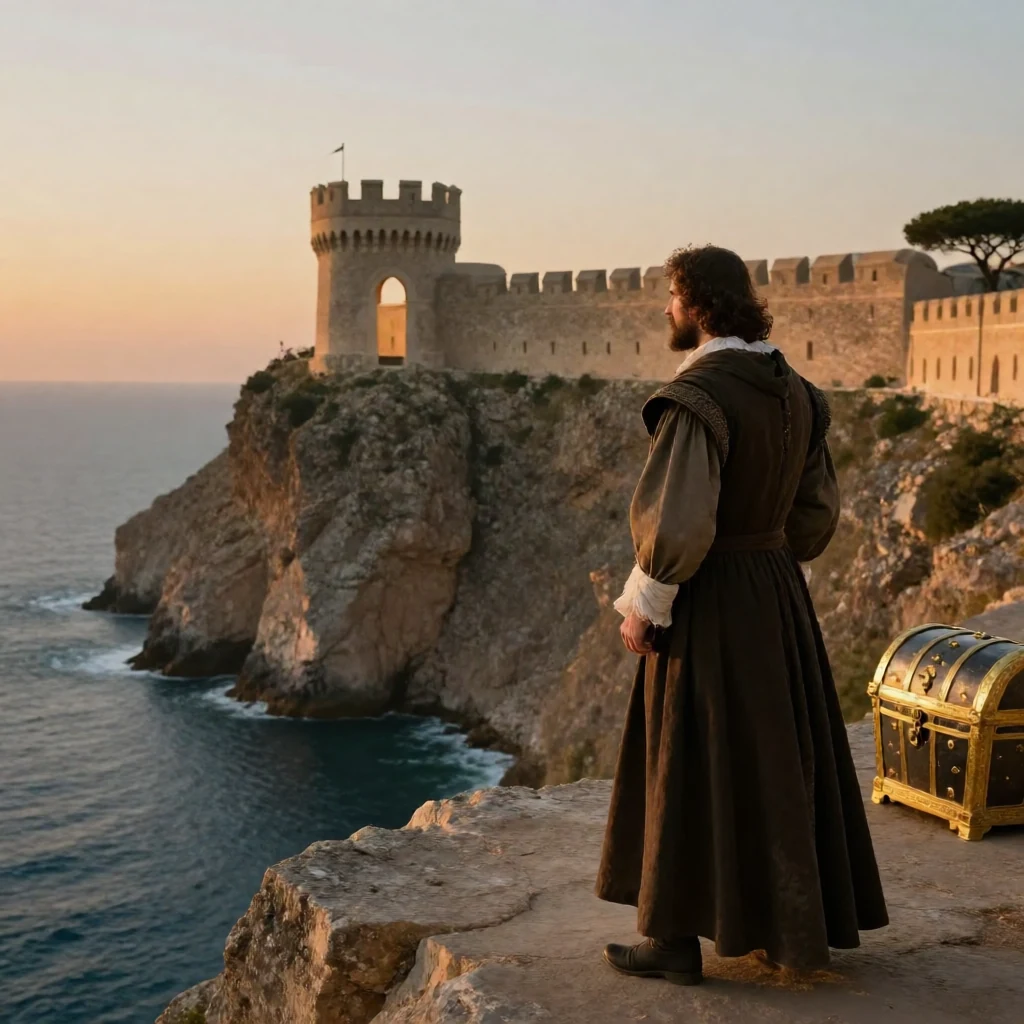
Inquiry to M. de Boville
M. de Boville, who rose from prison inspector to a prestigious police position, requires two days to gather the necessary intelligence. At the end of this period, he provides Villefort with initial information identifying the Count as an acquaintance of Lord Wilmore, a wealthy foreigner currently in Paris, and the Abbé Busoni, a highly respected Sicilian priest active in the East.
Description of Abbé Busoni
The Abbé Busoni maintains modest lodgings in a small two-storied house behind Saint-Sulpice. His residence reflects ascetic simplicity—a dining room with plain walnut furniture and an unadorned parlor. He prefers the upstairs sitting room, which serves as both library and study, filled with theological works and manuscripts where he immerses himself for months at a time. The abbé’s valet screens all visitors through a wicket gate, turning away those whose appearance displeases him with the stock response that the abbé is not in Paris. The abbé maintains a reputation for charity, always leaving funds for distribution to the poor.
Visit to the Abbé’s Residence
An agent dispatched by Villefort arrives at the Abbé’s residence on Rue Férou. Initially turned away by the valet, he leaves his card and a sealed message, requesting to return at eight o’clock that evening. The valet warns that the abbé may be occupied with his studies, which amounts to being unavailable.
Interview with Abbé Busoni
At the appointed hour, the visitor gains entry and climbs a rough staircase to meet the abbé in his library, where a lamp with a concentrated shade illuminates the space. The abbé, dressed in medieval monk’s attire with a hooded cowl, confirms his identity when questioned. During the interview, the abbé demonstrates control over the lighting, directing bright light toward the visitor while remaining partially obscured himself.
Questions on Monte Cristo’s Identity
The visitor asks directly whether the abbé knows the Count of Monte Cristo. The abbé responds by asking if the questioner means Monsieur Zaccone, revealing that “Monte Cristo” is merely an estate or rock name, not a family name. The abbé confirms he knew the Count extremely well, having played with him as a child in the shipyards of Malta where the Count’s father was a prosperous shipbuilder.
Testimony on the Count’s Wealth
Regarding the Count’s renowned fortune, the abbé offers a conservative estimate of 150,000 to 200,000 livres per annum, contradicting rumors of three to four million. He explains that the title of count may have been purchased, as such titles require territorial possessions in Italy. The abbé describes the Count as a charitable Quaker who received knighthood from the Pope for Christian services in the East and possesses several rings gifted by Eastern monarchs as tokens of appreciation.
The Auteuil House Inquiry
When questioned about the Count’s purchase of the Auteuil house, the abbé reveals that Monte Cristo confided his purpose: to establish a lunatic asylum similar to the one founded by the Count of Pisani in Palermo. The abbé presents this as a magnificent charitable undertaking. During this exchange, the abbé carefully maintains his priestly integrity, refusing to violate the secrets of confession while otherwise cooperating with the inquiry.
Visit to Lord Wilmore
Following the interview with the Abbé Busoni, the agent travels to Rue Fontaine-Saint-Georges, stopping at number five where Lord Wilmore resides. Lord Wilmore, described as one of those wealthy English tourists who spend fortunes traveling, occupies a furnished apartment but spends few hours there daily and rarely sleeps there. He notably refuses to speak French, though he writes it fluently. The agent arrives ten minutes before their appointed ten o’clock meeting, and is shown into a conventional furnished drawing room.
Lord Wilmore’s Account
Lord Wilmore appears at exactly ten o’clock, dressed in antiquated English fashion—a blue coat with gilt buttons from the 1812 era, white waistcoat, and too-short nankeen trousers. He initially insists on communicating only in English despite the agent’s offer to converse in French. Unlike the restrained Abbé, Lord Wilmore proves more forthcoming, partly because he harbors animosity toward the Count as his sworn enemy.
The original text of this work is in the public domain. This page focuses on a guided summary article, reading notes, selected quotes, and visual learning materials for educational purposes.