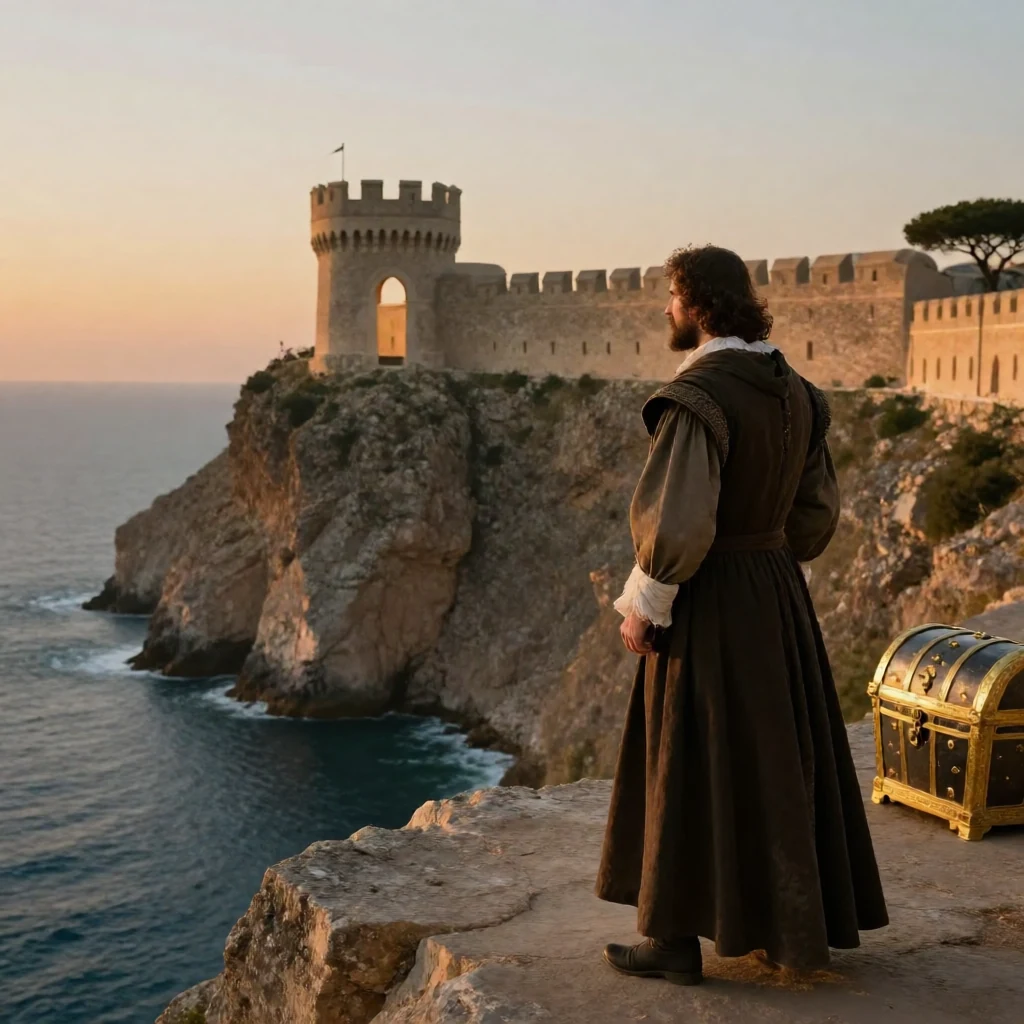
Count Confirms Noirtier’s Agreement with Ali
At the carriage, Ali stands perspiring from exertion, and the count questions him in Arabic about whether he visited Noirtier and delivered the letter. Ali signals affirmatively, then imitates the old man’s manner of closing his eyes to indicate assent. The count interprets this gesture as Noirtier’s acceptance, and gives the order to depart.
Monte Cristo Bids Farewell to Paris
Atop the hill of Villejuif under a starlit sky, the count dismisses the carriage briefly and gazes upon Paris, which appears as a sombre sea of phosphoric waves. He raises a prayerful address to the great city, reflecting that within six months he entered its gates led by the Spirit of God, has confided the secret purpose of his presence to God alone, and now retires without pride or hatred. He declares his mission accomplished and the city can no longer cause him pain or pleasure. After a final look over the vast plain, he reenters the carriage and disappears down the hill in a whirlwind of dust.
Journey to Marseilles and Maximilian’s Grief
During the ten leagues of silence that follow, Monte Cristo questions Maximilian about his decision to leave Paris, and Morrel confesses that departing feels like losing Valentine a second time. The count philosophizes that lost friends reside in the heart, not the earth, and counsels that weakened minds darken their own horizons. They reach Châlons, where the count’s steamboat awaits, and the vessel glides with such speed that towns and autumn-shaken trees flash past. As Paris recedes, a superhuman serenity surrounds the count, and even Morrel’s melancholy lifts momentarily as wind clears his brow.
Marseilles Arrival and Quay Nostalgia
Marseilles comes into view, described as the younger sister of Tyre and Carthage and successor to their Mediterranean empire. Powerful memories are stirred by the round tower of Fort Saint-Nicolas, Puget’s City Hall, and the brick quays of the port where the men played as children. They stop on the Canebière, where a vessel is setting sail for Algiers amid noisy farewells. Maximilian, unmoved by the spectacle, leads the count to the spot where his father once embraced him upon the Pharaon’s arrival. The count smiles and indicates he was present that day, pointing toward a corner of a street where a groaning woman waves farewell to a departing passenger.
Maximilian Departs for His Father’s Grave
Morrel recognizes the departing youth as Albert de Morcerf in a lieutenant’s uniform, and the count confirms his identification with a knowing smile. The count then asks if Maximilian has any business in the land, and Morrel replies brokenly that he must weep over his father’s grave. The count directs him to wait, stating he too has a pious visit to make, and they part sorrowfully. Maximilian turns east toward the cemetery while Monte Cristo watches until he disappears from sight, then walks slowly toward the Allées de Meilhan.
Monte Cristo Visits Mercédès’s Home
Monte Cristo seeks out a small house shaded by linden trees and covered by an aged vine, the same dwelling once inhabited by old Dantès. The worn stone steps and unpainted door of three planks remain exactly as they were, though the entire house is now at Mercédès’s disposal rather than just the garret. The woman seen waving from the quay has just entered this house, and Monte Cristo arrives at the corner of a street nearly simultaneously. He enters familiarly through the brick-paved passage without knocking, knowing how to work the weather-beaten latch.
Count Finds Weeping Mercédès
In the sunlit garden Mercédès once found a sum of money placed there by the count, Monte Cristo hears a deep sob and discovers her seated beneath an arbor of Virginia jessamine. She has raised her veil and hidden her face in her hands, giving free rein to the grief she had restrained in her son’s presence. The scene marks the culmination of the count’s pilgrimage to the home that holds the most poignant memories of his former life.
The original text of this work is in the public domain. This page focuses on a guided summary article, reading notes, selected quotes, and visual learning materials for educational purposes.