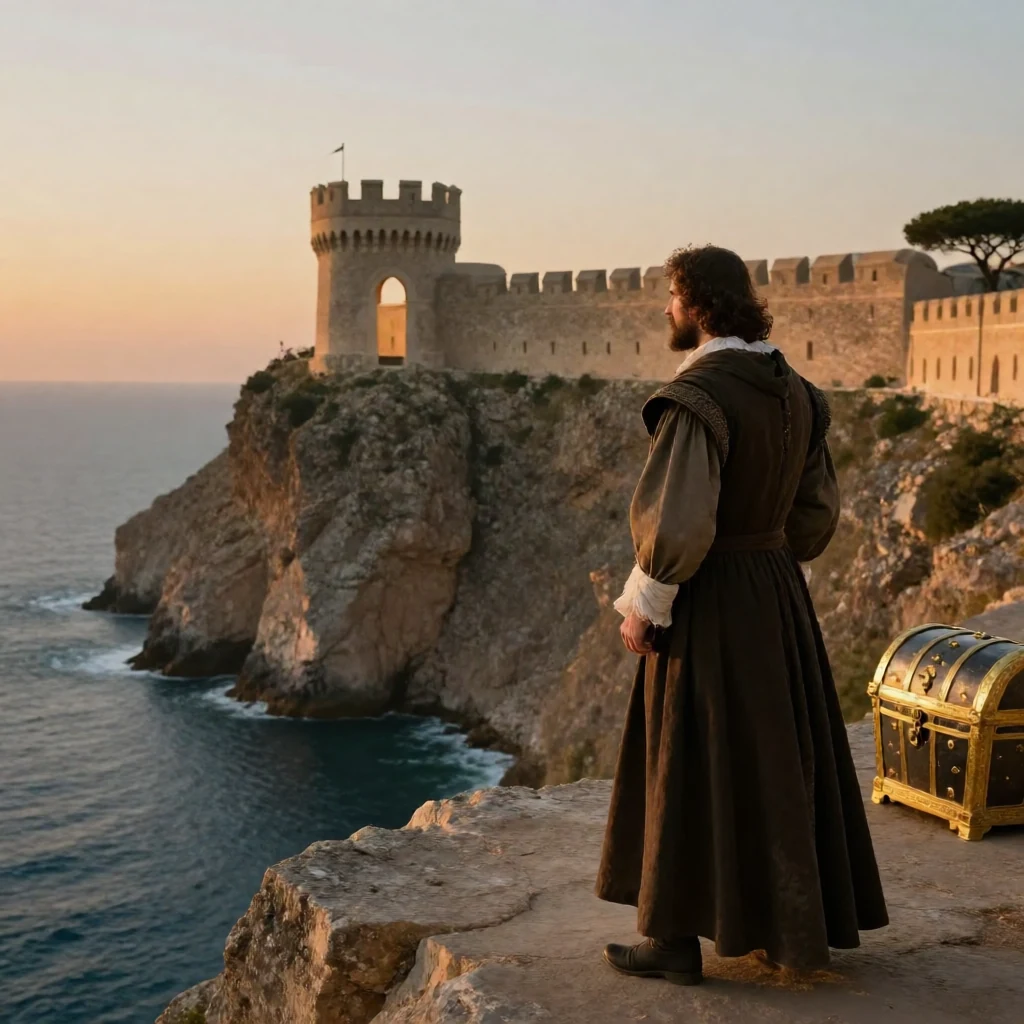
Doubt Over Past Vengeance
Tormented by his doubt, Monte Cristo questions whether he has deceived himself or pursued a false path. He wonders whether the end he proposed could have been mistaken, or whether one hour could suffice to prove to an architect that his life’s work was an impossible, sacrilegious undertaking. Dismissing such madness, he concludes that his dissatisfaction springs from a failure to clearly appreciate the past, which becomes indistinct like a landscape receding behind a traveler. Comparing himself to a man wounded in a dream who feels the wound yet cannot recall when he received it, he confronts the unease that gnaws at his conscience.
Resolving to Revisit Past Suffering
Monte Cristo resolves to revisit the scenes of his former suffering in order to recover clarity of heart. Addressing his regenerate, visionary, and invincible self, he commands himself to exchange riches for poverty, liberty for a prison, and a living body for a corpse. Too much gold and splendor, he feels, are reflected in the mirror through which he seeks to behold Dantès. He must hide his diamonds, bury his gold, and shroud his splendor if he is to truly review the life of starvation and wretchedness that shaped him.
Walking the Streets of Past Imprisonment
Acting on this resolve, Monte Cristo walks down the Rue de la Caisserie, the very street through which, twenty-four years earlier, he had been led by a silent and nocturnal guard. The houses, now smiling and animated by daylight, were on that long-ago night dark, mute, and closed. He murmurs that they were the same, only now illuminated by the sun rather than cloaked in night. He continues toward the quay by the Rue Saint-Laurent and advances to the Consigne, the point where he had originally embarked for the Château d’If.
Boat Ride to Château d’If
At the Consigne, Monte Cristo hails a passing pleasure-boat with a striped awning, whose owner eagerly rows toward him. The weather is magnificent, the excursion a treat: a red, flaming sun sinks into the welcoming ocean, the sea lies smooth as crystal, fish leap from the water, and on the horizon appear the white boats of fishermen and merchant vessels bound for Corsica or Spain. Yet, despite the serenity and beauty of the scene, the Count, wrapped in his cloak, can think only of the terrible voyage he is retracing.
Recalling the Original Imprisonment Voyage
As the boat carries him onward, the details of his original imprisonment voyage return one by one to Monte Cristo’s memory. He recalls the solitary light burning at the Catalans, his first sight of the Château d’If, his violent struggle with the gendarmes when he tried to throw himself overboard, his despair at being vanquished, and the awful sensation of a carbine muzzle touching his forehead. Like dried-up streams replenished by autumnal storms, his heart fills once more with the bitterness that once nearly overwhelmed Edmond Dantès, and the serene sky and brilliant sunshine seem to give way to black heavens and the phantom of the Château d’If looming like a mortal enemy. When they reach the landing, he shrinks instinctively to the far end of the boat, startled by the boatman’s gentle announcement of their arrival.
Touring the Abandoned Château d’If
Stepping onto the same rock where he had once been dragged by guards at bayonet-point, Monte Cristo finds the ascent shorter than he remembered, though each stroke of the oar had awakened a new throng of ideas. The Château d’If has held no prisoners since the July Revolution and is now inhabited only by a guard tasked with preventing smuggling. A concierge waits at the door to exhibit this monument of curiosity, once a scene of terror. Upon inquiring about the ancient jailers, Monte Cristo learns that they have all been pensioned or reassigned; the current concierge has only been there since 1830.
Hearing the Tale of Prisoner No. 34
Visiting his own dungeon, Monte Cristo beholds the dull light struggling through the narrow opening and fixes his eyes on the spot where his bed had stood and on the new stones marking the breach made by Abbé Faria. His limbs tremble and he seats himself on a log of wood. When he asks whether any traditions are attached to the prison beyond the story of Mirabeau’s poisoning, the concierge mentions a tale told by his predecessor Antoine—none other than Monte Cristo’s former jailer. At the name, the Count recalls the bearded face, brown jacket, and jingling keys, and, pressing his hand to his heart to still its beatings, he asks to hear the story of prisoner No. 34, fearing to hear his own history.
The original text of this work is in the public domain. This page focuses on a guided summary article, reading notes, selected quotes, and visual learning materials for educational purposes.