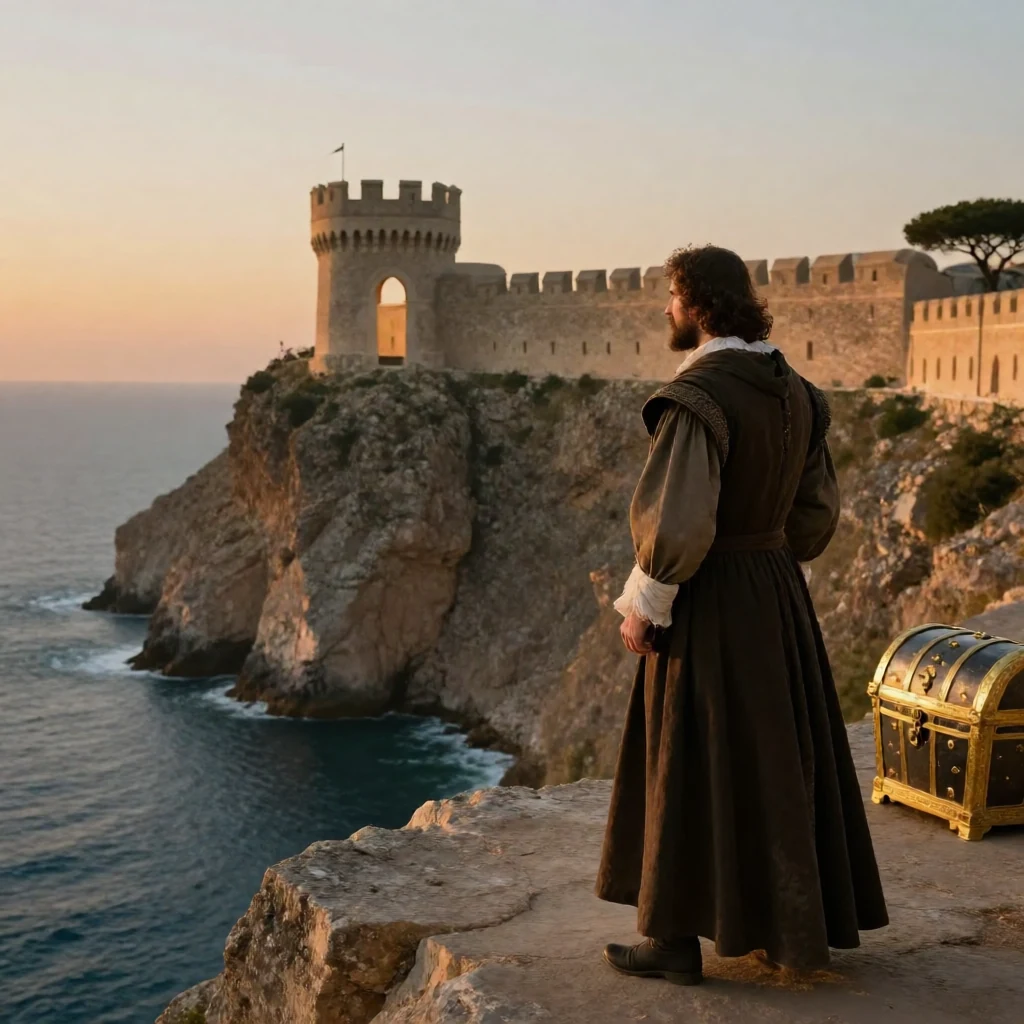
KAPITEL 21. The Island of Tiboulen
This excerpt opens Chapter 21: The Island of Tiboulen, following Edmond Dantès immediately after his escape from the Château d’If, as he travels aboard a merchant tartan bound for Leghorn.
Dantès Secures Crew Passage and Provisions
Dantès negotiates with the ship’s captain to join the crew for the voyage, agreeing to accept the same provisions and wages as the other sailors. Jacopo, the sailor who rescued Dantès, provides him with a shirt and trousers, and Dantès receives bread and rum after going 40 hours without food or drink. The captain and crew are surprised by Dantès’ demonstrated intelligence and physical vigor.
Dantès Identifies Château d’If Escape Alarm
While aboard the tartan, Dantès notices a small white cloud atop the Château d’If’s bastion and hears a faint gunshot. He correctly identifies this as the prison’s escape alarm, fired after a prisoner broke out of the facility. The captain briefly harbors suspicion of Dantès, but Dantès’ calm composure while drinking rum allays any doubts.
Dantès Assumes Helm to Watch Marseilles
Pretending to be fatigued, Dantès requests to take over the helm from the steersman, a request the captain approves. This placement lets Dantès keep his eyes fixed on Marseilles as the ship sails away from the port.
Dantès Confirms 14 Years of Imprisonment, Swears Vengeance
Dantès asks Jacopo for the current date, and learns it is 28 February 1829, exactly 14 years to the day after his arrest (he was 19 when he was imprisoned, and is now 33). He briefly mourns the likelihood that his beloved Mercédès believes him dead, then renews his oath of implacable vengeance against Danglars, Fernand, and Villefort, the three men who orchestrated his unjust imprisonment.
Ship Speed Renders Dantès’ Vengeance Vow Feasible
The tartan is sailing at full speed before the wind toward Leghorn, moving so quickly that even the fastest sailor in the Mediterranean would be unable to catch it. This speed makes Dantès’ previously vague vow of vengeance feel like an achievable goal.
KAPITEL 22. The Smugglers
On joining the crew of the Genoese tartan La Jeune Amélie, Dantès conceals his true identity while the captain gradually accepts him as a valuable sailor, first mistrusting he might be a customs officer but later reassured by his maritime skills and calm demeanor. At Leghorn, Dantès undergoes a physical transformation when a barber removes his long beard and hair, revealing how fourteen years of imprisonment have altered his appearance from that of a young, smiling man to someone with a hardened, thoughtful face marked by aristocratic beauty and a somber intensity. Over the course of two and a half months of smuggling voyages along the Mediterranean coast, Dantès becomes intimately acquainted with the illicit trade, forming a bond with the loyal crewman Jacopo while learning all the secret signs by which smugglers recognize each other, and repeatedly sailing past the Island of Monte Cristo that he so desperately wishes to explore. During a skirmish with customs officers at the Duchy of Lucca, Dantès is wounded in the shoulder but displays the endurance and sang-froid he has developed through suffering, and when the patron proposes using the deserted Island of Monte Cristo as a neutral ground for a major smuggling venture, Dantès must conceal his elation at what appears to be destiny finally bringing him to his promised treasure.
Boarding La Jeune Amélie
Edmond Dantès boards the Genoese tartan La Jeune Amélie and quickly perceives that he has joined a smuggler’s crew. The captain is remarkably multilingual, conversant in tongues from Arabic to Provençal—a skill that spares him reliance on interpreters and facilitates communication with vessels at sea, coastal boats, and the nameless figures who haunt seaport quays. Edmond recognizes that he is on board a smuggling vessel, though he keeps his own identity concealed.
The Captain’s Distrust
The captain receives Dantès with initial suspicion, knowing him well to the customs officers along the coast. Between the smugglers and these “industrious guardians of rights and duties,” a perpetual battle of wits ensues. The captain suspects Dantès might be an emissary of the customs service, perhaps sent to extract trade secrets through some ingenious ruse. Dantès’s skilled handling of the lugger begins to reassure the captain, but deeper confidence must still be earned.
The original text of this work is in the public domain. This page focuses on a guided summary article, reading notes, selected quotes, and visual learning materials for educational purposes.