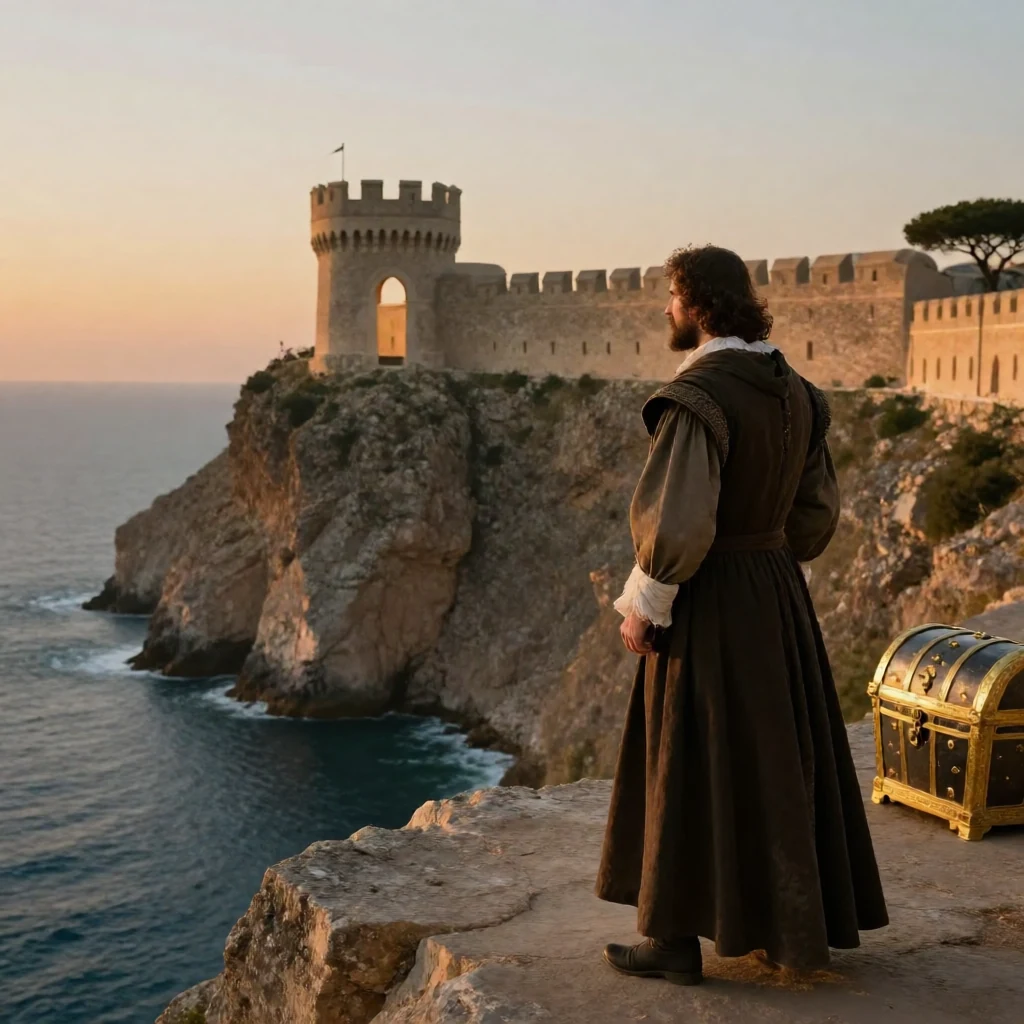
Breakfast Invitation and Meal Conversation
A servant announces that breakfast is ready, and the count invites Albert and Franz to join him, citing his isolation and hoping they may one day return the hospitality in Paris. Bertuccio is ordered to lay covers for three. During the meal, which Franz finds excellent and finely served, the count barely touches the food, seeming to act more as a polite host than an eager diner, which reminds Franz of the Countess G——’s conviction that the count is a vampire. Albert, by contrast, eats heartily, indifferent to the philosophical conversation.
Final Carnival and Execution Viewing Plans
After breakfast, Franz checks his watch and explains that he and Albert must still acquire masks for the Carnival. The count offers to have costumes brought to a private room at the Piazza del Popolo, where they can dress either before or after the execution, since the scaffold itself is part of the festivities. Franz declines the window overlooking the execution, accepting instead the carriage and the Rospoli Palace window, and explains that he wishes to pass through the Corso on foot to observe something. The count agrees, and they arrange for the carriage to meet them via the Via del Babuino. A servant then announces a penitent seeking an audience, and the count excuses himself to another room.
Albert’s Opinion of the Count of Monte Cristo
Left in the salon, Albert helps himself to the excellent cigars and shares his opinion of the count when Franz asks: Albert finds him a delightful host, a well-traveled and well-read man of Stoic philosophy, and—most importantly—one who keeps superb cigars. Franz, knowing that Albert deliberately delays forming judgments, makes no attempt to change his mind, but points out that the count had studied Albert with particular attention. Albert, untroubled, attributes this to his outmoded Parisian attire and asks Franz to disabuse the count of the impression that he is a provincial.
KAPITEL 35. La Mazzolata
Chapter 35. La Mazzolata follows the Count, Franz, and Albert as they proceed from Franz’s rooms to the Piazza del Popolo to witness an execution. The chapter confirms the Count’s identity through a prearranged window signal, then unfolds the grim spectacle of a Roman beheading by mace. A last-minute pardon saves one prisoner while inflaming the other, leading to a violent execution before a carnival-minded crowd. The chapter culminates in a chilling moment in which the Count, far from being repulsed, exults in the scene and his view of human nature.
Count Joins Franz and Albert, Heads to Piazza del Popolo
The Count arrives at Franz’s rooms and the three men set out for the Piazza del Popolo on foot via the Corso, with the Count’s carriage taking a different route. They pass along the Piazza di Spagna and the Via Frattina, threading between the Fiano and Rospoli palaces. Albert remarks that Italian cigars are poor, and the Count hints that he may visit Paris soon to collect on Albert’s offer of better ones. The tone is convivial as they begin their walk.
Franz Verifies Count’s Identity at Rospoli Palace Windows
Franz steers the conversation toward the windows of the Rospoli Palace, seeking to verify the signal agreed between the man in the mantle and the Transteverine peasant. The Count identifies his windows as the last three, and Franz observes that the side windows are hung with yellow damask while the center one displays white damask and a red cross—exactly as promised. The signal confirms that the Count and the cloaked figure are one and the same.
Group Observes Guillotine and Carnival Preparations in the Square
The three continue down the Corso toward the Piazza del Popolo, where the crowd thickens. Two objects dominate the view above the multitude: the central obelisk topped with a cross, and the uprights of the scaffold at the junction of the three streets, with the curved blade of the mandaïa gleaming between them. Although masks cannot circulate and carriages are halted, the square is full of festive observers behind windows, doors, and balconies, while scaffolds rise and flags are hung for the Carnival.
The original text of this work is in the public domain. This page focuses on a guided summary article, reading notes, selected quotes, and visual learning materials for educational purposes.