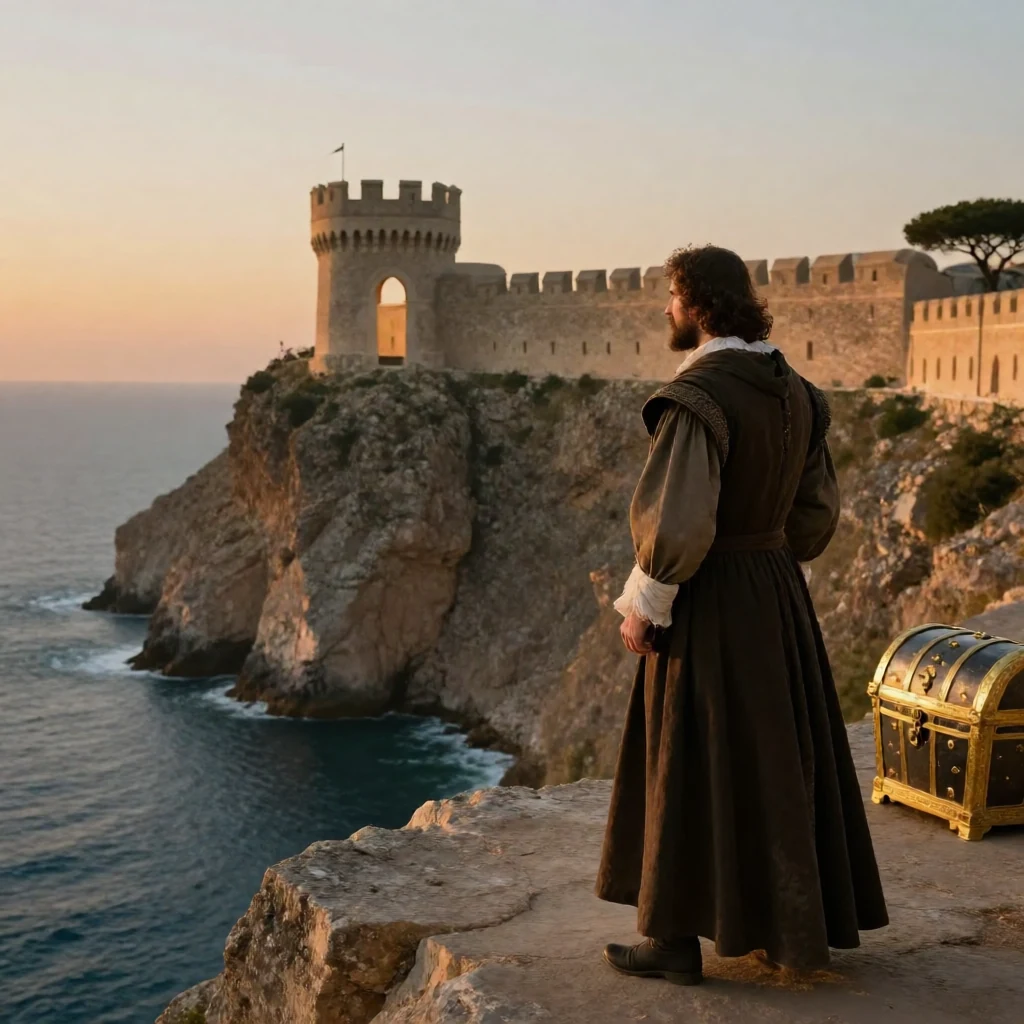
Reveal of the Count of Monte Cristo
Morcerf identifies his Roman savior as the Count of Monte Cristo. The group initially doubts the count’s existence, with Debray joking he may be a descendant of Holy Land nobles who owned Calvary, until Maximilian Morrel confirms Monte Cristo is a small, uninhabited island in the Mediterranean, and Morcerf explains the count purchased a Tuscan noble title. Morcerf adds that the count uses the alias Sinbad the Sailor, and rumors claim he owns a hidden cave filled with immense treasure, which Franz d’Épinay reportedly entered blindfolded, served by mute attendants and extraordinarily beautiful women.
Debate Over the Count’s Wealth and Background
The group debates the Count of Monte Cristo’s wealth and background. Morcerf compares the count to a poor fisherman from Arabian Nights who hides the riches of the Indies in a secret cavern, suggesting the count’s modest appearance is a deliberate disguise for his vast fortune. Debray asks if Morcerf has seen the count’s reputed Greek mistress, and Morcerf confirms he has seen her at the theatre and heard her during a breakfast with the count, noting the count eats very little, leading to further questions about his nature.
Rumors of the Count’s Vampire Reputation
The conversation shifts to rumors about the count’s strange reputation: Morcerf notes that the Countess G——, who knew the rumored vampire Lord Ruthven, has declared the Count of Monte Cristo is a vampire, prompting laughter from the group as the breakfast finally approaches its scheduled time.
KAPITEL 40. The Breakfast
The chapter centers on a breakfast gathering hosted by Albert de Morcerf, where his friends initially trade rumors and speculation about the enigmatic Count of Monte Cristo ahead of his scheduled visit. The count arrives suddenly and silently, impressing the group with his polished demeanor, before engaging in warm interactions with the guests, revealing unusual personal habits, recounting his past connections to Roman bandits, and laying out his unorthodox personal philosophy.
Friends Debate the Count’s Mysterious Reputation
Albert de Morcerf’s friends Lucien Debray, Beauchamp, and Château-Renaud trade rumors and speculation about the Count of Monte Cristo ahead of his scheduled visit. Debray provides a detailed physical description of the count and notes his unsettlingly calm, polite demeanor when discussing the details of torture at a public execution, which left Morcerf shuddering. Morcerf remarks that the count’s formidable presence makes Parisian idle socialites seem like a different race entirely, while the friends joke that rumors frame the count as a vampire or sorcerer who made a pact with the devil, dismissing the stories as fanciful ahead of his arrival.
Unexpected Arrival of the Count of Monte Cristo
As the friends press Morcerf for proof of his outlandish stories, the clock chimes half-past ten and the count is announced, entering the room silently without any prior sound of a carriage or footsteps in the antechamber. He is dressed in simple, immaculately tailored clothing made by the finest Parisian makers, appears roughly 35 years old, and is an almost exact match to Debray’s earlier physical description. He greets Albert formally, apologizing for being a few seconds late, explaining that traveling 500 leagues through France was arduous, and French rules forbidding postilions from being beaten made the journey slower than expected.
Count’s Unusual Warmth Toward Maximilian Morrel
When Albert introduces Maximilian Morrel, captain of the Spahis, the count—who had been politely but coldly formal with the other guests—steps forward, a faint flush rising to his pale cheeks. He compliments Morrel’s French African uniform, his voice vibrating and eyes flashing with uncharacteristic warmth and intensity before he quickly regains his usual calm composure. Morrel and the other guests notice the count’s unusual, obvious emotional reaction to Morrel’s presence.
Count Apologizes for Unfamiliarity with Parisian Etiquette
Before the group moves to the breakfast room, the count addresses the guests to preemptively apologize for any potential breaches of Parisian etiquette. He explains he is a complete stranger to Paris, this being his first visit to the city, and has only previously followed Eastern customs that are entirely at odds with Parisian social norms. He asks the guests to excuse any behavior that seems too Turkish, Italian, or Arabian, and the group responds with admiration for his frank, polished manner.
The original text of this work is in the public domain. This page focuses on a guided summary article, reading notes, selected quotes, and visual learning materials for educational purposes.