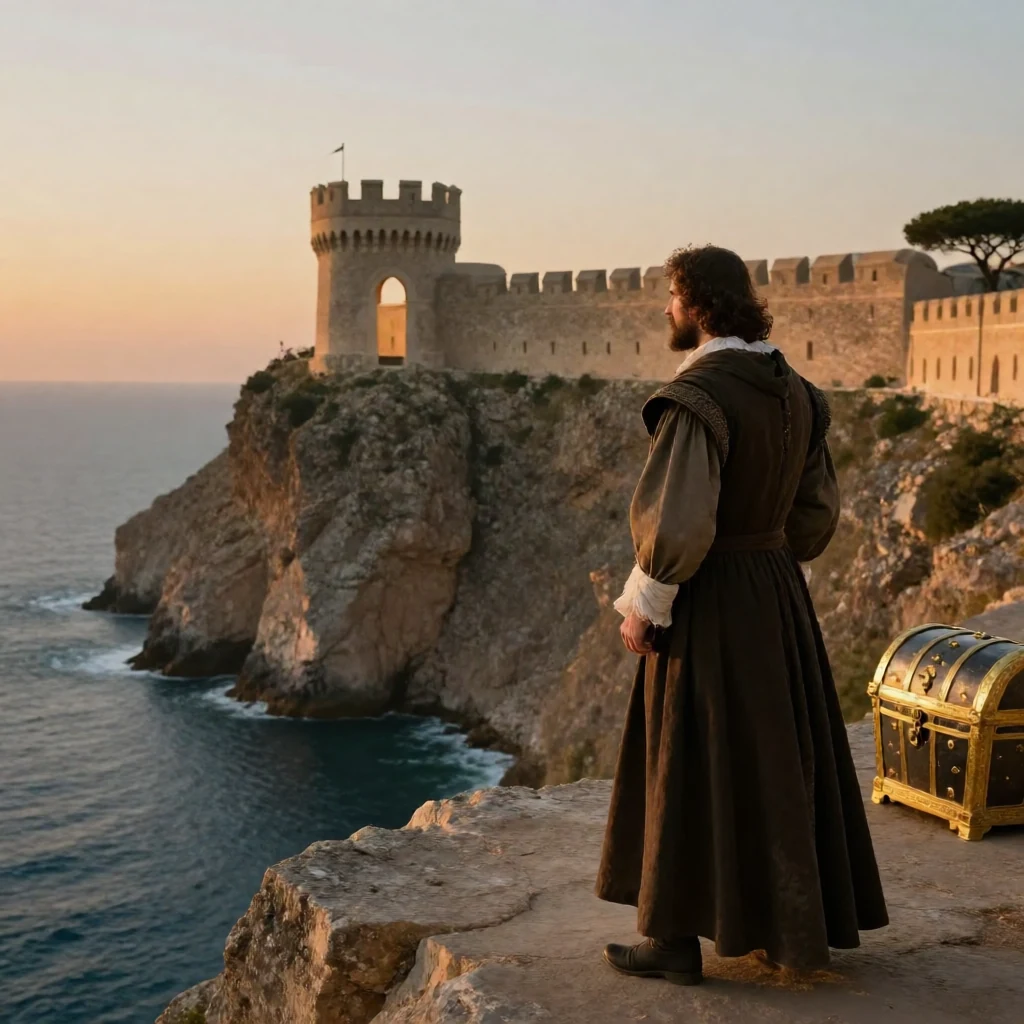
CAPÍTULO 18. The Treasure
Chapter 18, titled “The Treasure,” continues the narrative of Edmond Dantès and Abbé Faria in their prison setting. The chapter begins with Faria revealing a half-burnt document to Dantès, claiming it relates to a vast hidden treasure. Despite Dantès’ concern that this represents a return of Faria’s supposed madness, the abbé insists on sharing the full history behind the paper, recounting the story of Cardinal Spada, the Borgia conspiracy, and a fortune that was never found. The chapter weaves together themes of imprisonment, loyalty, mental instability, historical intrigue, and the enduring mystery of lost wealth.
The Burnt Document
Faria, recovering in his cell, shows Dantès a sheet of paper that has been rolled into a cylinder over time. The document is half-burnt, bearing traces of Gothic characters written in a peculiar ink. Faria declares that this paper represents his treasure, half of which now belongs to Dantès as proof of his fidelity.
Faria’s Secret
Faria confides to Dantès that the half-burnt paper contains details of a genuine treasure. He explains that he has kept silent about it for years because others dismissed him as mad, but he trusts Dantès to believe him. The abbé offers to prove the document’s significance by sharing the history of how it came into his possession, though Dantès remains skeptical and fears his friend is suffering a serious mental relapse.
The Governor’s Visit
The governor arrives to visit Faria after hearing of his illness from the jailer. Faria conceals his paralysis to avoid being moved to better quarters and separated from Dantès. The governor leaves convinced that the “poor madman” is only slightly indisposed and feels a certain affection for him.
A Question of Sanity
After the governor’s departure, Dantès struggles to reconcile Faria’s obvious rationality and wisdom on most matters with his persistent belief in a treasure. He spends the day alone in his cell, dreading the moment when he will be fully convinced of the abbé’s madness. When Faria eventually drags himself through the passage to reach Dantès, the young man realizes he cannot avoid hearing the story any longer.
The Story Begins
With Dantès resigned to listening, Faria begins his narrative by identifying himself as the former secretary and intimate friend of Cardinal Spada, the last of that noble Roman family. He explains that he had access to all of the cardinal’s affairs and often observed him annotating ancient volumes and searching through dusty family manuscripts in pursuit of hidden knowledge.
Cardinal Spada
Faria recounts that Cardinal Spada was the last prince of his name, a nobleman whose family’s wealth had become proverbial. Though Spada was not actually rich, he lived on this reputation. Upon opening a volume relating to the History of Rome, specifically the twentieth chapter of the Life of Pope Alexander VI., Faria discovered the foundation of the mystery involving the Borgia family and the fate of Cardinal Spada.
The Borgia Conspiracy
Faria describes Pope Alexander VI.’s scheme to raise money by creating two new cardinals: Giovanni Rospigliosi and Cæsar Spada. The pope and his son, Cæsar Borgia, sold the existing offices of these men and the cardinalate hats themselves, generating eight hundred thousand crowns. After elevating the cardinals, the Borgias invited them to dinner—a sinister invitation that Spada understood to be a death sentence.
A Fatal Dinner
Spada, suspecting the danger, made his will and tried to warn his nephew to wait near the vineyard where the dinner would take place, but the nephew arrived and was lured into drinking poisoned wine. Spada was pressured to taste another bottle. An hour later, a physician declared both men had been poisoned by mushrooms. Spada died at the vineyard’s threshold, and his nephew died at home, leaving behind only a cryptic will mentioning a breviary with gold corners.
The Vanishing Fortune
After the cardinals’ deaths, Cæsar Borgia and the pope searched Spada’s inheritance but found only a few thousand crowns in plate and money. The nephew’s wife was told to search for a will, but none was found beyond the brief mention of the breviary. The two palaces and vineyard belonging to the family were of little value. When Alexander VI. was accidentally poisoned and Cæsar was later killed, the Borgias never revealed having found the cardinal’s treasure.
The original text of this work is in the public domain. This page focuses on a guided summary article, reading notes, selected quotes, and visual learning materials for educational purposes.