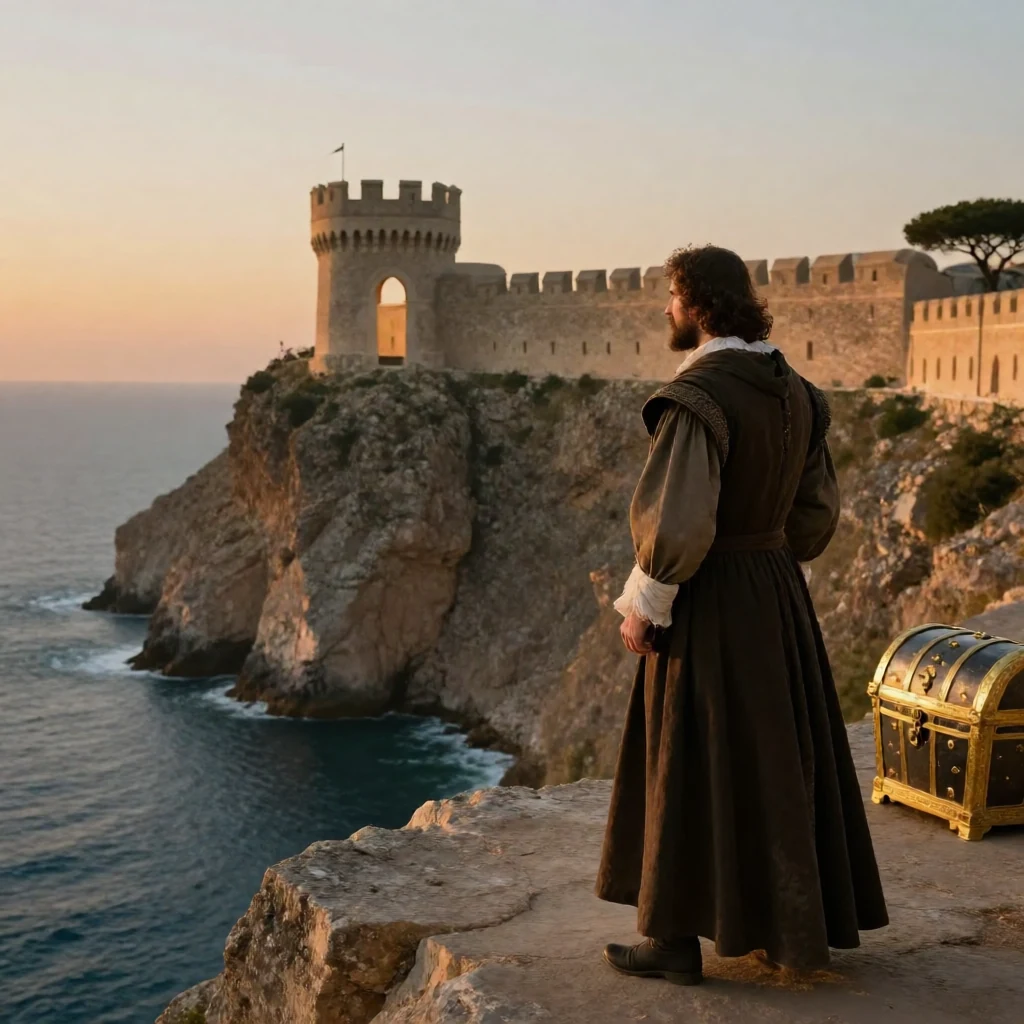
Chapter 58. M. Noirtier de Villefort
In the king’s attorney’s household, M. and Madame de Villefort entered the chamber of M. Noirtier, the paralytic patriarch whose only remaining senses were sight and hearing, and whose sole communication was the eloquent language of his eye. They came to announce Valentine’s marriage to Franz de Quesnel, Baron d’Épinay.
At the name, Noirtier’s pupil dilated; his eyelids trembled. Villefort understood at once: the political hatred between his father and the elder d’Épinay, assassinated in 1815 leaving a Bonapartist meeting. He explained coldly that the young couple would take Noirtier into their household. The old man’s look grew furious, his face purpling with a soundless cry; Villefort opened a window, blaming the heat.
Asked whether Edward should be sent, Noirtier winked violently: no. Asked whether Valentine, he closed his eyes eagerly: yes. Valentine arrived, read his distress, and working through their alphabet-dictionary discovered he wished to send for a notary. His determination to oppose the marriage by every legal means was unmistakable. Barrois declared he would fetch a notary at once, acknowledging no master but Noirtier.
Chapter 59. The Will
When the notary arrived, he hesitated without proof of the testator’s mental capacity. Valentine offered to instruct him in the old man’s language—a closing of the lids for yes, a winking for no. Persuaded, the notary watched her recite the alphabet until W, where the old man signaled her to stop. He meant a will.
Two notaries arranged themselves around the paralytic, testing his understanding by naming sums in ascending order; at 900,000 francs his eye stopped them. A small casket was brought, revealing bank-notes exactly to that amount. Asked about inheritance, Noirtier refused Valentine, refused Edward, refused Villefort, refused the Danglars entirely. Pressed further, he indicated her hand—her marriage. He wished to disinherit her because she was to marry Franz.
Villefort declared he would marry his daughter to whom he pleased. The notary asked whether the entire fortune should be diverted. Noirtier signified yes, intending charitable purposes regardless of legal challenge. Triumph shone in his eye as his son’s face darkened. The will was drawn up, approved by Noirtier, signed by seven witnesses, sealed by the notary, and entrusted to M. Deschamps, the family notary.
Chapter 60. The Telegraph
In the drawing-room, the Villeforts found the Count of Monte Cristo awaiting them. He perceived Villefort’s hidden trouble beneath his composure. The procureur confided his misfortune: his father had disinherited Valentine of 900,000 francs as punishment for her intended marriage to Franz, the son of a man Noirtier had detested since their political feuds. Encouraged, Villefort resolved to proceed.
Madame de Villefort hinted that perhaps the family ought to explain the disinheritance to d’Épinay and let him withdraw. Monte Cristo intervened with calculated praise for Villefort’s resolve, and the procureur accepted that the marriage should be settled beyond revocation. When the count mentioned the address Rue de la Fontaine, No. 28, Villefort started visibly—the house had once belonged to M. de Saint-Méran. The count feigned ignorance and pressed his invitation.
Before departing, Monte Cristo announced his destination: a telegraph. He meditated on the semaphore’s beetle-claw arms, marveling that thought could cross three hundred leagues by will. The operator, he learned, was a poor wretch hired for twelve hundred francs a year, condemned to watch his insect companion for hours. He preferred a rural telegraph, declined an introduction to the minister, received directions via Bayonne and the tower of Montlhéry, thanked his hosts, and departed. At the door he encountered the two notaries who had just completed the act disinheriting Valentine.
Chapter 61. How a Gardener May Get Rid of the Dormice that Eat His Peaches
The next morning, rather than the night he had named, Monte Cristo set out by the Barrière d’Enfer, taking the road to Orléans. He passed the telegraph at Linas without stopping and reached the tower of Montlhéry, where he dismounted and climbed the winding path. Beyond a hedge lay a small wooden gate and a garden of perhaps twenty by twelve feet, edged in thick box.
He found a man of fifty-five crouched behind a wheelbarrow, gathering strawberries. The gardener discoursed on dormice and the son of Mère Simon, who had stolen three berries, and led his visitor up into the tower to inspect the telegraph room.
The operator, paid a thousand francs yearly and lodged in his tower, understood none of the signals he transmitted. He had served fifteen years—ten as operator, five as supernumerary—and after twenty-five years would receive a hundred-crown pension. The work was tedious, but he had recreation hours and holidays in fog, when he could garden. Monte Cristo offered fifteen bank-notes and ten thousand more for the man to repeat three specific signs in place of the current message—enough to buy a house and two acres yielding a thousand francs yearly. Scarlet and perspiring, the operator performed the substituted signals while his right-hand correspondent contorted in frantic protest, and the left-hand correspondent obediently repeated the altered message onward to the Minister of the Interior.
That telegram reached the minister, where Debray immediately ordered his carriage and drove to the baroness. “Has your husband any Spanish bonds? He must sell at whatever price. Don Carlos has fled from Bourges and returned to Spain.” The baroness ran to her husband; Danglars sold at any price, the Spanish funds collapsed, he lost five hundred thousand francs but rid himself of his Spanish shares. That evening Le Messager published, by telegraph, that Don Carlos had escaped and Barcelona risen; the next morning Le Moniteur retracted the report—a signal improperly interpreted owing to fog—and the funds rose one per cent higher than before their fall. Counting what he had missed gaining, Danglars stood a million francs worse off. When Morrel arrived with news of Danglars’s strange reverse, Monte Cristo smiled. “I have just made a discovery for twenty-five thousand francs, for which I would have paid a hundred thousand.” “What have you discovered?” asked Morrel. “I have just discovered how a gardener may get rid of the dormice that eat his peaches.”
The original text of this work is in the public domain. This page focuses on a guided summary article, reading notes, selected quotes, and visual learning materials for educational purposes.