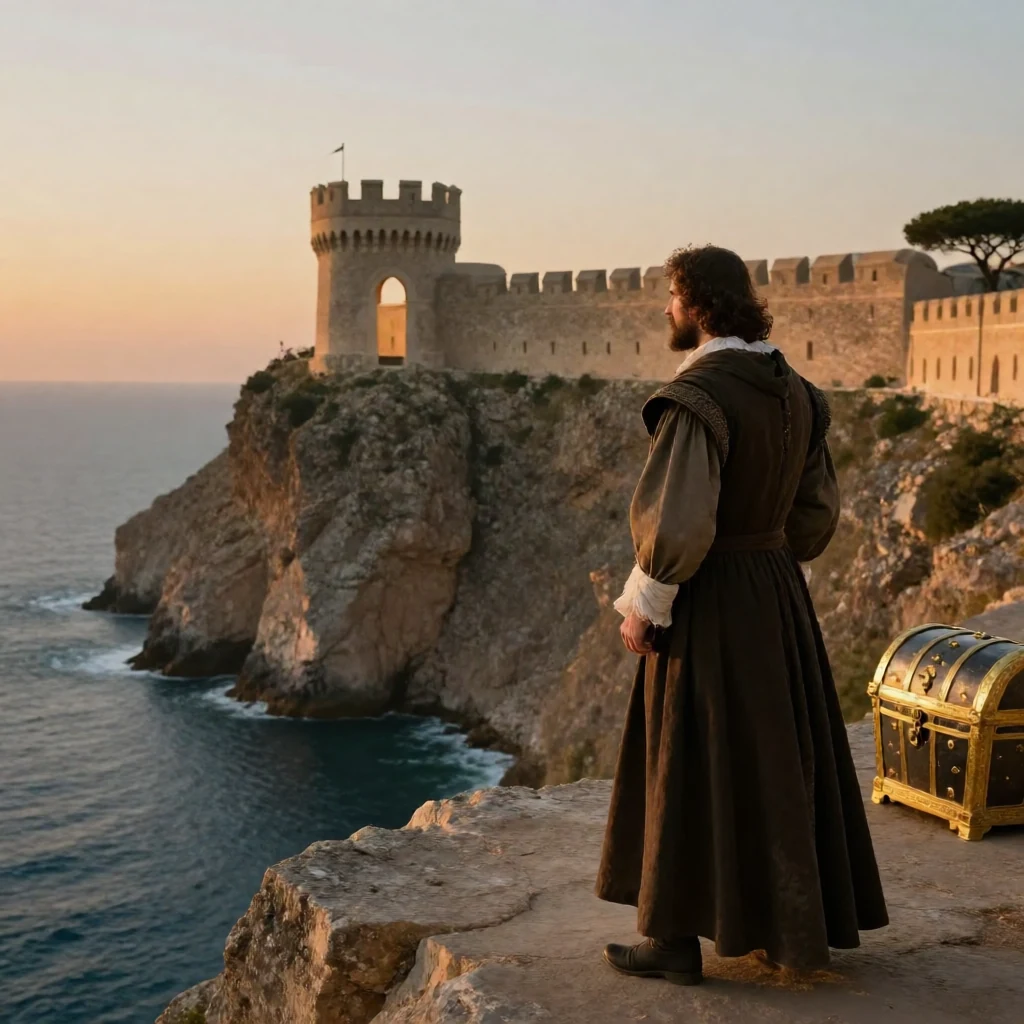
Dantès Inquires After Mercédès in the Catalan Village
That evening, the mysterious stranger (Dantès) is seen walking through the Catalan village, entering a poor fisherman’s hut to inquire about persons who have been dead or absent for fifteen to sixteen years. The questions provoke great wonder among the neighbors. The following day, the family from whom Dantès gathered his information receives a munificent gift: an entirely new fishing-boat with two seines and a tender.
Dantès Departs Marseilles
The recipients of the generous gift wish to thank their benefactor, but Dantès has already departed—giving final orders to a sailor before springing onto a horse and leaving through the Porte d’Aix, having accomplished his mysterious mission in Marseilles.
CAPÍTULO 26. The Pont du Gard Inn
The chapter introduces the Pont du Gard Inn, a struggling roadside tavern situated between Beaucaire and Bellegarde, identifiable by the flapping tin sign depicting the famous aqueduct. The establishment is run by Gaspard Caderousse, a weathered, sun-darkened man in his middle years, together with his sickly and perpetually complaining wife Madeleine Radelle, known by the Provençal sobriquet La Carconte, along with two meager servants. The inn has fallen on hard times ever since a new canal between Beaucaire and Aiguemortes siphoned off the post-road traffic that once brought the couple customers, leaving Caderousse to spend long, fruitless days watching the empty road from his doorstep while his wife’s bitter laments echo from her upstairs room. The quiet is broken when a priest, mounted on a Hungarian-bred horse, arrives under the fierce midday sun and inquires whether the host is indeed Gaspard Caderousse, formerly a tailor living on the fourth floor of the Allées de Meilhan. Seating himself at a table and soothing the hostile black dog Margotin, the abbé proceeds to question Caderousse about a young sailor named Edmond Dantès, whom the innkeeper enthusiastically claims as an intimate friend, his face flushing and then paling as the priest reveals that Dantès died a broken prisoner before reaching his thirtieth year. Stirred by news of Dantès’s last wishes to clear his name, and even more so by the priest’s mention of a diamond of immense value given to the doomed sailor by a wealthy English fellow-prisoner, Caderousse’s manner grows increasingly eager and unsettled, betraying the mixture of greed, guilt, and old envy that the impassive abbé observes with quiet, penetrating scrutiny. Chapter 26, “The Pont du Gard Inn,” unfolds within the inn where Caderousse and his wife La Carconte reside. The Abbé Faria (disguised) visits to question Caderousse about Edmond Dantès, his deceased friends, and the circumstances of old Dantès’s death, while revealing a valuable diamond left as a bequest. The chapter traces Caderousse’s growing cupidity, his wife’s persistent warnings to stay silent, and culminates with Caderousse yielding to temptation and beginning to recount the full story of the betrayals that ruined Dantès.
CAPÍTULO 26. The Pont du Gard Inn
The chapter introduces the Pont du Gard Inn, a struggling roadside tavern situated between Beaucaire and Bellegarde, identifiable by the flapping tin sign depicting the famous aqueduct. The establishment is run by Gaspard Caderousse, a weathered, sun-darkened man in his middle years, together with his sickly and perpetually complaining wife Madeleine Radelle, known by the Provençal sobriquet La Carconte, along with two meager servants. The inn has fallen on hard times ever since a new canal between Beaucaire and Aiguemortes siphoned off the post-road traffic that once brought the couple customers, leaving Caderousse to spend long, fruitless days watching the empty road from his doorstep while his wife’s bitter laments echo from her upstairs room. The quiet is broken when a priest, mounted on a Hungarian-bred horse, arrives under the fierce midday sun and inquires whether the host is indeed Gaspard Caderousse, formerly a tailor living on the fourth floor of the Allées de Meilhan. Seating himself at a table and soothing the hostile black dog Margotin, the abbé proceeds to question Caderousse about a young sailor named Edmond Dantès, whom the innkeeper enthusiastically claims as an intimate friend, his face flushing and then paling as the priest reveals that Dantès died a broken prisoner before reaching his thirtieth year. Stirred by news of Dantès’s last wishes to clear his name, and even more so by the priest’s mention of a diamond of immense value given to the doomed sailor by a wealthy English fellow-prisoner, Caderousse’s manner grows increasingly eager and unsettled, betraying the mixture of greed, guilt, and old envy that the impassive abbé observes with quiet, penetrating scrutiny.
The original text of this work is in the public domain. This page focuses on a guided summary article, reading notes, selected quotes, and visual learning materials for educational purposes.