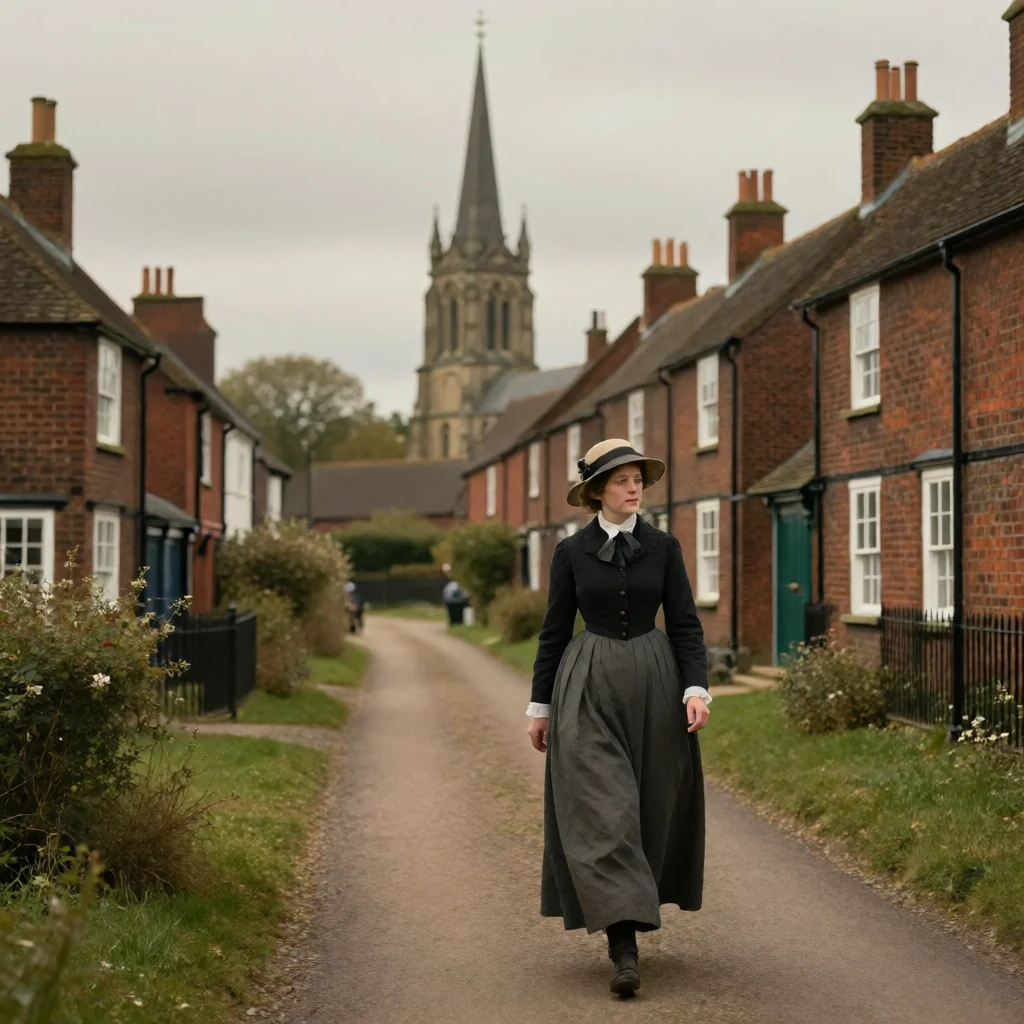
Walter Scott’s Influence
The chapter begins with a poem describing how the name of Walter Scott stirred the souls of the Garth children, enlarging their world with tales of Evan Dhu, Bradwardine, and Vich Ian Vor, and filling them with wonder, love, and belief toward the distant author.
Fred Visits the Garths
Fred Vincy, having come to see that even a spirited young man must sometimes walk for want of a horse, sets out at five o’clock toward Lowick Parsonage. He calls on Mrs. Garth by the way, hoping to assure himself that she accepts their new relations willingly.
The Family Under the Apple-Tree
Fred finds the Garth family group, dogs and cats included, gathered under the great apple-tree in the orchard. Mrs. Garth’s eldest son Christy, home for a short holiday, lies by her chair; Jim reads aloud from Ivanhoe; Ben shoots arrows with his old bow; and Letty listens open-eyed amid signs of recent cherry-gathering. The peaceful scene is centered on the reading until Fred’s arrival shifts the attention of the children.
Mrs. Garth’s Admonition
After the children are sent away, Mrs. Garth takes the opportunity to speak to Fred. She emphasizes the devotion of such elders as Caleb Garth and Mr. Farebrother, and when Fred mentions his hope of winning Mary, she surprises him by suggesting he made a great mistake in asking Mr. Farebrother to speak on his behalf.
Revelation of Farebrother’s Love
Mrs. Garth explains that young people are blind to what their wishes cost others, and when Fred protests he cannot see how his request could have pained Mr. Farebrother, she presses the point. Fred, suddenly grasping the implication, bluntly asks whether Mr. Farebrother is in love with Mary. Mrs. Garth confirms the suspicion but adds that she spoke only from inference and is not aware that Mary knows anything of the matter.
The Interrupted Conversation
Before Mrs. Garth can retract or qualify her words, chaos erupts under the apple-tree: Ben bounces across the grass, the kitten drags Mrs. Garth’s knitting, the milk is upset, cherries are scattered, and the kitten is crowned with the half-knitted sock-top. The disturbance ends Fred’s tête-à-tête; he departs swiftly, and Mrs. Garth, mortified at having exceeded herself, can only say “God bless you” by way of partial retractation.
Fred’s Troubled Walk to Lowick
Fred’s light, hopeful nature is deeply bruised by the suggestion that, had he been out of the way, Mary might have made a thoroughly good match. He is also piqued at his own clumsiness in enlisting Farebrother’s help, and a new jealousy takes root. He begins to imagine what the sharp edge of rivalry would feel like, though he suspects Mrs. Garth may be wrong about Mary’s feelings, since Mary has been staying at the parsonage where her mother cannot see what passes in her mind.
Arrival at the Parsonage
Arriving at the parsonage, Fred finds Mary and the three ladies in animated discussion in the drawing-room. Mary is copying labels from cabinet drawers in her fine handwriting, Mr. Farebrother is out in the village, and the ladies know nothing of Fred’s particular relation to Mary. He manages to tell her of Christy’s arrival and of his engagement with her father, and is comforted to see her moved by the latter news.
Discussion of Clergymen
Mrs. Farebrother and her sisters draw Fred and Mary into a discussion about clergymen, prompted by Mary’s confession that she never liked any clergyman except the Vicar of Wakefield and Mr. Farebrother. When pressed, Mary jokingly blames clergymen’s neckcloths, and the ladies puzzle over her reasons. Fred’s piqued tone, Mary’s open preference for Farebrother above all, and the ladies’ evident encouragement of that preference fill Fred with jealousy, even as he acknowledges the Vicar’s estimable qualities.
The Spider in the Study
Mr. Farebrother returns, hears the news of the engagement under Caleb Garth with quiet satisfaction, and praises Mary’s handwriting. He then invites Fred to help carry drawers back into his fine new study, and asks Mary to come admire a “stupendous spider” he has found. Mary, accustomed to dismissing flattering beliefs as ridiculous, perceives the Vicar’s pastoral intention at once: he has never deviated from his old kindness toward her, and the chapter closes on this delicate, self-effacing stratagem.
The original text of this work is in the public domain. This page focuses on a guided summary article, reading notes, selected quotes, and visual learning materials for educational purposes.