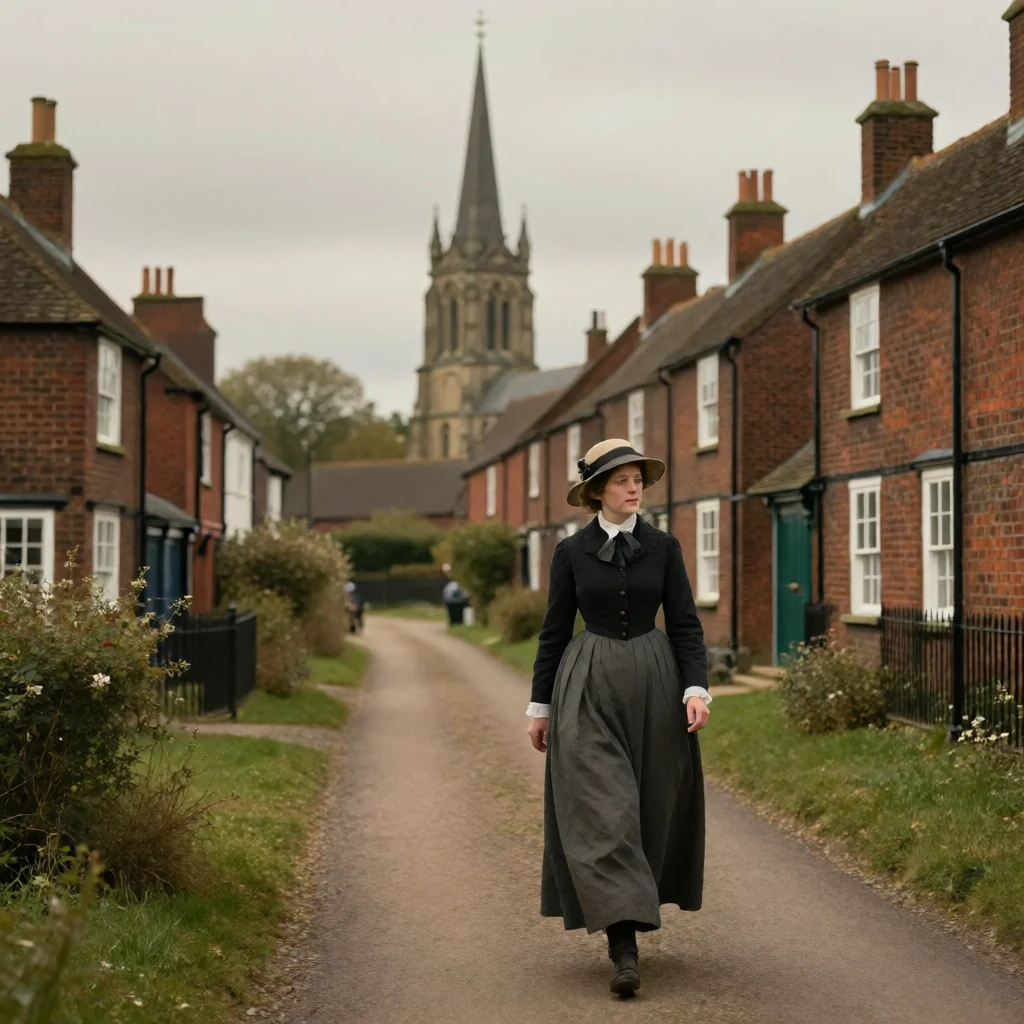
Will’s Fierce Opening Retort
Will reacts with fierce, immediate defiance when Raffles first brings up his mother, giving a direct, confrontational answer to the question and challenging any consequences of the inquiry, as he refuses to give the impression he minds others learning about his origins.
Raffles Probes Will’s Family
Raffles holds back from escalating Will’s aggressive stance, instead shifting to mention he knew Will’s mother when she was a young girl, note Will’s strong resemblance to his father, and ask if Will’s parents are still alive.
Will Angrily Answers Parent Question
Will responds with a thunderous, curt “No” to the question of whether his parents are alive, maintaining his hostile, confrontational posture throughout the exchange.
Raffles Departs After Initial Clash
Raffles lifts his hat, turns, and walks away from the initial encounter, heading toward the road rather than returning to the auction room. Will briefly considers letting Raffles share more information, but ultimately decides he prefers not to receive details from that source.
Raffles Reconnects With Will Street-Side
Later that evening, Raffles catches up to Will on the street, either having forgotten Will’s earlier harshness or intentionally approaching with overly familiar, jovial behavior. He makes small talk about the pleasantness of the town and neighborhood before pivoting back to topics related to Will’s family.
Raffles Recalls Meeting Will’s Father
Raffles shares that he met Will’s father in Boulogne while abroad, pointing out Will’s strong physical resemblance to his father (matching mouth, nose, eyes, and foreign-style hairline) and noting Will’s father was very ill when they met, asking if he eventually recovered.
Raffles Reveals Will’s Mother’s Past
Raffles claims he knows the reason Will’s mother ran away from her family as a young woman, describing her as proud, pretty, and honorable. He alleges her family operated a high-end, respectable receiving house for stolen goods, and she fled after a spurned suitor revealed their operation to her out of spite, as she had no involvement in their work. He adds he once traveled for the family in a gentlemanly capacity, and notes her son was alive and her daughter was out of favor at the time of her departure. He then invites Will to join him for a drink at the Blue Bull.
Will Flees Raffles’ Invitation
Will refuses the invitation, dashing down a passage toward Lowick Gate and almost running to put distance between himself and Raffles.
Will Reflects on Encounter’s Stakes
Walking alone on the dark, starlit Lowick road, Will feels sullied by the exchange, as if dirt has been thrown on him amid scorn. He is unsettled by the confirmation that his mother never told him why she left her family, but reasons that even if his maternal family’s past is as ugly as Raffles claims, he is no worse for it, as his mother braved hardship to separate herself from them. He worries that if Dorothea’s social circle, including the Chettams, learned this story, they would use it as grounds to deem him unfit to associate with Dorothea, but resolves that his own integrity is untainted by his maternal family’s actions, and anyone who judges him for their past would be proven wrong.
CHAPITRE LXI.
The chapter opens with an epigraph from Samuel Johnson’s Rasselas in which Imlac remarks that “Inconsistencies… cannot both be right, but imputed to man they may both be true,” a thematic prelude that frames the moral contradictions explored throughout the chapter.
Rasselas Epigraph on Inconsistencies
The chapter is prefaced by a quotation from Rasselas in which Imlac observes that inconsistencies, though they cannot both be right, may both be true when imputed to human beings, foreshadowing Bulstrode’s self-deception.
Mrs. Bulstrode Reports an Impudent Visitor
Returning from a journey to Brassing, Mr. Bulstrode is met at home by his wife Harriet, who draws him into his private sitting-room and reports that an impudent red-faced man with large whiskers had called asking for him, claimed to be an old friend named “Nick,” and made insulting remarks about Bulstrode’s luck in wives. She dissuaded the visitor from waiting only by threatening to set a fierce dog on him.
The original text of this work is in the public domain. This page focuses on a guided summary article, reading notes, selected quotes, and visual learning materials for educational purposes.