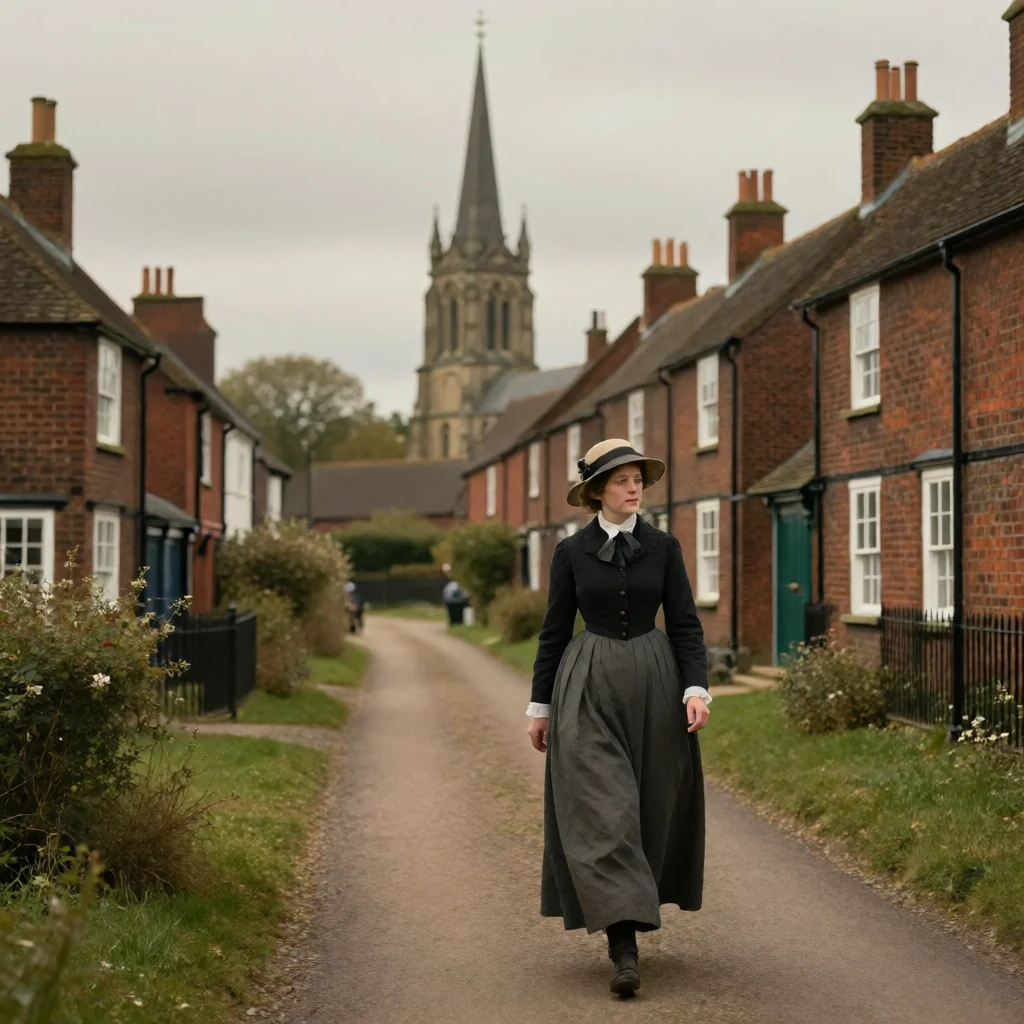
Rosamond’s Despair and Scheme
Rosamond has confined herself to home, venturing out only to church and to visit her father Mr. Vincy, to whom she has spoken of their potential move to London with little money. Her mind has become fixed on Will Ladislaw’s coming as her sole point of hope, and she has associated this with new urgency for Lydgate to make immediate arrangements to leave Middlemarch. She does not see how the coming would cause the going, but she believes it will. This way of establishing sequences—where a desirable cause leads immediately to a desirable effect—rid us of doubt and makes our minds strongly intuitive, though it leaves us unprepared when the sequence is sundered. Rosamond arranges objects with her usual nicety but moves with increased slowness; she sits at the piano meaning to play, then desists, lingering on the music stool with white fingers suspended and a dreamy ennui. Lydgate feels a strange timidity before her marked melancholy, as a perpetual silent reproach, and the strong man shrinks from her look, sometimes starting at her approach. This morning, Rosamond descends from her upstairs room dressed for a walk, equipped with a letter to post—a letter addressed to Mr. Ladislaw written with charming discretion but intended to hasten his arrival by a hint of trouble. The servant notices her and thinks “there never did anybody look so pretty in a bonnet poor thing.”
Dorothea’s Unwavering Trust
Until Lydgate opened a glimpse of some trouble in his married life, Dorothea’s image of Mrs. Lydgate had always been associated with that of Will Ladislaw. Even when agitated by Mrs. Cadwallader’s graphic report of gossip, her strongest impulsive prompting had been towards vindicating Will from any sullying surmises. When she had interpreted his words as a probable allusion to a feeling towards Mrs. Lydgate, she had had a quick, sad, excusing vision of the charm there might be in his constant opportunities of companionship with that fair creature. But his parting words had implied that she herself was the object of whom his love held him in dread, that it was his love for her only which he was resolved not to declare but to carry away into banishment. From that time, Dorothea, believing in Will’s love for her and in his delicate sense of honor, felt her heart quite at rest as to any regard he might have for Mrs. Lydgate—she was sure that the regard was blameless. There are natures in which, if they love us, we are conscious of having a sort of baptism and consecration: they bind us over to rectitude and purity by their pure belief about us. Dorothea’s nature was of that kind. She had accepted her whole relation to Will very simply as part of her marriage sorrows, and would have thought it very sinful in her to keep up an inward wail because she was not completely happy.
Gossip and Genealogy
With the disclosures about Bulstrode came another fact affecting Will’s social position, which roused afresh Dorothea’s inward resistance to what was said about him in that part of her world which lay within park palings. “Young Ladislaw the grandson of a thieving Jew pawnbroker” had entered emphatically into the dialogues about the Bulstrode business, at Lowick, Tipton, and Freshitt, and was a worse kind of placard on poor Will’s back than the “Italian with white mice.” Upright Sir James Chettam was convinced that his own satisfaction was righteous when he thought with some complacency that here was an added league to that mountainous distance between Ladislaw and Dorothea, which enabled him to dismiss any anxiety in that direction as too absurd. Perhaps there had been some pleasure in pointing Mr. Brooke’s attention to this ugly bit of Ladislaw’s genealogy, as a fresh candle for him to see his own folly by. Dorothea had observed the animus with which Will’s part in the painful story had been recalled more than once; but she had uttered no word, being checked by the consciousness of a deeper relation between them which must always remain in consecrated secrecy. Her silence shrouded her resistant emotion into a more thorough glow; and this misfortune in Will’s lot, which others wished to fling at his back as an opprobrium, only gave something more of enthusiasm to her clinging thought.
The original text of this work is in the public domain. This page focuses on a guided summary article, reading notes, selected quotes, and visual learning materials for educational purposes.