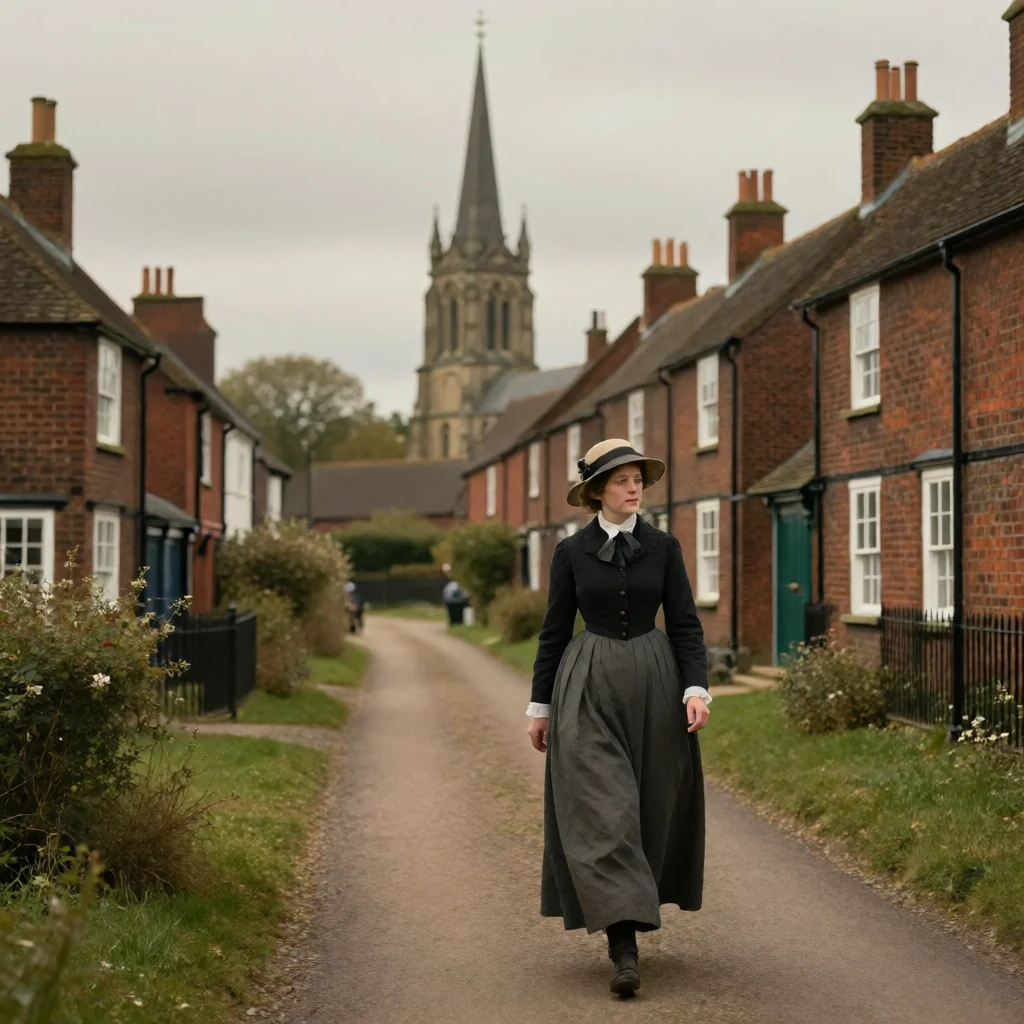
Tantripp’s Resentful Comment on Casaubon’s Books
Tantripp’s Resentful Comment on Casaubon’s Books Left behind, Tantripp mutters to the butler Pratt that she wishes every book in Mr. Casaubon’s library was built into a catacomb for “your master,” recalling her visit to Roman antiquities. She refuses, out of a kind of loyalty, to call Mr. Casaubon anything but “your master” when speaking to the other servants.
CHAPITRE XLVIII.
Dorothea, after long hesitation on the gravel walks, forces herself to enter the Yew-tree Walk to seek her husband and offer him the reconciliation he has been pressing upon her, recognizing that no law compels her to this fellowship but only his nature and her own compassion. She finds him seated in the summer-house with his face bowed upon his arms on the stone table, and when he does not respond to her repeated assurances that she has come and is ready, she removes his velvet cap and leans close, crying to him to wake; but her answer is never delivered, for the silence in his ear is never again to be broken, and later in the day Lydgate sits by her bedside as she lies delirious, begging him to explain everything to her husband and to tell him she will soon come to promise, not yet knowing that the man she sought to comfort is already dead.
Pratt’s Preference for Tantripp
Pratt laughed at the situation involving his master, making clear that though he liked his master very well, he liked Tantripp even better, hinting at amusement or affection that supersedes his regard for Mr. Casaubon.
Dorothea’s Reluctance to Marital Duty
Dorothea lingers among the nearby clumps of trees, hesitating as she once did before, though now from a different cause. Whereas previously she feared her effort at fellowship might be unwelcome, she now dreads approaching the spot where she must bind herself to a fellowship she shuns. Neither law nor the world’s opinion compels her—only her husband’s nature and her own compassion, only the ideal and not the real yoke of marriage. Though she sees the whole situation clearly, she feels fettered, unable to spurn the stricken soul that entreats hers. Acknowledging that this may be weakness, she nonetheless knows she cannot delay longer and must proceed to the Yew-tree Walk.
Dorothea Finds Her Husband in the Summer-house
Entering the Yew-tree Walk, Dorothea cannot at first see her husband. Following the bends of the path, she expects to catch sight of his figure wrapped in a blue cloak and velvet cap—his usual outer garments for chill garden days. Diverging slightly toward the summer-house, she turns the angle and discovers him seated on the bench close to a stone table, his arms resting on it and his brow bowed down upon them, the blue cloak dragged forward to screen his face on either side.
Dorothea’s Failed Attempt to Rouse Her Husband
Assuming at first that he is merely asleep and that the summer-house is too damp for resting, Dorothea recalls that lately he has often taken this same posture while she reads to him, sometimes speaking as well as listening with his face thus bowed. She enters the summer-house and announces, “I am come, Edward; I am ready.” When he takes no notice and she believes him fast asleep, she lays her hand on his shoulder and repeats, “I am ready!” Still he does not move. Overcome by a sudden confused fear, she leans down, removes his velvet cap, and presses her cheek close to his head, crying in distress, “Wake, dear, wake! Listen to me. I am come to answer.” But Dorothea never gave her answer.
Dorothea’s Delirious Request to Lydgate
Later in the day, Lydgate sits by Dorothea’s bedside as she speaks deliriously, thinking aloud and recalling the thoughts that had passed through her mind the night before. Though she recognizes Lydgate and calls him by name, she seems to feel it right that she should explain everything to him, and repeatedly begs him in turn to explain everything to her husband. She asks him to tell Edward that she will come to him soon and is ready to promise—only that the thinking about it had been so dreadful as to make her ill, though not very ill, and she will soon be better. Yet the silence in her husband’s ear was never more to be broken.
The original text of this work is in the public domain. This page focuses on a guided summary article, reading notes, selected quotes, and visual learning materials for educational purposes.