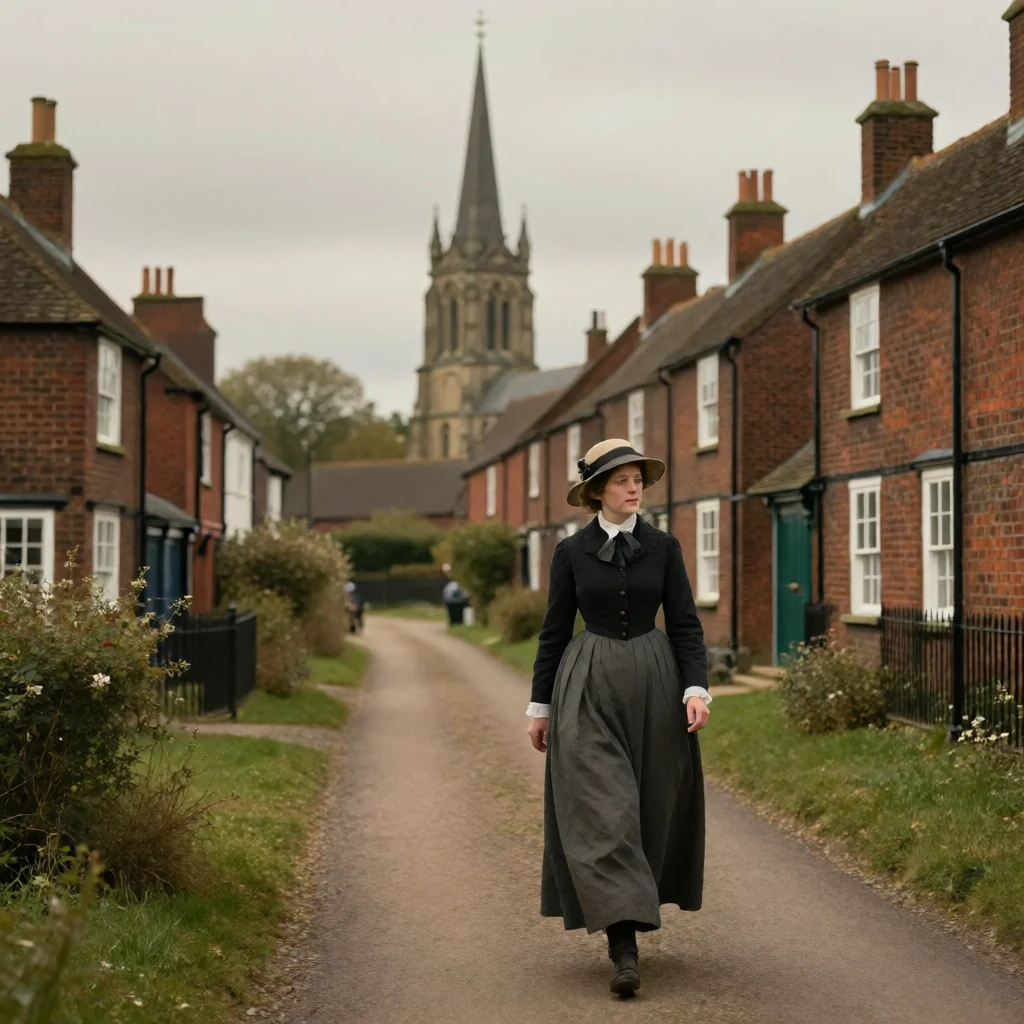
Mary Garth’s Verdict
When Mr. Farebrother explains that Fred is willing to pursue ordination only if Mary would consider marrying him, Mary gives a clear verdict: she will never marry Fred if he becomes a clergyman, as she finds the idea of him performing clerical duties ridiculous and contemptible, viewing a clergy career pursued for gentility’s sake as foolish. She does not rule out a future with Fred if he chooses a different, more respectable worldly path instead.
CHAPITRE LII.
Mr. Farebrother converses with Mary Garth about Fred Vincy’s prospects, urging her to be direct about her feelings since another man’s happiness hangs in the balance. Mary explains that she cannot promise to marry Fred until he has done something to earn that promise, though she affirms her deep and longstanding attachment to him and would never give him up for anyone else. Mr. Farebrother, suppressing his own quietly revealed feelings for Mary, accepts her answer with magnanimous restraint and rides back to Middlemart, leaving Mary struck by a sudden, indefinable sadness in his manner.
Mary and Mr. Farebrother’s Conversation
Mr. Farebrother engages Mary in a serious conversation, probing whether she holds Fred Vincy in such low regard that she could dismiss him entirely as a clergyman. He notes that young women tend to be severe and do not feel the stress of action as men do, and gently presses Mary for a direct and open answer about her feelings. Mary perceives an unusual gravity and restrained emotion in his tone, and is struck by the strange possibility that his words might refer to himself, though she quickly dismisses the thought as implausible.
A Discussion About Fred Vincy
The conversation centers on whether Fred Vincy should pursue a clerical career. Mary acknowledges that Fred has plenty of sense but doubts he would demonstrate it as a clergyman, calling such an endeavor a “piece of professional affectation.” When Mr. Farebrother asks whether Fred might have hope if he pursued some other way of earning his bread, Mary responds with a slight resentment that he should need to ask again what she has already told Fred directly: that he must do something worthy before posing such questions.
Mary’s Declaration of Affection
Pressing Mary for candor, Mr. Farebrother argues that when a woman’s feelings touch the happiness of another life, the nobler course is to be perfectly direct and open. In response, Mary declares that her feeling for Fred has taken too deep a root to be supplanted by anyone else. She speaks of her long gratitude for his steady devotion since they were children, her inability to imagine any new feeling weakening that bond, and her wish to see him worthy of everyone’s respect. However, she refuses to promise to marry him until he proves himself, declaring him free to choose someone else rather than bring shame to her parents.
The Vicar’s Magnanimous Duty
Having fulfilled his commission thoroughly, Mr. Farebrother takes his leave of Mary, putting out his hand and offering a blessing, and expressing hope that he will live to join her hands with Fred’s. Mary, moved by something indefinable in his manner—a resolute suppression of pain that recalls her father’s trembling hands in times of trouble—asks him to stay for tea, but he declines. Within three minutes he is back on horseback, having magnanimously discharged a duty far harder than the renunciation of whist or the writing of penitential meditations.
CHAPITRE LIII.
This chapter opens with a philosophical framing that outsiders often mistake apparent inconsistency for insincerity, overlooking the complex, hidden internal forces that shape belief and conduct. It traces Nicholas Bulstrode’s acquisition of Stone Court, his self-justifying interpretation of the purchase as a divinely sanctioned opportunity to expand his religious influence, the secret, self-serving motives Joshua Rigg held for selling the estate, the reactions of Peter Featherstone’s aggrieved relatives to the sale, and the sudden arrival of John Raffles at Stone Court, which upends Bulstrode’s peaceful spiritual state and fills him with dread of his hidden past being exposed.
The original text of this work is in the public domain. This page focuses on a guided summary article, reading notes, selected quotes, and visual learning materials for educational purposes.