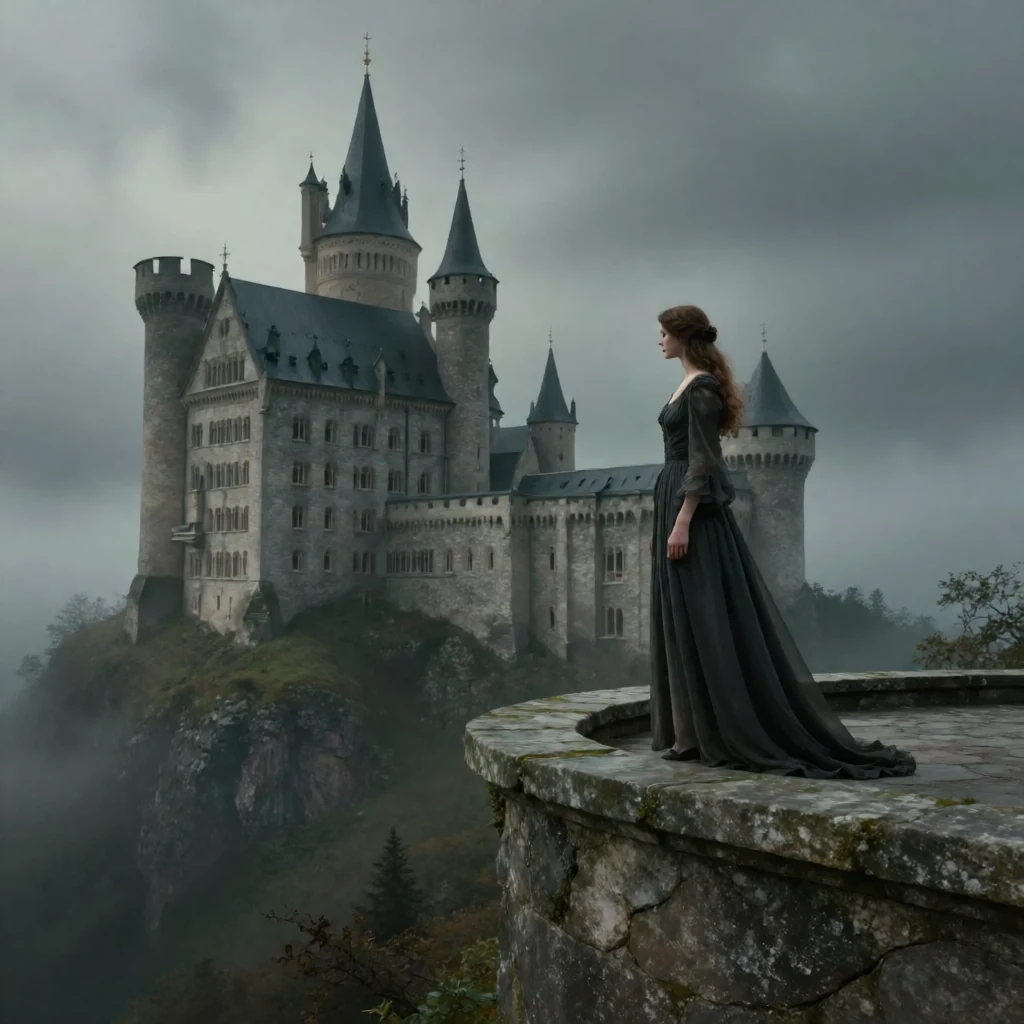
Twilight Thoughts of Valancourt
After composing her poem and calming her fears, Emily sits at her casement reading, with her gaze often drifting to the soothing landscape that lulls her into gentle melancholy. As the sun sets over the mountains and sea and twilight falls, her thoughts turn to Valancourt: she revisits memories of the midnight music she heard at Udolpho, becomes convinced the voice she heard was his, and feels grief and regret at his imprisonment in the gloomy castle.
Maddelina’s Midnight Kindness
Emily lingers at her casement long after dark, soothed by the moonlight and the soft murmur of the brook and woods, as memories of her happy, protected childhood in La Vallée with her parents arise, sharpening the pain of her current forlorn, perilous situation and reducing her to temporary despondence. She is soon awakened by a knock at her door, and finds Maddelina, who has brought her a secret supper of grapes, figs, and wine, risking her mother Dorina’s anger to comfort the distressed Emily.
Solitary Days and Sketches
In the days that follow, Emily remains mostly in her room, attended only by Maddelina at meals, and begins to feel fond of her pleasant, embowered chamber, experiencing a rare sense of security she associates with home. With no new sources of distress, her emotional state recovers enough for her to enjoy her books and drawing supplies, and she amuses herself by sketching the landscape from her window, adding small, touching narrative groups to her drawings that help her briefly forget her real suffering as she waits for whatever the future holds.
The Walk to the Sea
After a sweltering day, a lovely evening convinces Emily to take a walk, accompanied by Maddelina and her required guard Bertrand. She follows the stream toward the sea, delighting in the warm sunset light gilding the Apennines, the fruit-laden citrus groves, and the calm bay. She reaches a headland crowned with a ruined beacon tower, and gazes out over the sequestered shores, grey marble cliffs tufted with myrtle, and the glassy sea reflecting the sunset’s pink hues.
Longing for France
Standing at the headland looking out over the sea, Emily is seized by intense, aching longing for her native France and her lost happy life, watching a distant vessel and wishing vainly that the sea would carry her home. The soft, melancholy sound of the surf against the shore brings her to tears as she reflects on her helpless situation, until the sound of distant voices draws her attention.
The Singing Peasants
Emily hears a chorus of voices coming from around a nearby promontory, and after a brief pause, a single female voice begins to sing a chant. She quickens her pace, rounds the rock, and sees two groups of peasants: one seated in the shade, the other standing on the edge of the sea around a young girl holding a flower chaplet, who appears poised to cast it into the waves.
CHAPITRE VII.
This chapter covers a festive sea nymph invocation performed by Tuscan peasants, Emily’s conversation with her companion Maddelina about the tradition, a description of the peasant girls’ traditional attire, the post-invocation peasant dance and socializing, Emily’s reflective walks in Tuscany, and her belated recollection of forgotten estate papers left at Udolpho.
Sea Nymph Invocation Performance
Emily listens in surprise to a formal invocation to a sea nymph delivered in elegant Tuscan, accompanied by soft pastoral instruments. The poem calls on the nymph to rise from her pearly cave to soothe the shore with her music, and is followed by a repeating chorus of “Arise!” The surrounding group then throws a flower garland into the waves as the chant fades into silence.
Emily and Maddelina Discuss Sea Nymph Custom
After the performance, Emily asks Maddelina about the reference to a sea nymph. Maddelina explains that while no peasants truly believe in sea nymphs, old traditional songs reference them, so the community sings to them and throws garlands into the sea during festival sports. Emily is both surprised and admiring that classic literary traditions have spread even to rural Tuscan peasant culture.
The original text of this work is in the public domain. This page focuses on a guided summary article, reading notes, selected quotes, and visual learning materials for educational purposes.