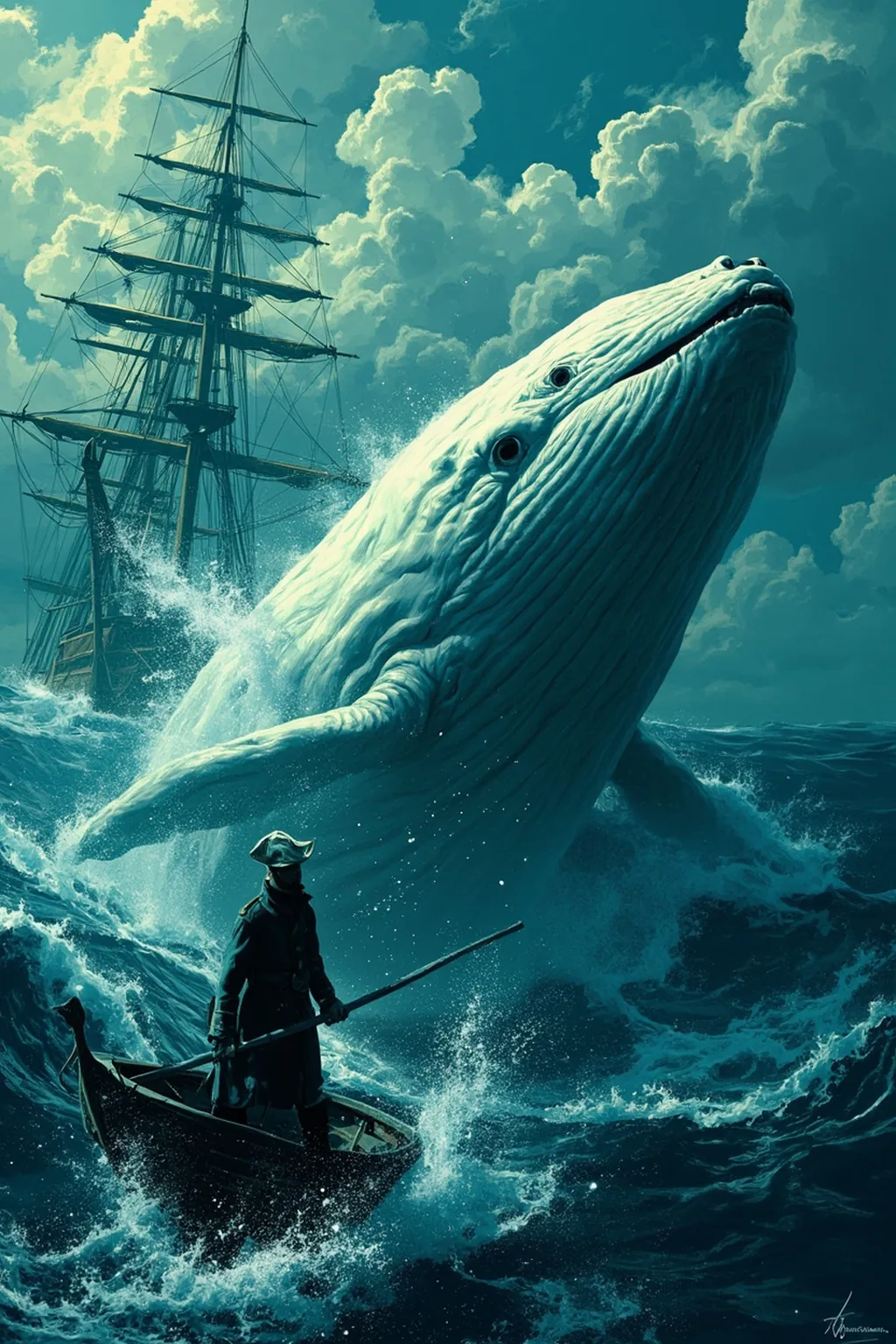
Durand’s Whaling Engravings
Two other notable French engravings come from an artist signing himself “H. Durand.” One depicts a quiet noon scene among Pacific islands with a French whaler anchored in a calm, taking water on board while palms droop in the breezeless air. The other shows a far more dramatic scene: a ship hove-to in Leviathanic life with a Right Whale alongside during the cutting-in process. A boat pushes off to chase distant whales while harpoons and lances are readied and a sudden roll of sea lifts the small craft like a rearing horse. Smoke from the boiling whale rises like smoke over smithies while a black cloud promises approaching squalls.
第五十七章 Of Whales in Paint; in Teeth; in Wood; in Sheet-Iron; in
This chapter explores the myriad ways in which whales have been represented in human art and culture, as well as their surprising appearances in natural formations. Melville examines whales rendered in paint, carved in teeth and bone, sculpted in wood, forged in metal, fossilized in stone, glimpsed in mountain profiles, and imagined among the stars. The chapter celebrates the whaleman’s intimate connection with his quarry by tracing how the creature pervades both material craftsmanship and celestial imagination.
Of Whales in Stone, Mountains, and Stars
Melville introduces the chapter’s thematic range, encompassing whales found in geological formations and celestial observation. He prepares the reader for a survey spanning from petrified leviathans embedded in the earth to the whale-like profiles glimpsed along mountain ridges and the starry formations that suggest cosmic cetaceans. This broad introduction establishes that the whaleman’s world extends far beyond the ocean’s surface into stone, landscape, and the heavens above.
The original text of this work is in the public domain. This page focuses on a guided summary article, reading notes, selected quotes, and visual learning materials for educational purposes.