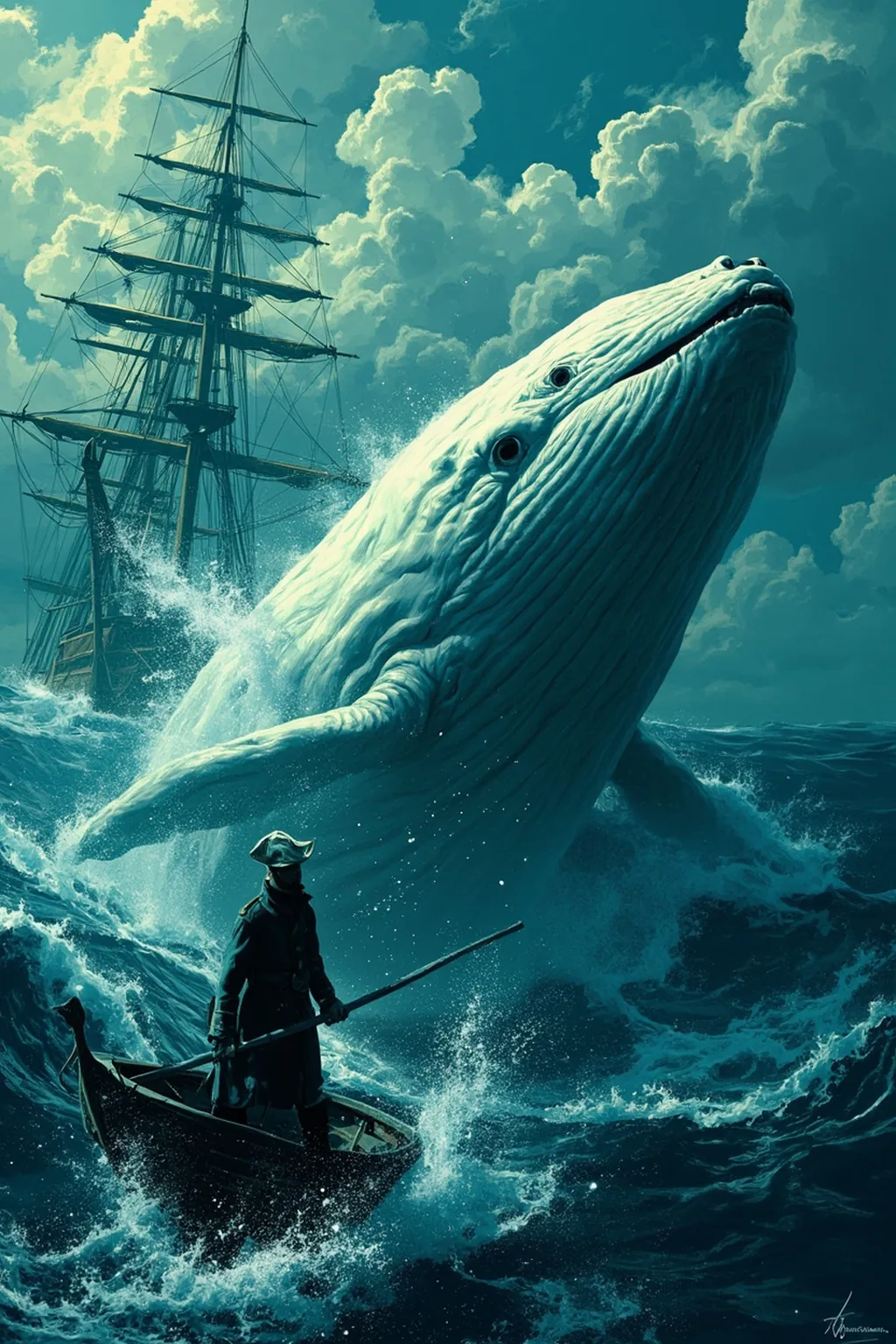
Moby Dick; Or, The Whale
An ordered chapter-preserving outline from Chapter 5: CHAPTER 1. Loomings. through Chapter 153: CHAPTER 135. The Chase.—Third Day..
Chapter 5: CHAPTER 1. Loomings.
Ishmael introduces his existential malaise and explains his philosophical and practical reasons for taking to the sea, culminating in his decision to embark on a whaling voyage.
The Spleen and the Remedy
Ishmael describes his depressive state and his habit of going to sea to cure it, contrasting his quiet departure with Cato's dramatic suicide.
Symptoms of the Soul
A catalog of grim symptoms—pausing at coffin warehouses and a desire to knock off hats—that signal it is time to sail.
A Universal Impulse
Ishmael asserts that almost all men share a deep, magnetic attraction to the ocean.
The Water-Gazers of Manhattan
Ishmael observes the crowds of landsmen in New York City who are drawn to the water's edge, reinforcing the connection between meditation and water.
Sentinels of the Docks
Description of men fixed in ocean reveries along the wharves, escaping their confinement on land.
The Magic Stream
Philosophical exploration of how landscape and thought inevitably lead to water, and the necessity of water to beauty.
The Image of Life
The myth of Narcissus is reinterpreted as the universal pursuit of the ungraspable phantom of life found in rivers and oceans.
The Role of the Common Sailor
Ishmael explains why he specifically chooses to work as a common sailor rather than a passenger or officer, citing pay, exercise, and a stoic acceptance of hierarchy.
Rejection of Rank
He refuses the indignity of being a passenger and the responsibility of being a Captain or Cook.
The Philosophy of Service
Ishmael reconciles the drudgery of taking orders with a New Testament view of universal servitude and the satisfaction of being paid.
The Call of the Whale
Ishmael reveals the specific motivations that draw him to a whaling voyage, framing it as a grand, fated adventure driven by curiosity and a love for the remote.
The Programme of Providence
He views the voyage as a brief interlude in a cosmic script, contrasting his 'shabby part' with grand historical events.
The Itch for the Remote
The overwhelming idea of the mysterious whale and the desire to sail forbidden seas finally sway him to join the crew.
Chapter 6: CHAPTER 2. The Carpet-Bag.
Ishmael arrives in New Bedford and faces a cold, anxious delay before he can reach Nantucket. He wanders the dark streets seeking affordable shelter, encountering several ominous or expensive inns before finally stumbling upon the dilapidated Spouter Inn.
Arrival and Disappointment
Ishmael leaves Manhattan for New Bedford but finds himself stranded for the weekend, missing the packet to Nantucket.
The Nantucket Bias
Despite New Bedford's dominance in whaling, Ishmael insists on sailing only from Nantucket, drawn by its ancient, boisterous heritage.
A Cold, Lonely Saturday Night
With little money and no acquaintances, Ishmael faces a biting December night and the urgent problem of finding lodging.
The Search for Shelter
Ishmael paces the gloomy streets, rejecting establishments that seem too expensive or rowdy for his meager means.
Rejection of Comfort
He bypasses 'The Crossed Harpoons' and 'The Sword-Fish Inn,' deterred by their bright lights and the implication of high costs.
The Trap
He stumbles into a building he mistakes for an inn, only to find a terrifying negro church preaching on damnation.
The Spouter Inn
Drawn by a dim light and a forlorn creaking sign, Ishmael arrives at a ramshackle building that seems to match his budget and his mood.
Ominous Signs
The names 'Spouter' and 'Peter Coffin' strike him as ominous, yet the poverty of the building suggests cheap lodgings.
Euroclydon and Lazarus
Ishmael meditates on the biting wind and the disparity between the rich, who can ignore the cold, and the poor, like Lazarus, who suffer from it.
Chapter 7: CHAPTER 3. The Spouter-Inn.
Ishmael enters the gloomy Spouter-Inn, where he confronts a terrifying painting and a bar built from a whale's jaw. Forced to share a bed with a mysterious harpooneer, he endures a night of escalating anxiety before meeting the cannibal Queequeg and achieving a sudden, peaceful camaraderie.
The Entry and the Painting
Ishmael navigates the dark, ship-like entryway and becomes obsessed with a smoky, chaotic painting that he eventually deciphers as a whale impaling itself on a ship's masts.
The Chaos of the Canvas
The painting initially appears to depict chaos or a storm, confusing Ishmael until he identifies the central form.
The Leviathan Revealed
Ishmael realizes the art shows a Cape Horner in a hurricane, with an exasperated whale leaping onto the ship's three mast-heads.
The Bar and the Weapons
Moving deeper into the inn, Ishmael encounters walls hung with savage weapons and a bar constructed from the jawbone of a right whale, presided over by a deceptive landlord.
The Heathenish Array
Ishmael shudders at rusty harpoons and monstrous clubs, including storied weapons with violent histories.
The Whale’s Jaw and Jonah
The landlord, nicknamed Jonah, serves poison from deceptive glasses inside the arch of the whale's jaw.
The Harpooneer’s Bed
The landlord informs Ishmael the inn is full, forcing him to share a bed with a harpooneer. Ishmael's prejudice and fear lead him to try to sleep on a bench instead.
The Supper and the Warning
Ishmael eats a dismal supper and learns the harpooneer is a dark-complexioned man who eats only rare steaks.
The Failed Bench
Ishmael attempts to sleep on a hard, short bench but is defeated by the cold and the landlord's teasing planing of the wood.
The Head-Peddler’s Mystery
Ishmael confronts the landlord about the harpooneer's late hours and receives a confusing story about the man selling shrunken heads, which deepens his dread.
The Madman’s Story
The landlord jokes that the harpooneer is out peddling his head, then clarifies he is selling New Zealand heads to avoid working on the Sabbath.
Reluctant Acceptance
Despite believing he is bedding a dangerous cannibal, Ishmael follows the landlord to the room, finding a massive bed and a strange shaggy mat.
The Savage in the Room
The harpooneer returns, and Ishmael watches in terror as the tattooed, bald-headed man performs a pagan ritual with a wooden idol before extinguishing the light.
The Arrival and Appearance
The stranger enters with a shrunken head and a tomahawk. Ishmael is horrified by his purple, tattooed skin and lack of hair.
The Pagan Rite
The savage places a small ebony idol in the fireplace, burns a biscuit as an offering, and sings a chant, convincing Ishmael he is a heathen.
The Confrontation and Reversal
The lights go out and the savage jumps into the armed with a tomahawk. Ishmael screams for help, but the landlord's intervention reveals the man's name and nature, leading to instant friendship.
The Darkness and the Threat
In the dark, the cannibal jumps into bed and threatens Ishmael, who shouts for the landlord.
Queequeg and the Monkey Jacket
The landlord introduces Queequeg as harmless. Ishmael overcomes his fear, realizing it is better to sleep with a sober cannibal than a drunken Christian.
Chapter 8: CHAPTER 4. The Counterpane.
Ishmael wakes to find Queequeg's tattooed arm affectionately thrown over him, triggering a childhood memory of supernatural terror. He navigates the awkward intimacy and the proximity of a tomahawk, eventually observing Queequeg's bizarre and hybrid toilette rituals.
The Awkward Embrace
Ishmael wakes to find Queequeg's tattooed arm thrown over him, blending with the patchwork quilt, creating a sensation of confusing intimacy.
Recollection of Childhood Terror
Ishmael recalls a traumatic childhood memory of being sent to bed early, waking in darkness to feel a supernatural hand holding his own, a fear that mirrors his current shock.
Sobering to Reality
The past night's events return to Ishmael, replacing fear with a comical realization of his predicament: being hugged like a bride by a slumbering cannibal.
The Tomahawk and the Awakening
Ishmael attempts to free himself from Queequeg's grip, discovering a tomahawk near the savage's side, which heightens the tension before he successfully wakes his bedfellow.
Queequeg Rouses
After much wriggling and expostulation, Queequeg wakes, shakes himself off, and sits up stiffly, slowly recognizing Ishmael.
A Gesture of Civility
Queequeg signals that he will dress first and leave the room to Ishmael, an act of politeness that surprises Ishmael and prompts him to observe the 'savage' more closely.
The Savage Toilette
Ishmael watches Queequeg dress, witnessing a strange mix of civilized and savage behaviors that highlight the harpooner's hybrid nature.
Dressing Under the Bed
Queequeg puts on his hat and boots, but insists on crawling under the bed to complete the latter, a bizarre act Ishmael attributes to his incomplete civilization.
Shaving with a Harpoon
Queequeg washes selectively and then, to Ishmael's amazement, uses the sharpened head of his harpoon to shave his face before the mirror.
Proud Departure
Finished with his toilette, Queequeg dons his jacket and marches out of the room carrying his harpoon like a marshal's baton.
Chapter 9: CHAPTER 5. Breakfast.
Ishmael joins the diverse crew of whalemen for breakfast, observing their sun-weathered complexions and contrasting their social awkwardness with Queequeg's confident, albeit uncouth, behavior at the table.
Reconciliation with the Landlord
Ishmael descends to the bar-room and greets the landlord pleasantly, showing no malice for the prank of sharing a bed with Queequeg, valuing the humor of the situation.
The Gathering of Whalemen
The bar-room fills with a rugged, shaggy collection of ship officers and tradesmen, whose appearances betray the varying durations of their time ashore through the fading of their tropical tans.
Reading the Complexions
Ishmael analyzes the sun-baked faces of the crew, noting the gradations from fresh 'sun-toasted' hues to the bleached look of long shore leave, culminating in the unique, barred topography of Queequeg's face.
The Paradox of the Table
The group moves to breakfast, where Ishmael anticipates boisterous sea-stories but instead discovers a profound, embarrassed silence among the otherwise fearless whalemen.
Bashful Bears
Contrary to the expectation that world travelers are self-possessed, these veteran whalers act sheepishly and shyly in the domestic setting of a shared meal.
Queequeg’s Cool Assurance
Queequeg sits at the head of the table with absolute composure, contrasting sharply with the others, though he commits a social breach by using his harpoon to snag beefsteaks.
Post-Prandial Repose
After focusing solely on rare beefsteaks, Queequeg retires to the public room to smoke his tomahawk-pipe, digesting his meal in quiet solitude as Ishmael heads out for a walk.
Chapter 10: CHAPTER 6. The Street.
Ishmael explores New Bedford, contrasting the shocking presence of cannibals and rustic greenhorns with the town's opulent, oil-funded elegance and beautiful inhabitants.
The Shock of the Savage
Ishmael's initial astonishment at Queequeg fades as he observes the streets filled with actual cannibals and wild sailors, making New Bedford seem stranger than other major seaports.
The Green Country Dandies
Amidst the savages, Ishmael spots comical groups of young, inexperienced men from Vermont and New Hampshire who have come to seek whaling glory dressed in absurd, impractical finery.
The Ill-Fitted Sea-Outfit
Ishmael describes the ridiculous gear these 'bumpkins' purchase, predicting that their straps and buttons will fail miserably in the face of a real tempest.
The Wealth of the Whale
The narrative shifts to the grandeur of New Bedford, revealing that the town's patrician houses and gardens are built entirely upon the immense wealth harvested from the sea by whalemen.
Whales for Dowers
Ishmael hyperbolically describes the abundance of oil, noting that fathers give whales as dowries and citizens burn spermaceti candles recklessly every night.
Summer and Women
The chapter concludes with a lush description of the town's summer flora and the legendary beauty of its women, whose bloom is said to rival the roses and musk of Salem.
Chapter 11: CHAPTER 7. The Chapel.
Ishmael visits the Whaleman’s Chapel on a stormy Sunday, where he contemplates the memorial tablets of lost sailors alongside Queequeg, meditating on the nature of death, faith, and the soul's immortality before his impending voyage.
Entry into the Storm-Tossed Chapel
Ishmael fights through driving sleet to reach the chapel, finding a scattered, silent congregation of isolated sailors and widows sitting apart in their grief.
The Tablets of the Lost
The congregation stares at marble tablets on the walls memorializing specific men lost to the sea, including those towed away by whales or killed in battle.
Queequeg’s Curiosity
Queequeg, unable to read the inscriptions, is the only one to notice Ishmael, watching with incredulous curiosity while the others remain absorbed by the texts.
The Presence of Grief
Ishmael observes the women present, sensing that the bleak tablets cause old wounds to bleed afresh in the hearts of those who have lost loved ones without a body to bury.
Meditation on the Unburied Dead
Ishmael reflects on the despair of empty memorials and the 'deadly voids' of those who perished without a grave, questioning the nature of death and the silence of the dead.
Faith Among the Tombs
Despite the terrifying implications of the memorials, Ishmael asserts that Faith feeds among the tombs and gathers hope from these very doubts.
Confronting His Own Fate
Reading the tablets on the eve of his voyage, Ishmael acknowledges the high probability of death but undergoes a philosophical reversal.
The Reversal to Merriment
Ishmael grows merry, deciding that the body is merely the 'lees' of his better being and that while the body can be destroyed, his soul is invulnerable.
Chapter 12: CHAPTER 8. The Pulpit.
Ishmael observes the arrival of Father Mapple, a revered ex-sailor turned preacher, and describes the nautical architecture of the pulpit, interpreting its design as a symbol of the spiritual leadership and isolation required of the ministry.
The Arrival of Father Mapple
Father Mapple enters the chapel, his appearance marked by the robustness of age and the lingering effects of the storm, revealing his past as a harpooneer.
A Second Flowering Youth
Mapple is described as being in a hardy old age that seems to merge into a second youth, his wrinkles shining with a newly developing bloom.
From Sailor to Saint
The congregation watches him remove his waterlogged sailor's garb and array himself in a decent suit, marking his transition from the sea to the pulpit.
The Architecture of the Pulpit
Ishmael examines the unique construction of the pulpit, which is built like a ship's mast-head with a rope ladder, and observes Mapple's ascent.
Ascending the Mast
Mapple mounts the perpendicular rope ladder with sailor-like dexterity, climbing hand over hand as if ascending the main-top of a vessel.
The Isolation of the Preacher
Upon reaching the top, Mapple hauls the ladder up into the pulpit, effectively cutting off physical access and symbolizing his spiritual withdrawal from the world.
A Self-Containing Stronghold
Ishmael interprets this act as a sign that the pulpit is a fortress where the preacher is isolated to commune with God before delivering the word.
Nautical Imagery and Symbolism
The description expands to the maritime artwork and construction of the pulpit, reinforcing the theme that the pulpit is the prow of the world.
The Vision of Deliverance
A painting behind the pulpit depicts a ship in a storm with an angel's face beaming sunlight, symbolizing divine hope amidst the tempest of life.
The Pulpit as the Prow
Ishmael concludes that the pulpit, shaped like a ship's bow and leading the world, must bear the earliest brunt of God's wrath and invoke the first winds.
Chapter 13: CHAPTER 9. The Sermon.
Father Mapple delivers a powerful, nautically-themed sermon based on the story of Jonah, using it to illustrate the consequences of disobedience, the necessity of repentance, and the heavy burden of the preacher's duty.
The Call to Order and Prayer
Father Mapple commands the congregation to condense like a ship's crew, kneels in the pulpit's bows, and offers a devout prayer that seems to come from the bottom of the sea.
The Hymn of the Whale
Mapple reads a hymn describing Jonah's terror in the whale's belly and his subsequent deliverance, ending with a burst of exultation that swells above the storm outside.
The Lesson of Jonah’s Sin
Mapple begins his exegesis by focusing on Jonah's willful disobedience and attempt to flee God, interpreting the voyage to Tarshish as a futile attempt to escape the Divine presence.
The Guilty Fugitive
The sermon vividly describes Jonah as a skulking criminal, marked by a guilty eye and hasty departure, who is instantly suspected by the honest sailors.
The Lamp of Conscience
Mapple describes the swinging lamp in Jonah's cabin, which reveals the crookedness of the ship and symbolizes Jonah's crooked soul hanging in false levels.
The Storm and Casting Lots
The narrative moves to the divinely sent storm that endangers the ship, culminating in the sailors casting lots to reveal Jonah as the cause of their peril.
Confession and Sacrifice
Jonah confesses he is a Hebrew fleeing God, and instructs the mariners to throw him overboard to quell the storm, an act they perform with reluctance.
The Model of Repentance
Mapple interprets Jonah's prayer inside the fish not as a plea for pardon, but as grateful acceptance of just punishment, presenting Jonah as a model of true repentance.
The Burden of the Pilot-Prophet
Mapple shifts focus to his own role, identifying with Jonah as a 'pilot of the living God' who carries the heavier burden of preaching unwelcome truths to a wicked world.
Woe to the Unfaithful Pilot
He pronounces woe upon any preacher who seeks to please men rather than God, or who preaches truth while being a castaway himself.
The Delight of Duty
The sermon concludes with a reversal from woe to a description of the 'inward delight' found in standing firm for truth against the world, ending with a vision of dying in obedience to God.
Chapter 14: CHAPTER 10. A Bosom Friend.
Ishmael returns to the inn to find Queequeg counting pages of a book and whittling his idol. Overcoming initial strangeness, Ishmael feels a mysterious affinity for the harpooner, leading to a shared smoke, a declaration of 'marriage' as bosom friends, and a theological reconciliation that allows them to sleep together in peace.
Queequeg’s Solitary Rituals
Ishmael observes Queequeg alone at the inn, whittling his little negro idol and then counting the pages of a large book with deliberate, childlike regularity.
The Philosophy of the Savage
Ishmael closely studies Queequeg’s appearance and demeanor, perceiving a simple honesty and a 'Socratic wisdom' in his self-contained indifference to the strangers around him.
Resemblance to Washington
Ishmael finds Queequeg’s shaven head and projecting brow noble, comparing his phrenological shape to a bust of George Washington.
The Melting of Indifference
Despite Queequeg’s initial lack of acknowledgment, Ishmael feels a 'melting' in his heart, drawn to the savage’s lack of civilized hypocrisy and deciding to befriend him.
The Social Smoke
Ishmael joins Queequeg, explains the book, and proposes a smoke. Sharing the pipe acts as a thawing agent, transforming indifference into camaraderie.
The Marriage of Bosom Friends
Bonded by the smoke, Queequeg presses his forehead to Ishmael’s, clasps his waist, and declares they are 'married'—bosom friends willing to die for one another.
Sharing Wealth and Worship
Queequeg shares his money and embalmed head with Ishmael. When Queequeg prepares to pray to his idol, Ishmael faces a crisis of conscience regarding joining in.
Theological Reconciliation
Ishmael rationalizes that true worship is doing the will of God—loving one's neighbor—and thus joins Queequeg in idolatry to preserve their bond.
Confidential Disclosures in Bed
The chapter ends with the pair in bed, chatting confidentially like a honeymooning couple, solidifying their new and intimate union.
Chapter 15: CHAPTER 11. Nightgown.
Ishmael and Queequeg lie awake in bed, enjoying the physical contrast of cold air and warm blankets. They light a pipe and share a smoke, which prompts Queequeg to begin recounting the history of his native island.
Wakeful Intimacy
The pair transitions from napping to sitting up in bed, huddling together with their knees drawn up to preserve warmth in the cold room.
The Philosophy of Contrast
Ishmael reflects on the necessity of cold to truly feel warmth, arguing that true comfort relies on the contrast between the snug bed and the arctic air outside.
Opening Eyes to the World
Ishmael opens his eyes to the dark room, experiencing a momentary revulsion at leaving the self-created darkness of his mind for the physical gloom.
The Shared Smoke
Queequeg suggests lighting a pipe, and Ishmael finds his previous prejudices against smoking in bed have vanished due to their newfound affection.
Overcoming Prejudice
Ishmael realizes that love has bent his stiff morals, allowing him to find only 'condensed confidential comfortableness' in sharing the pipe.
Queequeg’s History Begins
Under the canopy of blue smoke, Queequeg begins to speak of his native island, prompting Ishmael to listen eagerly for the story.
Chapter 16: CHAPTER 12. Biographical.
Queequeg recounts his royal origins and his desperate stowaway journey to Christendom, only to become disillusioned by Christian wickedness. He resolves to remain a pagan harpooneer and cements his bond with Ishmael by agreeing to join him on a whaling voyage out of Nantucket.
Royal Origins and Ambition
Queequeg is revealed to be the son of a High King from the uncharted island of Rokovoko, who possessed a noble ambition to see Christendom and improve his people.
The Desperate Stowaway
Rejected by a visiting ship, Queequeg paddles his canoe to a strait and ambushes the vessel, capsizing his own canoe and refusing to let go of the deck until he is accepted.
Acceptance and Humility
The captain, struck by his dauntlessness, allows him to stay. Queequeg accepts the lowly position of a common sailor to learn the arts of the Christians.
Disillusionment with Christendom
Queequeg observes the misery and wickedness of sailors in Sag Harbor and Nantucket, concluding that Christians are no better than heathens and deciding to die a pagan.
Reluctance to Return
When asked about returning to his throne, Queequeg feels Christianity has unfitted him for it, choosing instead to sow his wild oats as a harpooneer.
The Pact to Sail Together
Ishmael reveals his own whaling ambitions, and Queequeg immediately resolves to accompany him to Nantucket to share every watch and hazard.
Mutual Benefit
Ishmael joyfully accepts the partnership, valuing Queequeg's harpooning expertise to complement his own merchant seaman experience.
Sealing the Bond
With the story finished, Queequeg embraces Ishmael, blows out the light, and they fall asleep, ready for their shared journey.
Chapter 17: CHAPTER 13. Wheelbarrow.
Ishmael and Queequeg depart New Bedford for Nantucket, drawing stares for their unlikely friendship. Aboard the packet schooner, Queequeg confronts a mocking greenhorn, and when a boom accident sends the man overboard, Queequeg heroically rescues him, earning the captain's pardon and Ishmael's eternal devotion.
Departure and the Wheelbarrow
After settling bills with Queequeg's money, the pair borrows a wheelbarrow to transport their luggage to the schooner, with Queequeg insisting on bringing his personal harpoon.
Tales of Cultural Misunderstandings
Queequeg shares anecdotes about his first encounters with Western technology, including a story about a wheelbarrow and a Captain washing his hands in a sacred wedding punchbowl.
Embarkation and the Endless Voyage
The schooner departs down the river. Ishmael reflects on the endless cycle of whaling voyages and feels a sense of liberation leaving the 'turnpike earth' for the sea.
The Confrontation with the Greenhorn
Passengers jeer at the interracial friends. Queequeg catches a young bumpkin mimicking him and responds by tossing him high into the air, alarming the Captain.
The Captain’s Warning
The Captain threatens Queequeg, but Queequeg dismisses the man as too small to kill, claiming he only hunts big whales.
The Boom Accident
A sudden strain parts the mainsail sheet, sending the boom sweeping wildly across the deck and knocking the greenhorn overboard.
Queequeg’s Heroic Rescue
While the crew panics, Queequeg secures the boom and dives into the freezing water to retrieve the drowning man, whom he successfully brings back to the boat.
Reconciliation and Mutual Stock
The crew and Captain apologize to Queequeg. Ishmael pledges his loyalty to Queequeg, who casually remarks that cannibals must help Christians in this joint-stock world.
Chapter 18: CHAPTER 14. Nantucket.
Ishmael arrives in Nantucket and reflects on the island's unique geography and mythical origins. He elevates the Nantucketers to the status of sea-conquerors, arguing that they alone possess true ownership of the ocean, living upon it as natives of a watery world.
Arrival and Geography
After a smooth passage, Ishmael describes Nantucket as a barren, sandy outpost completely surrounded by the ocean, contrasting it with the fertile landscapes of the mainland.
The Legend of Settlement
Ishmael recounts the traditional story of an eagle stealing an Indian infant, leading the parents to discover the island and find only the child's skeleton in an ivory casket.
Evolution of the Whaler
Tracing the Nantucketers' progression from digging in the sand for clams to launching a global navy, Ishmael depicts their inevitable rise to conquer the sea.
Ownership of the Sea
Ishmael asserts that while other seamen merely traverse or plunder the surface, the Nantucketer alone resides and draws his life from the deep, treating the ocean as his private plantation.
Life on the Waves
The chapter concludes with a poetic image of the Nantucketer sleeping on the waves, as at home on the water as a prairie cock on land or a gull on the billows.
Chapter 19: CHAPTER 15. Chowder.
Ishmael and Queequeg arrive at the Try Pots inn in Nantucket, navigating confusing directions and ominous imagery. They enjoy a legendary meal of clam and cod chowder, and settle in for the night after Mrs. Hussey confiscates Queequeg's harpoon due to a past tragedy.
Navigating the Town
Following Peter Coffin's convoluted directions, Ishmael and Queequeg argue over starboard and larboard before finally locating the inn.
Ominous Entrance
The inn is marked by two black pots suspended from a mast that resembles a gallows, prompting Ishmael to have superstitious fears about death and Tophet.
Meeting Mrs. Hussey
They encounter the freckled, yellow-garbed Mrs. Hussey scolding a man, and she promptly asks them to choose between clam or cod for supper.
The Chowder Experiment
Misunderstanding the offer, Ishmael tests the kitchen by ordering 'cod' after the clam chowder arrives, resulting in a second, delicious bowl of fish stew.
The Fishy Atmosphere
Ishmael reflects on the overwhelming fishiness of the establishment, from the shell-paved ground to the shark-skin account books and the fish-fed cow.
The Harpoon Confiscated
Mrs. Hussey refuses to let Queequeg keep his harpoon in the bedroom, recounting the story of a young sailor found dead with his own weapon.
Breakfast Plans
Before retiring, Ishmael orders both clam and cod chowder for breakfast, along with smoked herring.
Chapter 20: CHAPTER 16. The Ship.
Following Yojo's oracle, Ishmael selects the Pequod for their voyage while Queequeg fasts. He negotiates his lay with the eccentric Quaker owners, Peleg and Bildad, and receives a cryptic warning about the mysterious, moody Captain Ahab before signing the articles.
Yojo’s Instruction
Queequeg reveals that his god Yojo has commanded Ishmael to choose the ship alone, while Queequeg remains behind to fast and pray.
Selecting the Pequod
Ishmael inspects the available ships and chooses the Pequod, captivated by her grotesque and weather-beaten appearance, adorned with the bones and teeth of whales.
Meeting Captain Peleg
Ishmael encounters Captain Peleg, a blustering Quaker owner, who interrogates him about his whaling experience and motives, eventually testing his resolve to see the world.
Introducing Captain Ahab
Peleg reveals that the actual captain is Ahab, a man who lost his leg to a whale, and warns Ishmael about the dangers of the profession.
Negotiating the Lay
Ishmael descends to the cabin to meet the other owner, the pious and miserly Bildad. The two Quakers argue fiercely over Ishmael's share of the profits.
The Argument of Conscience
Peleg argues for a generous 300th lay, while Bildad insists on a stingy 777th lay to protect the interests of the ship's widowed and orphaned investors.
Signing the Articles
Peleg overrules Bildad, and Ishmael happily signs on for the 300th lay, securing a passage for Queequeg the next day.
Inquiring About Ahab
Before leaving, Ishmael asks to see Captain Ahab. Peleg describes him as a moody, deep, and god-like man, currently in hiding due to a lingering illness.
The Warning and the Name
Peleg defends Ahab's character against his ominous biblical name, attributing his recent dark moods to the pain of his lost leg and affirming his human connections.
Ishmael’s Impression
Walking away, Ishmael feels a mixture of painfulness, sympathy, and indescribable awe regarding the unseen Captain Ahab.
Chapter 21: CHAPTER 17. The Ramadan.
Ishmael respects Queequeg's religious fast until he finds him locked in a trance-like state, sparking a panic. After a forced entry reveals Queequeg is merely meditating, Ishmael endures a night of anxiety and later lectures his friend on the foolishness of religious self-torture before they ship out.
Respecting the Ritual
Ishmael reflects on the universality of religious eccentricity and decides to let Queequeg complete his Ramadan undisturbed.
The Locked Door
Returning in the evening, Ishmael finds the door locked and Queequeg unresponsive. Discovering the harpoon is missing, he fears Queequeg has committed suicide.
Confrontation with the Landlady
Mrs. Hussey attempts to stop Ishmael from breaking down the door, fearing property damage, but eventually provides a key that fails to work.
Forcing Entry
Ishmael bursts the door open to find Queequeg squatting in a rigid, statue-like trance with Yojo on his head.
The Long Vigil
Queequeg refuses to move or speak. Ishmael covers him with a bearskin but spends a sleepless night anxious about the strange, silent figure in the room.
Breaking the Fast
At dawn, Queequeg cheerfully announces his Ramadan is over. Ishmael, relieved but annoyed, decides to lecture him on the dangers of religious fanaticism.
Ishmael’s Sermon
Ishmael argues that fasting is physically unhealthy and leads to morbid spirituality, linking hell to indigestion.
Queequeg’s Rebuttal
Queequeg counters with a story of cannibalistic feasting that caused his only bout of dyspepsia, viewing Ishmael's concern with condescending pity.
Departure for the Pequod
Queequeg consumes a massive breakfast to make up for the fast, and the two friends head to the ship to sign on.
Chapter 22: CHAPTER 18. His Mark.
Queequeg and Ishmael attempt to board the Pequod but are blocked by Captains Peleg and Bildad, who demand proof of Queequeg's conversion. Ishmael's universalist argument and Queequeg's harpoon demonstration secure his place, leading to a signing ceremony that blends the practical, the pagan, and the pious.
Confrontation at the Wigwam
Captain Peleg refuses to allow the 'cannibal' Queequeg on board without papers, and Captain Bildad demands to know if he belongs to a Christian church.
Ishmael’s Defense
Pressed for an answer, Ishmael claims Queequeg is a member of the 'First Congregational Church,' explaining that all humanity belongs to this ancient, universal congregation.
The Harpoon Demonstration
Impressed by Ishmael's 'sermon,' Peleg is willing to accept Queequeg but asks for a demonstration of skill. Queequeg throws his harpoon across the deck to hit a tiny speck of tar, proving his worth.
Signing the Articles
Peleg offers Queequeg the generous ninetieth lay. In the cabin, Queequeg signs the ship's articles not with his name, but by tattooing his unique 'mark' onto the paper.
Bildad’s Tracts and Peleg’s Rebuttal
Bildad presses a religious tract on Queequeg and warns him to save his soul, while Peleg argues that too much piety ruins a harpooneer's aggression and usefulness.
Reminiscence of the Typhoon
Bildad cites a past typhoon to prove men think of death, but Peleg counters that in true danger, one thinks only of survival and practical action, not judgment.
Bildad’s Economy
The theological debate ends as Bildad stalks off to deck, where he obsessively gathers scraps of rope and tar to prevent waste, revealing his parsimonious nature.
Chapter 23: CHAPTER 19. The Prophet.
Immediately after signing the articles, Ishmael and Queequeg are accosted by a scarred, ragged stranger named Elijah. He speaks in riddles about Captain Ahab's lost leg, a past death-like trance, and a prophecy, unsettling Ishmael before vanishing into the crowd.
Elijah’s Appearance
A disheveled man with a pockmarked face intercepts Ishmael and Queequeg, demanding to know if they have shipped on the Pequod and inquiring about their souls.
Warnings About Ahab
Elijah hints that Captain Ahab, known as 'Old Thunder,' is not merely sick but permanently changed by a past encounter with a whale and a violent skirmish.
The Prophecy
The stranger references a specific prophecy regarding Ahab's lost leg and suggests that the crew is doomed to accompany him on a fated voyage.
Ishmael’s Dismissal
Ishmael attempts to shrug off the man's words as the gibberish of a lunatic, but Elijah insists that what is signed is signed and the fate is sealed.
The Revelation of Identity
Before departing, the stranger identifies himself as Elijah. Ishmael and Queequeg dismiss him as a humbug trying to frighten them.
The Shadowing
Ishmael notices Elijah following them at a distance. This physical pursuit, combined with the earlier cryptic talk, plants a seed of dread and vague apprehension in Ishmael's mind.
Vague Apprehensions
Ishmael's mind races to connect Elijah's hints with Peleg's warnings, the squaw Tistig's prophecy, and the mysterious nature of the voyage.
False Relief
Ishmael tests the suspicion by doubling back, but Elijah passes them without looking. Ishmael convinces himself the man is not following them and dismisses the fear.
Chapter 24: CHAPTER 20. All Astir.
The Pequod enters a final frenzy of preparation as the sailing date approaches. Aunt Charity bustles about ensuring the ship is stocked with every necessity, while Ishmael grows increasingly anxious about the unseen Captain Ahab.
Feverish Preparations
The ship is a hive of activity with new sails, rigging, and provisions being loaded. The crew is ordered to bring their chests aboard, though the departure is delayed by the sheer volume of required stores.
Aunt Charity’s Industry
Bildad’s sister, Aunt Charity, personifies the frantic provisioning, bringing everything from pickles and quills to flannel for rheumatic backs to ensure the crew's safety and comfort.
The Weapons
In a striking image of domesticity turned martial, Aunt Charity comes on board carrying an oil-ladle and a whaling lance, underscoring the dual nature of the voyage as both home and hunt.
The Owners’ Oversight
Captain Peleg roars orders from his wigwam while Bildad meticulously checks off items from his long list, ensuring no spare spar or line is forgotten.
Ahab’s Absence
Despite the imminent departure, Captain Ahab remains ashore. Ishmael inquires about him daily but receives only vague assurances that he is recovering and will appear shortly.
Suppressed Anxiety
Ishmael admits to himself that he is uneasy about committing to a voyage under a dictator he has never seen, yet he suppresses these suspicions to avoid backing out.
Final Summons
The order is finally given that the ship will sail the next day, prompting Ishmael and Queequeg to make an early start for the docks.
Chapter 25: CHAPTER 21. Going Aboard.
Ishmael and Queequeg attempt to board the Pequod at dawn but are intercepted by the mysterious prophet Elijah, who hints at unseen men joining the ship. Once aboard, they find the ship quiet and wake a sleeping rigger who reveals that Captain Ahab has secretly returned.
Elijah’s Interception
As they approach the wharf in the grey dawn, Elijah accosts them, blocking their path and peering between them with unsettling intensity.
Questions of Shadowy Men
Elijah demands to know if they saw men heading toward the ship. Ishmael admits to seeing vague figures in the mist, which Elijah confirms with ominous significance.
A Threat and a Warning
Elijah hints at legal trouble with the Grand Jury and mentions a warning he decided not to give, leaving Ishmael in a state of wonder.
Aboard the Sleeping Ship
Entering the quiet ship, they find the forecastle occupied by a deeply sleeping rigger. Queequeg treats the sleeping man as a piece of furniture, sitting on him and explaining his custom of using people as ottomans.
Waking the Rigger
The rigger is eventually roused by the tobacco smoke. He confirms the ship sails today and reveals that Captain Ahab came aboard the previous night.
Ahab’s Invisible Presence
As the crew bestirs itself for the morning departure, Ishmael realizes the Captain is already on board, though he remains hidden in his cabin.
Chapter 26: CHAPTER 22. Merry Christmas.
The Pequod departs Nantucket on a cold Christmas Day under the chaotic command of the part-owners Peleg and Bildad, while Captain Ahab remains unseen below. The departure is marked by a mix of rough discipline, pious singing, and sentimental farewells.
Final Preparations and Orders
After Aunt Charity delivers her final gifts, Peleg and Bildad take charge on deck, ordering the crew to strike the tent and man the capstan while Ahab stays hidden in the cabin.
The Pilots’ Contrast
Bildad acts as pilot, singing psalms to cheer the crew, while Peleg rages and physically kicks the men to work harder, creating a dissonant atmosphere of piety and violence.
Ishmael’s First Kick
Ishmael hesitates at the capstan, fearing Peleg's erratic behavior, and receives a sharp kick from the Captain to spur him into action.
Departure into the Winter Sea
The ship glides into the freezing Atlantic, encased in ice. Despite the cold and wet, Bildad's hymn about Canaan stirs a sense of hope and pleasant havens in Ishmael.
The Owners’ Farewell
As the pilot boat arrives to take the owners off, Bildad lingers anxiously, unable to let go of the ship and his investment, while Peleg tries to hurry the departure.
Bildad’s Domestic Advice
Before being forced over the side, Bildad offers a chaotic stream of final advice ranging from spiritual warnings to practical concerns about butter and cheese.
Plunging into the Atlantic
Separated from the pilot boat, the crew gives three heavy-hearted cheers and the ship steers blindly into the vast, lonely ocean.
Chapter 27: CHAPTER 23. The Lee Shore.
Ishmael discovers Bulkington, the mariner recently returned from a long voyage, at the helm of the Pequod. This sight prompts a philosophical reflection on the 'Lee Shore,' using Bulkington's refusal to stay on land as a metaphor for the soul's desperate need to remain in the perilous, infinite deep rather than seek the safety of the shore.
Bulkington at the Helm
Amidst the freezing departure, Ishmael is awed to find Bulkington steering the ship, unable to rest on land despite just returning from a four-year voyage.
The Metaphor of the Lee Shore
Ishmael compares a ship in a gale to the human soul: the land offers safety and comfort, but for the storm-tossed vessel, the shore is the greatest danger, threatening destruction if touched.
Fighting for Landlessness
The ship must crowd all sail off shore, fighting the winds that would drive it home, choosing the perilous sea over the 'slavish' safety of the lee.
The Philosophy of the Deep
Ishmael elevates Bulkington's restlessness to a spiritual truth, asserting that the highest truth and independence are found only in the shoreless, indefinite infinite, akin to God.
Apotheosis of the Mariner
Concluding the reflection, Ishmael hails Bulkington as a demigod who chooses to perish in the infinite rather than crawl cravenly to the safe but inglorious land.
Chapter 28: CHAPTER 24. The Advocate.
Ishmael mounts a spirited defense of the whaling profession against landsmen who consider it unpoetical and disreputable. He argues for its historical grandeur, its role in global exploration and politics, and its noble associations, ultimately declaring the whale-ship his true university.
Addressing the Stigma
Ishmael acknowledges that whaling is viewed as a 'butchering' business and lacks the prestige of liberal professions, but he counters by comparing the whaleman's peril to that of honored soldiers.
The Argument of Cleanliness
He challenges the accusation of uncleanliness, asserting that a sperm whale-ship is among the cleanliest things on earth compared to the carrion of battlefields.
The Argument of Peril
He contends that the terrors of facing a sperm whale surpass the comprehensible terrors of war, demanding a higher form of courage.
Economic and Political Magnitude
Ishmael presents statistics to prove the immense scale of the American whaling industry and cites historical examples of royal and governmental support to validate its importance.
The Pioneer of Civilization
He posits that whaling has been the most influential force of the last sixty years, acting as a pioneer that discovered unknown lands and paved the way for civilization and commerce.
Exploration and Geopolitics
The whale-ship explored uncharted waters and broke the Spanish monopoly in the Pacific, indirectly contributing to the liberation of South American nations.
The Mother of Colonies
He credits the whale-ship with the discovery and settlement of Australia and the opening of Japan, as well as saving early colonies from starvation.
Noble Associations and Royalty
Ishmael defends the aesthetic nobility of whaling by citing its famous chroniclers like Job and Alfred the Great, and its connection to Benjamin Franklin's lineage.
The Royal Fish
He invokes English law declaring the whale a 'Royal Fish' and cites Roman triumphs to argue the whale has figured grandly in history.
Personal Testimony
Concluding his defense, Ishmael declares that the whale-ship was his Yale College and Harvard, the source of any potential honor or glory he might achieve in life.
Chapter 29: CHAPTER 25. Postscript.
Ishmael adds a speculative postscript to his defense of whaling, arguing that the sacred oil used to anoint monarchs at their coronations must be sperm oil, thereby linking the whaling industry directly to the dignity of royalty.
The Advocate’s Surmise
Ishmael justifies the inclusion of a reasonable surmise to bolster his case, suggesting that suppressing such an eloquent possibility would be blameworthy.
The Ritual of Anointing
He describes the curious process of seasoning kings and queens for their functions, specifically the solemn anointing of the head with oil.
The Stigma of Hair Oil
Ishmael contrasts the regal dignity of the ceremony with the common contempt for men who use hair oil in daily life, hinting that such men are often deficient.
Identifying the Royal Oil
By eliminating other known oils such as olive, macassar, or cod-liver, Ishmael deduces that the only substance fitting for a coronation is sweet, unmanufactured sperm oil.
The Loyal Claim
He concludes with a triumphant declaration to the British that whalemen are the indispensable suppliers of the coronation oil for their kings and queens.
Chapter 30: CHAPTER 26. Knights and Squires.
Ishmael introduces the chief mate, Starbuck, analyzing his complex character defined by rigid morality, deep-seated fears, and a tragic family history. The narrative pauses to reflect on the nature of human dignity and the potential for spiritual collapse before the might of an enraged leader.
Starbuck’s Physical and Moral Portrait
Starbuck is described as a lean, enduring Quaker, seemingly built of 'twice-baked biscuit,' possessing an internal vitality that functions like a chronometer in any climate.
The Psychology of Fear
Unlike reckless dare-devils, Starbuck’s courage stems from a conscientious estimation of peril. He believes a fearless man is dangerous, preferring sailors who possess a healthy fear of the whale.
Prudence Over Glory
Starbuck views courage as a practical tool to be conserved, refusing to lower boats after sundown or fight unnecessarily suicidal battles, prioritizing survival over glory.
Ghosts of the Deep
The source of Starbuck's caution is revealed to be the traumatic loss of his father and brother to the sea, memories that fuel his superstition and restrain his daring.
The Achilles’ Heel of Courage
Ishmael predicts that a man organized like Starbuck, possessing both deep reverence and traumatic memory, has a latent vulnerability that could cause his courage to burn up under spiritual terrors.
The Threat of the Will
Starbuck can withstand natural horrors, but he may crumble before the 'concentrating brow' of an enraged and mighty man, foreshadowing a conflict with Captain Ahab.
Democratic Dignity
The narrator digresses to defend the inherent nobility of man, arguing that true dignity is democratic and god-like, found even in the lowliest workers, and demands reverence for the fall of valor.
Chapter 31: CHAPTER 27. Knights and Squires.
Ishmael profiles the remaining mates, Stubb and Flask, and their respective harpooneers, Tashtego and Daggoo. He contrasts their personalities and physical traits, establishing the 'knight and squire' dynamic that structures the ship's command, before reflecting on the diverse, isolated origins of the crew.
Stubb, the Second Mate
Stubb is introduced as a happy-go-lucky, indifferent Cape-Cod-man who treats deadly whale hunts with the casual air of a dinner party or a routine job.
Stubb’s Disinfectant
Ishmael attributes Stubb's impious good humor and fearlessness to his perpetual pipe smoking, which serves as a spiritual disinfectant against the miseries of the world.
Flask, the Third Mate
Flask, nicknamed 'King-Post' for his stout build, is a pugnacious young man who views whales merely as magnified water-rats, lacking all reverence for their mystic nature.
The Knightly Structure
The three mates are established as the captains of the whaleboats, each paired with a specific harpooneer in a 'Gothic Knight' and squire relationship.
The Squires: Tashtego and Daggoo
The harpooneers are introduced: Tashtego, a pure-blooded Indian serving Stubb, and Daggoo, a gigantic African savage serving the diminutive Flask.
Tashtego the Gay-Header
Tashtego is described as an inheritor of unvitiated warrior blood, having traded his bow for a harpoon, possessing an almost supernatural grace.
Daggoo the Imperial Negro
Daggoo is a towering, lion-like figure who retains his barbaric virtues and creates a visual contrast alongside his 'little' knight, Flask.
The Isolatoes
Ishmael reflects on the composition of the crew, noting that while the officers are Americans, the crew is a diverse mix of global Islanders—'Isolatos'—federated under one keel.
Poor Little Pip
The chapter concludes with a foreshadowing of Little Pip, the Alabama boy, who is noted as having already met a tragic fate, beating his tambourine in eternity.
Chapter 32: CHAPTER 28. Ahab.
Captain Ahab finally emerges from his seclusion, revealing a terrifying physical presence marked by a scar and an ivory leg. His imposing demeanor dominates the crew, creating an atmosphere of unease that slowly begins to soften as the weather improves.
The Invisible Commander
For days after leaving Nantucket, Ahab remains hidden in his cabin, issuing orders through the mates while Ishmael's anxiety grows, fueled by the ragged Elijah's warnings.
The Emergence
On a gloomy morning as the ship rushes southward, Ishmael ascends to the deck and sees Ahab standing on the quarter-deck for the first time.
The Burned Brand
Ahab is described as a man made of solid bronze, bearing a livid, rod-like mark running from his hair to his clothing, resembling a lightning scar on a tree.
Origins of the Mark
Superstition surrounds the mark; an old Indian claims it came from an elemental strife at sea when Ahab was forty, while a Manxman insinuates it is a birth-mark.
The Ivory Leg
Ishmael notes Ahab's barbaric white leg, fashioned from a sperm whale's jaw, which he steadies in a hole bored into the deck.
The Crucifixion Face
Ahab stands in a singular posture of fixed dedication, looking forward without speaking. His face bears a crucifixion of woe that commands a painful silence from the officers.
Thawing of the Mood
As the ship leaves the winter weather behind, Ahab becomes more visible and less of a recluse, though initially remaining as silent and unnecessary as a mast.
A Faint Blossom
The pleasant holiday weather gradually charms Ahab, causing him to occasionally respond with a look that hints at a smile beneath his rugged exterior.
Chapter 33: CHAPTER 29. Enter Ahab; to Him, Stubb.
Under the enchanting influence of the tropical weather, Ahab begins to spend his nights on deck. His insomnia and heavy tread disturb the crew, leading to a tense confrontation with Stubb that leaves the second mate shaken and introspective.
The Enchanting Atmosphere
The Pequod sails through bright, perfumed spring days near the equator, an environment that seems to act upon Ahab's soul, stirring his restlessness.
The Insomniac’s Watch
Ahab, unable to sleep like the aged, emerges from his cabin each night, viewing the descent as entering a tomb. He usually avoids the quarter-deck to spare the sleeping crew the noise of his ivory leg.
The Confrontation
One night, Ahab’s mood drives him to pace the deck. Stubb, awakened by the noise, jokingly suggests muffling the ivory leg, an innocent remark that triggers Ahab’s explosive wrath.
Ahab’s Scorn
Ahab reacts with ferocious insults, commanding Stubb to go below like a dog to his kennel and threatening to clear the world of him.
Stubb’s Retreat
Stubb is momentarily stunned and considers violence, but Ahab's terrifying aspect forces him to retreat below decks in confusion.
Stubb’s Soliloquy
Alone in his hammock, Stubb grapples with the encounter, oscillating between anger, fear, and a bizarre impulse to pray for the old man.
Diagnosing the Captain
Stubb analyzes Ahab's behavior—his hot hammock, his secret visits to the hold—concluding the Captain is plagued by a dangerous conscience or madness.
The World Turned Upside Down
Unable to resolve the insult or the fear, Stubb decides the entire experience is a dream and forces himself to sleep, hoping daylight will clarify the 'juggling'.
Chapter 34: CHAPTER 30. The Pipe.
Following his confrontation with Stubb, Ahab attempts to find solace in smoking his pipe. However, the act fails to soothe his turbulent spirit, leading him to reject the symbol of serenity and cast it into the sea.
The Throne of Bones
Ahab orders his ivory stool and pipe, seating himself on the weather side of the deck. He is likened to a Norse king upon a throne of narwhale tusks, a monarch of the sea.
The Failed Serenity
As Ahab smokes, he realizes the habit no longer brings peace. He perceives his nervous puffs as 'toiling' rather than pleasuring, and feels the pipe is unsuited to his torn, iron-grey locks.
Rejection of Comfort
Deciding that the pipe has lost its charm, Ahab tosses the still-lighted object into the ocean. The fire hisses out as the ship rushes past the sinking bubble.
The Lurching Pace
With the pipe gone, Ahab resumes pacing the deck with a slouched hat and a lurching gait, stripped of the last pretense of calm.
Chapter 35: CHAPTER 31. Queen Mab.
Stubb recounts a bizarre dream to Flask in which a humpbacked merman reinterprets Ahab's insult as an honor, advising submission. The dream's logic is immediately tested when Ahab shouts a specific command to hunt a white whale.
Stubb’s Dream Recount
Stubb describes dreaming that Ahab kicked him with his ivory leg. He struggled to kick back, losing his own leg in the process, while rationalizing that a false leg cannot deliver a true insult.
The Humpbacked Merman
A strange, humpbacked merman intervenes in the dream, turning his back to reveal it studded with marlinspikes. He warns Stubb against kicking and forces him to listen.
The Logic of Honor
The merman argues that being kicked by Ahab's ivory leg is a distinction comparable to being knighted by a queen. He advises Stubb to accept the kicks as honors and never retaliate.
Wisdom Through Submission
Stubb wakes up convinced the dream has made him wise. He tells Flask to ignore Ahab completely, regardless of what the Captain says.
The Command from Above
Ahab suddenly shouts from the quarter-deck, ordering the crew to look sharp for whales and specifically screaming to split their lungs if they see a white one.
The Special Wind
Stubb points out the 'queer' nature of the order to Flask, sensing that something bloody is on Ahab's mind. He falls silent as Ahab approaches.
Chapter 36: CHAPTER 32. Cetology.
Ishmael pauses the narrative to establish a pseudo-scientific classification of whales, arguing that the sperm whale is the true monarch of the seas and proposing a taxonomic system based on size.
The State of the Science
Ishmael reviews the confused and incomplete history of whale study, noting that while many authors have written on the subject, few have seen living whales and fewer still understand the sperm whale.
The New Monarch
He declares the Greenland whale deposed and proclaims the great sperm whale as the true king of the ocean, a creature whose life remains largely unwritten.
The Architect’s Challenge
Ishmael assumes the role of architect to draft a systematization of Cetology, acknowledging the difficulty of classifying such a vast and chaotic subject.
Defining the Whale
He settles the debate on whether a whale is a fish by siding with tradition over Linnaeus, defining a whale specifically as a spouting fish with a horizontal tail.
The Classification System
He proposes a division of whales into three primary books based on magnitude: the Folio, the Octavo, and the Duodecimo whales.
Book I. The Folio Whale
The largest category, typified by the Sperm Whale, including the Right Whale, Fin-Back, Hump-backed, Razor Back, and Sulphur Bottom whales.
Chapter 37: BOOK I. (_Folio_), CHAPTER I. (_Sperm Whale_).—This whale, among the
Ishmael provides a detailed profile of the Sperm Whale, asserting its dominance in size, danger, majesty, and commercial value, while exploring the philological absurdity of its name.
The Leviathan Profiled
The Sperm Whale is identified as the largest and most formidable inhabitant of the globe, as well as the most commercially significant due to the spermaceti found within it.
Historical Misconceptions
Ishmael recounts how spermaceti was originally thought to come from the Greenland or Right Whale, and was so scarce it was treated as a rare medicine rather than a fuel.
The Naming of the Whale
The name 'Sperm Whale' is explained as a linguistic accident where the name of the product was mistakenly transferred to the source creature, a confusion dealers maintained to enhance value.
Chapter 38: BOOK I. (_Folio_), CHAPTER II. (_Right Whale_).—In one respect this is
Ishmael classifies the Right Whale as the second species of the Folio group, noting its historical precedence in hunting and its commercial value, while dismissing attempts to distinguish it from the Greenland whale.
The Venerable Leviathan
Identified as the first whale regularly hunted by man, the Right Whale is valued for its baleen and 'whale oil,' though the latter is considered inferior to spermaceti.
A Multitude of Names
The whale is known by many titles among fishermen, including the Great Whale, the True Whale, and the Greenland Whale, creating obscurity around its identity.
The Question of Distinction
Ishmael rejects the idea that the American Right Whale and the English Greenland Whale are different species, arguing that naturalists create repelling intricacy through inconclusive subdivisions.
Chapter 39: BOOK I. (_Folio_), CHAPTER III. (_Fin-Back_).—Under this head I reckon
Ishmael describes the solitary and elusive Fin-Back, using its unique anatomy to illustrate the failure of traditional taxonomy based on external features, thereby justifying his size-based classification system.
The Misanthropic Leviathan
The Fin-Back is characterized as a solitary, fast-swimming creature often seen by transatlantic passengers, distinguished by a sharp, dorsal fin that resembles a sundial.
The Banished Cain
Ishmael elevates the whale's antisocial nature to a mythic level, comparing it to Cain bearing a mark, noting it avoids both its own kind and human pursuit.
The Failure of Feature Taxonomy
He argues that classifying whales by specific features like baleen, humps, or fins is impossible because these traits appear inconsistently across different species, ruining every naturalist's system.
Justification for Bibliographical System
Since internal anatomy is equally unhelpful for sorting, Ishmael asserts that the only practical method is to classify whales by their entire liberal volume—the size-based system he has adopted.
Chapter 40: BOOK I. (_Folio_) CHAPTER IV. (_Hump Back_).—This whale is often seen
Ishmael catalogs the Hump Back whale, noting its physical resemblance to a peddler's pack, its common presence on the American coast, and its surprisingly playful nature compared to other leviathans.
The Peddler Whale
The Hump Back is described as carrying a great pack on its back, leading to nicknames like the Elephant and Castle whale, though its hump is distinct from that of the sperm whale.
Commercial and Playful Value
While his oil is of little value and he possesses baleen, the Hump Back is distinguished as the most gamesome and light-hearted of all whales, known for creating lively foam and white water.
Chapter 41: BOOK I. (_Folio_), CHAPTER V. (_Razor Back_).—Of this whale little is
Ishmael describes the elusive Razor Back, a whale known only by its name and the sharp ridge of its back, which steadfastly avoids both hunters and naturalists.
The Unknown Leviathan
Sighted only at a distance off Cape Horn, the Razor Back is defined by its retiring nature and the long, sharp ridge of its spine.
Eluding Classification
Despite not being a coward, the whale refuses to reveal more than its back to observers, rendering it a mystery to both hunters and philosophers.
Chapter 42: BOOK I. (_Folio_), CHAPTER VI. (_Sulphur Bottom_).—Another retiring
Ishmael concludes the Folio classification with the elusive Sulphur Bottom, a whale of immense size and speed that remains largely a mystery, before transitioning to the Octavo group.
The Brimstone Belly
Described as a retiring gentleman with a sulfur-colored belly, likely acquired from deep dives, this whale is rarely seen and never chased due to its immense speed.
The Unknowable Prodigy
Sightings are too distant to study his features, and only legends remain; Ishma admits he can say nothing true of the creature beyond its existence.
Transition to the Octavo
The Folio section ends, and Ishmael introduces Book II, the Octavo group, explaining the nomenclature is based on the book's shape preserving the whale's figure.
Chapter 43: BOOK II. (_Octavo_), CHAPTER I. (_Grampus_).—Though this fish, whose
Ishmael introduces the Grampus, a moderate-sized whale often mistaken by landsmen but recognized by naturalists, noting its gregarious nature and its role as a harbinger of the Sperm Whale.
The Proverbial Breather
Though famous among landsmen for its loud blowing, the Grampus is not always popularly classed as a whale despite possessing the grand distinctive features of the leviathan.
Habits and Value
Of moderate octavo size, the Grampus swims in herds and is never regularly hunted, though it yields considerable oil of good quality.
The Harbinger
Fishermen regard the appearance of the Grampus as a premonitory sign of the approach of the great Sperm Whale.
Chapter 44: BOOK II. (_Octavo_), CHAPTER II. (_Black Fish_).—I give the popular
Ishmael rechristens the Black Fish as the Hyena Whale, detailing its voracious nature, sinister appearance, and its utility as a source of cheap oil for hunters.
Nomenclature and Appearance
Rejecting the vague name 'Black Fish,' Ishmael proposes 'Hyena Whale' due to the creature's voracity and the upward curve of its lips, which creates a perpetual Mephistophelean grin.
Habits and Identification
Found in all latitudes, this sixteen-to-eighteen-foot whale is distinguished by the peculiar way it displays its hooked dorsal fin, resembling a Roman nose.
Utility to Hunters
Sperm whale hunters capture the Hyena whale when larger prey is scarce, valuing it as a source of cheap oil for domestic use despite its thin blubber.
Chapter 45: BOOK II. (_Octavo_), CHAPTER III. (_Narwhale_), that is, _Nostril
Ishmael examines the Narwhale, focusing on the mystery and function of its singular tusk, its historical value as an antidote, and its picturesque appearance in the polar seas.
The Sinister Tusk
Described as a left-handed, clumsy-looking creature due to the tusk growing only from the left side of the jaw, the Narwhale's horn is a subject of speculation regarding its use in raking the sea or piercing ice.
Historical Reverence
The horn was anciently prized as a poison antidote and distilled for fainting ladies; Sir Martin Frobisher famously presented a long horn to Queen Elizabeth, who displayed it at Windsor.
Appearance and Value
With a milk-white coat dotted like a leopard, the Narwhale yields superior oil but is seldom hunted, remaining mostly in the circumpolar regions.
Chapter 46: BOOK II. (_Octavo_), CHAPTER IV. (_Killer_).—Of this whale little is
Ishmael describes the mysterious and savage Killer whale, a formidable predator that attacks even the largest whales, and reflects on the universality of the name.
The Savage Predator
Little is known to naturalists about this whale, which is the size of a grampus and possesses a savage, Feegee-like nature.
Attacking the Folio
The Killer demonstrates its ferocity by latching onto the lips of the great Folio whales like a leech, worrying them to death.
The Universal Name
Though never hunted and its oil unknown, the name 'Killer' is noted as indistinct, as all creatures, including humans and sharks, are killers in their own way.
Chapter 47: BOOK II. (_Octavo_), CHAPTER V. (_Thrasher_).—This gentleman is famous
Ishmael describes the Thrasher, a whale that attacks the Folio by flogging it with its tail, and then transitions to defining the smaller Duodecimo class of whales.
The Flogging Foe
The Thrasher is distinguished by its powerful tail, which it uses like a ferule to beat the Folio whale while mounted on its back.
The Outlaws of the Sea
Like the Killer, the Thrasher is an outlaw in the lawless seas, shrouded in mystery and rarely hunted.
Transition to Duodecimoes
The Book of Octavo concludes, and Ishmael introduces the Book of Duodecimo, listing the smaller porpoise whales.
Defining the Small Whale
Ishmael defends the classification of small, spouting fishes with horizontal tails as whales, despite their lack of hugeness.
Chapter 48: BOOK III. (_Duodecimo_), CHAPTER 1. (_Huzza Porpoise_).—This is the
Ishmael classifies the common porpoise, naming it the Huzza Porpoise for its jubilant behavior, and details its physical resemblance to the Sperm whale, its value to sailors, and its status as a lucky omen.
Nomenclature and Behavior
Ishmael assigns the name 'Huzza Porpoise' to distinguish this common species, noting its hilarious, crowd-like shoals that swim joyfully before the wind.
The Lucky Omen
The appearance of these vivacious fish delights mariners and is considered a lucky omen, signaling a spirit of godly gamesomeness.
Utility and Resemblance
Beyond providing oil and meat, the porpoise yields valuable jaw fluid for jewellers; despite its small size, its spout reveals it as a miniature Sperm whale.
Chapter 49: BOOK III. (_Duodecimo_), CHAPTER II. (_Algerine Porpoise_).—A pirate.
Ishmael introduces the Algerine Porpoise, a savage pirate of the Pacific known for its aggression and elusive nature.
The Pirate Profile
Classified as a pirate and very savage, this porpoise is found only in the Pacific and is somewhat larger than the common Huzza Porpoise.
Aggression and Elusiveness
The creature is fierce enough to battle sharks when provoked, yet despite many attempts, Ishmael has never seen one successfully captured.
Chapter 50: BOOK III. (_Duodecimo_), CHAPTER III. (_Mealy-mouthed Porpoise_).—The
Ishmael concludes the classification of whales with the Mealy-mouthed Porpoise, lists unverified species, and reflects philosophically on the unfinished nature of his grand system.
Appearance and Demeanor
The largest porpoise is distinguished by a gentleman-like figure, sentimental eyes, and a 'bright waist' that gives it a mealy-mouthed appearance resembling a meal-bag thief.
The Rabble of Uncertain Whales
Ishmael lists a catalog of half-fabulous whales known only by reputation, inviting future investigators to verify and incorporate them into his system.
The Unfinished Cathedral
Ishmael justifies leaving his cetological system unfinished, comparing it to the Cologne Cathedral and asserting that true grandeur requires the contributions of posterity.
Chapter 51: CHAPTER 33. The Specksnyder.
Ishmael explores the unique rank and domestic arrangements of the harpooneer, tracing the historical evolution of the 'Specksnyder' to illustrate the unusual social hierarchy of a whale-ship, which Captain Ahab exploits to establish a terrifying, absolute authority.
The Historical Specksnyder
The chapter opens by defining the unique status of the harpooneer, specifically the historical Dutch 'Specksnyder' or Fat-Cutter, who once shared command with the captain over the hunting department.
Modern Hierarchy and Domestic Peculiarity
In the modern American fishery, the harpooneer is a senior officer who socially equals the captain but nominally ranks above the crew, necessitating that he live and eat aft in the cabin to maintain professional distinction.
Discipline and Quarter-Deck Majesty
Despite the communal nature of whaling, the rigid forms of the quarter-deck are preserved to maintain order, with captains often parading with a grandeur that rivals military or imperial authority.
Ahab’s Incarnate Sultanism
Ahab, though moody and uninterested in shallow pomp, strictly observes these sea customs. He uses the external forms of rank not for their intended purpose, but to mask and entrench his own internal 'sultanism,' transforming naval etiquette into a tool for irresistible dictatorship.
The Theory of External Power
Ishmael philosophizes that intellectual superiority requires paltry external arts—like crowns or titles—to exert practical power over the masses, a principle Ahab embodies to terrifying effect.
The Nature of Ahab’s Grandeur
The chapter concludes by reflecting that Ahab possesses no outward royal trappings; his grandeur is internal and elemental, plucked from the skies and the deep, existing in the unbodied air of his will.
Chapter 52: CHAPTER 34. The Cabin-Table.
The chapter contrasts the oppressive, silent tyranny of the officers' dinner under Captain Ahab with the chaotic, voracious freedom of the harpooneers' meal, highlighting Ahab's absolute isolation and the strange social dynamics of the ship.
The Officers' Descent
Dough-Boy announces dinner, prompting Ahab to descend first, followed by Starbuck and Stubb, who observe strict protocol. Flask, the last to descend, briefly dances on deck before adopting a submissive persona to enter the cabin.
The Sultan at Table
Ishmael analyzes the 'witchery of social czarship' where Ahab presides in silence. The mates eat with terrified reverence, treating the meal as a solemn ritual where even the sound of chewing is suppressed.
Flask's Perpetual Hunger
As the lowest officer, Flask is the last to eat and the first to rise, a scheduling injustice that leaves him perpetually starving. He longs for the days before the mast when he could eat his fill.
The Harpooneers' Feast
After the officers leave, the harpooneers arrive. In stark contrast to the officers' silence, they dine with frantic democracy, terrifying the steward Dough-Boy with their voracious appetites and weapon-sharpening.
Dough-Boy's Servitude
The nervous steward, son of a bankrupt baker, is traumatized by serving these 'cannibals,' fearing they might scalp or eat him. He finds relief only when they leave, their bones jingling like scimitars.
Ahab's Isolation
The chapter concludes by noting that despite living in the cabin, the officers and harpooneers essentially live in the open air, for the cabin offers no companionship. Ahab is an alien, a Grisly Bear sucking his own paws in the gloom of his soul.
Chapter 53: CHAPTER 35. The Mast-Head.
Ishmael explores the history, physical conditions, and psychological perils of standing the mast-head watch, contrasting the practical necessities of whaling with the dreamy, philosophical danger of losing oneself to the sea's infinite void.
History of the Mast-Head
Tracing the practice from ancient Egyptian astronomers and St. Simeon Stylites to modern statues like Napoleon and Washington, Ishmael notes that modern land-based standers are lifeless compared to the active duty of a seaman.
The Practical Watch
On a whaling ship, the mast-heads are manned from sunrise to sunset. In the pleasant tropic weather, the watch is a sublime, uneventful respite from the world's news and domestic cares.
Lack of Cosiness
Ishmael laments the lack of shelter, comparing the precarious perch on the cross-trees unfavorably to the 'crow's-nests' used by Greenland whalers, which Captain Sleet equipped with comforts and a rifle.
The Philosophical Peril
Ishmael confesses to neglecting his duty to watch for whales, lost in profound thought. He warns ship-owners against hiring 'Platonists' who seek asylum in the fishery to escape the world.
Pantheistic Dissolution
In the opium-like listlessness of the watch, the young philosopher loses his identity, merging his soul with the infinite ocean until a slip or a sudden movement brings a horrific return to reality and the risk of death.
Chapter 54: CHAPTER 36. The Quarter-Deck.
Captain Ahab summons the crew to the quarter-deck, nails a gold doubloon to the mast as a reward for Moby Dick, and secures a blood oath to hunt the White Whale, overcoming Starbuck's moral objections through a mix of charisma, intimidation, and metaphysical justification.
Ahab's Ascension and Pacing
Ahab emerges from his cabin, pacing the deck with a heavy, rhythmic stride that mirrors the intensity of his singular obsession, unsettling the crew who sense a storm brewing in his demeanor.
The Assembly and Interrogation
Ahab orders all hands aft, including the mast-heads. He whips the crew into a frenzy by asking them routine whaling questions, building their excitement before revealing his true, singular purpose.
The Gold Offer
Ahab nails a Spanish gold ounce to the mast, offering it to whoever raises the specific white whale that dismasted him. The harpooneers recognize the beast as Moby Dick.
The Revelation of Vengeance
Ahab confesses that Moby Dick took his leg and vows to chase him around the world. He demands the crew join his private war, shifting the business from profit to personal revenge.
Starbuck's Resistance
Starbuck protests that hunting a brute for vengeance is blasphemous and unprofitable. Ahab counters with his metaphysical view that the whale is a 'pasteboard mask' for a malicious intelligence he must strike through.
The Coerced Submission
Ahab overwhelms Starbuck with a torrent of words, arguing that the crew's bloodlust and the momentum of the hunt leave Starbuck no choice but to comply. Starbuck silently acquiesces, feeling the weight of fate.
The Pagan Rite
Ahab enacts a solemn ritual: he passes grog among the crew, fills the sockets of the harpoons with spirits, and leads the harpooneers in a toast to death for Moby Dick, binding them in an 'indissoluble league.'
Chapter 55: CHAPTER 37. Sunset.
Alone in his cabin at sunset, Ahab reflects on his isolation, the burden of his monomania, and his successful manipulation of the crew, reaffirming his unalterable path toward vengeance.
The Burden of the Crown
Gazing out the stern window, Ahab contemplates the 'Iron Crown of Lombardy' of his obsession, feeling its weight and the split nature of his psyche, which protects him from pain but isolates him from beauty.
The Loss of Enjoyment
He laments that his high perception strips him of the ability to enjoy the world's loveliness, leaving him damned in the midst of Paradise as the sun sets.
Manipulation of the Crew
Ahab revels in the ease with which he bent the crew to his will, comparing himself to a match that wastes itself to ignite powder, or a cog that fits into all their wheels.
The Prophecy and Revenge
He embraces his madness and the prophecy of his dismemberment, vowing to become both prophet and fulfiller by dismembering the whale that took his leg.
The Iron Way
Ahab defies any gods or forces that might oppose him, declaring his soul is grooved to run on iron rails toward his fixed purpose, unable to swerve from the path of destruction.
Chapter 56: CHAPTER 38. Dusk.
Leaning against the mainmast at dusk, Starbuck grapples with his spiritual enslavement to Ahab's madness, the terrifying revelry of the crew, and the latent horror of the voyage he feels powerless to stop.
Starbuck's Internal Conflict
Starbuck feels his soul is overmatched and 'drilled' out by Ahab's monomania. He recognizes the ineffable cable tying him to the captain, forcing him to obey while hating with a touch of pity.
The Miserable Office
He laments his position as Ahab's first mate, forced to support a suicide mission. He sees Ahab's tyranny over the crew and hopes God might intervene, yet feels his own heart is too heavy to act.
The Contrast of Fore and Aft
A burst of revelry from the forecastle highlights the crew's heathen enthusiasm for the hunt. Starbuck contrasts this noise with the silence of Ahab's cabin, seeing the ship as a microcosm of life's horror.
The Metaphor of the Ship
Starbuck envisions the ship as a gay bow dragging a dark, brooding cabin, hunted by wolfish gurglings. He feels the 'latent horror' of existence and pleads for support to fight the grim future.
Chapter 57: CHAPTER 39. First Night-Watch.
Stubb, alone on the fore-top, responds to the day's tension with fatalistic humor and a song, dismissing the gravity of Ahab's madness as predestinated and preferring to laugh at the unknown future.
Stubb's Philosophy of Laughter
Stubb concludes that laughter is the wisest answer to all queerness, finding comfort in the belief that everything is predestinated and that Ahab has already fixed Starbuck's fate as well.
Fatalism and Distraction
He reflects on the 'carcase' of the situation and decides to face whatever comes with a laugh. His mind wanders to domestic thoughts of his wife and a light-hearted song about fleeting love.
The Interruption
Stubb's revelry is cut short by a call from Mr. Starbuck. He acknowledges his superior's authority and the fact that Starbuck likely has his own burdens, before obediently going to attend to his duty.
Chapter 58: CHAPTER 40. Midnight, Forecastle.
A chaotic scene in the forecastle where the multi-ethnic crew sings, dances, and flirts, but the rising wind and racial tensions erupt into violence before a squall forces them to their stations, leaving the black cabin-boy Pip to pray for mercy.
Revelry and Song
The watch stands in various attitudes, singing a chorus about Spanish ladies and whales. The mood is initially light and sentimental, though interrupted by the mate's call for the watch.
International Carousal
Sailors from various nations—the Dutch, French, Icelandic, Maltese, and others—banter, complain, and attempt to dance. They are a mix of weary, lustful, and playful, creating a fragmented, noisy atmosphere.
The Gathering Storm
The sky darkens and the wind rises. The sailors' chatter turns to the weather, with some noting the ominous signs. The mood shifts from leisure to tension as the elements begin to threaten.
Racial Tension and Brawl
A confrontation erupts between the Spanish sailor and Daggoo, the African harpooneer, over racial slurs. The crew eggs them on, forming a ring, but the fight is interrupted by the onset of the squall.
The Squall and Pip's Prayer
The mate orders the crew to reef topsails. The men scramble to their stations in the chaos. Pip, left cowering under the windlass, connects the 'white squall' to the White Whale and prays to the 'big white God' for protection.
Chapter 59: CHAPTER 41. Moby Dick.
Ishmael recounts the history and rumors surrounding the White Whale, explaining how Ahab's encounter with him transformed into a monomaniacal quest that has now captivated the entire crew.
Ishmael's Complicity
Ishmael admits that his own oath was welded to the crew's with a shout, driven by a mystical sympathy and dread that makes Ahab's private feud feel like his own.
The Spread of Rumors
Due to the isolation of whaling, news of the White Whale spread slowly. Initially, his ferocity was dismissed as general Sperm Whale danger, but repeated fatal encounters began to shake the hunters' fortitude.
Superstition and Ubiquity
Wild rumors exaggerated the whale's power, suggesting he was ubiquitous and immortal. Whalemen, prone to superstition, began to believe he was a supernatural agent that no weapon could kill.
The Whale's Natural Terror
Stripped of superstition, the whale's physical appearance—his snow-white forehead and hump—and his intelligent malignancy struck fear. He was known to feign retreat only to turn and destroy the boats.
Ahab's Encounter and Loss
Ishmael describes the specific battle where Ahab, maddened by the whale's destruction of his boats, dashed forward with a knife only to have his leg sheared off by the whale's jaw.
The Birth of Monomania
During the homeward voyage, Ahab's physical pain fused with his spiritual anguish, creating a deep-seated lunacy. Though he appeared sane upon return, his madness had only contracted and focused.
The Purpose of the Voyage
Ahab's sanity was subverted entirely to his mad objective. He disguised his condition from the Nantucketers, who even viewed his scar as a qualification for hunting such a monster.
The Crew's Involuntary Submission
Ishmael reflects on how the diverse, morally enfeebled crew was swept up by Ahab's 'infernal fatality.' He cannot fully explain the psychological mechanism, but acknowledges that he too has abandoned himself to the chase.
Chapter 60: CHAPTER 42. The Whiteness of the Whale.
Ishmael attempts to articulate the nameless horror he feels regarding Moby Dick, concluding that it is the whale's whiteness—a symbol of both divine purity and a terrifying, void-like nothingness—that appalls him most.
The Paradox of Beauty and Terror
Ishmael contrasts the traditional associations of whiteness with beauty, royalty, innocence, and holiness against the intense panic the color inspires when divorced from these contexts.
Natural Examples of Terror
He cites the polar bear, the white shark, and the albatross as creatures whose 'ghastly whiteness' creates a loathsome or supernatural dread that exceeds their physical danger.
The Albino and the Pallor of Death
The repulsion felt for the Albino man and the marble pallor of the dead are examined. Whiteness is shown to be the color of ghosts, shrouds, and the Apocalypse, enforcing a nameless terror.
Psychological and Geographical Dread
Ishmael explores why the White Tower, the White Mountains, and the city of Lima evoke a stronger, spectral fear than their colorful counterparts, suggesting whiteness represents a fixed, apoplexy of the soul.
The Instinct of the Demonism
Using the metaphor of a colt terrified by the unseen scent of a buffalo robe, Ishmael argues that humans possess an instinctive knowledge of the 'demonism in the world' that whiteness represents.
Philosophical Conclusion
Ishmael theorizes that whiteness represents the visible absence of color—a 'colorless all-color of atheism'—and the void of the universe. It is the mask of a charnel-house, making the Albino whale the symbol of this cosmic horror.
Chapter 61: CHAPTER 43. Hark!
During a silent mid-watch, Archy hears mysterious noises from the after-hold and suspects a secret presence, but his skeptical neighbor Cabaco dismisses the sounds as indigestion.
The Silent Mid-Watch
Under fair moonlight, the crew stands in a silent cordon passing water buckets. The atmosphere is hushed and reverent, broken only by the sound of the ship's movement.
Archy's Suspicion
Archy whispers to Cabaco that he hears coughing and sleepers turning over in the after-holds. He insists there is someone hidden below deck who has not yet been seen.
Cabaco's Dismissal
Cabaco mocks Archy's sensitivity, attributing the noises to the biscuits Archy ate for supper. He demands the bucket be passed, ignoring the potential omen.
Chapter 62: CHAPTER 44. The Chart.
Ahab obsessively studies sea charts and logbooks to calculate Moby Dick's migratory patterns, driven by a monomania that physically and spiritually torments him, creating a separate, hellish entity within his own mind.
The Nightly Ritual
After the crew's ratification, Ahab retires to his cabin to pore over wrinkled charts and logbooks, tracing courses with a pencil while the lamp's shadows play upon his brow.
Calculating the Odds
Ahab uses his knowledge of tides, currents, and the 'Season-on-the-Line' to predict where the whale might be, treating the hunt as a scientific certainty rather than a chance.
The Season-on-the-Line
Ahab realizes he missed the specific season for the equatorial Pacific but plans to intercept the whale in the interim, relying on the creature's periodic movements and his own circumnavigation.
The Unmistakable Mark
Ahab reflects on the whale's unique physical features—his white brow and hump—and his own scalloped fins, convinced that recognition is inevitable and the inescapable nature of his revenge.
The Creation of the Demon
Ahab's nightmares and sleepwalking reveal that his obsession has become a separate, autonomous entity within him. His soul flees his body in horror, leaving a formless being driven solely by the will to hunt.
Chapter 63: CHAPTER 45. The Affidavit.
Ishmael presents a compilation of sworn testimonies and historical records to substantiate the existence of identifiable individual whales and their capacity for intelligent, destructive malice against ships.
The Recognition of Individuals
Ishmael cites personal experience of striking the same whale years apart, identified by unique marks and harpoons, proving whales are distinct individuals with specific identities.
Famous Historical Whales
He lists renowned whales like Timor Tom and New Zealand Jack, who were widely known for their scars and behavior, attaining a level of celebrity comparable to historical figures.
The Hidden Cost of the Fishery
Ishmael argues that landsmen are ignorant of the true perils of whaling because deaths and disasters often go unreported, leaving the public unaware of the blood spilled for oil.
The Essex Catastrophe
A detailed account of the sinking of the Essex by a large sperm whale is provided, including testimony that the attack appeared calculated and malicious rather than accidental.
Further Attacks on Ships
Additional instances are recounted, including the Union and a naval sloop-of-war, to demonstrate that whales possess the strength to stove and sink large vessels.
Collisions and Pursuits
Ishmael provides narratives of whales colliding with ships and even towing them, emphasizing their immense physical power and occasional deliberate aggression.
Ancient Corroboration
The historical account of Procopius is analyzed to argue that a sea-monster destroying Roman ships was likely a sperm whale, proving such behavior has ancient roots.
Chapter 64: CHAPTER 46. Surmises.
Ahab analyzes the necessity of maintaining the pretense of a standard whaling voyage to manage his crew's psychology, secure their loyalty through profit, and prevent a mutiny born of his monomania.
The Danger of Monomania
Ahab recognizes that his single-minded pursuit of Moby Dick risks alienating his crew, particularly Starbuck, whose soul abhors the quest and might rebel without distractions.
Managing the Crew's Psychology
To prevent the crew from being paralyzed by the 'full terror' of the voyage, Ahab decides they must have ordinary, temporary employments to keep them healthily suspended for the final hunt.
The Necessity of Profit
Ahab understands that the crew's 'sordid' need for cash is a permanent condition. He must allow them to hunt for oil to prevent financial dissatisfaction from turning into mutiny.
Protecting Against Usurpation
Having revealed his private purpose prematurely, Ahab knows he is vulnerable to charges of usurpation. He must maintain his authority by demonstrating competence in the nominal business of the ship.
The Pretense of Normalcy
Ahab resolves to force himself to evince a passionate interest in standard whaling, hailing the mast-heads to keep a sharp lookout for any sign of life, not just the White Whale.
Chapter 65: CHAPTER 47. The Mat-Maker.
Ishmael and Queequeg weave a sword-mat, prompting a metaphysical meditation on fate and free will, which is violently interrupted by the sighting of whales and Ahab's mysterious summoning of his phantom crew.
The Loom of Time
As Ishmael and Queequeg weave the mat, the rhythmic motion induces a trance-like state where Ishmael perceives the loom as Time, the warp as Necessity, and the shuttle as his own Free Will.
The Role of Chance
Ishmael observes that Queequeg's sword strikes the woof with varying intensity, symbolizing Chance, which interacts with Necessity and Free Will to shape the final fabric of destiny.
The Cry from the Mast-Head
The philosophical reverie is shattered by Tashtego's unearthly cry from the cross-trees, announcing the sighting of a school of sperm whales on the lee-beam.
Immediate Mobilization
The ship erupts into commotion. Ahab demands the exact time, and the crew prepares to lower the boats, anticipating the whales will surface directly ahead.
The Sudden Interruption
Just as the boats are poised to launch, a sudden exclamation draws all eyes to Ahab, who is now surrounded by five dusky phantoms that seem to have materialized from the air.
Chapter 66: CHAPTER 48. The First Lowering.
The Pequod lowers its boats to chase a whale, revealing Ahab's secret phantom crew. The hunt descends into chaos as a squall hits, resulting in a failed strike, a capsized boat, and a desperate night lost at sea before rescue.
The Revelation of the Phantom Crew
As the boats are lowered, Ahab's secret crew—led by the Parsee Fedallah—emerges from hiding, shocking the ship's company but failing to halt the launch.
Stubb and Starbuck on the Strangers
Stubb jokes about the devils to keep his crew rowing, while Starbuck grimly acknowledges the stowaways, deducing Ahab's secret agency in the matter.
The Chase Begins
Ahab's boat, powered by his tiger-like crew, surges ahead. The chase pauses as the whales sound, leading to a tense silence where officers stand on gunwales to spot the prey.
The Sight of the Whales
Tashtego spots the whales again. The boats tear through the water in a thrilling, dangerous pursuit, with Flask in a frenzy and Stubb mocking him from behind.
The Strike and the Squall
As Starbuck's boat closes in, Queequeg harpoons a whale, but the iron glances off. Simultaneously, a violent squall strikes, capsizing the boat and separating the crew from the ship.
The Forlorn Hope
Swamped and lost in the mist, the men bail uselessly as night falls. Starbuck lights a lantern and hands it to Queequeg, creating a symbol of hope amidst the despairing darkness.
Rescue and Return
At dawn, the ship looms out of the mist, nearly crushing the swamped boat. The crew is hauled aboard, reunited with the ship that had been searching for tokens of their survival.
Chapter 67: CHAPTER 49. The Hyena.
After surviving the near-fatal squall, Ishmael adopts a nihilistic, 'hyena-like' philosophy, viewing the voyage as a cosmic joke. He decides to draft his will with Queequeg, finding a grim peace in having already symbolically died.
The Genial Desperado Philosophy
Ishmael describes a state of mind where extreme tribulation makes life seem like a vast practical joke, rendering fear and disaster meaningless.
Impartial Witnesses to Peril
Ishmael questions Stubb and Flask about the dangers of whaling. Their casual acceptance of capsizing and death confirms the insanity of the trade to him.
The Deliberation to Make a Will
Recognizing the extreme risks of Starbuck's prudence and the hunt for the White Whale, Ishmael resolves to go below and write his will.
Queequeg as Executor
Ishmael enlists Queequeg as his lawyer, executor, and legatee, highlighting their deep bond and the practical necessity of preparing for death.
The Resurrection of Ishmael
Having completed his will, Ishmael feels a stone rolled away from his heart. He regards himself as a ghost who has already died, granting him fearless immunity to the voyage's perils.
Chapter 68: CHAPTER 50. Ahab’s Boat and Crew. Fedallah.
The crew speculates on the propriety of a maimed captain like Ahab leading a boat, while the narrative reveals the secret preparations Ahab made to secure his own phantom crew, culminating in an unsettling portrait of the Parsee Fedallah.
Stubb and Flask Debate Ahab’s Leg
Stubb and Flask discuss the strangeness of Ahab whaling with his ivory leg, debating the extent of his disability and his refusal to kneel.
The Question of Captain Safety
The narrative explores the strategic dilemma of whether a captain should risk his life in the hunt, comparing Ahab to Tamerlane and noting the owners would never sanction a maimed man in a boat.
Clandestine Preparations
Ahab secretly prepares a spare boat for himself, modifying the thole-pins and sheathing to accommodate his ivory leg, actions that aroused curiosity but were misunderstood as mere personal readiness.
The Integration of the Phantom Crew
The strange appearance of Ahab's tiger-yellow crew is rationalized by the sailors as typical maritime oddity, allowing the men to accept their presence on board.
The Mystery of Fedallah
Fedallah remains an ominous, muffled figure linked to Ahab’s fate. He is described as a creature from an ancient, ghostly world, suggesting a demonic or preternatural authority over the captain.
Chapter 69: CHAPTER 51. The Spirit-Spout.
The Pequod pursues a mysterious, silvery spout seen only at night, which leads them through serene seas into a tormented gale at the Cape of Good Hope, while Ahab maintains a relentless, fatalistic vigil.
The Moonlit Spout
Fedallah spots a silvery, celestial jet of water in the moonlight. The sight is so enthralling that the crew, usually fearful of night lowers, instinctively desires to chase it.
The Alluring Chase
Ahab drives the ship forward in pursuit, but the spout vanishes. It reappears intermittently over subsequent nights, always ahead of the ship, luring them on like a phantom.
Superstition and Dread
The crew becomes convinced the spout belongs to Moby Dick. A sense of treacherous dread grows, tempered only by the strangely bland, wearisome weather that accompanies the sightings.
Cape Tormentoso
The serene weather breaks as they round the Cape. The ship enters a violent gale surrounded by ominous seabirds, transforming the sea into a scene of anguish and condemnation.
Ahab’s Gloomy Vigil
Amidst the storm, Ahab stands silent and motionless on deck for hours, staring into the gale, while the crew secures themselves in bowlines, reduced to practical fatalism.
The Sleeping Captain
Starbuck discovers Ahab below decks, asleep in his chair but with eyes fixed on the tell-tale compass, his unremoved hat still dripping with sleet, revealing his obsession persists even in rest.
Chapter 70: CHAPTER 52. The Albatross.
The Pequod encounters a ghostly, dilapidated whaler, the Goney. Ahab's attempt to inquire about the White Whale is thwarted by a dropped trumpet and the wind, leading to a moment of melancholy and a philosophical reflection on the futility of his circumnavigation.
The Spectral Ship
Ishmael spots the Goney, a bleached and rusted whaler resembling a skeleton. Her crew looks wild and ragged after four years at sea, yet they remain silent as they pass close by.
The Thwarted Inquiry
Ahab attempts to hail the stranger to ask if they have seen the White Whale, but his trumpet falls into the sea and the rising wind prevents him from being heard.
Ahab’s Message to Home
Ahab seizes the moment to shout instructions to the homeward-bound Nantucket ship, redirecting his future mail to the Pacific Ocean and effectively announcing his intention never to return.
The Omen of the Fish
As the wakes cross, shoals of small fish that had been swimming peacefully alongside the Pequod suddenly dart away to the stranger ship. Ahab interprets this flight with deep, helpless sadness.
Round the World
Ahab orders the helm up to continue the voyage. The narrator reflects on the irony of circumnavigation, which leads only back to the start, and the barren mazes of chasing a demon phantom.
Chapter 71: CHAPTER 53. The Gam.
The narrative pauses to define and explore the 'Gam,' a unique social custom exclusive to whaling ships where crews visit and exchange news, contrasting this camaraderie with the isolation or formality of other maritime vessels.
Ahab’s Reluctance
Ahab avoids boarding the Albatross not just due to weather, but because he refuses to consort with strangers who cannot provide information about the White Whale.
The Necessity of Sociability
Unlike merchant ships or men-of-war, whalers have profound reasons to socialize: exchanging letters, sharing intelligence on cruising grounds, and bonding over shared perils.
Maritime Contrasts
The chapter contrasts the friendly whaler with the dandified merchant ship, the bowing man-of-war, the hurried slave-trader, and the villainous pirate, highlighting the unique brotherhood of whalemen.
Defining the Gam
A formal definition is provided: a Gam is a social meeting of two whalers where captains visit each other's ships while crews exchange places in the boats.
The Dignity of the Standing Captain
The mechanics of a Gam are detailed, focusing on the physical challenge of the captain who must stand in the rocking whale-boat without a seat or tiller, maintaining dignity amidst the buffeting of oars.
Chapter 72: CHAPTER 54. The Town-Ho’s Story.
Ishmael recounts the story of the Town-Ho, narrated to Spanish gentlemen in Lima, detailing a mutiny sparked by tyranny, a secret pact of silence, and a fateful encounter with Moby Dick that serves as a dark omen for the Pequod.
The Frame: The Golden Inn
Ishmael sets the scene at the Golden Inn in Lima, telling the story to Don Sebastian, Don Pedro, and other Spanish cavaliers who interject with questions and demands for verification.
The Leak and the Lakeman
The Town-Ho develops a leak but continues cruising. The narrative introduces Steelkilt, a wild and noble 'Lakeman' from Buffalo, and Radney, the tyrannical mate who hates him.
The Mutiny Erupts
Radney provokes Steelkilt by ordering him to sweep the deck, a task meant for boys. When Radney attacks with a hammer, Steelkilt kills him in self-defense, leading to a standoff.
The Barricade and Imprisonment
Steelkilt and his allies barricade themselves in the forecastle. After a stalemate, they are tricked into imprisonment below decks, where they endure darkness and starvation.
Betrayal and the Gallows
Steelkilt's allies betray him to save themselves, gagging him and turning him over to the Captain. The three mutineers are hung in the rigging, but Steelkilt whispers a threat that stays the Captain's hand.
Radney’s Return and Steelkilt’s Revenge
Radney, miraculously recovered, attempts to flog Steelkilt but is halted by the Captain. Steelkilt secretly prepares a netted iron ball, planning to murder Radney at the helm.
The Encounter with Moby Dick
Moby Dick is sighted, and the crew gives chase despite the secret pact not to. In the confusion, Steelkilt cuts the line at a critical moment, allowing the whale to seize and destroy Radney.
The Aftermath and Desertion
The ship reaches a savage island where most of the crew deserts. Steelkilt later intercepts the Captain seeking help, forces him to swear an oath, and escapes to France, leaving the widow of Radney behind.
The Verification
The Spanish gentlemen demand proof of the story's truth. Ishmael calls for a priest and a copy of the Evangelists, swearing a solemn oath that the story is true.
Chapter 73: CHAPTER 55. Of the Monstrous Pictures of Whales.
Ishmael critiques the history of artistic and scientific representations of whales, arguing that every depiction from ancient sculptures to modern natural history texts is fundamentally inaccurate and grotesque.
The Promise of Truth
Ishmael introduces his intention to eventually paint the true form of the whale, but first seeks to dismantle the false and monstrous pictures that currently populate the world's imagination.
Ancient and Mythological Errors
The critique begins with ancient sources, noting that the Hindoo Matse Avatar resembles an anaconda rather than a whale, and Christian artists like Guido and Hogarth create bizarre, armor-plated monsters.
Scientific and Natural History Blunders
Ishmael mocks 'scientific' attempts, citing Captain Colnett’s whale with a five-foot eye and Frederick Cuvier’s illustration that looks like a squash, proving experts are as blind as artists.
The Impossibility of Capture
The fundamental reason for these failures is explained: a living whale cannot be hoisted out of the water, and a stranded whale collapses like a wrecked ship, losing its true form.
The Skeleton’s Deception
Even the skeleton offers no true portrait, as the bones lack the flesh and padding that define the whale's shape, leaving the creature essentially unpaintable.
Chapter 74: CHAPTER 56. Of the Less Erroneous Pictures of Whales, and the True
Ishmael evaluates the existing visual representations of whales, dismissing most scientific outlines while praising the dramatic accuracy of French engravings that capture the perilous spirit of the hunt.
Dismissal of Scientific Outlines
Ishmael reviews the four published outlines of the Sperm Whale, finding Beale's the best but still flawed, and critiques Scoresby's Right Whale drawings for being too small and lacking action.
Garnery’s Sperm Whale Engraving
A detailed analysis of the first French engraving, which depicts a Sperm Whale destroying a boat. Ishmael lauds the 'living and breathing commotion' and the anatomical vitality of the scene despite minor errors.
Garnery’s Right Whale Engraving
Analysis of the second engraving showing a Right Whale hunt. Ishmael contrasts the raging foreground 'tumultuous white curds' with the becalmed background and the inert mass of the conquered whale.
The French Aptitude for Action
Ishmael praises the French genius for capturing action, comparing Garnery's work to the battle scenes at Versailles and contrasting it with the mechanical, lifeless sketches produced by English and American draughtsmen.
Durand’s Complementary Scenes
Two additional engravings by H. Durand are examined: one of 'oriental repose' showing a calm anchorage, and another of intense activity depicting the cutting-in process and a boat rearing like a horse.
Chapter 75: CHAPTER 57. Of Whales in Paint; in Teeth; in Wood; in Sheet-Iron; in
Ishmael catalogs the myriad forms in which the image of the whale appears to the human eye, moving from physical artifacts to the grandest natural and celestial illusions.
The Beggar’s Painted Board
The chapter opens with a crippled beggar on Tower-hill displaying a crude painting of a whale attack that cost him his leg, symbolizing the tangible danger of the fishery.
Skrimshander and the Savage Artist
Ishmael describes the intricate carvings on whale teeth and bone created by sailors, attributing this artistic patience to the 'savage' nature restored in men by long exile from civilization.
Domestic Iron and Wood Replicas
The survey moves to wooden carvings in forecastles, brass whale knockers on country doors, and sheet-iron weather-cocks on church spires, noting their varying degrees of artistic faithfulness.
Nature’s Petrified and Mountainous Forms
Ishmael identifies the whale in the natural landscape, seeing petrified shapes in rocky cliffs and living profiles in the undulating ridges of mountainous countries.
Celestial Whales and the Final Aspiration
The chapter culminates in a cosmic vision, tracing constellations like Argo-Navis and Cetus in the night sky, and expressing a desire to ride a whale beyond the mortal sight to see the fabled heavens.
Chapter 76: CHAPTER 58. Brit.
The Pequod sails through vast meadows of brit, the food of Right Whales. The sight of these feeding giants prompts Ishmael to reflect on the deceptive nature of the ocean, its perpetual hostility to man, and the psychological parallel between the perilous sea and the human soul.
The Meadow of Brit
Sailing northeast from the Crozetts, the ship enters endless fields of yellow brit, resembling ripe wheat, where Right Whales feed undisturbed by the whalers.
The Feeding Leviathans
Right Whales are observed swimming sluggishly through the brit, filtering it through their baleen. Their movement is compared to mowers in a field, though their immense size makes them appear like lifeless rocks.
The Alien Nature of the Deep
Ishmael contemplates how different sea creatures are from land animals, noting the lack of 'sagacious kindness' and the presence of sharks, emphasizing the ocean's unsocial and repelling nature.
The Sea as Murderous Foe
The ocean is described as an everlasting terror that insults and murders man, destroying ships and crews just as the biblical flood swallowed the world, yet familiarity has dulled man's sense of this awfulness.
The Sea Fiend to its Own Offspring
The sea is portrayed as a savage force that kills its own inhabitants, dashing whales against rocks and engaging in universal cannibalism, hiding its horrors beneath beautiful azure surfaces.
The Soul’s Insular Tahiti
The chapter concludes with a philosophical analogy: just as the terrifying ocean surrounds the gentle land, the horrors of the half-known life encompass the peaceful, joyous island within the human soul.
Chapter 77: CHAPTER 59. Squid.
A false alarm of Moby Dick leads the crew to a rare and terrifying encounter with a gigantic squid, revealing the deep-sea food chain and the mysterious nature of the leviathan's prey.
The Phantom Spout
While sailing through a serene sea, Daggoo spots a strange, intermittent white mass in the distance, which he initially mistakes for the White Whale breaching.
Ahab’s Immediate Response
Driven by a mix of habit and eagerness, Ahab instantly orders the boats lowered upon seeing the white form, leading the chase without hesitation.
The Unearthly Apparition
The boats converge on the target, which reveals itself not as a whale but as a vast, formless, cream-colored pulpy mass with radiating arms like anacondas.
Starbuck’s Terror and Ahab’s Withdrawal
Starbuck is more shaken by this 'white ghost' than he would be by Moby Dick. Ahab, realizing the mistake, silently turns his boat back to the ship.
Theory of the Squid and Kraken
Ishmael explains the superstitions surrounding the squid, believed to be the Sperm Whale's sole food source, and connects it to the legendary Kraken of Pontoppodan.
Chapter 78: CHAPTER 60. The Line.
Ishmael provides a technical and philosophical examination of the whale-line, detailing its construction, the lethal mechanics of its management, and the metaphorical implications of living entangled in such fatal bonds.
Material and Construction
The composition of the whale-line is described, noting the shift from hemp to Manilla rope for strength and aesthetics, and the precise coiling required to prevent fatal accidents.
Mechanics of the Tub and Line
The arrangement of the line in the tub and the boat is explained, emphasizing the necessity of the loose lower end to prevent the boat from being dragged under by a sounding whale.
The Perilous Embrace
Ishmael describes how the line is threaded through the entire boat and around every oarsman, creating a situation where the crew sits amidst deadly coils capable of shearing off limbs.
Habit and Terror
The psychological state of the whalemen is explored; despite the immediate danger of being 'Mazeppa-ed' by the line, habit allows them to joke and row as if facing certain death with a noose around their necks.
Philosophical Mazeppa
The chapter concludes by expanding the nautical danger into a universal metaphor: all men live enveloped in whale-lines, unaware of the fatal turn of death until it strikes.
Chapter 79: CHAPTER 61. Stubb Kills a Whale.
A drowsy watch is shattered by the discovery of a Sperm Whale, leading to a stealthy approach that erupts into a violent, high-speed chase where Stubb harpoons and ultimately slaughters the beast.
The Drowsy Trance
The entire crew succumbs to a hypnotic sleep in the stagnant heat, only to be shocked awake by the sudden sight of a whale rolling peacefully nearby.
The Silent Approach
Ahab orders a silent pursuit using paddles to avoid alarming the whale, but the creature sounds, diving deep and forcing a tense wait for its reappearance.
The Breakneck Chase
The whale resurfaces and accelerates, transforming its shape for speed. Stubb orders the crew to row with chaotic energy, initiating a wild, screaming race.
The Strike and the Line
Tashtego harpoons the whale, and the line runs with such force it burns through Stubb’s hands. The boat is towed at a terrifying speed, vibrating through air and water.
The Bloody Assault
As the whale slows, Stubb hurls multiple darts into its flank, turning the sea red with blood. The crew glows with the reflection of the gore amidst the spraying foam.
The Final Thrust
Stubb delivers a deep, churning lance thrust to the whale's vitals, triggering the creature's death 'flurry' which nearly swamps the boat in boiling spray.
The Burst Heart
The whale’s heart bursts, spouting clotted gore. Stubb acknowledges the death, noting that both his pipe and the whale's spout are extinguished.
Chapter 80: CHAPTER 62. The Dart.
Ishmael critiques the standard whaling practice of requiring the harpooneer to row furiously before striking, arguing that this exhaustion causes more missed opportunities than the speed of the whale.
The Impossible Standard
The harpooneer is expected to pull the heaviest oar while shouting at the top of his lungs, a physical demand that leads to exhaustion and a high rate of failure when the strike is finally required.
The Critical Transition
Upon a successful strike, the boat is thrown into chaos as the harpooneer and boatheader must swap places while the whale begins its run, endangering the crew.
Ishmael’s Reform
Ishmael argues that the headsman should remain in the bows to both dart and lance, avoiding the fatal fatigue of rowing and ensuring the harpooneer strikes from idleness, not toil.
Chapter 81: CHAPTER 63. The Crotch.
Ishmael describes the 'crotch,' a notched rest for harpoons, and explains the dangerous mechanics of using a second iron to secure a whale, highlighting the chaos and peril of loose weapons during a multi-boat chase.
The Apparatus
The crotch is defined as a notched stick holding two harpoons, allowing the harpooneer to snatch the weapon instantly like a rifle from a wall.
The Strategy of Two
The rationale for carrying two irons is explained: to double the chances of holding the whale if the first iron draws out during the drag.
The Critical Jeopardy
If the whale's violent movement prevents a second strike, the connected iron must still be tossed overboard to avoid disaster, often resulting in fatal accidents.
The Dangling Terror
A loose second iron becomes a lethal hazard, skittishly curvetting about the boat and whale, entangling lines, and remaining a threat until the whale is dead.
The 'Multi-Boat' Chaos
Ishmael foreshadows the extreme danger of future scenes where four boats engage a single whale, potentially leaving eight or ten loose irons dancing in the water.
Chapter 82: CHAPTER 64. Stubb’s Supper.
Following the arduous tow of Stubb's whale, Ahab retreats in dark dissatisfaction while Stubb celebrates with a midnight steak. The scene transforms into a dark comedy as Stubb forces the cook to preach to voracious sharks and then subjects him to a mocking theological interrogation.
The Tow and Ahab’s Despair
The crew struggles to tow the massive carcass to the ship. Ahab secures the whale but retreats to his cabin, visibly despairing that this death does not advance his monomaniac quest for Moby Dick.
Stubb’s Midnight Feast
Stubb, flushed with victory, orders a steak cut from the whale. He eats at the capstan amidst a chaotic swarm of sharks feasting on the carcass, creating a hellish banquet atmosphere.
The Sermon to the Sharks
Stubb summons the old cook Fleece and orders him to preach to the sharks to quiet their noise. Fleece delivers a comic, dialect-heavy sermon on self-control, which ultimately fails to silence the voracious fish.
The Interrogation of Fleece
Stubb engages Fleece in a teasing catechism about his age, birth, and culinary skills, asserting the cook must be born again to learn how to properly prepare a whale steak.
Mock Theology and Final Orders
Stubb mocks Fleece’s understanding of heaven and salvation, using the cook's anatomy to make a point. He concludes by leaving complex, contradictory orders for future meals before dismissing the grumbling cook.
Chapter 83: CHAPTER 65. The Whale as a Dish.
Ishmael explores the history and philosophy of consuming whale meat, contrasting the delicacy enjoyed by Esquimaux and whalers with the abhorrence of landsmen, ultimately exposing the hypocrisy of civilized dining.
Historical Delicacies
Historical anecdotes are presented regarding the consumption of whale tongue in France and porpoises in Henry VIII's court, establishing the creature as a former noble dish.
The Problem of Scale and Richness
The sheer size and excessive fat content of the whale make it unappetizing to civilized men, though whalers and Esquimaux utilize the blubber and spermaceti in various ways, such as frying biscuits in oil.
The Brains and Calf’s Head
A specific description of the sperm whale's brains being cooked as a delicacy leads to a digression on calves' heads and the irony of eating intelligence to gain it.
The Cannibal Hypocrisy
Ishmael argues that eating a whale by its own light is no worse than civilized butchery, condemning the gourmand who feasts on goose liver while judging the cannibal.
The Materials of Civilization
The chapter concludes by pointing out that civilized men use the bones and feathers of the animals they eat to construct the tools of their dining, proving their own complicity.
Chapter 84: CHAPTER 66. The Shark Massacre.
Queequeg and a seaman stand the anchor-watch to protect the whale carcass from a voracious swarm of sharks. The defense escalates into a chaotic, bloody battle where the sharks display supernatural ferocity, attacking their own entrails and refusing to die even after being hauled on deck.
The Anchor-Watch Setup
Stubb sets the anchor-watch after supper. Queequeg and a seaman take the deck, illuminating the water and preparing to defend the massive whale carcass from the sharks.
The Battle with Spades
The mariners use long, razor-sharp whaling-spades to strike at the sharks' skulls. The sheer number of sharks turns the sea into a foamy confusion of mixed and struggling hosts.
Revelations of Ferocity
In the chaos, the sharks exhibit horrific behavior, snapping at each other's disembowelments and even biting their own bodies, consuming their own entrails repeatedly.
The Pantheistic Vitality
A dead shark is hoisted on deck for its skin, yet it nearly severs Queequeg's hand when he tries to close its jaw, revealing a malevolent life force that lingers in the creature's bones.
Queequeg’s Theological Conclusion
Nursing his injured hand, Queequeg dismisses the differences between Fejee and Nantucket gods, concluding that whatever deity created such a monster must be a 'dam Ingin.'
Chapter 85: CHAPTER 67. Cutting In.
The Pequod is transformed into a chaotic slaughterhouse as the crew initiates the physically grueling process of stripping the blubber from the whale. Through a synchronized system of heavy tackles, spades, and boarding-swords, the men violently peel the whale's 'rind,' hoisting the massive strips aloft and lowering them into the hold in a rhythmic, industrial frenzy.
The Setup: A Sabbath of Blood
The ship is turned into a shamble on a Saturday night, with the massive cutting tackles—blocks and ropes resembling a bunch of grapes—hoisted to the main-top to prepare for the butchery.
The Hook and the Heave
Starbuck and Stubb cut a hole for the heavy blubber hook, and the crew heaves at the windlass. The ship careens dangerously under the strain until the blubber strip snaps free, peeling away in a spiral like an orange rind.
The Dangerous Sway
The blood-dripping blubber is hoisted until it grazes the main-top, swaying perilously over the deck. The crew must dodge the massive, swinging 'blanket-piece' to avoid being struck or pitched overboard.
The Surgeon's Slice
A harpooneer uses a boarding-sword to slice a hole in the swaying mass for a second tackle, then severs the strip completely with precise, desperate lunges to prepare it for lowering.
The Continuous Rhythm
The work proceeds in a dual, hypnotic rhythm: one tackle hoists a new strip while the other lowers the finished piece into the blubber-room, where hands coil it like serpents amidst the ship's groaning and the men's singing.
Chapter 86: CHAPTER 68. The Blanket.
Ishmael examines the anatomy of the whale's skin, distinguishing between the transparent outer membrane and the thick, vital blubber. He interprets the scars on the whale's body as hieroglyphics and praises the 'blanket' of blubber that allows the creature to survive in the Arctic, holding it up as a model of human independence and vitality.
The Controversy of Skin
Ishmael defends his opinion against whalemen and naturalists, arguing that the thick blubber is the true skin, not the thin, isinglass-like membrane that can be scraped off.
The Magnitude of the Integument
Calculating the oil yield from the blubber of a large Sperm Whale, Ishmael emphasizes the sheer physical enormity of the creature based on the volume of its 'skin' alone.
Hieroglyphics and Scars
Ishmael describes the intricate markings on the whale's hide, comparing them to Italian engravings and undecipherable hieroglyphics, while noting the rough scratches likely caused by battles with other whales.
The Cosy Blanket
The blubber is likened to a blanket or poncho that insulates the warm-blooded whale, allowing it to thrive in freezing Arctic waters where unprotected men would freeze solid.
A Model for Humanity
Ishmael elevates the whale as a symbol of self-sufficiency, urging man to emulate its ability to maintain its own internal temperature and vitality regardless of the hostile environment.
Chapter 87: CHAPTER 69. The Funeral.
The stripped carcass of the whale is cast adrift, becoming a massive, white sepulchre surrounded by voracious sharks and screaming birds. This 'funeral' transforms the dead leviathan into a navigational hazard, as its ghostly appearance causes superstitious sailors to misidentify it as land, perpetuating a false orthodoxy through unthinking imitation.
Casting Adrift the Marble Sepulchre
The tackles release the beheaded whale, which floats away as a colossal, white phantom. The scene is one of violent consumption, with sharks tearing at the flesh and birds diving like poniards.
The Mockery of Mourning
Ishmael condemns the 'doleful and mocking' nature of the event, where the scavengers act like pious mourners while feasting on the carcass, illustrating the vultureism of the natural world.
The Vengeful Ghost of the Whale
Even in death, the whale exerts a power over the world. Its white mass is mistaken for uncharted land by timid sailors, who log it as a dangerous shoal and shun the area for years.
The Orthodoxy of Error
The narrator critiques the law of precedents and the survival of old beliefs, comparing sailors leaping over a phantom shoal to sheep following a leader over a vacuum, exposing the absurdity of unexamined traditions.
The Powerless Panic
The chapter concludes with a reflection on how the whale's body was a terror in life, yet its ghost becomes a source of irrational panic in death, prompting a question about belief in the supernatural.
Chapter 88: CHAPTER 70. The Sphynx.
Following the anatomical feat of beheading the massive Sperm Whale, the severed head is hoisted alongside the ship. In the ensuing silence, Ahab confronts the mute head as an oracle, demanding it reveal the secrets of the deep, only to be interrupted by a cry of a new sail that rekindles his obsession.
The Anatomical Feat
The narrator details the immense difficulty of beheading a whale, which lacks a neck and requires the surgeon to cut blindly deep into the flesh to sever the spine at a critical point.
Hoisting the Burden
Due to its colossal size, the head cannot be brought fully on deck. Instead, it is hoisted against the ship's side, buoyed by the water, dragging the vessel dangerously to one side like Judith holding the head of Holofernes.
The Calm and the Oracle
As the crew dines, an intense copper calm settles over the sea. Ahab emerges alone, leans over the chains, and prods the suspended head with a spade, treating it like the Sphynx in the desert.
The Unspeakable Secret
Ahab addresses the venerable, moss-covered head, recounting the horrific tragedies it has witnessed in the deep—lovers sinking, murdered mates, and lost ships—and demands it speak the hidden truths that could make an infidel of the faithful.
The Interruption and Renewal
Ahab's monologue is shattered by the cry of 'Sail ho!' The news of another vessel transforms his demeanor from brooding intensity to triumphant anticipation, as he interprets the breeze as a spiritual sign.
Chapter 89: CHAPTER 71. The Jeroboam’s Story.
The Pequod encounters the whaler Jeroboam, but communication is hindered by a quarantine and the presence of Gabriel, a Shaker prophet turned mad sailor who claims to be the Archangel. Gabriel recounts the story of the chief mate Macey, who was killed by the White Whale after ignoring Gabriel's warnings, and the encounter concludes with a tense exchange over a letter for the dead man.
Signal and Quarantine
The Pequod signals the approaching Jeroboam, and Captain Mayhew responds but refuses to come aboard due to a malignant epidemic on his ship, maintaining a strict distance between the vessels.
The Prophet Gabriel
Stubb identifies a frenzied oarsman as Gabriel, a Shaker who believes he is the Archangel Gabriel. His delirium and threats of divine retribution have given him complete control over the Jeroboam's superstitious crew.
Ahab's Inquiry
Ahab attempts to question Mayhew about the White Whale, but Gabriel interrupts with frantic warnings of doom. The conversation is further disrupted by the rough sea, which Gabriel interprets as a sign.
The Tale of Macey
Mayhew relates how Macey, the chief mate, defied Gabriel's prohibition and hunted Moby Dick. The whale rose and smote Macey from the boat without touching the others, validating Gabriel's prophecy and cementing his power over the crew.
The Fatal Letter
Ahab discovers a letter in his bag for the late Mr. Harry Macey. When he attempts to pass it to Mayhew, Gabriel intercepts it, declares Ahab is soon to die, and impales the letter on a knife to throw it back at Ahab's feet before fleeing.
Chapter 90: CHAPTER 72. The Monkey-Rope.
Ishmael describes the perilous operation of cutting-in the whale, where he is physically linked to Queequeg by a monkey-rope. This bond forces a metaphysical realization of shared fate amidst the dangers of sharks and the crushing mass of the whale, culminating in a comic rebellion against the ship's temperance enforcement.
The Siamese Ligature
Ishmael explains the mechanics of the monkey-rope, which binds him to Queequeg as the harpooneer works on the submerged whale. He reflects on the loss of individual free will and the terrifying reality that one man's mistake can doom the other.
The Universal Condition
Ishmael expands the specific danger of the rope into a philosophical metaphor for human existence, arguing that all men are connected by invisible cords to the fortunes and errors of their neighbors.
Peril Among Sharks
Queequeg works in a frenzy of sharks, protected only by Ishmael's jerks of the rope and the clumsy, hazardous assistance of Tashtego and Daggoo, who slaughter sharks with spades that threaten Queequeg as much as the fish.
The Anticlimactic Reward
After the exhausting labor, a dripping Queequeg expects spirits but is handed tepid ginger water by the steward, a result of Aunt Charity's temperance influence.
Stubb's Rebellion
Stubb mocks the ginger water as useless fuel for a shivering cannibal and accuses the steward of trying to poison the crew for insurance money. He countermands the captain's implied orders, forces the steward to bring real grog, and hurls Aunt Charity's ginger-jub into the sea.
Chapter 91: CHAPTER 73. Stubb and Flask kill a Right Whale; and Then Have a Talk
Stubb and Flask pursue and capture a Right Whale, an ignoble prize taken only to balance the ship with the previously caught Sperm Whale. During the tow back, Stubb entertains Flask with superstitious banter about Fedallah being the devil in disguise, while the ship labors under the weight of both heads.
The Pursuit and Capture
Despite the low esteem for Right Whales, the crew pursues one to balance the ship. The whale nearly smashes the boats and ship in a maelstrom before being killed, its blood attracting a frenzy of sharks.
The Devil in Disguise
While securing the whale, Stubb and Flask discuss Fedallah. Stubb asserts that Fedallah is the devil, citing his age, his hidden tail, and his mysterious influence over Ahab, whom he intends to swindle.
Stubb's Plan
Stubb boasts that he is not afraid of the devil. He details a plan to grab Fedallah by the neck, wrench his tail off at the capstan, and sell it as an ox whip, thereby docking the devil of his power.
The Ship's Balance
The Right Whale is hoisted on the larboard side to counterbalance the Sperm Whale on the starboard. The narrator uses this physical balancing act to metaphorize the intellectual struggle between opposing philosophies like Locke and Kant.
Fedallah's Omen
As the ship strains under the twin burdens, Fedallah is seen calmly eyeing the Right Whale's head and comparing its wrinkles to the lines in his own hand, standing within Ahab's shadow.
Chapter 92: CHAPTER 74. The Sperm Whale’s Head—Contrasted View.
The narrator conducts a detailed comparative anatomy of the Sperm and Right Whale heads suspended from the Pequod, highlighting the Sperm Whale's superior dignity and symmetry. The analysis focuses on the peculiar, separated placement of the eyes and ears, suggesting a divided consciousness, before concluding with a practical examination of the mouth and the extraction of the ivory jaw.
Contrast in Dignity
Comparing the two heads, the narrator notes the mathematical symmetry and imposing dignity of the Sperm Whale, particularly the 'grey-headed' appearance that signifies age and experience, which the Right Whale lacks.
The Divided Vision
The whale's eyes are placed far back on the head, preventing it from seeing directly ahead or behind. This separation creates two distinct fields of vision with a blind void in the middle, implying a brain capable of simultaneous, contradictory perceptions.
The Hidden Ear
The ear is described as minute and almost invisible, differing between the species. The narrator reflects on the paradox of the whale sensing the world through such small channels, arguing that mental subtlety matters more than physical aperture.
The Mouth and Jaw
The crew canters the head to inspect the mouth, finding it deceptively beautiful. The lower jaw, however, is likened to a terrifying portcullis of teeth, which sometimes hangs loose in living, dispirited whales.
Extraction of Ivory
The massive jaw is hoisted aboard like an anchor. Queequeg and the other harpooneers act as dentists, using tackles and spades to wrench out the forty-two teeth, after which the bone is sawn into slabs for commercial use.
Chapter 93: CHAPTER 75. The Right Whale’s Head—Contrasted View.
The narrator conducts a detailed examination of the Right Whale's head, contrasting its ungainly shape and complex baleen structure with the Sperm Whale's anatomy. The chapter concludes with a philosophical comparison of the two severed heads, attributing a stoic practicality to the Right Whale and a speculative, Platonic indifference to the Sperm Whale.
External Appearance
The Right Whale's head is likened to a shoemaker's last or a gigantic shoe, lacking the symmetry of the Sperm Whale. It features a barnacled crown and a massive, sullen lower lip that yields significant oil.
The Baleen Interior
Entering the mouth through a hare-lip fissure, the narrator describes the interior as resembling a wigwam lined with hundreds of baleen plates. These 'blinds' filter food and are historically used for fashion, though their utility is now in decline.
The Tongue and Organ
The arrangement of baleen is compared to the pipes of a great organ, with the tongue serving as a soft carpet. The tongue is noted for being fat and fragile, yielding a specific amount of oil.
Philosophical Contrast
Summarizing the anatomical differences, the narrator interprets the expressions of the dying heads. The Right Whale is seen as a Stoic with practical resolution, while the Sperm Whale resembles a Platonian indifferent to death.
Chapter 94: CHAPTER 76. The Battering-Ram.
The narrator analyzes the Sperm Whale's head as a physiological battering-ram, emphasizing its dense, boneless, and incredibly tough composition. He argues that this structure, potentially buoyed by hypothetical lung-cells, possesses an unstoppable force capable of catastrophic destruction, challenging the reader to abandon sentimental incredulity in the face of such terrifying truth.
Anatomy of the Ram
The front of the whale's head is described as a dead, blind wall of vertical, boneless mass. It lacks sensory organs and is encased in a substance tougher than iron, likened to a pavement of horses' hoofs.
The Tow and Cork Hypothesis
Comparing the head to the protective bumpers used between ships, the narrator suggests the whale's head acts as a massive, elastic buffer. He hypothesizes that the internal lung-celled honeycombs may connect to the air, allowing for atmospheric distension that adds to the ram's power.
The Irresistible Force
The narrator combines the physical impregnability of the head with the immense driving power of the whale's body. He asserts that this force is so great that the whale could theoretically sever continents, and only those who confront such 'clear Truth' can truly comprehend it.
Chapter 95: CHAPTER 77. The Great Heidelburgh Tun.
The narrator dissects the anatomy of the Sperm Whale's upper head, comparing the spermaceti-filled 'Case' to the Heidelburgh Tun. He describes the precious, fluid nature of the oil and the delicate, perilous process of preparing to tap this massive reservoir without spilling its invaluable contents.
Anatomical Division
The head is divided into two quoins: a lower bony section and an upper unctuous mass. This upper mass is further subdivided into the 'junk' and the 'Case,' the latter being the reservoir for spermaceti.
The Junk and the Case
The 'junk' is described as a honeycomb of oil-filled fibers. The 'Case' is likened to the Heidelburgh Tun, holding the purest spermaceti, which crystallizes upon exposure to air and is highly prized.
The Lining and Dimensions
The interior of the Case is lined with a pearl-colored membrane. The narrator calculates the tun's depth at over twenty-six feet, emphasizing the massive scale of the oil reservoir.
The Peril of Extraction
The decapitation process requires extreme caution to avoid rupturing the spermaceti magazine. The head is hoisted high, creating a complex rigging of ropes, in preparation for the critical tapping operation.
Chapter 96: CHAPTER 78. Cistern and Buckets.
The crew attempts to extract spermaceti from the severed whale head using a precarious bucket system. The operation turns into a disaster when Tashtego falls into the head, which then detaches and sinks. Queequeg performs a daring underwater rescue, cutting into the sinking head to retrieve his shipmate.
The Baling Operation
Tashtego climbs onto the suspended whale head and uses a long pole to guide a bucket deep into the 'Tun' to scoop out spermaceti. The process continues until the reservoir is nearly emptied.
Tashtego's Fall
In a sudden accident, Tashtego loses his footing or grip and plunges headfirst into the oily depths of the whale's head, disappearing from sight while the crew watches in horror.
Catastrophe and Detachment
As Daggoo attempts to reach Tashtego, the massive tackle holding the head fails. The head tears loose, swings violently, and then drops into the sea, dragging the buried Tashtego down with it.
Queequeg's Daring Rescue
Queequeg dives overboard and chases the sinking head. Using his sword, he cuts a hole in the casing and drags Tashtego out by his hair, hauling him to safety just in time.
The Physics of the Sink
The narrator explains why the head sank: emptied of its buoyant oil, the remaining heavy tendinous walls had greater specific gravity than water. He reflects on the 'sweet' death Tashtego nearly faced, buried in spermaceti.
Chapter 97: CHAPTER 79. The Prairie.
Ishmael attempts to apply the pseudo-sciences of physiognomy and phrenology to the Sperm Whale, arguing that its lack of conventional features like a nose paradoxically enhances its grandeur. He concludes that the whale's massive, inscrutable brow signifies a divine, silent genius that surpasses human understanding.
The Impossible Science
Ishmael acknowledges that no scientist has yet dared to analyze the whale's face, comparing the task to reading the wrinkles on the Rock of Gibraltar. Despite his lack of qualifications, he resolves to attempt a physiognomical reading of the Leviathan.
The Anomaly of the Absent Nose
The Sperm Whale is described as physiognomically anomalous because it lacks a proper nose. Ishmael argues that while a noseless statue is hideous, the whale's sheer magnitude transforms this absence into an added grandeur, removing any indignity from its appearance.
The Sublime Forehead
The full front view of the whale's head is presented as sublime and god-like. Unlike human foreheads that reveal thoughts, the whale's brow is a blank, pleated firmament that conveys only doom and inscrutable power, lacking distinct features like eyes or a mouth.
Pyramidical Silence and Deity
Ishmael identifies the whale's genius as lying in its 'pyramidical silence' and lack of a tongue. He suggests that ancient cultures would have deified the whale above other tongueless beasts, potentially exalting it to the highest seat of the gods.
The Indecipherable Hieroglyphics
The chapter concludes with the assertion that the whale's brow is an unreadable hieroglyphic. Ishmael admits that even the greatest linguists cannot read the true nature of faces, leaving the whale's 'awful Chaldee' brow as a terrifying, insoluble mystery.
Chapter 98: CHAPTER 80. The Nut.
Ishmael examines the phrenology of the Sperm Whale, noting that its massive skull hides a tiny, inaccessible brain. He argues that traditional head-reading fails here and proposes a 'spinal theory' of character, suggesting the whale's immense spinal cord and hump represent its true seat of power and indomitableness.
The Hidden Brain
The whale's skull is described as a massive fortress concealing a brain no larger than a human's, buried twenty feet deep behind the spermaceti. Ishmael notes that to the casual observer, the spermaceti itself appears to be the seat of intelligence.
The False Brow
Ishmael asserts that the living whale presents a 'false brow' to the world, making phrenological reading of the head a delusion. The true brain is invisible and protected, much like an inner citadel.
The Human Resemblance
When the skull is unloaded and viewed from the rear, it bears a striking resemblance to a human skull. Ishmael interprets the lack of 'self-esteem' and 'veneration' bumps as signs of the whale's exalted, inhuman potency.
The Spinal Theory of Character
Ishmael critiques phrenologists for ignoring the spine, proposing that a man's character is better read in his backbone. He celebrates his own spine as the staff of his flag, suggesting structural integrity reflects spiritual nobility.
The Whale's Spinal Cord
Applying the spinal theory to the whale, Ishmael highlights the enormous size of the spinal canal and cord, which connects directly to the brain and maintains a massive girth. He argues this spinal magnitude compensates for the small brain.
The Hump of Indomitableness
Ishmael identifies the whale's prominent hump as the external sign of a massive vertebra. He designates this hump as the 'organ of firmness or indomitableness,' predicting the crew will learn the truth of this trait.
Chapter 99: CHAPTER 81. The Pequod Meets The Virgin.
The Pequod encounters the German ship Jungfrau, whose captain begs for oil to light his lamps. Shortly after, a pod of whales is raised, sparking a chaotic race between the crews. The Pequod harpooners steal the kill from the Germans, leading to a gruesome slaughter of a diseased, ancient whale. The subsequent attempt to secure the carcass nearly capsizes the ship, forcing a desperate severance of the chains.
Encounter with the Jungfrau
Captain Derick De Deer of the Jungfrau approaches the Pequod not in friendship, but out of necessity. He begs for lamp oil, revealing his ship is 'clean' (empty) and his crew has been left in darkness.
The Race for the Giant
Whales are raised simultaneously, and the chase begins. The Germans have the initial advantage, but the Pequod's crews, taunted by Derick, exert themselves furiously to overtake him.
The Diseased Straggler
The target is a solitary, yellowish, infirm whale lagging behind the pod. It moves with agonizing slowness and appears afflicted with jaundice or a stomach ailment, yet its immense size makes it the most valuable prize.
Derick's Taunt and the Crab
Derick mocks the Pequod's crews with the oil can they just gave him. However, a crab catches in his oar, causing a delay that allows the Pequod's boats to surge forward and flank the German.
The Interception and Kill
As Derick prepares to strike, the Pequod's three harpooners—Queequeg, Tashtego, and Daggoo—simultaneously dart their irons over the German's boat. The collision spills Derick and his men into the sea, securing the prize for the Pequod.
The Sounding and the Slaughter
The whale sounds deep, dragging the boats perilously close to capsizing. When it surfaces, exhausted and bleeding from non-valvular wounds, the crew surrounds it. Flask strikes a 'bunch' on the whale's flank, causing a jet of blood that goads the whale into a frenzy, capsizing Flask's boat before the whale dies.
The Mysterious Carcass
While securing the body, the crew discovers ancient weapons embedded in the flesh: a corroded harpoon and a stone lance head, hinting at the whale's immense age and unknown history.
The Ship in Peril
The whale's body begins to sink with immense weight, dragging the Pequod over on its side. The ship groans under the strain, and the chains cannot be pried loose. Queequeg uses a hatchet to sever the fastenings, righting the ship just in time.
The Virgin's Futile Chase
As the Pequod recovers, the Jungfrau is seen chasing a Fin-Back, a fast species often mistaken for the Sperm Whale but impossible to catch. The German ship and its crew disappear in a hopeless pursuit.
Chapter 100: CHAPTER 82. The Honor and Glory of Whaling.
Ishmael elevates the profession of whaling by tracing its lineage to mythological and religious heroes. Aiming to counter the perceived disgrace of the industry, he reinterprets famous legends involving monsters and sea creatures as acts of whaling, thereby enrolling figures like Perseus, St. George, Hercules, Jonah, and Vishnoo into the 'fraternity' of whalemen.
The Emblazoned Fraternity
Ishmael asserts that the deeper he researches whaling, the more impressed he is by its antiquity and honor. He expresses pride in belonging to a profession that includes so many demi-gods and heroes.
Perseus, the First Whaleman
Perseus is identified as the first whaleman, noted for slaying the sea monster to save Andromeda. Ishmael emphasizes the 'knightly' nature of the kill—done for rescue rather than oil—and cites the physical evidence of the monster's skeleton in ancient Joppa.
St. George and the Dragon
Ishmael argues that St. George's dragon was actually a whale, citing biblical texts where whales and dragons are synonymous. He claims that fighting a land reptile would be less glorious, and that artistic depictions are inaccurate due to the ignorance of the times.
The Tutelary Guardian
Ishmael declares the whale to be the true guardian of England, suggesting that Nantucket whalemen are more entitled to the Order of St. George than the knights themselves, as they possess the true courage to face the leviathan.
Hercules and Jonah
Hercules is claimed as an 'involuntary' whaleman due to being swallowed by a whale. Ishmael then draws a parallel to the prophet Jonah, cementing the biblical connection to the trade.
Vishnoo, the Divine Whaleman
Ishmael reaches the apex of his argument by recounting the Hindu legend of Vishnoo. He describes the god incarnating as a whale to dive to the ocean floor and retrieve the sacred Vedas needed to recreate the world.
The Member-Roll
The chapter concludes with a triumphant listing of the fraternity—Perseus, St. George, Hercules, Jonah, and Vishnoo—asserting that no other club can boast such a roster of grand masters.
Chapter 101: CHAPTER 83. Jonah Historically Regarded.
Ishmael defends the historical veracity of the story of Jonah and the whale against the skepticism of a fellow whaleman named Sag-Harbor. He systematically dismantles Sag-Harbor's scientific and geographical objections using theological interpretations, continental commentaries, and the argument of miraculous intervention.
The Challenge to Faith
Ishmael introduces the skepticism of some Nantucketers, specifically Sag-Harbor, regarding the Jonah story. He compares this doubt to ancient skepticism of Hercules, implying that doubt does not negate fact.
The Anatomical Objection
Sag-Harbor argues the story is false because his Bible depicts the whale with two spouts, identifying it as a Right-R Whale, which has a throat too small to swallow a man.
The Bishop's Rebuttal
Ishmael counters with Bishop Jebb's theory that Jonah was not swallowed whole but lodged in the whale's mouth, which is large enough to hold a whist-table, or perhaps a hollow tooth.
The Gastric and Alternative Theories
Sag-Harbor doubts a man could survive gastric juices. Ishmael rebuts with various learned theories: that Jonah hid in a dead whale, or swam to a ship named 'The Whale', or clung to a life-preserver mistaken for a whale.
The Geographical Impossibility
Sag-Harbor argues it is impossible for a whale to transport Jonah from the Mediterranean to Nineveh in three days, as the distance is too great and the rivers too shallow.
The Miraculous Route
Ishmael suggests the whale could have traveled via the Cape of Good Hope. He dismisses the logistical impossibility by citing a Portuguese priest who viewed this route as a magnification of the miracle.
The Verdict on Skepticism
Ishmael condemns Sag-Harbor's skepticism as foolish pride and impious rebellion against the clergy. He cites the enduring belief of Turks and the existence of a Mosque built in Jonah's honor as final proof of the story's truth.
Chapter 102: CHAPTER 84. Pitchpoling.
A chapter centered on the technical artistry and lethal elegance of pitchpoling—a specialized whaling maneuver—revealing Stubb's character through his masterful killing of a fleeing whale, while Queequeg's earlier ritualistic preparation casts an air of presentiment over the hunt.
The Anointing and Presentiment
Queequeg performs a ritualistic greasing of the boat's hull with unusual intensity, as if obeying some unspoken foreboding—a quiet opening that establishes both practical preparation and the superstitious undercurrent that runs through the Pequod's crew.
The Practice of Greasing
Ishmael explains the whaler's custom of anointing boat bottoms with oil to reduce friction, drawing a parallel to carriage axles—a practical matter elevated to something like ritual.
Queequeg's Unusual Devotion
Queequeg crawls beneath the boat, rubbing oil into the keel with the diligence of one trying to grow hair on a bald head—his effort suggests he senses something coming, a presentiment that will prove warranted.
The Chase and the Running Whale
Whales are sighted but flee in disorderly panic; Tashtego plants an iron in one, but the stricken whale refuses to sound and continues its desperate horizontal flight, creating a tactical crisis that demands an extraordinary response.
The Disordered Flight
The whales scatter like Cleopatra's barges fleeing Actium—a classical allusion that frames the hunt as a kind of naval battle, with the prey already in panicked retreat before the boats close.
The Tactical Problem
Tashtego's iron holds, but the whale's relentless speed makes hauling alongside impossible; the line will eventually tear free unless the whale can be lanced from distance—a problem that requires the specialized technique of pitchpoling.
The Art of Pitchpoling
Ishmael pauses the action to explain the mechanics and demands of pitchpoling—the delicate art of hurling a long, light lance from a pitching boat at a fleeing whale, a skill that separates veteran whalemen from novices.
The Weapon Described
The pitchpole lance is lighter and longer than a harpoon, made of pine with a rope warp for retrieval—designed for distance and accuracy rather than holding power.
The Constraint Established
Pitchpoling is a last resort for running whales; the harpoon must already be planted, establishing the sequence of the hunt and the escalating violence of techniques.
Stubb's Performance
Stubb takes center stage, revealing his character through the elegant violence of pitchpoling—his coolness, humor, and lethal precision combine into a disturbing display of skill that treats the whale's death as sport.
The Juggler's Balance
Stubb stands in the bow, balanced against the boat's motion, examining his lance with theatrical care before raising it high like a juggler's staff—a performance that displays his mastery over both the weapon and his own fear.
The First Strike
The lance arcs through the air and finds its mark; the whale's spout turns from water to blood, and Stubb responds with dark humor, comparing the scene to a Fourth of July celebration with wine flowing from fountains.
The Repeated Casts
Again and again Stubb throws and retrieves the lance, the weapon returning like a trained greyhound—each throw a demonstration of control, each retrieval a renewal of the killing rhythm.
The Death and the Watcher
The whale enters its death flurry while Stubb, his work complete, drops astern and watches in silence—a closing image that juxtaposes his earlier joking cruelty with a mute, almost reverent attention to the creature's final moments.
The Flurry
The agonized whale thrashes through its death convulsions, the natural consequence of Stubb's artistry—a reminder that technical skill serves lethal purpose.
Stubb's Silent Watch
Stubb folds his hands and watches the whale die without words—the jokes have stopped, and what remains is the simple, somber fact of a creature's end, witnessed by the man who caused it.
Chapter 103: CHAPTER 85. The Fountain.
An essayistic chapter that transforms a scientific question—whether the whale's spout is water or vapor—into a meditation on knowledge, mystery, and the sublime nature of the Sperm Whale, culminating in a vision of the creature crowned with rainbows and Ishmael's own philosophy of doubt and intuition.
The Enduring Problem
Ishmael opens with a paradox: despite six thousand years of observation and centuries of whalers working close to whales, the nature of the spout remains unsettled—a striking gap in knowledge that frames the chapter's inquiry.
The Precise Moment of Writing
Ishmael pins the problem to a specific time—fifteen and a quarter minutes past one o'clock on December 16, 1851—grounding his philosophical inquiry in the immediate present of the narrative voice.
The Noteworthy Ignorance
The central question is posed: is the spout water or vapor? That such a basic fact remains unknown after millennia of observation becomes itself a subject of wonder.
The Whale's Breath
Ishmael establishes the anatomical facts of whale respiration—the lungs, the spiracle, the hours-long capacity to hold breath—creating a foundation of scientific certainty before returning to the mystery.
Lungs, Not Gills
Unlike fish, the whale has lungs and must surface to breathe; its windpipe has no connection to its mouth, only to the spiracle atop its head—a design that forces periodic visits to the upper world.
The Cretan Labyrinth
The whale carries oxygenated blood in a complex network of vessels, allowing it to remain submerged for an hour or more—a camel-like reserve of vitality that explains its ability to dive deep.
The Regularity of Breath
The whale insists on completing its full count of breaths before descending; this regularity exposes it to the hunter's harpoon—its very life-rhythm becomes its vulnerability.
The Question of Water
Ishmael examines whether water mixes with the spout, considering the whale's lack of smell, its voicelessness, and the anatomy of the spouting canal—questions that circle back to the central mystery.
The Lost Sense of Smell
If the spout were water, it might explain the whale's obliterated sense of smell—but since the nature of the spout remains uncertain, this explanation remains suspended.
The Voiceless Leviathan
The whale's windpipe opens only into the spouting canal; it has no voice, unless its rumblings count as speech through the nose—a silence that matches its profound nature.
The Gas-Pipe Analogy
The spouting canal runs horizontally beneath the upper surface of the head, like a city gas-pipe—but whether it also serves as a water-pipe remains the unanswered question.
The Difficulty of Knowing
Ishmael confronts the practical impossibility of determining the spout's nature through observation—the mist, the commotion, and the danger all conspire to keep the truth hidden.
The Obscuring Mist
The spout is wrapped in sparkling mist; close observation is impossible because the whale is always in violent motion when near, with water cascading everywhere.
The Basin on the Head
Even in calm, the whale carries a small basin of water in the fissure of its spout-hole—any moisture observed might be from this reservoir rather than the spout itself.
The Poisonous Jet
The spout is dangerous—acrid, capable of peeling skin, blinding eyes; whalemen avoid it as poisonous, making close investigation a perilous undertaking.
The Hypothesis of Mist
Unable to prove his case, Ishmael offers a hypothesis grounded not in evidence but in the whale's inherent dignity—the spout is pure vapor, rising from a creature of profundity.
The Profound Being
The Sperm Whale is no shallow creature; it is never found near shore, but lives in the deep—a ponderous, profound being whose nature suggests a correspondingly elevated spout.
The Steam of Deep Thoughts
Ishmael playfully proposes that deep thinkers—Plato, Dante, the Devil—emit a semi-visible steam when thinking profound thoughts; he claims to have seen it in his own mirror while writing on eternity.
The Rainbow and the Doubt
The chapter closes with a vision of the whale crowned in mist and rainbow, and Ishmael's personal philosophy emerges—the marriage of earthly doubt and heavenly intuition that defines his stance toward the world.
The Canopy of Vapor
The whale sails through calm tropical seas with a canopy of vapor over his head, sometimes glorified by a rainbow—as if heaven placed its seal upon his incommunicable contemplations.
Doubts and Intuitions
Ishmael confesses his own condition: doubts of all things earthly, intuitions of some things heavenly; this combination makes neither believer nor infidel, but one who regards both with equal eye.
Chapter 104: CHAPTER 86. The Tail.
Ishmael delivers an extended meditation on the sperm whale's tail—its anatomy, power, grace, and five characteristic motions—building toward a final admission of the creature's fundamental unknowability. The chapter moves from physical description through aesthetic philosophy to mystical reverence, culminating in the recognition that even this visible 'back part' of the whale remains incomprehensible.
A Poet's Unconventional Subject
Ishmael announces his intent to celebrate the whale's tail—a less celestial subject than antelope eyes or exotic birds, but worthy of poetry. The ironic humility establishes the chapter's tone: reverent attention to the overlooked and monstrous.
Physical Structure and Concentrated Power
Detailed description of the tail's dimensions, its triune layered structure (compared to Roman masonry), and the way the whale's entire muscular system converges into this organ. The tail emerges as the point where the leviathan's 'measureless force' concentrates—capable, theoretically, of annihilation.
Strength and Beauty United
A philosophical turn: real strength enhances rather than impairs beauty. Ishmael cites sculpted Hercules, Goethe's corpse, and Michelangelo's God the Father as examples where robustness creates aesthetic power. The whale's tail embodies this principle—its 'appalling beauty' arises from titanic force moving with infantile ease.
The Five Great Motions
Ishmael catalogs the tail's five characteristic uses: propulsion (the whale's sole means of forward motion), battle (contemptuously used against man), sweeping (displaying delicate touch sensitivity), lobtailing (playful thunderous slapping), and peaking flukes (the grand pre-dive gesture). Each motion reveals different aspects of the creature's nature.
First Motion: Propulsion
Unlike other sea creatures, the whale never wriggles—a sign of inferiority. The tail coils and springs backward, producing the characteristic darting, leaping motion. Side-fins serve only for steering.
Second Motion: Battle Against Man
Significantly, sperm whales fight each other with head and jaw, but against humans they chiefly use the tail—contemptuously. The blow comes from recoil; delivered in open air it is irresistible. Sideways through water, it merely cracks ribs and planks—'child's play' to seasoned whalemen.
Third Motion: Sweeping and Touch
Ishmael speculates that the whale's sense of touch concentrates in the tail, comparable to an elephant's trunk in delicacy. The whale moves his flukes across the surface with 'maidenly gentleness'—yet the slightest contact dooms a sailor. A pity the tail lacks prehensile power.
Fourth Motion: Lobtailing
In solitary seas, the whale unbends from dignity and plays kitten-like on the ocean surface. Yet even in play, power manifests: the tail flirted high, then smiting down with thunderous concussion resounding for miles—like a great gun discharged.
Fifth Motion: Peaking Flukes
The grandest sight in animated nature: the flukes tossed erect before a dive, vibrating a moment, then shooting downward. Ishmael recounts seeing a herd at sunrise, all peaked in concert toward the sun—a gesture of adoration. The vision evokes both Satanic torment and archangelic praise, depending on the viewer's mood.
The Elephant Comparison
A chance comparison between tail and trunk should not imply equality. The mightiest elephant is but a terrier to Leviathan; the trunk but a lily stalk to the tail. The whale's flukes can hurl entire boats into the air like a juggler's balls. A footnote adds curious similarities in spouting behavior.
The Final Admission
Ishmael deplores his inability to express the tail's full significance. Hunters have called its mystic gestures akin to Free-Mason signs—intelligent communication. But dissection yields only surface knowledge: 'I know him not, and never will.' The chapter closes with biblical allusion: the whale seems to say, 'Thou shalt see my back parts, my tail, but my face shall not be seen.' Yet even the back parts cannot be fully made out—and the whale has no face at all.
Chapter 105: CHAPTER 87. The Grand Armada.
A nested pursuit through the Straits of Sunda—whales fleeing, the Pequod chasing, Malay pirates chasing the Pequod—gives way to an uncanny descent into the panicked herd's serene center, where maternal intimacy with the monsters yields to renewed violence and the quarry's escape.
The Gateway and the Plan
Ishmael surveys the strategic straits between Sumatra and Java—a natural rampart unguarded by forts but haunted by Malay pirates—while Ahab plots his course through Oriental seas toward the final rendezvous with Moby Dick.
The Vast Herd
After empty seas near Java Head, lookouts descry an immense caravan of sperm whales—thousands swimming in crescent formation through the straits, their spouts rising like the chimneys of a metropolis.
Chased and Chasing
The Pequod crowds sail after the whales, but Tashtego spots Malay pirates emerging from ambush in the rear. Ahab paces the deck between the monsters ahead and the bloodthirsty pursuers behind, through the same gate leading to vengeance and deadly end.
Into the Frantic Shoal
The pirates are outrun; boats launch as the wind dies. The whales rally, then suddenly become 'gallied'—paralyzed with panic, swimming in aimless circles. Queequeg strikes a whale that bolts into the herd's heart, dragging the boat into delirious peril among crazed monsters.
The Serene Heart
The tow-line draws them into the innermost calm—a smooth lake where cows and calves swim fearlessly about the boat like household dogs. Gazing into transparent depths, they witness nursing mothers and an infant still tethered by umbilical cord, the sea's subtlest secrets divulged.
The Wounded Desperado
A whale maddened by a cutting-spade tangled in its lines crashes through the calm, wounding its own comrades. The herd contracts in terror; the boat is jammed between vast black bulks, escaping by desperate oar-work and losing only Queequeg's hat.
The Fugitives Depart
The herd clumps together and flees with augmented speed. The boats pick up drugged stragglers and Flask's killed whale, but most escape—illustrating the fishery's saying: the more whales, the less fish. The captured whales will be taken by other craft than the Pequod.
Chapter 106: CHAPTER 88. Schools and Schoolmasters.
A natural history chapter that reads as social satire: Ishmael anatomizes whale society into two opposed formations—the harem school with its lordly protector, and the bachelor school of young males—culminating in a moral contrast between male cowardice and female devotion.
The Two Kinds of Schools
Beyond the vast armadas, smaller bands of twenty to fifty whales are sometimes encountered. These schools divide by sex: female harems and all-male bands of young bulls.
The Harem and Its Lord
The female school travels under the protection of a single full-grown male—a luxurious Ottoman surrounded by his concubines, vastly larger than the delicate ladies he guards.
A Watery Seraglio
The lord whale keeps cavalier attendance on his school, falling to the rear at any alarm to cover their flight. He is a gentleman of gallantry, swimming in solaces and endearments.
Fashionables on the Move
Like leisure-class travelers, the harem seeks perpetual comfort—summering in northern seas, lounging at the Equator for feeding season, then departing for Oriental waters to evade excessive heat.
The Bashaw's Fury
When intruding young males approach his ladies, the schoolmaster attacks with prodigious fury. Whales battle for love like elks locking antlers—many bear the scars of these encounters.
The Nursery Abandoned
The lord whale has no taste for the nursery, only the bower. His anonymous babies are left to maternal care—every child an exotic, scattered across the world.
The Repentant Turk
In age, the sated Turk undergoes a transformation: lassitude overtakes him, he forswears the harem, and becomes an exemplary solitary—cruising alone among the meridians, warning young whales from amorous errors.
The Schoolmaster's Name
The title seems derived from the harem-school, but some surmise it satirizes a certain Frenchman whose early lessons were of folly, not wisdom—now preached as warning.
The Ancient Lone Whale
Almost universally, a solitary whale proves ancient. Like moss-bearded Daniel Boone, he will have no one near him but Nature herself—the best of wives, though she keeps moody secrets.
The Forty-Barrel Bulls
The all-male schools offer a strong contrast to the harems: young, vigorous, pugnacious. They are the most dangerous whales to encounter, full of fight and wickedness.
Young Recklessness
Like a mob of collegians, they tumble round the world at a rollicking rate—no prudent underwriter would insure them. When three-fourths grown, they break up to seek settlements of their own.
The Final Difference
A closing contrast reveals the sexes' character: strike a forty-barrel bull, and his comrades flee; strike a female, and her companions swim around her with every token of concern—sometimes lingering until they too are taken.
Chapter 107: CHAPTER 89. Fast-Fish and Loose-Fish.
A chapter that begins in technical whaling law and expands into devastating social satire. Ishmael uses two simple legal principles to expose the machinery of possession itself—revealing how all human society, from serfs to nations to the reader, operates by the raw logic of Fast-Fish and Loose-Fish.
The Problem of Disputed Possession
When several ships cruise together, a whale may be struck by one vessel, escape, and be captured by another. Without some universal law, the most vexatious and violent disputes would arise among fishermen.
The Two Great Principles
The American fishermen have created their own code, surpassing Justinian's Pandects in terse comprehensiveness. Two laws only: a Fast-Fish belongs to the party fast to it; a Loose-Fish is fair game for whoever can soonest catch it.
The Need for Commentary
The masterly code's admirable brevity necessitates a vast volume of commentaries to expound it. What is a Fast-Fish? The technical definitions multiply.
What Constitutes Fast
Alive or dead, a fish is fast when connected to an occupied ship by any controllable medium—mast, oar, cable, telegraph wire, or strand of cobweb. Or when it bears a waif, so long as the waifing party can take it alongside.
The Case at Law
A curious English whale-trover case from fifty years past: plaintiffs harpooned a whale but abandoned boat and lines to save their lives; defendants captured the whale before their eyes and kept everything. The law must decide.
Erskine's Witty Defense
Counsel for the defendants illustrates his position with a recent crim. con. case: a gentleman who abandoned his vicious wife, then sued to recover her. The lady, once abandoned, became a Loose-Fish—fair game for the next harpooner.
Lord Ellenborough's Ruling
The boat returns to plaintiffs (abandoned to save lives), but whale, harpoons, and line belong to defendants. The whale was a Loose-Fish when captured; the fish acquired property in the articles stuck in it; whoever takes the fish takes all.
Fast-Fish as the Law of the World
The two whaling laws are fundamentals of all human jurisprudence. Possession is often the whole of the law. Ishmael launches a cascade of indictments: Russian serfs, the widow's last mite, the villain's mansion, the broker's ruinous discount, the Archbishop's £100,000, the Duke's hereditary towns, John Bull's Ireland, Brother Jonathan's Texas.
Possession as the Whole Law
What are Russian serfs and Republican slaves but Fast-Fish? What is the widow's last mite to the rapacious landlord, the undetected villain's marble mansion, the broker's discount from the bankrupt? All Fast-Fish—where possession is the whole of the law.
Loose-Fish as the Law of Nations
The doctrine of Loose-Fish is still more widely applicable—internationally and universally. America in 1492, Poland to the Czar, Greece to the Turk, India to England, Mexico to the United States. All Loose-Fish.
Thoughts and Rights as Loose-Fish
What are the Rights of Man and the Liberties of the World but Loose-Fish? What all men's minds and opinions? What the principle of religious belief? What the great globe itself?
The Reader as Both
A final turn: what are you, reader, but a Loose-Fish and a Fast-Fish, too? The chapter closes by implicating the reader in the same logic of possession that governs whales, nations, and souls.
Chapter 108: CHAPTER 90. Heads or Tails.
A satirical legal chapter exposing the absurdity of ancient privilege. Ishmael narrates a recent case where poor mariners are stripped of their whale by the Duke of Wellington, then dismantles the legal reasoning behind the crown's claim—revealing learned commentary to be both factually wrong and morally hollow.
The Royal Division
An old English law decrees that of any whale captured on the coast, the King must have the head and the Queen the tail. The division is like halving an apple—no intermediate remainder. The law remains in force.
The Case of the Cinque Ports Mariners
Within the last two years, honest mariners of Dover or Sandwich killed and beached a fine whale after a hard chase, promising themselves £150 from oil and bone—fantasizing of rare tea with wives and good ale with cronies.
The Learned Gentleman with Blackstone
Up steps a most Christian and charitable gentleman, lays Blackstone upon the whale's head, and declares it a Fast-Fish belonging to the Lord Warden. The mariners scratch their heads in respectful consternation.
'It Is His'
The dialogue becomes a grim refrain. The mariners plead: we took trouble and peril; we hoped to relieve our bed-ridden mothers; won't the Duke take half? To each plea, the same answer: 'It is his.'
The Duke's Receipt
The whale is seized and sold. His Grace the Duke of Wellington receives the money. An honest clergyman writes to beg consideration; the Duke replies that he has already done so and received the money, advising the reverend to stop meddling.
The Source of the Right
The Duke's claim is delegated from the Sovereign. On what principle does the Sovereign originally possess this right? Plowdon supplies the reason: the whale belongs to King and Queen 'because of its superior excellence.' This has ever been held a cogent argument.
Why the Head, Why the Tail?
Why should the King have the head and the Queen the tail? The lawyer William Prynne explains that the tail supplies the Queen's wardrobe with whalebone. But whalebone is in the head, not the tail—a sad mistake for a sagacious lawyer. An allegorical meaning may lurk.
The Two Royal Fish
The whale and the sturgeon are styled royal fish by English law writers, both royal property under certain limitations. By inference, the sturgeon too must be divided—the King receiving the highly dense and elastic head, perhaps on some presumed congeniality.
Reason in All Things
And thus there seems a reason in all things, even in law. The chapter closes on a note of withering irony: the 'reason' in law is the reason of power, clothed in the absurdities of learned commentary.
Chapter 109: CHAPTER 91. The Pequod Meets The Rose-Bud.
A comic chapter of deception and profit. Stubb encounters a French whaler laboring over two worthless whale corpses, recognizes one as a drugged whale from the previous chase, and through a conspiratorial mistranslation tricks the ignorant French captain into abandoning his prize—then harvests ambergris from the carcass before Ahab's impatience cuts the enterprise short.
The Nose Discovers
A week after the Grand Armada, a peculiar and unpleasant smell drifts across a sleepy mid-day sea. The Pequod's noses prove more vigilant than its eyes. Stubb guesses these are the drugged whales from their recent chase.
The Aromatic Stranger
Through the vapors appears a French ship with furled sails and two whales alongside. Vulture sea-fowl circle and swoop—a blasted whale, dead and unmolested, floats as an unappropriated corpse exhaling unsavory odor.
Stubb's Recognition
Drawing nearer, Stubb sees his own cutting spade-pole entangled in the lines knotted round one whale's tail. The Frenchmen have been scraping the drugged leavings of the Pequod's hunt—poor devils, content with dry bones.
Stubb's Design
Stubb reflects that the dried-up whale may contain something worth more than oil: ambergris. He resolves to try for it and heads for the quarter-deck to seek permission—or at least opportunity.
The Bouton de Rose
The Pequod lies entrapped in the smell with no breeze to escape. Stubb pulls off for the stranger and reads her name: Bouton de Rose—Rose-bud. A wooden rose-bud figurehead, green stem and red bulb, presides over the stench.
The Guernsey-Man
Stubb hails the ship and finds a Guernsey-man who speaks English—the chief mate. Has he seen the White Whale? Never heard of such a whale. Ahab retires; Stubb returns to the Frenchman.
Nose Bags and Pipe-Stems
The Guernsey-man has slung his nose in a bag. Aboard, the sailors work slowly and talk fast, noses projecting like jib-booms. Some run to the mast-head for fresh air; others dip oakum in coal-tar and hold it to their nostrils. The surgeon yells entreaties from the round-house.
The Little Plan
Stubb sounds the Guernsey-man and finds he detests his captain—a conceited ignoramus, a former Cologne manufacturer on his first voyage. The mate has no suspicion about ambergris. Together they concoct a plan: the mate will interpret Stubb's words as he pleases, and Stubb will utter whatever nonsense comes uppermost.
The Diddling of the Captain
The French captain appears: small, dark, delicate, with large whiskers and a red cotton velvet vest with watch-seals. The farce begins. Stubb insults him; the mate translates as helpful warning.
The Fevered Ship
Stubb says the captain looks babyish; the mate translates that a ship spoke yesterday whose captain and crew died of fever caught from a blasted whale. The captain starts with eagerness.
The Baboon
Stubb calls the captain unfit to command, a baboon; the mate translates that the dried whale is far more deadly than the blasted one, and conjures them to cut loose as they value their lives.
The Captain Yields
The captain runs forward and commands the crew to cast loose the cables and chains. The whales are abandoned. Stubb confesses he has diddled him; the mate translates that Stubb is happy to have been of service.
Claiming the Prize
The Frenchman's boats tow the ship away; Stubb benevolently tows the lighter whale in the opposite direction, slacking out an unusually long tow-line. A breeze springs up. The Pequod slides between the Frenchman and Stubb's whale.
The Purse in the Plague
Stubb pulls to the floating body and begins excavation with his boat-spade. His crew look like gold-hunters. The horrible nosegay increases—then suddenly a faint stream of perfume steals through the tide of bad smells.
Windsor Soap and Old Cheese
Stubb strikes something and cries out—a purse! He draws out handfuls of something like ripe Windsor soap or rich mottled old cheese, unctuous and savory, between yellow and ash colour. Ambergris, worth a gold guinea an ounce.
Ahab's Impatience
Six handfuls are obtained; more is lost to the sea. Still more might have been secured, but Ahab's loud command cuts the enterprise short: desist and come aboard, else the ship will bid them goodbye. The profit must be abandoned to the chase.
The Scent of Profit
Amid the stench of death, a fortune in perfume. The chapter closes on the irony: what the ignorant captain abandoned as worthless contained what Stubb sought—but even Stubb's cunning must yield to Ahab's relentless purpose.
Chapter 110: CHAPTER 92. Ambergris.
A chapter that begins in commerce and ends in transcendence. Ishmael traces ambergris from its mysterious origins to its paradoxical nature—perfume born from sickness—and then pivots to defend the whaling trade against the charge of foul odor, culminating in an unexpected elevation of the sperm whale as a creature of natural fragrance.
A Curious Substance
Ambergris was so important to commerce that in 1791 a Nantucket-born Captain Coffin was examined at the bar of the English House of Commons. Its precise origin remained, like amber itself, a problem to the learned.
Amber and Ambergris
The two substances are distinct. Amber is hard, transparent, brittle, odorless—used for pipe-mouthpieces and beads. Ambergris is soft, waxy, highly fragrant—used in perfumery, pastiles, precious candles, hair-powders, pomatum. The Turks cook with it and carry it to Mecca; wine merchants flavor claret with it.
The Inglorious Origin
Who would think that fine ladies and gentlemen regale themselves with an essence found in the inglorious bowels of a sick whale? Ambergris is either cause or effect of the whale's dyspepsia. The cure might be three or four boat-loads of pills, and then running out of harm's way.
Sailors' Buttons
In the ambergris were found hard, round, bony plates. Stubb thought them sailors' trowsers buttons; they proved to be small squid bones embalmed in that manner.
Corruption and Incorruption
That the incorruption of this most fragrant ambergris should be found in the heart of such decay—is this nothing? Ishmael summons St. Paul on sowing in dishonor and raising in glory, Paracelsus on what maketh the best musk, and the strange fact that Cologne-water in its rudimental stages is the worst of ill-savors.
The Charge to Rebut
Ishmael would like to conclude with the theological appeal, but cannot. A charge must be repelled: that all whales always smell bad. The previous chapter's stench might seem to substantiate this slander. How did the odious stigma originate?
The Greenland Origin
The stigma traces to the first arrival of Greenland whaling ships in London, more than two centuries ago. Northern whalemen did not try out oil at sea; they cut blubber into bits and thrust it through bung-holes of casks. Breaking open these whale cemeteries in dock gave forth a savor like excavating a city grave-yard.
Smeerenberg
The charge may also be imputed to a Dutch village called Smeerenberg—fat-put-up—founded to try out blubber without carrying it home. A collection of furnaces, fat-kettles, and oil sheds, giving forth no pleasant savor when in full operation.
The South Sea Sperm Whaler
All this is quite different with a South Sea Sperm Whaler. In a voyage of four years, she may not consume fifty days in boiling out. The oil, once casked, is nearly scentless. Whales are not creatures of ill odor; whalemen cannot be detected by the nose.
The Fragrant Whale
The whale cannot be otherwise than fragrant, enjoying high health, taking abundance of exercise. The motion of a sperm whale's flukes above water dispenses a perfume, as when a musk-scented lady rustles her dress in a warm parlor. What shall the sperm whale be likened to for fragrance? To the famous elephant, jewelled and redolent with myrrh, led out to honor Alexander the Great.
Chapter 111: CHAPTER 93. The Castaway.
A tragedy of the insignificant made significant. Pip, the tender-hearted black boy with the tambourine, is thrust into the whale boats and panics—jumping twice into the sea. Abandoned by Stubb and overlooked by the other boats, he drifts alone in the heartless immensity until the ship rescues him. But the Pip who returns is transformed: the sea has drowned his soul's infinity and he comes back seeing God's foot upon the treadle of the loom—a living prophecy of the Pequod's shattered sequel.
The Most Insignificant
A most significant event befell the most insignificant of the Pequod's crew—an event that would provide the predestinated craft with a living and ever accompanying prophecy of whatever shattered sequel might prove her own.
The Ship-Keepers
Not every one goes in the boats. Some hands are reserved to work the vessel while boats pursue the whale. If there is an unduly slender, clumsy, or timorous wight in the ship, that wight is certain to be made a ship-keeper. So it was with Pip.
Pip's Brightness
Pip was over tender-hearted but at bottom very bright, with that pleasant, genial, jolly brightness peculiar to his tribe. He loved life and all life's peaceable securities. The panic-striking business in which he had become entrapped had blurred his brightness—but in the end it would be luridly illumined by strange wild fires.
The Diamond Against Gloom
As a jeweller shows a diamond's most impressive lustre by laying it against a gloomy ground and lighting it with unnatural gases, so Pip's brilliance would be shown off by the darkness to come. The evil-blazing diamond looks like some crown-jewel stolen from the King of Hell.
Into the Boats
In the ambergris affair, Stubb's after-oarsman sprained his hand. Temporarily, Pip was put into his place.
The First Lowering
Pip evinced much nervousness but happily escaped close contact with the whale, coming off not altogether discreditably. Stubb exhorted him to cherish his courageousness to the utmost, for he might often find it needful.
The Second Lowering
The boat paddled upon the whale. As the fish received the iron, it gave its customary rap—right under poor Pip's seat. He leaped paddle in hand, became entangled in the slack whale line, and was dragged foaming up to the chocks as the stricken whale ran.
Tashtego's Knife
Tashtego stood in the bows, full of the fire of the hunt. He hated Pip for a poltroon. He snatched the boat-knife and held its edge over the line: Cut? Pip's blue, choked face pleaded. Stubb roared: Damn him, cut! The whale was lost and Pip was saved.
Stubb's Ultimatum
Pip was assailed by yells and execrations. Stubb cursed him officially, then gave wholesome advice: Stick to the boat. But cases will happen when Leap from the boat is still better. Then he dropped all advice: Stick to the boat, or by the Lord, I won't pick you up. A whale would sell for thirty times what you would, Pip, in Alabama.
Pip Jumps Again
But we are all in the hands of the Gods; and Pip jumped again. This time he did not breast out the line. When the whale started to run, Pip was left behind on the sea, like a hurried traveller's trunk. Stubb was but too true to his word.
Alone on the Sea
A beautiful, bounteous, blue day. The spangled sea calm and cool, stretching to the horizon like gold-beater's skin. Pip's ebon head bobbed like a head of cloves. No boat-knife was lifted. Stubb's inexorable back was turned. In three minutes, a whole mile of shoreless ocean was between Pip and Stubb.
The Heartless Immensity
In calm weather, to swim in the open ocean is easy to the practised swimmer. But the awful lonesomeness is intolerable. The intense concentration of self in the middle of such heartless immensity—who can tell it? Sailors in a dead calm hug their ship and only coast along her sides.
The Unintended Abandonment
Had Stubb really abandoned him? No; he supposed the two boats in his wake would pick Pip up. But such consideration towards oarsmen jeopardized through timidity is not always manifested. A coward is marked with ruthless detestation peculiar to military navies and armies.
The Boats Give Chase
Those boats, without seeing Pip, spied whales and turned to give chase. Stubb's boat was so far away, and all so intent upon the fish, that Pip's ringed horizon began to expand around him miserably.
The Rescue and Transformation
By the merest chance the ship itself at last rescued him. But from that hour the little negro went about the deck an idiot. The sea had jeeringly kept his finite body up, but drowned the infinite of his soul.
Carried Down Alive
Not drowned entirely. Rather carried down alive to wondrous depths, where strange shapes of the unwarped primal world glided before his passive eyes. The miser-merman Wisdom revealed his hoarded heaps. Among the joyous, heartless, ever-juvenile eternities, Pip saw the coral insects that heaved the colossal orbs.
God's Foot Upon the Treadle
He saw God's foot upon the treadle of the loom, and spoke it; and therefore his shipmates called him mad. So man's insanity is heaven's sense; and wandering from all mortal reason, man comes at last to that celestial thought which, to reason, is absurd and frantic.
Blame Not Stubb Too Hardly
The thing is common in that fishery. And in the sequel of the narrative, it will then be seen what like abandonment befell myself.
Chapter 112: CHAPTER 94. A Squeeze of the Hand.
A chapter of ecstatic labor and sudden descent. Ishmael works at squeezing crystallized sperm back into fluid and is overcome by a strange, loving insanity—squeezing his co-laborers' hands, forgetting the horrible oath, visions of angels with jars of spermaceti. Then the chapter shifts: a catalog of whale substances, from the beautiful plum-pudding to the ineffable slobgollion, ending in the blubber-room where men stand on slippery blubber with sharp spades and toes are scarce among veterans.
Stubb's Whale Brought Aboard
That whale of Stubb's, so dearly purchased, was duly brought to the Pequod's side. All the cutting and hoisting operations were regularly gone through, even to the baling of the Heidelburgh Tun.
The Sweet and Unctuous Duty
The sperm had cooled and crystallized into lumps rolling in the liquid part. It was the business of Ishmael and others to squeeze these lumps back into fluid. A sweet and unctuous duty—no wonder sperm was such a favorite cosmetic in old times. Such a clearer, sweetener, softener, delicious molifier.
Fingers Like Eels
After having his hands in it for only a few minutes, his fingers felt like eels and began to serpentine and spiralise. Bathed in the soft, gentle globules, they broke richly like fully ripe grapes discharging their wine.
In a Musky Meadow
He snuffed up that uncontaminated aroma—literally like the smell of spring violets. For the time he lived as in a musky meadow. He forgot all about our horrible oath. In that inexpressible sperm, he washed his hands and his heart of it. He felt divinely free from all ill-will, petulance, or malice.
A Strange Sort of Insanity
Squeeze! squeeze! squeeze! all the morning long. He squeezed that sperm till he almost melted into it; till a strange sort of insanity came over him, and he found himself unwittingly squeezing his co-laborers' hands, mistaking them for the gentle globules.
Let Us Squeeze Hands All Round
Such an abounding, affectionate, friendly, loving feeling did this avocation beget. He was continually squeezing their hands and looking up into their eyes sentimentally: Oh! my dear fellow beings, why should we longer cherish any social acerbities? Let us squeeze ourselves universally into the very milk and sperm of kindness.
Attainable Felicity
Would that he could keep squeezing that sperm for ever! He has perceived that man must eventually lower his conceit of attainable felicity—not placing it in the intellect or fancy, but in the wife, the heart, the bed, the table, the saddle, the fireside, the country. Now he is ready to squeeze case eternally. In thoughts of the visions of the night, he saw long rows of angels in paradise, each with his hands in a jar of spermaceti.
Other Things Akin to Sperm
Now, while discoursing of sperm, it behooves to speak of other things akin to it in the business of preparing the sperm whale for the try-works.
White-Horse
Obtained from the tapering part of the fish and the thicker portions of his flukes. Tough with congealed tendons—a wad of muscle—but still contains some oil. Cut into portable oblongs, it looks much like blocks of Berkshire marble.
Plum-Pudding
Fragmentary parts of the whale's flesh adhering to the blanket of blubber. A most refreshing, convivial, beautiful object—exceedingly rich, mottled tint, with bestreaked snowy and golden ground, dotted with spots of the deepest crimson and purple. Plums of rubies in pictures of citron. Hard to keep from eating it. He stole behind the foremast to try it: it tasted like a royal cutlet from the thigh of Louis le Gros.
Slobgollion
An ineffably oozy, stringy affair, most frequently found in the tubs of sperm after prolonged squeezing and decanting. He holds it to be the wondrously thin, ruptured membranes of the case, coalescing.
Gurry
A term properly belonging to right whalemen. The dark, glutinous substance scraped off the back of the Greenland or right whale, covering the decks of those inferior souls who hunt that ignoble Leviathan.
Nippers
A short firm strip of tendinous stuff cut from the tapering part of Leviathan's tail. Edgewise moved along the oily deck, it operates like a leathern squilgee; by nameless blandishments, as of magic, allures along with it all impurities.
The Blubber-Room
To learn all about these recondite matters, descend into the blubber-room and have a long talk with its inmates. This place is a scene of terror to all tyros, especially by night.
Pike-and-Gaffman and Spade-Man
They generally go in pairs. The gaffman hooks on to a sheet of blubber and strives to hold it from slipping as the ship pitches and lurches. The spade-man stands on the sheet itself, perpendicularly chopping it into portable horse-pieces.
Toes Are Scarce
The spade is sharp as hone can make it; the spade-man's feet are shoeless. The thing he stands on will sometimes irresistibly slide away like a sledge. If he cuts off one of his own toes, or one of his assistants', would you be very much astonished? Toes are scarce among veteran blubber-room men.
Chapter 113: CHAPTER 95. The Cassock.
A chapter of sacred parody. A strange black object lies in the scuppers—longer than a Kentuckian is tall, jet-black as an idol. The mincer claims it, skins it, stretches it, and steps into it bodily: the full canonicals of his calling. Arrayed in decent black at his wooden pulpit, intent on bible leaves, he becomes a candidate for archbishopric, a lad for a Pope.
The Unaccountable Cone
Had you stepped on board the Pequod at a certain juncture, you would have scanned with no small curiosity a very strange, enigmatical object lying along lengthwise in the lee scuppers—longer than a Kentuckian is tall, nigh a foot in diameter at the base, and jet-black as Yojo, the ebony idol of Queequeg.
An Idol, Indeed
Such an idol as that found in the secret groves of Queen Maachah in Judea; and for worshipping which, King Asa, her son, did depose her, and destroyed the idol, and burnt it for an abomination at the brook Kedron.
The Mincer's Ritual
Look at the sailor, called the mincer, who now comes along, and assisted by two allies, heavily backs the grandissimus, as the mariners call it, and with bowed shoulders, staggers off with it as if he were a grenadier carrying a dead comrade from the field.
Removing the Dark Pelt
Extending it upon the forecastle deck, he proceeds cylindrically to remove its dark pelt, as an African hunter the pelt of a boa. He turns the pelt inside out, like a pantaloon leg; gives it a good stretching, so as almost to double its diameter; and hangs it, well spread, in the rigging, to dry.
The Investiture
Ere long, it is taken down. Removing some three feet towards the pointed extremity, and cutting two slits for arm-holes at the other end, he lengthwise slips himself bodily into it. The mincer now stands before you invested in the full canonicals of his calling. Immemorial to all his order, this investiture alone will adequately protect him while employed in the peculiar functions of his office.
The Sacred Office
That office consists in mincing the horse-pieces of blubber for the pots; an operation which is conducted at a curious wooden horse, planted endwise against the bulwarks, and with a capacious tub beneath it, into which the minced pieces drop, fast as the sheets from a rapt orator's desk.
What a Candidate for an Archbishopric
Arrayed in decent black; occupying a conspicuous pulpit; intent on bible leaves; what a candidate for an archbishopric, what a lad for a Pope were this mincer!
Bible Leaves! Bible Leaves!
This is the invariable cry from the mates to the mincer. It enjoins him to be careful, and cut his work into as thin slices as possible, inasmuch as by so doing the business of boiling out the oil is much accelerated, and its quantity considerably increased, besides perhaps improving it in quality.
Chapter 114: CHAPTER 96. The Try-Works.
A chapter of fire and inversion. The try-works are described—brick and mortar aboard an oak ship, furnaces burning the whale's own body to render its oil. At midnight the Pequod becomes a hell-ship, flames licking the darkness, harpooneers capering half in smoke and half in fire—the material counterpart of Ahab's monomaniac soul. Ishmael at the helm falls into a hallucination, turns himself about, faces the stern and nearly capsizes the ship. He wakes to a meditation on fire, truth, woe, and the Catskill eagle that can dive into blackest gorges and still soar higher than other birds.
The Masonry Aboard
An American whaler is outwardly distinguished by her try-works—the curious anomaly of the most solid masonry joining with oak and hemp. It is as if from the open field a brick-kiln were transported to her planks.
The Great Try-Pots
Removing the hatch exposes two great try-pots, each of several barrels' capacity. Kept remarkably clean, polished with soapstone till they shine within like silver punch-bowls. During night-watches cynical old sailors crawl into them to coil themselves away for a nap. A place for profound mathematical meditation—Ishmael discovered that in geometry all bodies gliding along the cycloid will descend from any point in precisely the same time.
The Iron Mouths
The bare masonry is penetrated by two iron mouths of the furnaces, fitted with heavy doors of iron. A shallow reservoir of water beneath prevents the heat from communicating to the deck. No external chimneys—they open direct from the rear wall.
The First Firing
About nine o'clock at night the Pequod's try-works were first started on this present voyage. Stubb oversees the business. The first fire must be fed with wood; after that, the crisp shrivelled blubber called scraps or fritters feeds the flames. Like a plethoric burning martyr, or a self-consuming misanthrope, once ignited, the whale supplies his own fuel and burns by his own body.
The Smoke of the Pit
Would that he consumed his own smoke! His smoke is horrible to inhale, and inhale it you must. An unspeakable, wild, Hindoo odor, such as may lurk in the vicinity of funereal pyres. It smells like the left wing of the day of judgment; it is an argument for the pit.
Midnight on the Burning Ship
By midnight the works were in full operation. The wild ocean darkness was licked up by fierce flames forking from the sooty flues. The burning ship drove on, as if remorselessly commissioned to some vengeful deed—like the pitch and sulphur-freighted brigs of Canaris bearing down upon Turkish frigates.
The Pagan Harpooneers
Standing on the wide hearth were the Tartarean shapes of the pagan harpooneers, always the whale-ship's stokers. With huge pronged poles they pitched hissing masses of blubber into the scalding pots, or stirred up the fires beneath, till the snaky flames darted out of the doors to catch them by their feet.
The Material Counterpart
The watch lounged on the windlass, their tawny features begrimed with smoke and sweat, narrating unholy adventures in words of mirth. The rushing Pequod, freighted with savages, laden with fire, burning a corpse, plunging into that blackness of darkness, seemed the material counterpart of her monomaniac commander's soul.
Ishmael at the Helm
So seemed it to Ishmael, as he stood at her helm and for long hours silently guided the way of this fire-ship on the sea. Wrapped in darkness himself, he but the better saw the redness, the madness, the ghastliness of others. The continual sight of the fiend shapes begat kindred visions in his soul.
The Fatal Inversion
Starting from a brief standing sleep, he was horribly conscious of something fatally wrong. He could see no compass—nothing but jet gloom, now and then made ghastly by flashes of redness. Uppermost was the impression that the ship was not bound to any haven ahead but rushing from all havens astern. The tiller seemed somehow inverted.
Facing the Stern
In his brief sleep he had turned himself about, and was fronting the ship's stern, with his back to her prow and the compass. In an instant he faced back, just in time to prevent the vessel from flying up into the wind and very probably capsizing. How glad and how grateful the relief from this unnatural hallucination of the night!
Look Not Too Long Into the Fire
Look not too long in the face of the fire, O man! Never dream with thy hand on the helm! Believe not the artificial fire, when its redness makes all things look ghastly. To-morrow, in the natural sun, the skies will be bright; the glorious, golden, glad sun, the only true lamp—all others but liars!
The Sun Hides Not
Nevertheless the sun hides not Virginia's Dismal Swamp, nor Rome's accursed Campagna, nor wide Sahara. The sun hides not the ocean, which is the dark side of this earth. That mortal man who hath more of joy than sorrow in him cannot be true. The truest of all men was the Man of Sorrows, and the truest of all books is Solomon's—Ecclesiastes is the fine hammered steel of woe. All is vanity.
The Catskill Eagle
Give not thyself up to fire, lest it invert thee, deaden thee; as for the time it did me. There is a wisdom that is woe; but there is a woe that is madness. And there is a Catskill eagle in some souls that can alike dive down into the blackest gorges, and soar out of them again and become invisible in the sunny spaces. And even if he for ever flies within the gorge, that gorge is in the mountains; so that even in his lowest swoop the mountain eagle is still higher than other birds upon the plain, even though they soar.
Chapter 115: CHAPTER 97. The Lamp.
A brief chapter of luminous contrast. Descend from the try-works to the forecastle and you would think you stood in an illuminated shrine of canonized kings—sleeping sailors in their oaken vaults, a score of lamps flashing upon their hooded eyes. In merchantmen, oil is more scarce than the milk of queens; sailors dress and eat in darkness. But the whaleman seeks the food of light and so lives in light. He makes his berth an Aladdin's lamp, replenishes his vessels at the try-works like mugs of ale at a vat, burns the purest oil sweet as early grass butter in April.
The Shrine of Canonized Kings
Had you descended from the Pequod's try-works to the forecastle, where the off duty watch were sleeping, you would have almost thought you were standing in some illuminated shrine of canonized kings and counsellors. There they lay in their triangular oaken vaults, each mariner a chiselled muteness; a score of lamps flashing upon his hooded eyes.
The Darkness of Merchantmen
In merchantmen, oil for the sailor is more scarce than the milk of queens. To dress in the dark, and eat in the dark, and stumble in darkness to his pallet—this is his usual lot.
The Food of Light
But the whaleman, as he seeks the food of light, so he lives in light. He makes his berth an Aladdin's lamp, and lays him down in it; so that in the pitchiest night the ship's black hull still houses an illumination.
Sweet as Early Grass Butter
See with what entire freedom the whaleman takes his handful of lamps—old bottles and vials—to the copper cooler at the try-works, and replenishes them there, as mugs of ale at a vat. He burns the purest of oil, in its unmanufactured, unvitiated state; a fluid unknown to solar, lunar, or astral contrivances ashore. It is sweet as early grass butter in April. He hunts for his oil to be sure of its freshness and genuineness, as the traveller on the prairie hunts up his own supper of game.
Chapter 116: CHAPTER 98. Stowing Down and Clearing Up.
A chapter of completion and cycle. The whale's oil is casked and lowered into the hold—leviathan returns to his native profundities, never more to rise and blow. The ship transforms from bloody chaos to pristine cleanliness, sailors emerge like bridegrooms from Holland, humorously discourse of parlors and sofas. But aloft, three men stand at the mastheads spying more whales. No sooner is the ship made spotless than the cry sounds again—There she blows!—and the whole weary routine begins anew. Ishmael reflects on the endless cycle of labor, the metempsychosis of souls, and sails with Pythagoras along the Peruvian coast.
The Last Chapter of Description
Already has it been related how the great leviathan is descried from the mast-head, chased over the watery moors, slaughtered in the valleys of the deep, towed alongside and beheaded, condemned to the pots. But now it remains to conclude by rehearsing the romantic proceeding of decanting off his oil into the casks and striking them down into the hold—where once again leviathan returns to his native profundities, sliding along beneath the surface as before; but alas! never more to rise and blow.
The Casking
While still warm, the oil is received into six-barrel casks. While the ship pitches and rolls in the midnight sea, the enormous casks are slewed round and headed over, perilously scooting across the slippery deck like landslides. Hammers rap round the hoops—for now, ex officio, every sailor is a cooper. At length the last pint is casked, the great hatchways are unsealed, and down go the casks to their final rest in the sea. The hatches are replaced and hermetically closed, like a closet walled up.
From Chaos to Cleanliness
One day the planks stream with blood and oil; great rusty casks lie about; smoke from the try-works has besooted all the bulwarks; mariners go about suffused with unctuousness; the entire ship seems great leviathan himself. But a day or two after, you would all but swear you trod some silent merchant vessel. The unmanufactured sperm oil possesses a singularly cleansing virtue—the decks never look so white as just after an affair of oil. From the ashes of burned scraps, a potent lye is made. Hands go diligently along the bulwarks with buckets and rags. The soot is brushed from the rigging. All implements are cleansed and put away.
Bridegrooms from Holland
The crew proceed to their own ablutions, shift from top to toe, issue to the immaculate deck fresh and all aglow, as bridegrooms new-leaped from out the daintiest Holland. With elated step they pace the planks, humorously discourse of parlors, sofas, carpets, fine cambrics; propose to mat the deck, take tea by moonlight on the piazza of the forecastle. To hint to such musked mariners of oil and bone and blubber were little short of audacity. Away, and bring us napkins!
There She Blows!
But mark: aloft there, at the three mast heads, stand three men intent on spying out more whales, which, if caught, will again soil the old oaken furniture. Many is the time the poor fellows, just buttoning the necks of their clean frocks, are startled by the cry of There she blows! and away they fly to fight another whale, and go through the whole weary thing again. Oh! my friends, but this is man-killing! Yet this is life.
Young Life's Old Routine
Hardly have we mortals by long toilings extracted from this world's vast bulk its small but valuable sperm; cleansed ourselves from its defilements; learned to live here in clean tabernacles of the soul—hardly is this done, when—There she blows!—the ghost is spouted up, and away we sail to fight some other world, and go through young life's old routine again.
Oh! The Metempsychosis!
Oh! Pythagoras, that in bright Greece, two thousand years ago, did die, so good, so wise, so mild; I sailed with thee along the Peruvian coast last voyage—and, foolish as I am, taught thee, a green simple boy, how to splice a rope!
Chapter 117: CHAPTER 99. The Doubloon.
A chapter of mirrored selves. Ahab pauses before the gold coin nailed to the mainmast and reads his own nature in its symbols—tower, volcano, victorious cock, all Ahab. One by one the crew approach: Starbuck sees the Trinity and the sun of Righteousness; Stubb reads the zodiac as the life of man from birth to death; Flask sees only sixteen dollars' worth of cigars; the Manxman reads the horse-shoe sign and foresees the lion; Queequeg compares it to his tattoos; Fedallah bows to the sun; Pip sees the ship's navel and prophesies that the White Whale will nail Ahab. Each reads himself in the coin. The round gold mirrors back each man's mysterious self.
Ahab's Riveted Glance
Ahab was wont to pace his quarter-deck, pausing at each spot, strangely eyeing the particular object before him. At the binnacle his glance shot like a javelin at the compass needle; at the mainmast the same riveted glance fastened upon the riveted gold coin, wearing the aspect of nailed firmness, dashed with a certain wild longing.
Virgin Gold from the Heart of Hills
The doubloon was of purest, virgin gold, raked from the heart of gorgeous hills. Though nailed amidst rustiness of iron bolts and verdigris of copper spikes, it preserved its Quito glow. Every sunrise found it where the sunset left it—set apart and sanctified to one awe-striking end. The mariners revered it as the white whale's talisman, wondering whose it would be at last.
The Signs Upon the Coin
On its round border: REPUBLICA DEL ECUADOR: QUITO. Three Andes' summits—from one a flame, a tower on another, on the third a crowing cock. Arching over all, a segment of the partitioned zodiac, the keystone sun entering the equinoctial point at Libra.
Ahab Reads Himself
There's something egotistical in mountain-tops and towers. The firm tower, that is Ahab; the volcano, that is Ahab; the courageous, undaunted, victorious fowl, that too is Ahab. All are Ahab. This round gold is but the image of the rounder globe, which like a magician's glass mirrors back his own mysterious self. The sun enters the sign of storms, the equinox. From storm to storm! Born in throes, 'tis fit that man should live in pains and die in pangs.
Starbuck's Trinity
The old man seems to read Belshazzar's awful writing. A dark valley between three mighty, heaven-abiding peaks, that almost seem the Trinity. In this vale of Death, God girds us round; the sun of Righteousness shines a beacon and a hope. Yet the great sun is no fixture; at midnight we gaze for him in vain. The coin speaks wisely, mildly, truly, but still sadly. I will quit it, lest Truth shake me falsely.
Stubb's Zodiac of Life
Stubb reads the zodiac as the life of man in one round chapter. Aries begets us; Taurus bumps us; Gemini is Virtue and Vice; Cancer drags us back; Leo gives fierce bites; Virgo is our first love; Libra weighs happiness and finds it wanting; Scorpio stings us in the rear; Sagittarius shoots arrows; Capricornus tosses us headlong; Aquarius drowns us; Pisces—we sleep. The sun goes through it every year and comes out alive and hearty. Jolly's the word for aye!
Flask's Cigars
I see nothing here but a round thing made of gold. Whoever raises a certain whale, this belongs to him. It's worth sixteen dollars—that's nine hundred and sixty cigars. I won't smoke dirty pipes like Stubb, but I like cigars. Here goes Flask aloft to spy 'em out.
The Old Witch's Signs
If the White Whale be raised, it must be in a month and a day, when the sun stands in some one of these signs. The horse-shoe sign is opposite the gold—and the horse-shoe sign is the lion, the roaring and devouring lion. Ship, old ship! my old head shakes to think of thee.
Queequeg's Thigh
Queequeg compares notes, looks at his thigh bone, thinks the sun is in the thigh or calf or bowels. He don't know what to make of the doubloon; he takes it for an old button off some king's trowsers.
Fedallah's Bow
The ghost-devil makes a sign to the sign and bows himself. There is a sun on the coin—fire worshipper, depend upon it.
Pip's Prophecy
I look, you look, he looks; we look, ye look, they look. They are all bats; I'm a crow. Here's the ship's navel, this doubloon, and they are all on fire to unscrew it. But unscrew your navel, and what's the consequence? When aught's nailed to the mast it's a sign that things grow desperate. Old Ahab! the White Whale; he'll nail ye! God goes 'mong the worlds blackberrying. Cook! ho, cook! and cook us!
Chapter 118: CHAPTER 100. Leg and Arm.
The Pequod meets the Samuel Enderby of London. Ahab hails the ship, asking of the White Whale, and the English captain raises a white arm of sperm whale bone in answer. Here is another man maimed by Moby Dick. Ahab boards impetuously, struggles with his leg, is hauled aboard by the cutting-tackle. The two captains shake ivory bones together—an arm that never can shrink, a leg that never can run. Captain Boomer tells his tale: the white whale took his arm, and he has lowered for him once, and that has satisfied him. No more White Whales for him. But Ahab cannot be dissuaded. His blood is at the boiling point. He departs abruptly, heading east, face set like a flint toward his own ship, leaving the English captain to ask if he is crazy.
Ship Ahoy
Ahab hails a ship showing English colours: Hast seen the White Whale? The stranger captain, a darkly-tanned, burly, good-natured man of sixty, reclines carelessly in his boat's bow. He holds up a white arm of sperm whale bone, terminating in a wooden head like a mallet. Man my boat! cries Ahab, impetuously.
Ahab's Humiliation
In the excitement, Ahab had forgotten that since the loss of his leg he had never stepped on board any vessel but his own. The strange ship lacked the mechanical contrivance of the Pequod. The great swells lift the boat high, then drop it halfway to the kelson. Ahab found himself abjectly reduced to a clumsy landsman again, hopelessly eyeing the changeful height he could hardly hope to attain. Every untoward circumstance from his mishap invariably irritated him. The officers swung tastefully-ornamented man-ropes, not bethinking them that a one-legged man must be too much of a cripple to use their sea bannisters.
Hauled Aboard
The strange captain cried: I see, I see! Jump, boys, and swing over the cutting-tackle. They had had a whale alongside a day or two previous; the massive curved blubber-hook was still attached. This was lowered to Ahab, who slid his solitary thigh into the curve of the hook—like sitting in the fluke of an anchor—and gave the word. Soon he was swung inside the bulwarks and landed upon the capstan head.
Shake Bones Together
With his ivory arm frankly thrust forth in welcome, the other captain advanced. Ahab put out his ivory leg, and crossed the ivory arm like two sword-fish blades. Aye, aye, hearty! let us shake bones together!—an arm and a leg!—an arm that never can shrink, d'ye see; and a leg that never can run. Where did'st thou see the White Whale?
Captain Boomer's Yarn
The White Whale, said the Englishman, pointing his ivory arm toward the East—there I saw him, on the Line, last season. And he took that arm off, did he? Ahab asked. Aye, he was the cause of it. Boomer tells the tale: a pod of whales, a bouncing great whale with a milky-white head and hump, all crows' feet and wrinkles. It was he! cried Ahab. Harpoons sticking in near his starboard fin. Aye, aye—they were mine—my irons, cried Ahab, exultingly. The whale's tail came down like a Lima tower, cutting the boat in two. The barb of the second iron caught Boomer just below the shoulder and bore him down. Thank the good God, the barb ript its way along the flesh—clear along the whole length of my arm—came out nigh my wrist, and up I floated.
The Jolly Surgeon
Dr. Bunger, ship's surgeon, tells his part: a shocking bad wound. Sat up with him nights; was very severe with him in the matter of diet—Drinking hot rum toddies with me every night, till he couldn't see to put on the bandages, interrupts Captain Boomer. The wound grew black; I knew what was threatened, and off it came. The ivory arm is the captain's work, not mine. Bunger exposes a bowl-like cavity in his skull—the captain tried to knock my brains out with that club-hammer once. He flies into diabolical passions sometimes. He was born with it, says Boomer.
What Became of the White Whale?
What became of the White Whale? now cried Ahab, impatiently. After he sounded, we didn't see him again. Did'st thou cross his wake again? Twice. But could not fasten? Didn't want to try to: ain't one limb enough? What should I do without this other arm? And I'm thinking Moby Dick doesn't bite so much as he swallows.
Two Maimed Captains
Bunger jokes: give him your left arm for bait to get the right. No, thank ye, Bunger, said the English Captain. He's welcome to the arm he has, since I can't help it, and didn't know him then; but not to another one. No more White Whales for me; I've lowered for him once, and that has satisfied me. There would be great glory in killing him, and a ship-load of precious sperm in him, but, hark ye, he's best let alone; don't you think so, Captain?—glancing at the ivory leg. He is. But he will still be hunted, for all that. What is best let alone, that accursed thing is not always what least allures. He's all a magnet!
This Man's Blood
Bunger, stoopingly walking round Ahab, snuffing like a dog: this man's blood—bring the thermometer!—it's at the boiling point!—his pulse makes these planks beat! He takes a lancet from his pocket. Avast! roars Ahab, dashing him against the bulwarks. Man the boat! Which way heading? Good God! cries the English Captain. What's the matter? He was heading east, I think.—Is your Captain crazy? whispering Fedallah. But Fedallah, putting a finger on his lip, slid over the bulwarks to take the boat's steering oar.
Face Set Like a Flint
In a moment Ahab was standing in the boat's stern, and the Manilla men were springing to their oars. In vain the English Captain hailed him. With back to the stranger ship, and face set like a flint to his own, Ahab stood upright till alongside of the Pequod.
Chapter 119: CHAPTER 101. The Decanter.
As the English ship fades from sight, Ishmael records her origins: the Samuel Enderby was named after the London merchant who founded the famous whaling house of Enderby & Sons—a house that rivals the Tudors and Bourbons in historical interest. They fitted out the first English ships to hunt the Sperm Whale, sent the Amelia around Cape Horn, induced the British government to send the Rattler, and dispatched the Syren to discover the Japanese Whaling Ground. Ishmael recalls boarding her off Patagonia—a fine gam, good flip, tough beef, indestructible dumplings. Why were English whalers such hospitable ships? The answer lies in the Dutch: they preceded the English in the fishery and passed on their fat old fashions of plenty to eat and drink. From an ancient Dutch volume, Ishmael transcribes the prodigious provisions for 180 sail—400,000 pounds of beef, 10,800 barrels of beer, 550 ankers of gin. The old Dutch whalers were high livers, and the English have not neglected so excellent an example. When cruising in an empty ship, get a good dinner out of the world, at least. And this empties the decanter.
The House of Enderby
The Samuel Enderby hailed from London, named after the late Samuel Enderby, merchant of that city, the original of the famous whaling house of Enderby & Sons—a house which comes not far behind the united royal houses of the Tudors and Bourbons in point of real historical interest. In 1775 it fitted out the first English ships that ever regularly hunted the Sperm Whale. The Nantucketers were the first among mankind to harpoon with civilized steel the great Sperm Whale, and for half a century the only people of the whole globe who so harpooned him.
The Amelia Rounds Cape Horn
In 1778, the Amelia, fitted out at the sole charge of the vigorous Enderbys, boldly rounded Cape Horn, and was the first among the nations to lower a whale-boat in the great South Sea. The voyage was skilful and lucky; her hold full of precious sperm, the Amelia's example was followed by other ships, English and American, and thus the vast Sperm Whale grounds of the Pacific were thrown open.
Discovery Ships
Not content, the indefatigable house induced the British government to send the sloop-of-war Rattler on a whaling voyage of discovery. In 1819, they fitted out the Syren for a tasting cruise to the remote waters of Japan. Thus the great Japanese Whaling Ground first became generally known. All honor to the Enderbies, whose house exists to the present day.
A Fine Gam Off Patagonia
Ishmael boarded her once at midnight somewhere off the Patagonian coast, and drank good flip down in the forecastle. It was a fine gam—they were all trumps, every soul on board. They flipped it at the rate of ten gallons the hour; and when the squall came, all hands were called to reef topsails, so top-heavy they had to swing each other aloft in bowlines. The beef was fine—tough, but with body in it. They had dumplings too; small, but substantial, symmetrically globular, and indestructible. The Samuel Enderby was a jolly ship; of good fare and plenty; fine flip and strong; crack fellows all.
Why Such Good Cheer?
Why was it that the Samuel Enderby, and some other English whalers, were such famous, hospitable ships—passed round the beef, and the bread, and the can, and the joke; and were not soon weary of eating, and drinking, and laughing? The abounding good cheer of these English whalers is matter for historical research. The English were preceded in the whale fishery by the Hollanders, Zealanders, and Danes; from whom they derived many terms still extant in the fishery; and what is yet more, their fat old fashions, touching plenty to eat and drink. As a general thing, the English merchant-ship scrimps her crew; but not so the English whaler.
Dan Coopman
In his researches, Ishmael stumbled upon an ancient Dutch volume which, by the musty whaling smell, must be about whalers. The title was Dan Coopman—which he concluded must be the memoirs of some Amsterdam cooper. But Dr. Snodhead assured him it meant The Merchant. This ancient and learned Low Dutch book treated of the commerce of Holland; and contained a very interesting account of its whale fishery, headed Smeer, or Fat.
The Dutch Larders
A long detailed list of the outfits for the larders and cellars of 180 sail of Dutch whalemen: 400,000 lbs. of beef; 60,000 lbs. Friesland pork; 150,000 lbs. of stock fish; 550,000 lbs. of biscuit; 72,000 lbs. of soft bread; 2,800 firkins of butter; 20,000 lbs. Texel & Leyden cheese; 144,000 lbs. cheese; 550 ankers of Geneva; 10,800 barrels of beer. Most statistical tables are parchingly dry in the reading; not so in the present case, where the reader is flooded with whole pipes, barrels, quarts, and gills of good gin and good cheer.
Two Barrels Per Man
Ishmael devoted three days to the studious digesting of all this beer, beef, and bread. Reckoning 30 men to each of their fleet of 180 sail, we have precisely two barrels of beer per man, for a twelve weeks' allowance, exclusive of his fair proportion of that 550 ankers of gin. Whether these gin and beer harpooneers, so fuddled as one might fancy them to have been, were the right sort of men to stand up in a boat's head and take good aim at flying whales—this would seem somewhat improbable. Yet they did aim at them, and hit them too. But this was very far North, where beer agrees well with the constitution; upon the Equator, beer would be apt to make the harpooneer sleepy at the mast-head and boozy in his boat.
The Emptied Decanter
Enough has been said to show that the old Dutch whalers of two or three centuries ago were high livers; and that the English whalers have not neglected so excellent an example. For, say they, when cruising in an empty ship, if you can get nothing better out of the world, get a good dinner out of it, at least. And this empties the decanter.
Chapter 120: CHAPTER 102. A Bower in the Arsacides.
Ishmael prepares to unbutton the whale still further—to set him before us in his unconditional skeleton. How can a mere oarsman know the subterranean parts of the whale? He confesses: few whalemen have penetrated beneath the skin of the adult whale. But he has dissected a cub Sperm Whale in miniature, and for exact knowledge of the full-grown skeleton, he is indebted to his late royal friend Tranquo, king of Tranque, one of the Arsacides. There, in a sea-side glen, a great Sperm Whale was found dead and stranded; its skeleton was transported up the Pupella glen, where a grand temple of lordly palms now sheltered it. The ribs hung with trophies, the vertebrae carved with hieroglyphics, an aromatic flame kept in the skull. Life folded Death; Death trellised Life. Ishmael measured the skeleton with a green rod while the priests argued. These admeasurements he now proposes to set down—copied verbatim from his right arm, where he had them tattooed.
How Now, Ishmael?
How is it that you, a mere oarsman in the fishery, pretend to know aught about the subterranean parts of the whale? Did erudite Stubb deliver lectures on the anatomy of the Cetacea? Can you land a full-grown whale on your deck for examination? A veritable witness have you hitherto been, Ishmael; but have a care how you seize the privilege of Jonah alone—the privilege of discoursing upon the frame-work of leviathan.
Two Opportunities
I confess that since Jonah, few whalemen have penetrated very far beneath the skin of the adult whale. Nevertheless, I have been blessed with an opportunity to dissect him in miniature. A small cub Sperm Whale was once bodily hoisted to the deck for his poke or bag. Think you I let that chance go, without breaking the seal and reading all the contents of that young cub? And for exact knowledge of the bones in their gigantic, full grown development, I am indebted to my late royal friend Tranquo, king of Tranque, one of the Arsacides.
The Lord of Tranque
Years ago, attached to the trading-ship Dey of Algiers, Ishmael was invited to spend part of the Arsacidean holidays with the lord of Tranque at his retired palm villa at Pupella—a sea-side glen not far from Bamboo-Town, his capital. King Tranquo, gifted with a devout love for all matters of barbaric vertu, had brought together whatever rare things the more ingenious of his people could invent—carved woods, chiselled shells, inlaid spears, costly paddles, aromatic canoes.
The Stranded God
Chief among the natural wonders was a great Sperm Whale, found dead and stranded after an unusually long raging gale, his head against a cocoa-nut tree. When the vast body had been stripped of its fathom-deep enfoldings, and the bones become dust dry in the sun, the skeleton was carefully transported up the Pupella glen, where a grand temple of lordly palms now sheltered it. The ribs were hung with trophies; the vertebrae carved with Arsacidean annals; in the skull the priests kept up an unextinguished aromatic flame, so that the mystic head again sent forth its vapory spout. Suspended from a bough, the terrific lower jaw vibrated over all the devotees, like the hair-hung sword that so affrighted Damocles.
Life Folded Death
It was a wondrous sight. The wood was green as mosses; the trees stood high and haughty; the earth beneath was as a weaver's loom, with a gorgeous carpet on it. Through the lacings of the leaves, the great sun seemed a flying shuttle weaving the unwearied verdure. Oh, busy weaver! unseen weaver!—pause!—one word!—whither flows the fabric? The weaver-god, he weaves; and by that weaving is he deafened. Amid the green, life-restless loom of that Arsacidean wood, the great, white, worshipped skeleton lay lounging—a gigantic idler! Life folded Death; Death trellised Life; the grim god wived with youthful Life, and begat him curly-headed glories.
The Ball of Twine
When with royal Tranquo Ishmael visited this wondrous whale, he marvelled that the king should regard a chapel as an object of vertu. He marvelled more that the priests should swear that smoky jet of his was genuine. To and fro he paced before this skeleton—brushed the vines aside—broke through the ribs—and with a ball of Arsacidean twine, wandered, eddied long amid its many winding colonnades and arbours. Cutting a green measuring-rod, he once more dived within the skeleton. The priests perceived him taking the altitude of the final rib: Dar'st thou measure this our god! A fierce contest rose among them; they cracked each other's sconces with their yard-sticks—and seizing that lucky chance, Ishmael quickly concluded his own admeasurements.
Skeleton Authorities
In this matter, Ishmael is not free to utter any fancied measurement he pleases. There are skeleton authorities to test his accuracy. A Leviathanic Museum in Hull, England; the museum of Manchester in New Hampshire; at Burton Constable in Yorkshire, Sir Clifford Constable has in his possession the skeleton of a Sperm Whale. Sir Clifford's whale has been articulated throughout—like a great chest of drawers, you can open and shut him in all his bony cavities. Sir Clifford thinks of charging twopence for a peep at the whispering gallery in the spinal column; threepence to hear the echo in the hollow of his cerebellum; sixpence for the unrivalled view from his forehead.
The Blank Page
The skeleton dimensions Ishmael shall now proceed to set down are copied verbatim from his right arm, where he had them tattooed; as in his wild wanderings at that period, there was no other secure way of preserving such valuable statistics. But as he was crowded for space, and wished the other parts of his body to remain a blank page for a poem he was then composing, he did not trouble himself with the odd inches; nor, indeed, should inches at all enter into a congenial admeasurement of the whale.
Chapter 121: CHAPTER 103. Measurement of The Whale’s Skeleton.
Ishmael lays before us a particular, plain statement touching the living bulk of the leviathan. A Sperm Whale of the largest magnitude, between eighty-five and ninety feet in length, will weigh at least ninety tons—considerably outweighing the combined population of a whole village of one thousand one hundred inhabitants. The skeleton at Tranque measured seventy-two feet; the skull and jaw comprised twenty feet, leaving fifty feet of plain back-bone. Ten ribs on a side, the largest eight feet and some inches. But the skeleton is by no means the mould of the invested form. How vain and foolish for timid untravelled man to try to comprehend the whale by merely poring over his dead skeleton. Only in the heart of quickest perils can the fully invested whale be truly and livingly found out. The spine tapers off at last into simple child's play.
The Weight of Leviathan
According to a careful calculation, a Sperm Whale of the largest magnitude, between eighty-five and ninety feet in length, and something less than forty feet in its fullest circumference, will weigh at least ninety tons. Reckoning thirteen men to a ton, he would considerably outweigh the combined population of a whole village of one thousand one hundred inhabitants. Think you not then that brains, like yoked cattle, should be put to this leviathan, to make him at all budge to any landsman's imagination?
Seventy-Two Feet of Bone
In length, the Sperm Whale's skeleton at Tranque measured seventy-two feet; so that when fully invested and extended in life, he must have been ninety feet long. In the whale, the skeleton loses about one fifth in length compared with the living body. Of this seventy-two feet, his skull and jaw comprised some twenty feet, leaving some fifty feet of plain back-bone. Attached to this back-bone, for something less than a third of its length, was the mighty circular basket of ribs which once enclosed his vitals.
The Ribs
To Ishmael this vast ivory-ribbed chest, with the long, unrelieved spine, resembled the hull of a great ship new-laid upon the stocks. The ribs were ten on a side. The first was nearly six feet long; they increased to the fifth, which measured eight feet and some inches; then diminished to the tenth, which spanned five feet and some inches. In some of the Arsacides they are used for beams whereon to lay footpath bridges over small streams.
The Skeleton Is Not the Mould
Ishmael was struck anew: the skeleton of the whale is by no means the mould of his invested form. The largest Tranque rib occupied that part of the fish which, in life, is greatest in depth—at least sixteen feet. Yet the corresponding rib measured but little more than eight feet. This rib conveyed only half the true notion of the living magnitude. Where he now saw but a naked spine, all had once been wrapped round with tons of added bulk in flesh, muscle, blood, and bowels. For the ample fins, but a few disordered joints; and in place of the weighty and majestic, but boneless flukes, an utter blank.
Where the Whale Is Found Out
How vain and foolish for timid untravelled man to try to comprehend aright this wondrous whale, by merely poring over his dead attenuated skeleton, stretched in this peaceful wood. No. Only in the heart of quickest perils; only when within the eddyings of his angry flukes; only on the profound unbounded sea, can the fully invested whale be truly and livingly found out.
Pompey's Pillar
The spine, with a crane, piled its bones high up on end, looks much like Pompey's Pillar. There are forty and odd vertebrae in all, not locked together. They mostly lie like the great knobbed blocks on a Gothic spire. The largest is in width something less than three feet, and in depth more than four. The smallest, where the spine tapers away into the tail, is only two inches in width, and looks something like a white billiard-ball. Still smaller ones had been lost by some little cannibal urchins, the priest's children, who had stolen them to play marbles with. Thus we see how that the spine of even the hugest of living things tapers off at last into simple child's play.
Chapter 122: CHAPTER 104. The Fossil Whale.
From his mighty bulk the whale affords a most congenial theme whereon to enlarge, amplify, and generally expatiate. Would you, you could not compress him. He should only be treated of in imperial folio. Having described him in most of his present anatomical peculiarities, it now remains to magnify him in an archaeological, fossiliferous, and antediluvian point of view. Fossil whales have been found at the base of the Alps, in Lombardy, France, England, Scotland, Louisiana, Mississippi, and Alabama. The most wonderful of all Cetacean relics was the almost complete skeleton found in Alabama in 1842—the Zeuglodon. Standing among these mighty skeletons, Ishmael is borne back to that wondrous period ere time itself began, when the whole world was the whale's. Ahab's harpoon had shed older blood than the Pharaoh's. The whale, having been before all time, must needs exist after all humane ages are over. In the Afric Temple of the Whale I leave you, reader, and if you be a Nantucketer, and a whaleman, you will silently worship there.
Imperial Folio
From his mighty bulk the whale affords a most congenial theme whereon to enlarge, amplify, and generally expatiate. Would you, you could not compress him. By good rights he should only be treated of in imperial folio. Think of the gigantic involutions of his intestines, where they lie in him like great cables and hawsers coiled away in the subterranean orlop-deck of a line-of-battle-ship.
Staggering Under Grandiloquence
Since I have undertaken to manhandle this Leviathan, it behooves me to approve myself omnisciently exhaustive in the enterprise. It now remains to magnify him in an archaeological, fossiliferous, and antediluvian point of view. Applied to any other creature than the Leviathan—to an ant or a flea—such portly terms might justly be deemed unwarrantably grandiloquent. But when Leviathan is the text, the case is altered. Fain am I to stagger to this emprise under the weightiest words of the dictionary. I have invariably used a huge quarto edition of Johnson, expressly purchased for that purpose; because that famous lexicographer's uncommon personal bulk more fitted him to compile a lexicon to be used by a whale author like me.
Give Me Vesuvius' Crater
One often hears of writers that rise and swell with their subject, though it may seem but an ordinary one. How, then, with me, writing of this Leviathan? Unconsciously my chirography expands into placard capitals. Give me a condor's quill! Give me Vesuvius' crater for an inkstand! Friends, hold my arms! For in the mere act of penning my thoughts of this Leviathan, they weary me, and make me faint with their outreaching comprehensiveness of sweep, as if to include the whole circle of the sciences, and all the generations of whales, and men, and mastodons, past, present, and to come. Such, and so magnifying, is the virtue of a large and liberal theme! We expand to its bulk. To produce a mighty book, you must choose a mighty theme. No great and enduring volume can ever be written on the flea, though many there be who have tried it.
Credentials as a Geologist
Ere entering upon the subject of Fossil Whales, I present my credentials as a geologist: in my miscellaneous time I have been a stone-mason, and also a great digger of ditches, canals and wells, wine-vaults, cellars, and cisterns of all sorts. I desire to remind the reader, that while in the earlier geological strata there are found the fossils of monsters now almost completely extinct; the subsequent relics discovered in the Tertiary formations seem the connecting links between the antichronical creatures, and those whose remote posterity are said to have entered the Ark. All the Fossil Whales hitherto discovered belong to the Tertiary period.
Fragments of Pre-Adamite Whales
Detached broken fossils of pre-adamite whales, fragments of their bones and skeletons, have within thirty years past, at various intervals, been found at the base of the Alps, in Lombardy, in France, in England, in Scotland, and in the States of Louisiana, Mississippi, and Alabama. Among the more curious of such remains is part of a skull, disinterred in 1779 in the Rue Dauphine in Paris; and bones disinterred in excavating the great docks of Antwerp, in Napoleon's time. Cuvier pronounced these fragments to have belonged to some utterly unknown Leviathanic species.
The Alabama Skeleton
By far the most wonderful of all Cetacean relics was the almost complete vast skeleton of an extinct monster, found in the year 1842, on the plantation of Judge Creagh, in Alabama. The awe-stricken credulous slaves took it for the bones of one of the fallen angels. The Alabama doctors declared it a huge reptile, and bestowed upon it the name of Basilosaurus. But some specimen bones being taken across the sea to Owen, the English Anatomist, it turned out that this alleged reptile was a whale, though of a departed species. A significant illustration of the fact that the skeleton of the whale furnishes but little clue to the shape of his fully invested body. Owen rechristened the monster Zeuglodon; and pronounced it one of the most extraordinary creatures which the mutations of the globe have blotted out of existence.
Before All Time
When I stand among these mighty Leviathan skeletons, I am, by a flood, borne back to that wondrous period, ere time itself can be said to have begun; for time began with man. Here Saturn's grey chaos rolls over me, and I obtain dim, shuddering glimpses into those Polar eternities; when wedged bastions of ice pressed hard upon what are now the Tropics; and in all the 25,000 miles of this world's circumference, not an inhabitable hand's breadth of land was visible. Then the whole world was the whale's; and, king of creation, he left his wake along the present lines of the Andes and the Himmalehs. Who can show a pedigree like Leviathan? Ahab's harpoon had shed older blood than the Pharaoh's. Methuselah seems a school-boy. I look round to shake hands with Shem. I am horror-struck at this antemosaic, unsourced existence of the unspeakable terrors of the whale, which, having been before all time, must needs exist after all humane ages are over.
The Temple of Denderah
Not alone has this Leviathan left his pre-adamite traces in the stereotype plates of nature; but upon Egyptian tablets, whose antiquity seems to claim for them an almost fossiliferous character, we find the unmistakable print of his fin. In an apartment of the great temple of Denderah, some fifty years ago, there was discovered upon the granite ceiling a sculptured and painted planisphere, abounding in centaurs, griffins, and dolphins. Gliding among them, old Leviathan swam as of yore; was there swimming in that planisphere, centuries before Solomon was cradled.
The Afric Temple of the Whale
Nor must there be omitted another strange attestation of the antiquity of the whale, as set down by the venerable John Leo, the old Barbary traveller. Not far from the Sea-side, they have a Temple, the Rafters and Beams of which are made of Whale-Bones; for Whales of a monstrous size are oftentimes cast up dead upon that shore. They keep a Whale's Rib of an incredible length for a Miracle, which lying upon the Ground with its convex part uppermost, makes an Arch, the Head of which cannot be reached by a Man upon a Camel's Back. This Rib is said to have lain there a hundred Years. Their Historians affirm, that a Prophet who prophesy'd of Mahomet, came from this Temple, and some do not stand to assert, that the Prophet Jonas was cast forth by the Whale at the Base of the Temple. In this Afric Temple of the Whale I leave you, reader, and if you be a Nantucketer, and a whaleman, you will silently worship there.
Chapter 123: CHAPTER 105. Does the Whale’s Magnitude Diminish?—Will He Perish?
A two-part inquiry into the whale's past and future. First, whether the whale has degenerated from his ancient bulk—Ishmael examines fossil evidence and rejects the exaggerated claims of Pliny and other ancient naturalists. Second, whether the whale can survive the remorseless havoc of the hunt—the buffalo comparison suggests extinction, but the nature of whaling, the polar citadels, and the vastness of the whale's pasture argue for survival. The chapter concludes by declaring the whale immortal in his species, surviving all floods and outlasting all pursuit.
The Two Questions
Ishmael poses a double inquiry concerning the Leviathan: whether in the long course of his generations he has degenerated from the original bulk of his sires, and whether he can long endure so wide a chase and so remorseless a havoc.
The Question of Magnitude
The first inquiry: has the whale diminished? Fossil evidence shows modern whales exceed their pre-adamite ancestors, yet ancient naturalists claim whales of acres-wide bulk. Ishmael, as whaleman, rejects these fables—the whale of today is as big as his ancestors in Pliny's time.
The Fossil Record
Investigation shows whales of the present day superior in magnitude to those whose fossil remains are found in the Tertiary system. The largest pre-adamite whale yet exhumed was less than seventy feet, while modern sperm whales have been captured near a hundred feet long.
Pliny's Acres of Bulk
Yet Pliny tells of whales that embraced acres of living bulk, Aldrovandus of others eight hundred feet long, and Lacépède sets down the Right Whale at three hundred twenty-eight feet. These authorities demand the conclusion that whales have degenerated since Adam's time.
The Whaleman's Answer to Pliny
But will any whaleman believe these stories? No. Egyptian mummies do not measure so much as a modern Kentuckian in his socks; prize cattle of Smithfield far exceed Pharaoh's fat kine. Ishmael will not admit that of all animals the whale alone should have degenerated.
The Question of Survival
The second inquiry: will the whale perish? The buffalo comparison seems to furnish an irresistible argument for speedy extinction. But the nature of whaling differs radically from the buffalo hunt, the whale has polar citadels impregnable to man, and his pasture is twice the size of all continents combined.
The Humped Herds
Comparing the humped herds of whales with the humped herds of buffalo, which not forty years ago overspread the prairies by tens of thousands and are now utterly exterminated, an irresistible argument seems furnished for the whale's speedy extinction.
Forty Whales, Forty Thousand Buffalo
Yet the far different nature of the whale-hunt peremptorily forbids so inglorious an end. Forty men in one ship hunting sperm whales for forty-eight months count themselves fortunate to take forty fish. The same men on horseback would have slain forty thousand buffalo.
The Polar Citadels
The whale-bone whales have two firm fortresses that will forever remain impregnable. Hunted from the middle seas, they resort to their Polar citadels, diving under glassy barriers to emerge among icy fields, and in a charmed circle of everlasting December, bid defiance to all pursuit.
The Elephant's Lesson
The King of Siam once took 4,000 elephants at one hunting. Elephants have been hunted for thousands of years by monarchs of the East yet survive in great numbers. Much more may the great whale outlast all hunting, whose pasture is twice as large as all the continents combined.
The Overlapping Generations
Moreover, from the presumed great longevity of whales—perhaps a century or more—several distinct adult generations are contemporary at any one time. The living population includes all who were alive seventy-five years ago, added to the present generation.
Immortal in His Species
Wherefore, for all these things, we account the whale immortal in his species, however perishable in his individuality. He swam the seas before the continents broke water; he once swam over the site of the Tuileries, and Windsor Castle, and the Kremlin. In Noah's flood he despised Noah's Ark; and if ever the world is to be again flooded, the eternal whale will still survive, and rearing upon the topmost crest of the equatorial flood, spout his frothed defiance to the skies.
Chapter 124: CHAPTER 106. Ahab’s Leg.
The precipitating manner in which Captain Ahab had quitted the Samuel Enderby of London had not been unattended with some small violence to his own person. He had lighted with such energy upon a thwart of his boat that his ivory leg had received a half-splintering shock. Though it still remained entire, and to all appearances lusty, yet Ahab did not deem it entirely trustworthy. And, indeed, it seemed small matter for wonder, that for all his pervading, mad recklessness, Ahab did at times give careful heed to the condition of that dead bone upon which he partly stood. For it had not been very long prior to the Pequod's sailing from Nantucket, that he had been found one night lying prone upon the ground, and insensible; by some unknown casualty, his ivory limb having been so violently displaced, that it had stake-wise smitten, and all but pierced his groin. That direful mishap was at the bottom of his temporary recluseness. But be all this as it may, he took plain practical procedures;—he called the carpenter, and bade him without delay set about making a new leg.
The Half-Splintering Shock
The precipitating manner in which Captain Ahab had quitted the Samuel Enderby of London had not been unattended with some small violence to his own person. He had lighted with such energy upon a thwart of his boat that his ivory leg had received a half-splintering shock. And when after gaining his own deck, and his own pivot-hole there, he so vehemently wheeled round with an urgent command to the steersman, the already shaken ivory received such an additional twist and wrench, that though it still remained entire, and to all appearances lusty, yet Ahab did not deem it entirely trustworthy.
A Former Woe
And, indeed, it seemed small matter for wonder, that for all his pervading, mad recklessness, Ahab did at times give careful heed to the condition of that dead bone upon which he partly stood. For it had not been very long prior to the Pequod's sailing from Nantucket, that he had been found one night lying prone upon the ground, and insensible; by some unknown, and seemingly inexplicable, unimaginable casualty, his ivory limb having been so violently displaced, that it had stake-wise smitten, and all but pierced his groin; nor was it without extreme difficulty that the agonizing wound was entirely cured.
The Genealogy of Grief
Nor, at the time, had it failed to enter his monomaniac mind, that all the anguish of that then present suffering was but the direct issue of a former woe; and he too plainly seemed to see, that as the most poisonous reptile of the marsh perpetuates his kind as inevitably as the sweetest songster of the grove; so, equally with every felicity, all miserable events do naturally beget their like. Yea, more than equally, thought Ahab; since both the ancestry and posterity of Grief go further than the ancestry and posterity of Joy. To trail the genealogies of these high mortal miseries, carries us at last among the sourceless primogenitures of the gods; so that, in the face of all the glad, hay-making suns, and soft cymballing, round harvest-moons, we must needs give in to this: that the gods themselves are not for ever glad. The ineffaceable, sad birth-mark in the brow of man, is but the stamp of sorrow in the signers.
Grand-Lama-like Exclusiveness
Unwittingly here a secret has been divulged. With many other particulars concerning Ahab, always had it remained a mystery to some, why it was, that for a certain period, both before and after the sailing of the Pequod, he had hidden himself away with such Grand-Lama-like exclusiveness; and, for that one interval, sought speechless refuge, as it were, among the marble senate of the dead. That direful mishap was at the bottom of his temporary recluseness. And not only this, but to that timid circle the above hinted casualty—remaining, as it did, moodily unaccounted for by Ahab—invested itself with terrors, not entirely underived from the land of spirits and of wails. So that, through their zeal for him, they had all conspired to muffle up the knowledge of this thing from others.
Plain Practical Procedures
But be all this as it may; let the unseen, ambiguous synod in the air, or the vindictive princes and potentates of fire, have to do or not with earthly Ahab, yet, in this present matter of his leg, he took plain practical procedures;—he called the carpenter. And when that functionary appeared before him, he bade him without delay set about making a new leg, and directed the mates to see him supplied with all the studs and joists of jaw-ivory (Sperm Whale) which had thus far been accumulated on the voyage, in order that a careful selection of the stoutest, clearest-grained stuff might be secured. This done, the carpenter received orders to have the leg completed that night; and to provide all the fittings for it, independent of those pertaining to the distrusted one in use. Moreover, the ship's forge was ordered to be hoisted out of its temporary idleness in the hold; and, to accelerate the affair, the blacksmith was commanded to proceed at once to the forging of whatever iron contrivances might be needed.
Chapter 125: CHAPTER 107. The Carpenter.
A philosophical meditation on individuality versus mass duplication opens the chapter, positioning the Pequod's carpenter as a paradoxically singular figure. Ishmael builds a portrait of extraordinary mechanical versatility—a man prepared for any emergency, practical or whimsical—yet reveals an unsettling impersonal stolidity beneath the expertise. The carpenter treats teeth as ivory, men as capstans; his wandering life has stripped him to a pure manipulator, a human tool. The chapter turns on a final revelation: despite his automaton-like qualities, he harbors a mysterious life-principle that keeps him perpetually soliloquizing, a sentry talking through the night to stay awake.
No Duplicate
The opening frames humanity in cosmic perspective—individuals appear wondrous, but in mass they seem mere duplicates. The carpenter enters as an exception: humble, yet distinctly singular, no copy of any other man.
A Thousand Nameless Emergencies
Like all sea-going carpenters, he has mastered collateral trades, but the Pequod's demands have made him singularly expert. Over years in distant seas, he has learned to address countless mechanical crises with unhesitating proficiency.
The One Grand Stage
His vice-bench becomes the theater for manifold skills. Vignettes accumulate: filing belaying pins, building a pagoda cage from whale bone, painting constellations on oars, pulling teeth. He meets every demand, practical or whimsical, with ready expertise.
Teeth But Ivory, Men But Capstans
A darker note emerges. His very readiness reveals an impersonal stolidity that shades into the universe's own indifference. He treats human parts as raw materials, men as machines—a detachment indistinguishable from the world's eternal silence.
A Stript Abstract
A lifetime of wandering has worn away all outward clingings, leaving him an unfractioned integral. He works not by reason or instinct but by spontaneous literal process—a pure manipulator, a Sheffield knife of a man, opened and used as needed.
No Mere Automaton
The final turn: beneath the mechanical exterior persists an unaccountable life-principle, a subtle something that has abided sixty years. His body is a sentry-box, and within, a soliloquizer keeps watch—talking always to stay awake.
Chapter 126: CHAPTER 108. Ahab and the Carpenter.
A dramatic scene unfolds on the night watch as the Carpenter files an ivory leg for his captain. Ahab arrives with characteristic imperiousness, testing the vice's grip and musing darkly on Prometheus, fire, and the probability of hell. He launches into grotesque specifications for an artificial man—no heart, brass forehead, vast brains—before the conversation turns to the phantom limb: Ahab will feel his lost leg still, two legs to the soul where one appears to the eye. From this revelation spirals metaphysical terror about invisible presences and eternal pain without body. Ahab exits lamenting his dependence on this blockhead for a bone to stand on, while the Carpenter resumes work, reflecting on his captain's queerness and the leg that will bear Ahab tomorrow.
The Carpenter at His Bench
Alone at his vice-bench, the Carpenter grumbles through clouds of bone dust, sneezing as he files the ivory joist. The work is straightforward—a mere shinbone—but he wants to finish it properly. He anticipates Ahab's arrival to check the length, muttering about the peculiar demands of working in dead lumber.
Well, Manmaker!
Ahab arrives with sardonic greeting: 'Well, manmaker!' The leg is measured, and Ahab tests the vice's grip with evident satisfaction—he craves something in this slippery world that can hold fast. The Carpenter warns of broken bones; Ahab dismisses the concern, drawn to the tool's unyielding grasp.
Prometheus About It
Ahab's attention shifts to the blacksmith at his forge. The myth of Prometheus animating men with fire strikes him as deeply significant: what is made in fire belongs to fire, and so hell becomes probable. The soot flying, the fierce red flame—all suggest creation's dark underside.
A Complete Man After a Desirable Pattern
In darkly comic flight, Ahab orders an artificial man: fifty feet high, chest like the Thames Tunnel, legs with roots, arms thick through the wrist, no heart, brass forehead, a quarter-acre of brains. Eyes to see outward? No—a skylight to illuminate inward. The Carpenter receives this impossible order with bewildered silence.
Another Leg in the Same Identical Place
The scene's central revelation: Ahab will still feel his lost leg when he mounts the new one. Two legs to the soul where one appears to the eye. The Carpenter has heard of this phenomenon—dismasted men still pricked by their old spar. Ahab confirms it with uncanny precision: where the Carpenter feels tingling life, there Ahab feels his phantom limb.
Invisible and Uninterpenetratingly Standing
From phantom limb, Ahab spirals into metaphysical terror. How does one know an invisible, thinking presence isn't standing precisely where one stands? In one's most solitary hours, are there eavesdroppers? And if his crushed leg still smarts, might not the Carpenter feel hell's fiery pains forever, without a body? The Carpenter fumbles for a reply; Ahab cuts him off.
Debtor to This Blockhead for a Bone
Ahab turns to leave, soliloquizing on the bitterness of dependence. Proud as a Greek god, yet indebted to this blockhead for a bone to stand on. He curses mortal inter-indebtedness—he would be free as air, yet is bound in the world's ledgers. He fantasizes dissolving himself down to a single vertebra, escaping the flesh he owes for.
He'll Be Standing on This To-morrow
Alone again, the Carpenter resumes his work, reflecting on Ahab's queerness—Stubb's one-word diagnosis. He thinks of the captain's jaw-bone wife, his driven legs, the bone legs worn out by the cord. This leg looks like a real one filed down to the core. Tomorrow Ahab will stand on it, take altitudes. Chisel, file, sand-paper—the work continues.
Chapter 127: CHAPTER 109. Ahab and Starbuck in the Cabin.
A practical crisis—a leaking oil hold—forces a confrontation between Starbuck's duty to the voyage's profit and Ahab's monomaniacal pursuit. Starbuck descends to the cabin to find Ahab absorbed in charts of Japanese waters, tracing his course toward the White Whale. What follows is an escalating clash: Ahab dismisses the leak, reveals his own soul as the deeper wound, and rejects all appeal to owners or conscience. When Starbuck dares a respectful defiance, Ahab levels a loaded musket at him. Starbuck masters his outrage and departs with a warning: let Ahab beware of himself. Alone, Ahab paces with the gun as staff, then yields—going on deck to order the repair. Whether from honesty or prudence, he relents.
Oil in the Hold Is Leaking
Routine pumping reveals oil mixed with water—the casks have sprung a leak. Starbuck descends to report the crisis, finding Ahab bent over charts of the Japanese islands, his new ivory leg braced against the table, tracing old courses with a pruning-knife. The collision between practical necessity and obsessive purpose is set.
On Deck! Begone!
Ahab's initial response is contemptuous dismissal. When Starbuck persists, Ahab reveals the deeper wound: he is himself all aleak, his soul the true leaky vessel. The metaphor extends—leaks within leaks, a foundering spirit no one can find or plug in life's gale. He refuses to halt the voyage for mere oil.
Owners, Owners?
Starbuck appeals to the owners' interest. Ahab erupts: let them outyell typhoons from Nantucket beach. He rejects Starbuck's prating about owners as if they were conscience. The only real owner is the commander; Ahab's conscience rides in the ship's keel. Absolute authority against subordinate duty.
I Do Dare, Sir—To Be Forbearing!
Starbuck dares a strangely respectful defiance—moving deeper into the cabin, reddening, cautious yet firm. A better man might overlook in Ahab what he would resent in a younger, happier one. He entreats understanding. Ahab's command of "On deck!" meets Starbuck's "Nay, sir, not yet."
One Captain That Is Lord Over the Pequod
Ahab seizes a loaded musket and levels it at Starbuck. One God over earth, one Captain over the Pequod. For an instant Starbuck seems struck by the muzzle-flash itself. He masters his fury, rises half-calm, and delivers his parting thrust: Ahab has outraged him, but the warning is not to beware Starbuck—it is to beware himself.
Ahab Beware of Ahab
Left alone, Ahab murmurs admiration: Starbuck waxes brave yet obeys. The warning lodges—"Ahab beware of Ahab—there's something there." He paces the cabin with the musket as staff, iron-browed, until the plaits of his forehead relax. He returns the gun to the rack and goes on deck.
Thou Art But Too Good a Fellow, Starbuck
On deck, Ahab speaks low to Starbuck—acknowledging his worth—then orders the crew to furl sails and up Burtons to break out the hold. The narrator cannot say whether honesty or prudence compelled the yield; perhaps fear of disaffection in his chief officer, perhaps some flash of recognition. The orders are executed.
Chapter 128: CHAPTER 110. Queequeg in His Coffin.
The Pequod's hold is stripped to its ancient timbers in search of a leak, an excavation that leaves the vessel hollow and top-heavy—a fitting prelude to the near-loss of its most vital harpooneer. Queequeg contracts a fever from his labors in the damp depths and swiftly declines toward death. At the last extremity he requests a coffin shaped like a Nantucket canoe, echoing his native island's burial rites, and arranges his effects within with ceremonial care. But having prepared for death, he abruptly reverses course—remembering unfinished business, he chooses to live. The coffin becomes his sea-chest, its lid carved with copies of the hieroglyphic tattoos that make his body an unreadable scripture.
The Hold Emptied
In calm weather the crew excavates the ship's lower tiers, hoisting ancient casks into daylight until the decks choke with stores and the hollow hull echoes like catacombs. The corroded, weedy puncheons suggest a buried age—Noah's flood recovered. The ship reels top-heavy, vulnerable to any squall, while far below the harpooneer works in darkness.
Seized with a Fever
Queequeg's fever rises from the very labor that sustains the ship. Crawling amid hold-slime in woolen drawers, he catches a chill that collapses into mortal illness. Within days he lies wasted in his hammock, nothing left of him but frame and tattooing—yet his eyes grow fuller, taking on a strange softness that suggests an immortal health no sickness can touch.
A Canoe for the Starry Archipelagoes
The crew has given him up. But Queequeg, facing death, makes one request: a coffin shaped like the dark canoes of Nantucket, recalling his native custom of sending warriors to float toward the starry archipelagoes where sea and heaven interflow. He cannot endure the thought of burial at sea—tossed to sharks in his hammock. A keel-less canoe-coffin will carry him down the dim ages.
The Carpenter's Measurement
The carpenter receives his orders with indifferent promptitude, chalking the dying man's dimensions with professional accuracy. From dark lumber cut in the Lackaday islands he builds the coffin, driving the last nail and planing the lid. When the crew protests its presence on deck, Queequeg commands the box brought to him—dying men must be indulged in their final tyranny.
Queequeg in His Coffin
Queequeg inspects his coffin with deliberate attention, then arranges his effects within: harpoon iron, paddle, biscuits, water flask, a bag of hold-earth, sailcloth pillow. He asks to be lifted inside, settles himself with Yojo clasped to his chest, and calls for the lid to close. His composed face visible through the open head-piece, he murmurs approval and signals to be returned to his hammock.
Pip's Dying March
Pip appears at the coffin's side, tambourine in hand, sobbing. He begs Queequeg to seek the missing Pip in the sweet Antilles, then his madness swells into a wild funeral march—Queequeg dies game!—that spirals into self-loathing as Pip condemns his own cowardice. Starbuck sees in these ravings a heavenly voucher. Throughout, Queequeg lies with closed eyes, dreaming.
He Could Not Die Yet
Having made every preparation for death, Queequeg suddenly rallies. He has remembered a duty ashore left undone; he has changed his mind about dying. To live or die is a matter of sovereign will—mere sickness cannot kill a man who resolves to live. Within days he stretches, yawns, springs into his boat and poises his harpoon, pronounced fit for the fight.
A Riddle to Unfold
The coffin becomes a sea-chest. Queequeg carves its lid with grotesque figures copied from his own tattooing—that hieroglyphic system inscribed by a prophet of his island, a complete theory of heaven and earth written on living skin. He carries a riddle he cannot read, a parchment whose mysteries will moulder unsolved. Ahab, observing him, cries out at the devilish tantalization of the gods.
Chapter 129: CHAPTER 111. The Pacific.
The chapter charts a profound movement from the narrator's transcendent, mystical awe upon entering the Pacific Ocean to Captain Ahab's stark, physical intensification of his hunt for the White Whale within those same waters. The vast, dreaming serenity of the sea becomes a stage for the amplification of Ahab's singular, destructive will.
Entry into the Great South Sea
The Pequod passes the Bashee isles and emerges into the vast Pacific. Ishmael expresses profound personal gratitude, feeling his youthful longing for this ocean finally answered by the sight of a thousand leagues of blue rolling eastward.
Meditation on the Ocean's Soul
Ishmael delivers a philosophical oration on the Pacific's unique, divine mystery. He describes it as a living entity with a hidden soul, a global pasture of 'drowned dreams' where all humanity's souls lie dreaming in the eternal swell of its waves. He concludes that the sea's vast, central embrace makes it the 'tide-beating heart of earth,' a seductive god demanding worship.
The Dreaming Watery Pasture
The Pacific's gentle, awful stirrings are likened to the undulations over a sacred grave. Its waves are the restlessness of countless dreaming souls—'shades and shadows, drowned dreams'—tossing like slumberers across its 'sea-pastures' and 'Potters’ Fields.'
The Zoning, Central Divinity
The ocean is framed as the world's midmost water, with the Atlantic and Indian as its arms. It connects the newest American coasts to the oldest Asian shores, binding all lands into one bay and revealing itself as the seductive, central deity of the globe.
Ahab's Antithetical Response
The contemplative mood shatters with the introduction of Ahab. Standing rigid at the mast, he physically and mentally rejects the Pacific's mystical allure. His dual sniffing—unthinkingly taking in the sweet island musk, consciously inhaling the salt of the new sea—symbolizes his absolute focus on the one thing the sea contains for him: the White Whale.
The Iron Statue
Ahab is depicted as a fixed, metallic monument beside the rigging, a human artifact of will standing against the organic, rolling vastness, his mind already 'launched' on a different, darker current.
Dual Scent, Singular Mind
With one nostril, he unconsciously breathes the sugary perfume of the Bashee isles, a world of 'mild lovers.' With the other, he deliberately draws the salt air of the Pacific, his consciousness immediately and solely linking it to the 'hated White Whale' swimming within it.
The Intensification of the Hunt
Now on the 'almost final waters' and heading for the Japanese grounds, Ahab's purpose undergoes a violent physical and psychological sharpening. His body becomes a diagram of compressed rage and resolve, culminating in a prophetic cry that erupts from his very sleep, announcing the bloody climax he envisions.
Geographical Milestone
The ship is 'launched at length' upon the final sea and glides toward the known cruising-ground of the White Whale, a tangible step that transforms the abstract hunt into an imminent, geographical confrontation.
Physical Manifestation of Will
Ahab's purpose 'intensified itself' into a physical state: his firm lips clamp 'like the lips of a vice,' and the veins on his forehead swell 'like overladen brooks,' his body straining under the pressure of his monomania.
The Prophetic Sleep-Cry
The obsession penetrates Ahab's unconscious. In his sleep, his 'ringing cry' echoes through the ship: 'Stern all! the White Whale spouts thick blood!' This involuntary utterance serves as a grim prophecy and a final, chilling declaration of the chapter's central conflict—the serene Pacific now only contains the stage for Ahab's bloody vendetta.
Chapter 130: CHAPTER 112. The Blacksmith.
Perth, the begrimed and blistered old blacksmith, works incessantly at his forge on deck, his patient hammer answering the crew's eager demands for mended harpoons and lances. Behind his silent toil lies a devastating history: a prosperous artisan with a loving family, undone by the 'Bottle Conjuror' he himself introduced to his home. His wife and children dead, his home lost, he wandered as a vagabond until the sea called to him with its promise of another life without the guilt of suicide. To that siren song, Perth answered and went a-whaling.
The Patient Hammer
Perth's portable forge remains lashed to the foremast, besieged by headsmen and harpooneers needing their weapons altered or repaired. An eager circle watches his every sooty movement, yet no impatience or complaint escapes him. Silent, slow, solemn—bowing over his chronically broken back—he hammers as if toil were life itself, the heavy beating of the iron the heavy beating of his heart.
The Shameful Story
A peculiar yawing in the old man's walk has provoked the crew's curiosity. Yielding at last to their importunity, he reveals the wretched fate that brought him here: a bitter winter midnight, a desperate search for shelter, and the loss of both feet to frostbite. From this confession unfolds the five-act tragedy of his life.
The Bottle Conjuror
He had been an artisan of famed excellence, with a youthful wife, three blithe children, a house and garden, a church in a grove. But a burglar slid into his happy home under cover of darkness—and the blacksmith himself had ignorantly conducted the thief into his family's heart. The Bottle Conjuror: upon the fatal cork's opening, the fiend shrivelled up his home.
Woe on Woe
The hammer's blows grew fewer and fainter. The wife sat frozen at the window; the bellows fell; the forge choked with cinders. The house was sold; the mother descended into churchyard grass; her children followed twice over. The houseless, familyless old man staggered off a vagabond in crape, his grey head a scorn to flaxen curls.
The Alluring Ocean
Death seems the only desirable sequel, but suicide carries guilt. To death-longing eyes, the ocean spreads forth its plain of unimaginable terrors and new-life adventures—a life more oblivious than death. The thousand mermaids sing from infinite Pacifics: come hither, broken-hearted; here is another life without intermediate death; bury thy gravestone and come.
Perth Went A-Whaling
Hearkening to these voices from East and West, at sunrise and fall of eve, the blacksmith's soul responds: Aye, I come! And so Perth went a-whaling—launching into the region of the strange Untried, the immense Remote, the Watery, the Unshored.
Chapter 131: CHAPTER 113. The Forge.
The deck forge becomes a sacred, oppressive space where Ahab's monomania is physically forged into a weapon. Through a tense dialogue with the ruined blacksmith Perth, Ahab contrasts repairable metal with his own unhealable wound. The subsequent ritual—involving Ahab's personal labor, a silent Parsee's invocation, the crew's blood sacrifice, and a diabolical baptism—consecrates the harpoon. Its completion as an inseparable trinity is immediately undercut by the haunting, mad laughter of Pip, blending triumph with the ship's growing tragedy.
The Forge: Patient Labor vs. Consuming Will
Perth, the aged, broken blacksmith, labors patiently on deck, his known personal ruin a silent counterpoint to the sailors' mundane requests. Ahab's arrival with a small leather bag shifts the atmosphere from routine repair to a focused, ominous commission.
Perth's Established Ruin
Perth's chronic pain and the 'shameful story' of his lost feet and family—a ruin brought by a burglar—are the unspoken backdrop to his toil, making him a vessel of endured suffering.
Ahab's Ominous Commission
Ahab pauses moodily, then presents his bag of horse-shoe stubbs, demanding a harpoon forged from this 'stubbornest stuff'—one that a thousand fiends could not part—for the White Whale.
The Metaphysical Wound: Dialogue of the Seam
Ahab forces a philosophical exchange that pivots from a pike-head's repairable 'seams and dents' to the one 'unsmoothable' seam: the ribbed scar on his own brow, a wound that has worked into his bone and soul. He offers his head upon the anvil, revealing the depth of his existential injury.
The Pike-Head Analogy
Perth confirms he can weld any flaw in metal 'but one,' establishing the metaphor for Ahab's own unhealable wound.
The Brow as Fate's Mark
Ahab dramatically reveals his scar as the 'one' unsmoothable seam, a physical manifestation of his fateful obsession that has 'worked down into the bone of my skull.'
The Ritual Forging: Fire, Blood, and Curse
The forging becomes a dark, collaborative ritual. Ahab personally welds the shank rods. Fedallah silently invokes near the fire. The barbs are tempered not with water but with the blood of three crewmen, and Ahab performs a diabolical baptism, consecrating the weapon to evil.
Ahab's Personal Labor
Ahab insists on hammering the twelve rods into one shank himself, his gasping breaths syncing with the forge, physically merging his will with the weapon's core.
Fedallah's Ambiguous Invocation
The Parsee passes silently, bowing over the fire, an action Stubb interprets as smelling of 'a hot musket’s powder-pan,' hinting at occult influence on the toil.
Blood-Tempering the Barbs
Rejecting water, Ahab has the hot barbs tempered in the living blood of Tashtego, Queequeg, and Daggoo, a sacrificial act binding the crew's life-force to the weapon's edge.
The Diabolical Baptism
As the iron consumes the blood, Ahab deliriously shouts, 'Ego non baptizo te in nomine patris, sed in nomine diaboli!', perverting Christian rite to dedicate the harpoon to the devil.
Assembly and Ominous Aftermath
The harpoon is assembled as an inseparable trinity—hickory pole, iron shank, and tow-line—like the Three Fates. Ahab stalks away with his weapon, but the triumph is haunted by Pip's 'light, unnatural' laugh, a pitiful sound that mockingly blends with the ship's black tragedy.
The Inseparable Trinity
Ahab selects a hickory pole, and the rope is braided and secured to the socket, creating an unbreakable unit of pole, iron, and rope, symbolizing fused destiny.
Ahab's Departure
Ahab moodily stalks away, the hollow ring of his ivory leg and the new hickory pole echoing on the planks—a sonic signature of his relentless, now-armed purpose.
Pip's Mirthless Laugh
Before entering his cabin, Ahab hears Pip's 'half-bantering, yet most piteous' laugh. The idiot's 'strange mummeries' are 'not unmeaningly blended' with the ship's tragedy, foreshadowing the psychological cost of the hunt.
Chapter 132: CHAPTER 114. The Gilder.
In the Japanese cruising ground, prolonged calm weather lulls the Pequod's crew into dreamy reverie—the ocean's velvet surface concealing its predatory nature. The stillness opens temporary pathways to peace, yet Ahab's inner darkness corrodes whatever solace he glimpses. A meditation on life's alternating calms and storms gives way to Starbuck's yearning faith and Stubb's jolly denial, two contrasting refusals to let fact destroy the golden illusion.
The Deceptive Calm
Days of mild weather and long hours chasing whales with little success create a hypnotic rhythm. Adrift on gentle swells, the men experience dreamy quietude—a tranquility that invites them to forget the tiger heart beneath the ocean's velvet paw, the remorseless fang hidden within beauty.
Fact and Fancy Intertwined
The stillness transforms perception: the sea feels like flowery earth, the distant ship moves through imagined prairie grass rather than waves. In this mystic mood, the boundary between reality and illusion dissolves, forming 'one seamless whole' where the weary might briefly touch something immortal.
Ahab's Breath Upon the Gold
The soothing scenes touch even Ahab, unlocking secret treasuries within him—yet his presence corrupts what it contacts. His breath tarnishes the golden keys. Where others might roll in spiritual clover, Ahab cannot sustain the calm; the drought of his earthly obsession prevails.
The Eternal Round
Life weaves calms with storms inextricably. There is no final harbor, no steady progress through life's stages—only an eternal cycling through infancy, youth, doubt, and manhood's unresolved 'If.' The soul is an orphan seeking a father whose secret lies buried in the grave.
Starbuck and Stubb in the Golden Light
Gazing into the same luminous sea, Starbuck murmurs of bridal loveliness, willing faith to oust fact and memory—he believes. Stubb leaps up in the same light, swearing he has always been jolly, erasing his own history with cheerful denial. Both men choose illusion over truth, each in his own way.
Chapter 133: CHAPTER 115. The Pequod Meets The Bachelor.
A homeward-bound ship laden with oil and celebration crosses the Pequod's path, its revelry a pointed rebuke to Ahab's grim purpose. The Bachelor's captain invites Ahab to join their triumph and dismisses the White Whale as mere rumor, but Ahab rejects both the offered fellowship and the implied critique of his quest. As the ships separate, the Pequod's crew watches the receding vessel with longing while Ahab fingers a vial of Nantucket sand—a token of the home he has forsaken.
A Ship in Holiday Apparel
The Bachelor approaches dressed for celebration—streamers flying from her mastheads, colors displayed from every line, a whale-boat suspended stern-down and a jawbone hanging from her bowsprit. She has wedged her final cask and bolted her hatches; her cruise is complete, and she sails among the fleet in vainglorious triumph before turning toward home.
Everything Filled
Where other ships have found nothing, the Bachelor has prospered absurdly. She has bartered away provisions to make room for more oil, stowing casks in cabins and on deck, dining off an oil-butt for a table. The crew has caulked and filled every container aboard—chests, boilers, coffee-pots, even the sockets of harpoon irons. Only the captain's pockets remain empty, reserved for his self-satisfied hands.
The Rejoicing Drama
Drums thunder from the forecastle; crewmen pound on try-pots stretched with fish skin. Mates dance with Polynesian women on the quarter-deck while fiddlers play from a boat suspended aloft. Men tear down the try-works, hurling brick and mortar into the sea with Bastille-like fury. The captain stands above it all, master of the spectacle.
Jubilation Against Foreboding
The two ships cross wakes, their captains embodying opposed destinies: one radiant with things accomplished, the other dark with things yet to come. The Bachelor's commander hails Ahab with raised glass. Ahab's only question is of the White Whale.
Empty Ship, Outward-Bound
The Bachelor's captain has heard of Moby Dick but dismisses him as myth; he urges Ahab aboard, promising to lift the gloom from his brow. Ahab calls him fool and declares the essential opposition: the Bachelor is full and homeward-bound, while he is empty and outward-bound. He orders sail set against the wind.
The Vial of Sand
The ships part—one running cheerily before the breeze, the other fighting it. The Pequod's crew gazes after the Bachelor with grave, lingering looks the revelers never notice. Ahab watches from the taffrail, turning a small vial of Nantucket soundings in his hand: the sound of home, sealed in glass, carried into the void.
Chapter 134: CHAPTER 116. The Dying Whale.
The day after the Bachelor's taunting success, fortune shifts: the Pequod sights and slays four whales, one by Ahab's hand. As sunset bathes the scene in rosy tranquility, Ahab watches a dying whale turn its head toward the sun—a gesture of homage that moves him to strange wonder. From this spectacle he draws a dark lesson: the whale's faithfulness to the sun is answered only by death's reversal, and in this Ahab finds a prouder, darker faith. He hails the sea as his true kin, born of earth but suckled by the waves.
Fortune's Breeze
The Pequod, long adroop, catches a rushing breeze from fortune's favor. The day after encountering the jubilant Bachelor, whales appear and four are killed—one by Ahab himself. Success has come at last, as if the Bachelor's luck were contagious.
Sun and Whale Die Together
The afternoon's crimson fight ends in stillness. Floating in the sunset sea, both sun and whale seem to die together, the rosy air filled with a sweetness like vesper hymns drifting from distant convent valleys. The violence of the hunt dissolves into elegiac beauty.
Soothed to Deeper Gloom
Ahab sterns off from his kill and watches the whale's final moments from his boat. The scene soothes him, but only deepens his gloom. What holds him is the dying whale's strange gesture: the slow, steadfast turning of its head toward the sun—a spectacle that conveys wondrousness unknown before.
Faithful Vassal of the Sun
Ahab reads the whale's sunward turn as an act of worship: the dying creature pays homage to fire, faithful vassal of the sun. Yet death reverses the gesture—no sooner does life expire than the corpse whirls about, facing some other way. The sun calls forth life but gives it not again.
A Prouder, Darker Faith
The reversal speaks to Ahab of the 'dark Hindoo half of nature'—the sea-queen who builds her throne of drowned bones and speaks truly in typhoon and burial calm. From this infidel power Ahab draws a lesson: the whale's vain striving confirms a darker faith, prouder for its acceptance of death's dominion. He is buoyed by the breaths of once-living things now dissolved into water.
Foster-Brothers of the Deep
Ahab hails the sea forever: born of earth, suckled by the waves, he claims the billows as his foster-brothers. The wild fowl finds rest in the eternal tossings; so too does Ahab find his true home not on land but in the unresting waters.
Chapter 135: CHAPTER 117. The Whale Watch.
Ahab's boat keeps vigil all night beside the windward whale, a lantern casting troubled light on the black glossy back. While the crew sleeps, Fedallah watches sharks circle the carcass. Ahab wakes from his recurring dream of hearses, and the Parsee reminds him of the prophecy: two hearses must appear before he can die. Fedallah adds that he himself will pilot Ahab beyond death, and that only hemp can kill him. Ahab laughs in derision, believing himself immortal on land and sea. The two fall silent as one man until dawn.
The Windward Whale
The four whales killed that evening lie scattered—one to windward, one to leeward, one ahead, one astern. Three are secured before dark, but the windward whale must wait for morning. Ahab's boat stays beside it through the night, a waif-pole thrust into the spout-hole, a lantern flickering over the dead bulk and the midnight waves.
The Parsee Watches
The crew sleeps, but Fedallah crouches in the bow, watching sharks circle the whale and tap the cedar planks with their tails. The air fills with a sound like the moaning of unforgiven ghosts over the Dead Sea—spectral, shuddering, ancient.
I Have Dreamed It Again
Ahab wakes face to face with the Parsee, the two of them seeming the last men in a flooded world. He has dreamed again of hearses. Fedallah reminds him of the prophecy: before Ahab can die on this voyage, he must see two hearses on the sea—one not made by mortal hands, one of American wood. Ahab scoffs that such a sight will never come.
Thy Pilot
Fedallah vows that even at the last, he will go before Ahab as pilot. Ahab presses the logic: if Fedallah dies first, he must appear again to guide Ahab further. The old man reads these pledges as proof he will slay Moby Dick and survive.
Hemp Only Can Kill Thee
Fedallah's eyes glow like fireflies in the dark as he offers one more pledge: only hemp can kill Ahab. The captain laughs in derision—hemp means the gallows, and he is far from any scaffold. He declares himself immortal on land and sea.
As One Man
The two fall silent, united in their uncanny knowledge. Grey dawn comes, the crew stirs from the boat's bottom, and by noon the dead whale is brought to the ship. The night's prophecies hang unspoken over the day's work.
Chapter 136: CHAPTER 118. The Quadrant.
As the Pequod approaches the equator, Ahab takes his daily solar observation. But the instrument that reveals his present position cannot answer where he is bound—or where Moby Dick awaits. In a fury of disillusionment, Ahab curses science itself and dashes the quadrant to the deck, renouncing all guidance but the level compass and dead-reckoning. The crew watches in awe as Fedallah's face betrays a sneering triumph for Ahab and a fatalistic despair for himself. Starbuck and Stubb reflect on the old man's fiery, doomed trajectory.
Impatient for the Equator
The season for the Line draws near. Each day the crew watches Ahab's glances aloft, the helmsman ostentatiously handling his spokes, the mariners standing ready at the braces, all eyes fixed on the nailed doubloon. At last the order comes: the ship will point her prow for the equator.
Taking Sight of the Solar Fire
Near high noon in the Japanese sea, Ahab seats himself in his hoisted boat to take his daily observation. The sun blazes with insufferable splendor over the glassy ocean. Through colored glasses he sights the solar fire, waiting for the precise meridian. Below him on deck, Fedallah kneels with upturned face, watching the same sun through half-hooded eyes, his wild expression subdued to an earthly passionlessness.
Where Is Moby Dick?
The observation taken, Ahab calculates his latitude on his ivory leg. But the answer only sends him into reverie. He looks up at the sun and demands more: the quadrant tells him where he is, but not where he is going. The sun must be eyeing Moby Dick at this very instant—Ahab's gaze meets the same solar eye that even now beholds the White Whale on the unknown side of the world.
Foolish Toy!
Gazing at the quadrant's cabalistical contrivances, Ahab denounces it as a babies' plaything. The world brags of its cunning, yet it can only show the pitiful point where one happens to be—not where a single drop of water will be tomorrow. He curses science, curses all that casts men's eyes aloft to heaven when God made their glances level to earth. He dashes the quadrant to the deck, tramples it underfoot, and renounces it forever: only the level compass and dead-reckoning shall guide him now.
A Sneering Triumph, a Fatalistic Despair
As Ahab tramples the instrument with live and dead feet, Fedallah's face betrays two expressions: a sneering triumph meant for Ahab, a fatalistic despair meant for himself. He rises unseen and glides away. The awestruck crew clusters on the forecastle until Ahab, pacing troubledly, shouts the order: the yards swing round, the ship wheels toward the equator, her three masts poised like the Horatii on a single steed.
Live in the Game, and Die in It
Starbuck watches Ahab lurch along the deck and thinks of a coal fire burning down to dumbest dust—all that fiery life reduced at last to a little heap of ashes. Stubb counters: sea-coal ashes, not common charcoal. He has heard Ahab mutter that destiny thrusts these cards into his hands and swears he must play them. Ahab acts right: live in the game, and die in it.
Chapter 137: CHAPTER 119. The Candles.
A typhoon strikes the Pequod, tearing her canvas and stoving in Ahab's boat. As lightning blazes, St. Elmo's fire—corpusants—ignites on all three mast-ends, casting a supernatural pallor over the terrified crew. Starbuck sees the storm as a divine warning and urges turning homeward. But Ahab, grasping the lightning-rod links, delivers a defiant monologue to the fire spirit, claiming defiance as worship. When his harpoon catches the pale fire, Starbuck pleads with him to forbear. Ahab blows out the flame and swears to transfix any man who tries to abandon the quest.
The Typhoon
In the Japanese seas, the most beautiful waters conceal the deadliest storms. A typhoon strikes the Pequod without warning, tearing away her canvas and leaving her bare-poled to fight the full fury of wind and thunder. Darkness brings a chaos of lightning that reveals the disabled masts and the rags of sail left for the storm's sport.
The Sea Will Have Its Way
Starbuck stands watch on the quarter-deck, scanning for further disaster at each lightning flash, while Stubb and Flask struggle to secure the boats. Their efforts prove futile; a massive sea stove in Ahab's boat at the stern. Stubb sings wildly to mask his terror, but Starbuck rebukes him—demanding he see what the storm truly means.
The Gale Comes from the Eastward
Starbuck grasps the storm's significance: the gale blows from the east, the very course Ahab has sworn to follow toward Moby Dick. The mate sees a chance for salvation—the same wind that hammers them could drive them homeward around the Cape of Good Hope. To windward lies blackness and doom; to leeward, a light that is not lightning.
The Corpusants!
Ahab emerges from the darkness, calling himself 'Old Thunder.' When Starbuck orders the lightning rods dropped, Ahab forbids it, demanding fair play even from the elements. Then the corpusants ignite—pallid fire tips every yard-arm and burns from each mast-end like three gigantic altar candles, casting the crew into awestruck silence.
Like a Far Away Constellation
The supernatural light transforms the deck into a tableau of terror and wonder. Daggoo looms gigantic against the glow; Tashtego's teeth gleam as if tipped with fire; Queequeg's tattoos burn like blue flames. When the vision fades, Stubb interprets the masts as spermaceti candles—a promise of fortune rather than doom.
Defiance Is Worship
Fedallah kneels at the mainmast's base, head bowed away from Ahab. The captain seizes the lightning-rod links and stands before the triple flames, addressing the fire spirit directly. He declares that he once worshipped it as a Persian, was burned in the sacrament, and now knows defiance as the only true worship. Even blinded by the flash, he claims his will against the fire's power.
God Is Against Thee, Old Man
Ahab's harpoon catches the pale fire, burning like a serpent's tongue. Starbuck seizes the captain's arm, pleading that God himself opposes this voyage—ill begun and ill continued—and urging him to turn homeward while they still can. The panic-stricken crew moves toward the braces, raising a half-mutinous cry.
Thus I Blow Out the Last Fear
Ahab dashes down the lightning links, snatches the burning harpoon, and waves it among the crew like a torch, threatening to transfix any man who tries to abandon ship. He declares their oaths to hunt the White Whale as binding as his own, then extinguishes the flame with a single breath—a gesture of absolute fearlessness. The sailors retreat from him in terror, as men flee a lightning-marked tree in a hurricane.
Chapter 138: CHAPTER 120. The Deck Towards the End of the First Night Watch.
During the typhoon, Starbuck approaches Ahab with urgent practical concerns: the main-top-sail yard is working loose, and the anchors threaten to break free. Ahab refuses every request to strike or secure anything, insisting instead on lashing all in place. He mocks Starbuck's caution as cowardice and raves that his 'brain-truck' sails amid the cloud-scud, revealing a mind as tempest-tossed as the sea around them.
We Must Send Down the Main-Top-Sail Yard
Starbuck approaches Ahab at the helm with urgent concerns. The band is working loose and the lee lift is half-stranded. He asks permission to strike the yard. Ahab refuses: 'Strike nothing; lash it.' When Starbuck protests—'Sir!—in God's name!—sir?'—Ahab dismisses him. Starbuck then reports the anchors are working loose and asks to bring them inboard. Ahab again refuses: 'Strike nothing, and stir nothing, but lash everything.'
The Wind Has Not Got Up to My Table-Lands Yet
Ahab scorns Starbuck's caution, feeling himself mistaken for 'the hunch-backed skipper of some coasting smack.' He declares that 'loftiest trucks were made for wildest winds, and this brain-truck of mine now sails amid the cloud-scud.' He calls it cowardice to send down brain-trucks in tempest time. The storm's roar aloft he would find sublime, did he not know 'that the colic is a noisy malady.'
Chapter 139: CHAPTER 121. Midnight.—The Forecastle Bulwarks.
Stubb and Flask mount the forecastle bulwarks to pass additional lashings over the anchors during the typhoon. Flask confronts Stubb on his earlier warning that Ahab's ship should carry extra insurance—loaded with powder barrels aft and lucifers forward. Stubb deflects through humor and sophistry, arguing that the drenching spray makes ignition impossible and that lightning rods pose no special danger. His banter spirals into philosophical musings about anchors and the world, ending with his tarpaulin blowing overboard—a comic note in a nasty night.
You Said the Very Contrary
Flask challenges Stubb's changed tune. Didn't Stubb once say that whatever ship Ahab sails in should pay extra insurance, as though loaded with powder barrels aft and boxes of lucifers forward? Stubb admits he may have changed his mind along with his flesh. But he deflects: supposing they are loaded with powder and lucifers, how could the lucifers catch fire in this drenching spray? Flask himself is soaked through—'Aquarius, or the water-bearer.' The Marine Insurance companies have extra guarantees: 'Here are hydrants, Flask.'
Any Man with Half an Eye
Stubb turns to the lightning rods. What's the difference between holding a mast's lightning-rod in a storm and standing by a mast without one? No harm comes to the rod-holder unless the mast is first struck. Not one ship in a hundred carries rods. He mocks Flask: 'I suppose you would have every man go about with a small lightning-rod running up the corner of his hat, like a militia officer's skewered feather.' Any man with half an eye can be sensible.
Tying a Man's Hands Behind Him
Stubb reflects on the anchors they are lashing down. 'Seems to me we are lashing down these anchors now as if they were never going to be used again. Tying these two anchors here, Flask, seems like tying a man's hands behind him.' He wonders whether the world is anchored anywhere—if so, she swings with an uncommon long cable. The work done, he jokes about long-tailed coats and cocked hats shedding water in storms.
This Is a Nasty Night, Lad
Mid-jest, Stubb's tarpaulin blows overboard. 'Lord, Lord, that the winds that come from heaven should be so unmannerly! This is a nasty night, lad.' The comic deflection closes the exchange—Stubb's humor persisting even as the storm claims his gear.
Chapter 140: CHAPTER 122. Midnight Aloft.—Thunder and Lightning.
A brief interlude aloft on the main-top-sail yard. Tashtego passes new lashings around the yard during the height of the typhoon. Thunder crashes about him as he works, and he mutters a rhythmic complaint—thunder is useless, what he wants is rum. The scene captures a solitary sailor's stubborn endurance amid the storm's fury.
The Main-Top-Sail Yard
Tashtego works alone at the main-top-sail yard, passing new lashings around it. Thunder crashes around him in the darkness. His muttered refrain—'Um, um, um. Stop that thunder! Plenty too much thunder up here. What's the use of thunder?'—gives voice to a sailor's grim endurance. He wants rum, not thunder. The brief scene isolates one man against the storm's vast noise, his small complaints swallowed by the gale.
Chapter 141: CHAPTER 123. The Musket.
As the typhoon rages, the Pequod's compass needles spin wildly and the helmsman is repeatedly thrown down. After midnight the storm abates; Starbuck and Stubb cut away the shattered sails and bend new ones. The wind shifts foul to fair—a good omen, the crew sings. Starbuck descends to report to Ahab and pauses before his door. Seeing the muskets, an evil thought evolves in his heart: the very weapon Ahab once pointed at him. He lifts it, loaded, and levels it at the door behind which Ahab sleeps. He thinks of his wife and child, of Ahab's madness, of the doom awaiting all. From within comes Ahab's voice crying out for Moby Dick. Starbuck wrestles like a man with an angel—then puts the musket back and sends Stubb to wake the captain instead.
The Compasses Go Round and Round
During the typhoon's violence, the man at the jaw-bone tiller is repeatedly hurled to the deck. The compass needles spin at every shock—a sight that hardly anyone can behold without unwonted emotion. The ship is a tossed shuttlecock to the blast.
Ho! The Fair Wind!
After midnight the typhoon abates. Starbuck and Stubb cut away the shivered remnants of the jib and topsails—they go eddying to leeward like the feathers of a storm-tossed albatross. New sails are bent and reefed. The helmsman watches the compass and sees a good sign: the foul breeze becomes fair. The yards are squared to the crew's joyful song. The evil portents seem falsified.
He Mechanically Went Below
In compliance with Ahab's standing order to report any decided change at any hour, Starbuck goes below—however reluctantly and gloomily. He pauses before Ahab's door. The cabin lamp swings fitfully, casting fitful shadows. A humming silence reigns though the elements roar outside. The loaded muskets in the rack shine against the forward bulkhead. Out of Starbuck's heart there strangely evolves an evil thought.
He Would Have Shot Me Once
Starbuck lifts the musket Ahab once pointed at him—the one with the studded stock. His hands shake though he has handled many deadly lances. It is loaded, powder in the pan. He thinks: 'I come to report a fair wind to him. But how fair? Fair for death and doom—that's fair for Moby Dick.' He recalls Ahab's refusals—to strike spars, to use lightning-rods, to heed the quadrant. Shall this crazed old man drag a whole ship's company to doom?
Shall I? Shall I?
Starbuck levels the musket at the door. Ahab's hammock swings within; his head is this way. 'A touch, and Starbuck may survive to hug his wife and child again.—Oh Mary! Mary!—boy! boy! boy!' But if he does not act, to what unsounded deeps may Starbuck's body sink with all the crew? 'Great God, where art Thou? Shall I? shall I?'
Stern All! Oh Moby Dick, I Clutch Thy Heart at Last!
From out of Ahab's tormented sleep come these words hurtling, as if Starbuck's voice had caused the long dumb dream to speak. The leveled musket shakes like a drunkard's arm against the panel. Starbuck seems wrestling with an angel.
He Placed the Death-Tube in Its Rack
Starbuck turns from the door and returns the musket to its rack. He meets Stubb on deck: 'He's too sound asleep, Mr. Stubb; go thou down, and wake him, and tell him. I must see to the deck here.' The moment passes. Starbuck has chosen not to act—but the choice haunts.
Chapter 142: CHAPTER 124. The Needle.
The morning after the typhoon, Ahab exults in the golden sea—his ship a 'sea-chariot of the sun.' But a counter-thought strikes: if the sun is astern, why do the compasses point East? The lightning has reversed them. The Pequod has been sailing away from Moby Dick. Ahab turns disaster into demonstration of power: he magnetizes a new needle before the awed crew, proving himself 'lord of the level loadstone.' His fatal pride shines in eyes of scorn and triumph.
The Sea-Chariot of the Sun
The not-yet-subsided sea rolls in slow billows. The invisible sun is known only by the spread intensity of his place; the sea is a crucible of molten gold. Ahab stands in enchanted silence, watching the sun's rays ahead when the ship pitches forward, and astern when she settles by the stern. He exults: 'Ho, ho! all ye nations before my prow, I bring the sun to ye! Yoke on the further billows; hallo! a tandem, I drive the sea!'
Thou Liest!
A counter-thought reins Ahab back. He rushes to the helm, demands the heading. 'East-sou-east, sir,' says the frightened steersman. 'Thou liest!' Ahab smites him. 'Heading East at this hour in the morning, and the sun astern?' Every soul is confounded—the phenomenon had blinded them by its very palpableness. Ahab thrusts his head into the binnacle: the compasses point East, but the Pequod is infallibly going West.
Last Night's Thunder
Before wild alarm can spread, Ahab laughs rigidly: 'I have it! It has happened before. Mr. Starbuck, last night's thunder turned our compasses—that's all.' The magnetic energy of the needle is one with the electricity of heaven. Lightning can annihilate a needle's loadstone virtue, leaving it no more useful than a knitting needle. The needles are exactly inverted. Ahab orders the course changed. The supposed fair wind was only juggling them.
Yesterday I Wrecked Thee
Ahab walks the deck in rolling reveries. His ivory heel slips on the crushed copper sight-tubes of the quadrant he dashed down the day before. 'Thou poor, proud heaven-gazer and sun's pilot! yesterday I wrecked thee, and to-day the compasses would fain have wrecked me. So, so. But Ahab is lord over the level loadstone yet.' He calls for a lance, a top-maul, and the smallest sail-maker's needle.
Ahab Can Make One of His Own
Ahab knocks the steel head from the lance. He has the mate hold the iron rod upright, then hammers the blunted needle upon it—magnetizing it through induction, or perhaps merely augmenting the crew's awe. He suspends the needle by thread over the compass-card. It quivers, spins, then settles. 'Look ye, for yourselves, if Ahab be not lord of the level loadstone! The sun is East, and that compass swears it!'
Eyes of Scorn and Triumph
One after another the crew peers into the binnacle, and one after another they slink away. Only their own eyes could persuade such ignorance. Starbuck had looked away. In his fiery eyes of scorn and triumph, Ahab stands revealed in all his fatal pride—master even of the compass that would have betrayed him.
Chapter 143: CHAPTER 125. The Log and Line.
Ahab orders the log and line heaved—remembering his oath after destroying the quadrant. The Manxman warns that the line is rotten, but Ahab dismisses him with philosophical wordplay about the Isle of Man. The line snaps. Before the reel can be recovered, Pip appears, mad and raving. The Manxman tries to drive him off, but Ahab claims him: 'Ahab's cabin shall be Pip's home henceforth.' The old man sees in the broken boy a reflection of his own soul. The Manxman mutters: 'Two daft ones now—one daft with strength, the other daft with weakness.'
Heave the Log
The log and line have hung untouched for most of the voyage—rains, spray, sun, and wind have rotted them. But Ahab's mood seizes him. His quadrant is gone; he remembers his frantic oath about the level log and line. The ship sails plungingly; astern the billows roll in riots. 'Forward, there! Heave the log!' The golden-hued Tahitian and the grizzly Manxman come to obey.
Sir, I Mistrust It
The Manxman holds the reel high and eyes the line. 'Sir, I mistrust it; this line looks far gone, long heat and wet have spoiled it.' Ahab answers: 'Twill hold, old gentleman. Long heat and wet, have they spoiled thee? Thou seem'st to hold.' He asks where the Manxman was born. 'In the little rocky Isle of Man, sir.' Ahab plays on the name: 'Here's a man from Man; a man born in once independent Man, and now unmanned of Man.'
The Mad Sea Parts the Log-Line
The log is heaved. The coils straighten out astern; the reel begins to whirl. The towing resistance makes the old reelman stagger. 'Hold hard!' Snap—the overstrained line sags in a long festoon; the tugging log is gone. Ahab: 'I crush the quadrant, the thunder turns the needles, and now the mad sea parts the log-line. But Ahab can mend all.' He orders a new log made and the line mended.
Pip? Whom Call Ye Pip?
As the line is hauled in, Pip appears—mad, raving. 'Pip jumped from the whale-boat. Pip's missing.' He thinks they've fished him up. 'A hatchet! a hatchet! cut it off—we haul in no cowards here.' The Manxman seizes him: 'Peace, thou crazy loon. Away from the quarter-deck!' Ahab advances: 'Hands off from that holiness! Where sayest thou Pip was, boy?'
Ahab's Cabin Shall Be Pip's Home
Ahab looks into Pip's vacant eyes. 'Who art thou, boy? I see not my reflection in the vacant pupils of thy eyes. Oh God! that man should be a thing for immortal souls to sieve through!' Pip babbles—bell-boy, ship's-crier, reward for Pip the coward. Ahab answers: 'There can be no hearts above the snow-line. Oh, ye frozen heavens! look down here. Ye did beget this luckless child, and have abandoned him, ye creative libertines. Here, boy; Ahab's cabin shall be Pip's home henceforth, while Ahab lives. Thou touchest my inmost centre, boy; thou art tied to me by cords woven of my heart-strings.'
Something That Weak Souls May Hold By
Pip feels Ahab's hand—'velvet shark-skin.' 'Ah, now, had poor Pip but felt so kind a thing as this, perhaps he had ne'er been lost! This seems to me, sir, as a man-rope; something that weak souls may hold by.' He asks that Perth rivet their hands together. Ahab answers: 'Nor will I thee, unless I should thereby drag thee to worse horrors than are here.' He leads Pip away: 'I feel prouder leading thee by thy black hand, than though I grasped an Emperor's!'
One Daft with Strength, the Other Daft with Weakness
The Manxman watches them go. 'There go two daft ones now. One daft with strength, the other daft with weakness.' He looks at the dripping end of the rotten line. 'Mend it, eh? I think we had best have a new line altogether.' The chapter closes on the old man's practical judgment—while above, something stranger than navigation has passed between Ahab and the broken boy.
Chapter 144: CHAPTER 126. The Life-Buoy.
Sailing toward the Equator through lonely waters, the Pequod passes rocky islets in the pre-dawn dark. Wild, unearthly cries rise from the sea—seals, Ahab explains, but the crew feels the omen. At sunrise a sailor falls from the mast-head. The life-buoy is dropped, but the sun-shrunken cask fills and sinks. Now a replacement must be found. Queequeg hints at his coffin. Starbuck orders it rigged as a life-buoy. The carpenter grumbles at this cobbling work—turning a coffin into a life-preserver—but sets to it. Death and salvation have become interchangeable.
Preluding Some Riotous Scene
The Pequod sails south-eastward by Ahab's levelled steel, her progress determined by his log and line. Through unfrequented waters, descrying no ships, impelled by unvarying trade winds over monotonously mild waves—all seems strangely calm, as if preluding some desperate scene. The ship draws near the Equatorial fishing-ground, the deep darkness before the dawn.
The Wailings of Ghosts
In the pre-dawn dark, the watch is startled by a cry so plaintively wild and unearthly—like half-articulated wailings of the ghosts of Herod's murdered Innocents—that all stand transfixed. The Christian crew say mermaids and shudder; the pagan harpooneers remain unappalled. The grey Manxman declares the sounds are voices of newly drowned men. Ahab, hearing of it at dawn, hollowly laughs: seals, he explains, that have lost their dams or cubs. But the crew's superstitious feeling about seals—human-looking faces, peculiar tones—only deepens the omen.
A Falling Phantom
At sunrise a man goes from his hammock to his mast-head at the fore—perhaps not yet half-waked. A cry is heard, a rushing, and looking up they see a falling phantom in the air; looking down, a little tossed heap of white bubbles in the blue of the sea. The life-buoy is dropped from the stern, but no hand rises to seize it. The sun has shrunken the cask; it slowly fills and sinks, following the sailor to the bottom. The first man of the Pequod to mount the mast on the White Whale's own ground is swallowed up in the deep.
The Fulfilment of an Evil Already Presaged
Few think of the larger meaning at the time. The crew is not grieved as a portent; they regard it not as foreshadowing evil in the future, but as the fulfilment of an evil already presaged. They know now the reason of those wild shrieks the night before. But the old Manxman says nay. The lost life-buoy must be replaced; Starbuck is directed to see to it.
A Life-Buoy of a Coffin
No cask of sufficient lightness can be found. In the feverish eagerness of the approaching crisis, all hands are impatient of any toil but what is directly connected with the final end. They are about to leave the stern unprovided when Queequeg hints a hint concerning his coffin. 'A life-buoy of a coffin!' cries Starbuck, starting. 'Bring it up; there's nothing else for it,' he says after a melancholy pause. 'Rig it, carpenter.'
The Whole He Can Endure; at the Parts He Baulks
The carpenter asks if he should nail down the lid, caulk the seams, pay over with pitch—mimicking each motion with his hand. 'Away! what possesses thee to this?' cries Starbuck. 'Make a life-buoy of the coffin, and no more.' He goes off in a huff. The carpenter mutters: 'He goes off in a huff. The whole he can endure; at the parts he baulks.' Starbuck can bear the voyage's doom, but not the particular horror of this transformation.
Cruppered with a Coffin
The carpenter grumbles at this cobbling sort of business—undignified, not his place. He likes clean, virgin, fair-and-square mathematical jobs, not work that's 'at an end in the middle, and at the beginning at the end.' He thinks of old women and tinkers, of bridal-bedsteads and card-tables, coffins and hearses. 'We work by the month, or by the job, or by the profit; not for us to ask the why and wherefore.' He'll do the job tenderly. He'll hang thirty Turk's-headed life-lines all round the coffin—'thirty lively fellows all fighting for one coffin, a sight not seen very often beneath the sun!'
Chapter 145: CHAPTER 127. The Deck.
Ahab encounters the Carpenter caulking Queequeg's coffin, now being converted into a life-buoy. He questions the old worker—leg-maker, undertaker, life-buoy maker—who moves between these trades without principle or meaning. The mallet rings on the coffin-lid, a sounding-board with naught beneath. Ahab meditates on the transformation: the dreaded symbol of death made the sign of hope. For a moment he wonders if the coffin might be an immortality-preserver—but rejects the thought. He retreats below to Pip, sucking wondrous philosophies from the mad boy's unknown conduits.
Thy Coffin Lies Handy to the Vault
The coffin lies on two line-tubs between the vice-bench and the open hatchway. The Carpenter caulks its seams, oakum unwinding from his frock. Ahab comes slowly from the cabin-gangway, hears Pip following. 'Back, lad; I will be with ye again presently.' He turns to the Carpenter: 'Middle aisle of a church! What's here?' 'Life-buoy, sir. Mr. Starbuck's orders.' Ahab stumbles at the hatchway; the Carpenter warns him. 'Thank ye, man. Thy coffin lies handy to the vault.'
Art Thou Not an Arrant, All-Grasping Old Scamp?
Ahab questions the Carpenter: did not this stump come from thy shop? Art thou not also the undertaker? The Carpenter admits he patched up the thing as a coffin for Queequeg, but now they've set him to turning it into something else. Ahab presses: 'Art thou not an arrant, all-grasping, intermeddling, monopolising, heathenish old scamp, to be one day making legs, and the next day coffins to clap them in, and yet again life-buoys out of those same coffins? Thou art as unprincipled as the gods, and as much of a jack-of-all-trades.' The Carpenter answers: 'I do not mean anything, sir. I do as I do.'
Naught Beneath
Ahab asks if the Carpenter never sings working about a coffin—the Titans hummed snatches chipping out craters for volcanoes; the grave-digger in the play sings, spade in hand. The Carpenter says the caulking mallet is full of music. 'Aye, and that's because the lid there's a sounding-board; and what in all things makes the sounding-board is this—there's naught beneath.' Ahab presses: a coffin with a body in it rings pretty much the same. Has the Carpenter ever helped carry a bier, heard the coffin knock against the churchyard gate? The Carpenter begins 'Faith, sir—' and Ahab seizes on the word: 'Faith? What's that?'
An Equator Cuts Yon Old Man
Ahab breaks off and goes aft. The Carpenter reflects: 'That was sudden, now; but squalls come sudden in hot latitudes.' He's heard the Isle of Albemarle is cut by the Equator right in the middle. 'Seems to me some sort of Equator cuts yon old man, too, right in his middle. He's always under the Line—fiery hot, I tell ye!' He returns to his work: 'This wooden mallet is the cork, and I'm the professor of musical glasses—tap, tap!'
A Life-Buoy of a Coffin
Ahab watches and listens. 'The greyheaded woodpecker tapping the hollow tree! Blind and dumb might well be envied now.' He sees the coffin resting on two line-tubs full of tow-lines. 'Here now's the very dreaded symbol of grim death, by a mere hap, made the expressive sign of the help and hope of most endangered life. A life-buoy of a coffin! Does it go further? Can it be that in some spiritual sense the coffin is, after all, but an immortality-preserver!'
Theoretic Bright One, But Uncertain Twilight
Ahab considers—and rejects. 'I'll think of that. But no. So far gone am I in the dark side of earth, that its other side, the theoretic bright one, seems but uncertain twilight to me.' The Carpenter's mallet drives him to the edge of something he cannot accept. 'Will ye never have done, Carpenter, with that accursed sound? I go below; let me not see that thing here when I return again.'
Unknown Conduits from Unknown Worlds
Ahab goes below to Pip. 'Now, then, Pip, we'll talk this over; I do suck most wondrous philosophies from thee! Some unknown conduits from the unknown worlds must empty into thee!' The chapter closes on Ahab's strange communion with the mad boy—seeking in Pip's brokenness what he cannot find in the Carpenter's hollow sounding-board or the coffin's transformed meaning.
Chapter 146: CHAPTER 128. The Pequod Meets The Rachel.
A large ship bears down on the Pequod, her spars thick with men. The Rachel has encountered Moby Dick—and lost a boat in the chase. Her captain boards and begs Ahab to join the search: his own son is among the missing. Ahab learns the White Whale was seen yesterday, but refuses to help. 'Captain Gardiner, I will not do it.' He descends to his cabin. The Rachel sails on alone, yawing hither and thither at every dark spot on the sea—'Rachel, weeping for her children, because they were not.'
Bad News; She Brings Bad News
The Rachel is descried bearing directly down on the Pequod, all her spars thickly clustering with men. As the broad-winged stranger shoots nigh, the Pequod's sails fall together like burst bladders, all life fleeing from the smitten hull. The old Manxman mutters: 'Bad news; she brings bad news.' Before her commander can hail, Ahab's voice is heard: 'Hast seen the White Whale?' 'Aye, yesterday. Have ye seen a whale-boat adrift?'
Where Was He?—Not Killed!
Ahab throttles his joy at news of the White Whale and would board the stranger, but the stranger captain descends his own side and springs to the Pequod's deck. Ahab recognizes a Nantucketer he knows. No formal salutation. 'Where was he?—not killed!—not killed!' The captain tells his story: three boats engaged with a shoal of whales, miles from the ship, when Moby Dick loomed up to leeward. A fourth boat—the swiftest keeled of all—was lowered in chase. The man at the mast-head saw the diminished dotted boat, a swift gleam of bubbling white water, and after that nothing more.
Stunsail on Stunsail
The recall signals were placed in the rigging; darkness came on. Forced to pick up her three far to windward boats before questing for the fourth, the ship increased her distance from it. When the rest of the crew was safe aboard, she crowded all sail—stunsail on stunsail—after the missing boat, kindling a fire in her try-pots for a beacon. She sailed, paused, lowered boats, dashed on again, paused, lowered boats—till daylight. Yet not the least glimpse of the missing keel had been seen.
Unite with My Own in the Search
The stranger captain reveals his object: he desires the Pequod to unite with his own in the search, sailing parallel lines four or five miles apart, sweeping a double horizon. Stubb whispers to Flask: 'Some one in that missing boat wore off that Captain's best coat; mayhap, his watch.' Then the captain cries out: 'My boy, my own boy is among them. For God's sake—I beg, I conjure—' He begs Ahab for forty-eight hours. 'You must, oh, you must, and you shall do this thing.'
His Son!
Stubb's cynicism collapses. 'His son! oh, it's his son he's lost! I take back the coat and watch—what says Ahab? We must save that boy.' The old Manxman stands behind them: 'He's drowned with the rest on 'em, last night. I heard; all of ye heard their spirits.' The fuller story emerges: the captain had two sons aboard, separated during the dark vicissitudes of the chase. The mate picked up the majority first; one son was saved, one still missing—a little lad of twelve years.
Captain Gardiner, I Will Not Do It
The stranger beseeches his poor boon. Ahab stands like an anvil, receiving every shock without quivering. 'I will not go,' says the stranger, 'till you say aye to me. Do to me as you would have me do to you in the like case. For you too have a boy, Captain Ahab—though but a child, and nestling safely at home now—a child of your old age too—Yes, yes, you relent; I see it—' 'Avast,' cries Ahab. 'Touch not a rope-yarn.' Then: 'Captain Gardiner, I will not do it. Even now I lose time. Good-bye, good-bye. God bless ye, man, and may I forgive myself, but I must go.'
Weeping for Her Children
Ahab descends to his cabin, leaving the stranger transfixed. Gardiner returns to his ship. The two ships diverge their wakes. Long as the Rachel is in view, she is seen to yaw hither and thither at every dark spot on the sea, her yards swung round, tacking starboard and larboard, beating against head seas. Her masts and yards are thickly clustered with men, like three tall cherry trees when boys are cherrying among the boughs. 'But by her still halting course and winding, woeful way, you plainly saw that this ship that so wept with spray, still remained without comfort. She was Rachel, weeping for her children, because they were not.'
Chapter 147: CHAPTER 129. The Cabin.
Ahab moves to go on deck; Pip catches his hand to follow. Ahab refuses him—there is something in the lad too curing to his malady, and for this hunt his malady is his most desired health. Pip begs to be used as Ahab's lost leg, to remain a part of him. Ahab is shaken by the boy's fidelity but holds firm. He blesses Pip and leaves. Alone in the cabin, Pip's mind unravels. He hallucinates admirals and captains, toasts shame upon cowards, hears Ahab's ivory foot above, and resolves to stay though the stern strike rocks.
Lad, Lad, Thou Must Not Follow Ahab Now
Pip catches Ahab's hand to follow him on deck. Ahab refuses: 'The hour is coming when Ahab would not scare thee from him, yet would not have thee by him. There is that in thee, poor lad, which I feel too curing to my malady. Like cures like; and for this hunt, my malady becomes my most desired health.' He orders Pip to stay below, to sit in his own screwed chair—'another screw to it, thou must be.'
Use Poor Me for Your One Lost Leg
Pip offers himself as substitute for Ahab's missing leg: 'No, no, no! ye have not a whole body, sir; do ye but use poor me for your one lost leg; only tread upon me, sir; I ask no more, so I remain a part of ye.' He will never desert Ahab as Stubb once deserted him. 'Sir, I must go with ye.'
This Makes Me a Bigot in the Fadeless Fidelity of Man
Ahab is moved: 'Oh! spite of million villains, this makes me a bigot in the fadeless fidelity of man!—and a black! and crazy!—but methinks like-cures-like applies to him too; he grows so sane again.' Yet he holds firm: 'If thou speakest thus to me much more, Ahab's purpose keels up in him. I tell thee no; it cannot be.'
God For Ever Bless Thee
Pip cries 'Oh good master, master, master!' Ahab responds: 'Weep so, and I will murder thee! have a care, for Ahab too is mad.' Then he softens: 'Listen, and thou wilt often hear my ivory foot upon the deck, and still know that I am there.' He takes Pip's hand: 'True art thou, lad, as the circumference to its centre. So: God for ever bless thee; and if it come to that,—God for ever save thee, let what will befall.'
Here He This Instant Stood; I Stand in His Air
Ahab goes. Pip steps forward: 'Here he this instant stood; I stand in his air,—but I'm alone. Now were even poor Pip here I could endure it, but he's missing. Pip! Pip! Ding, dong, ding! Who's seen Pip?' He tries the door—no lock, nor bolt, nor bar, yet it will not open. 'It must be the spell; he told me to stay here.'
Epaulets! Epaulets!
Pip seats himself in Ahab's chair, against the transom, in the ship's full middle. He hallucinates a banquet: 'Ha! what's this? epaulets! epaulets! the epaulets all come crowding! Pass round the decanters; glad to see ye; fill up, monsieurs! What an odd feeling, now, when a black boy's host to white men with gold lace upon their coats!—Monsieurs, have ye seen one Pip?' He toasts shame upon all cowards, names no names.
I Hear Ivory—Oh, Master!
Pip hears Ahab's ivory foot above: 'Oh, master! master! I am indeed down-hearted when you walk over me. But here I'll stay, though this stern strikes rocks; and they bulge through; and oysters come to join me.' He will remain in the cabin, faithful to Ahab's command, even as his mind fragments and the ship seems to founder.
Chapter 148: CHAPTER 130. The Hat.
Ahab has chased his foe into an ocean-fold. The Rachel has reported Moby Dick seen yesterday. Now the old man's gaze falls upon the crew like the unsetting polar star—all humor, joy, sorrow ground to dust in the clamped mortar of his iron soul. He no longer goes below. He trusts no one's eyes but his own. He rigs a basket to the mast-head and gives the rope into Starbuck's hands. A sea-hawk sweeps down, steals his hat, and flies on. The hat is never restored. The omen is accounted evil.
The Unsetting Polar Star
All other whaling waters swept, Ahab has chased his foe into an ocean-fold. He stands at the very latitude and longitude where his wound was inflicted. A vessel has been spoken that encountered Moby Dick yesterday. Now something lurks in the old man's eyes hardly sufferable for feeble souls to see. 'As the unsetting polar star, which through the livelong, arctic, six months' night sustains its piercing, steady, central gaze; so Ahab's purpose now fixedly gleamed down upon the constant midnight of the gloomy crew.' All their bodings, doubts, fears hide beneath their souls.
Ground to Finest Dust
In this foreshadowing interval, all humor vanishes. Stubb no more strove to raise a smile; Starbuck no more strove to check one. Joy and sorrow, hope and fear, seemed ground to finest dust, powdered in the clamped mortar of Ahab's iron soul. Like machines, they dumbly moved about the deck, ever conscious that the old man's despot eye was on them.
We Two Watchmen Never Rest
Even as Ahab's eyes awed the crew, the inscrutable Parsee's glance awed his. A gliding strangeness invests Fedallah; ceaseless shudderings shake him; the men look dubious, half uncertain whether he is mortal substance or tremulous shadow. He has never been known to slumber or go below. He stands still for hours, never sits or leans. His wan but wondrous eyes say: 'We two watchmen never rest.'
One Watch on Deck
Ahab no longer goes beneath the planks. He stands in his pivot-hole, or paces between two undeviating limits—the main-mast and the mizen—or stands in the cabin-scuttle, his hat slouched over his eyes. The night-damp gathers in beads of dew upon his stone-carved coat. The clothes that the night wet, the next day's sun dried upon him. He eats in the open air, never touches supper, never reaps his beard. His whole life becomes one watch on deck.
Forethrown Shadow, Abandoned Substance
Ahab and Fedallah never seem to speak. At times they stand far parted in the starlight—Ahab in his scuttle, the Parsee by the mainmast—fixedly gazing upon each other. 'As if in the Parsee Ahab saw his forethrown shadow, in Ahab the Parsee his abandoned substance.' Yet Ahab seems an independent lord, the Parsee but his slave. Still both seem yoked together, an unseen tyrant driving them—the lean shade siding the solid rib.
I Will Have the First Sight Myself
Three or four days slide by after meeting the Rachel; no spout has been seen. Ahab seems distrustful of his crew's fidelity—except the Pagan harpooneers. He doubts whether Stubb and Flask might not willingly overlook the sight he seeks. He refrains from expressing his suspicions, but acts: 'I will have the first sight of the whale myself. Aye! Ahab must have the doubloon!' He rigs a nest of basketed bowlines to be hoisted to the mast-head.
I Give It Into Thy Hands, Starbuck
Ahab looks round upon his crew—pausing on Daggoo, Queequeg, Tashtego, shunning Fedallah—then settles his eye on the chief mate: 'Take the rope, sir—I give it into thy hands, Starbuck.' Starbuck, the one man who has ventured to oppose him, whose faithfulness he seemed to doubt—this is the man to whom Ahab gives his whole life. He is hoisted to his perch, gazing abroad upon the sea for miles and miles.
Your Hat, Your Hat, Sir!
Ahab has been aloft ten minutes when a red-billed savage sea-hawk comes wheeling and screaming round his head. The Sicilian seaman at the mizen-mast-head cries out: 'Your hat, your hat, sir!' But already the sable wing is before the old man's eyes; the long hooked bill at his head. With a scream, the black hawk darted away with his prize. An eagle flew thrice round Tarquin's head, removing his cap to replace it—that omen was accounted good. But Ahab's hat was never restored. The wild hawk flew on and on; far in advance of the prow, it disappeared. A minute black spot was dimly discerned, falling from that vast height into the sea.
Chapter 149: CHAPTER 131. The Pequod Meets The Delight.
The Pequod sails on. Another ship is descried—most miserably misnamed the Delight. Upon her shears lie the shattered ribs of a whale-boat. Ahab asks if they have seen the White Whale; the hollow-cheeked captain points to the wreck. Ahab asks if they killed him; the captain answers that the harpoon is not yet forged that ever will do that. Ahab snatches Perth's iron and swears it will be the White Whale's death. The Delight buries one of five men lost to Moby Dick. Ahab interrupts the service and flees—but not before the splash of the corpse sprinkles the Pequod's hull. A voice cries after them: 'Ye but turn us your taffrail to show us your coffin!'
Shattered Ribs and Splintered Planks
The intense Pequod sails on; the life-buoy-coffin still lightly swung. Another ship is descried—most miserably misnamed the Delight. All eyes fix upon her broad beams, called shears. Upon the stranger's shears are beheld the shattered white ribs and splintered planks of what had once been a whale-boat—'as plainly as you see through the peeled, half-unhinged, and bleaching skeleton of a horse.'
Hast Seen the White Whale?
'Hast seen the White Whale?' Ahab cries. The hollow-cheeked captain from his taffrail points with his trumpet to the wreck. 'Hast killed him?' 'The harpoon is not yet forged that ever will do that,' the other answers, sadly glancing upon a rounded hammock on the deck, whose gathered sides some noiseless sailors are busy sewing together.
Here in This Hand I Hold His Death
'Not forged!' Ahab snatches Perth's levelled iron from the crotch and holds it out. 'Look ye, Nantucketer; here in this hand I hold his death! Tempered in blood, and tempered by lightning are these barbs; and I swear to temper them triply in that hot place behind the fin, where the White Whale most feels his accursed life!'
You Sail Upon Their Tomb
The Delight's captain replies: 'Then God keep thee, old man—see'st thou that'—pointing to the hammock—'I bury but one of five stout men, who were alive only yesterday; but were dead ere night. Only that one I bury; the rest were buried before they died; you sail upon their tomb.' He turns to his crew and begins the burial service: 'may the resurrection and the life—'
Brace Forward! Up Helm!
Ahab interrupts like lightning: 'Brace forward! Up helm!' The suddenly started Pequod is not quick enough to escape the sound of the splash that the corpse makes as it strikes the sea. 'Not so quick, indeed, but that some of the flying bubbles might have sprinkled her hull with their ghostly baptism.'
Ye But Turn Us Your Taffrail to Show Us Your Coffin
As Ahab glides from the dejected Delight, the strange life-buoy hanging at the Pequod's stern comes into conspicuous relief. A foreboding voice cries from her wake: 'Ha! yonder! look yonder, men! In vain, oh, ye strangers, ye fly our sad burial; ye but turn us your taffrail to show us your coffin!'
Chapter 150: CHAPTER 132. The Symphony.
On a clear steel-blue day, the feminine air and masculine sea embrace. Ahab, haggard and ruined, leans over the rail and drops a tear into the Pacific. Starbuck draws near. Ahab speaks of forty years at sea, the young wife he widowed by marrying, the child he barely knows. He sees his family in Starbuck's eye. Starbuck pleads to turn homeward, and for a moment Ahab seems to yield, speaking of his boy's hand on the hill. But then he shakes like a blighted fruit tree, casting away hope. What nameless thing commands him? Is Ahab, Ahab? Starbuck steals away in despair. Ahab crosses the deck and finds Fedallah waiting at the rail.
The Firmaments of Air and Sea
A clear steel-blue day. The firmaments of air and sea are hardly separable in that all-pervading azure. The pensive air is transparently pure and soft, with a woman's look; the robust and man-like sea heaves with long, strong swells, as Samson's chest in sleep. Aloft, the sun gives this gentle air to this bold and rolling sea, even as bride to groom. At the girdling line of the horizon, a soft tremulous motion denotes the fond, throbbing trust with which the poor bride gives her bosom away.
Splintered Helmet of a Brow
Tied up and twisted; gnarled and knotted with wrinkles; haggardly firm and unyielding; his eyes glowing like coals that still glow in the ashes of ruin—untottering Ahab stood forth in the clearness of the morn, lifting his splintered helmet of a brow to the fair girl's forehead of heaven. The invisible winged creatures frolicking round are oblivious of old Ahab's close-coiled woe.
One Wee Drop
Ahab leans over the side and watches how his shadow in the water sank and sank, the more he strove to pierce the profundity. But the lovely aromas in that enchanted air did at last seem to dispel, for a moment, the cankerous thing in his soul. The step-mother world, so long cruel, now threw affectionate arms round his stubborn neck. From beneath his slouched hat Ahab dropped a tear into the sea; nor did all the Pacific contain such wealth as that one wee drop.
Starbuck Saw the Old Man
Starbuck saw the old man; saw him how he heavily leaned over the side; and he seemed to hear in his own true heart the measureless sobbing that stole out of the centre of the serenity around. Careful not to touch him, or be noticed by him, he yet drew near to him, and stood there. Ahab turned. 'Starbuck!' 'Sir.'
Forty Years of Continual Whaling
Ahab speaks: 'Oh, Starbuck! it is a mild, mild wind, and a mild looking sky. On such a day I struck my first whale—a boy-harpooneer of eighteen! Forty years of continual whaling! Forty years of privation, and peril, and storm-time! Forty years on the pitiless sea! I have not spent three ashore. When I think of this life I have led; the desolation of solitude it has been—oh, weariness! heaviness! Guinea-coast slavery of solitary command!'
Wife? Rather a Widow with Her Husband Alive
Ahab speaks of his young girl-wife, wedded past fifty, sailed for Cape Horn the next day, leaving but one dent in his marriage pillow. 'Wife? wife?—rather a widow with her husband alive! Aye, I widowed that poor girl when I married her, Starbuck.' He speaks of the madness, the frenzy, the boiling blood with which old Ahab has furiously chased his prey—'more a demon than a man!' He calls himself a forty years' fool. 'Is it not hard, that with this weary load I bear, one poor leg should have been snatched from under me?'
I See My Wife and My Child in Thine Eye
Ahab asks Starbuck to brush aside his hair. 'Locks so grey did never grow but from out some ashes!' He asks if he looks very old. 'I feel deadly faint, bowed, and humped, as though I were Adam, staggering beneath the piled centuries since Paradise.' He bids Starbuck stand close: 'Let me look into a human eye; it is better than to gaze into sea or sky; better than to gaze upon God. By the green land; by the bright hearth-stone! this is the magic glass, man; I see my wife and my child in thine eye.'
Lower Not When I Do
Ahab tells Starbuck: 'No, no; stay on board, on board!—lower not when I do; when branded Ahab gives chase to Moby Dick. That hazard shall not be thine. No, no! not with the far away home I see in that eye!'
Let Us Away! This Instant Let Me Alter the Course!
Starbuck pleads: 'Oh, my Captain! my Captain! noble soul! grand old heart, after all! why should any one give chase to that hated fish! Away with me! let us fly these deadly waters! let us home! Wife and child, too, are Starbuck's—wife and child of his brotherly, sisterly, play-fellow youth; even as thine, sir, are the wife and child of thy loving, longing, paternal old age! Away! let us away!—this instant let me alter the course! How cheerily, how hilariously, O my Captain, would we bowl on our way to see old Nantucket again!'
The Boy's Hand on the Hill
Ahab yields: 'They have, they have. I have seen them—some summer days in the morning. About this time—yes, it is his noon nap now—the boy vivaciously wakes; sits up in bed; and his mother tells him of me, of cannibal old me; how I am abroad upon the deep, but will yet come back to dance him again.' Starbuck cries: 'Tis my Mary, my Mary herself! She promised that my boy, every morning, should be carried to the hill to catch the first glimpse of his father's sail! Yes, yes! no more! it is done! we head for Nantucket! Come, my Captain, study out the course, and let us away! See, see! the boy's face from the window! the boy's hand on the hill!'
Like a Blighted Fruit Tree He Shook
But Ahab's glance was averted; like a blighted fruit tree he shook, and cast his last, cindered apple to the soil. He speaks: 'What is it, what nameless, inscrutable, unearthly thing is it; what cozening, hidden lord and master, and cruel, remorseless emperor commands me; that against all natural lovings and longings, I so keep pushing, and crowding, and jamming myself on all the time?'
Is Ahab, Ahab?
Ahab continues: 'Is Ahab, Ahab? Is it I, God, or who, that lifts this arm? But if the great sun move not of himself; but is as an errand-boy in heaven; nor one single star can revolve, but by some invisible power; how then can this one small heart beat; this one small brain think thoughts; unless God does that beating, does that thinking, does that living, and not I. By heaven, man, we are turned round and round in this world, like yonder windlass, and Fate is the handspike.' He speaks of the mild wind, the air that smells of a far-away meadow, the mowers sleeping among the new-mown hay. 'Sleeping? Aye, toil we how we may, we all sleep at last on the field.'
Blanched to a Corpse's Hue with Despair
But blanched to a corpse's hue with despair, the Mate had stolen away. Ahab crossed the deck to gaze over on the other side; but started at two reflected, fixed eyes in the water there. Fedallah was motionlessly leaning over the same rail.
Chapter 151: CHAPTER 133. The Chase—First Day.
In the mid-watch Ahab snuffs the air and declares a whale near. At daybreak a long sleek is sighted ahead. Ahab is hoisted to the main royal-mast head and cries: 'There she blows! A hump like a snow-hill! It is Moby Dick!' He claims the doubloon—Fate reserved it for him. The boats are lowered; Starbuck stays aboard. The whale is serene, beautiful, terrible. He sounds. An hour passes. The birds signal his return. Ahab sees the white spot rising—the open mouth, the scrolled jaw. He whirls the boat aside. Moby Dick bites the craft in twain. Ahab falls into the sea. The whale circles the wrecked crew. The Pequod drives him off. Ahab is rescued—crushed, but soon rises again. 'The eternal sap runs up in Ahab's bones again!' The chase continues from the ship. At evening Ahab pauses before his wrecked boat on deck. He rejects omens. He declares the doubloon shall abide till the White Whale is dead. He stands watch till dawn.
Ahab Scenting the Prey
In the mid-watch Ahab steps forth from the scuttle, thrusts out his face fiercely, snuffing up the sea air as a sagacious ship's dog. He declares a whale must be near. Soon the peculiar odor of the living sperm whale is palpable to all. Ahab orders the ship's course altered, the sail shortened.
The Long Sleek at Dawn
At daybreak a long sleek is sighted directly ahead—smooth as oil, resembling the polished metallic-like marks of some swift tide-rip. Ahab cries: 'Man the mast-heads! Call all hands!' Daggoo rouses the sleepers with thundering claps of three clubbed handspikes. 'What d'ye see?' 'Nothing, nothing sir!' 'T'gallant sails!—stunsails! alow and aloft, and on both sides!'
There She Blows! It Is Moby Dick!
Ahab casts loose the life-line and is hoisted to the main royal-mast head. While but two thirds of the way aloft he raises a gull-like cry: 'There she blows!—there she blows! A hump like a snow-hill! It is Moby Dick!' The men rush to the rigging. From this height the whale is seen some mile ahead, his high sparkling hump, his silent spout. 'And did none of ye see it before?' Tashtego says he cried out the same instant. 'Not the same instant; not the same—no, the doubloon is mine, Fate reserved the doubloon for me. I only; none of ye could have raised the White Whale first.'
Lower, Lower—Quick, Quicker!
Ahab cries: 'He's going to sound! In stunsails! Down top-gallant-sails! Stand by three boats. Mr. Starbuck, remember, stay on board, and keep the ship.' Soon all the boats but Starbuck's are dropped; all the boat-sails set; all the paddles plying; Ahab heading the onset. A pale, death-glimmer lights up Fedallah's sunken eyes; a hideous motion gnaws his mouth.
The Gliding Whale
Like noiseless nautilus shells their light prows sped through the sea; but only slowly they neared the foe. The ocean grew still more smooth; seemed a noon-meadow. The whale's dazzling hump is distinctly visible, sliding along as if an isolated thing, set in a revolving ring of finest, fleecy, greenish foam. A tall but shattered pole of a recent lance projects from the white whale's back. A gentle joyousness—a mighty mildness of repose in swiftness—invests the gliding whale. 'Not Jove, not that great majesty Supreme! did surpass the glorified White Whale as he so divinely swam.'
The Grand God Revealed Himself
The whale still withholds the full terrors of his submerged trunk. But soon the fore part of him slowly rose from the water; his whole marbleized body formed a high arch, like Virginia's Natural Bridge; warningly waving his bannered flukes in the air, the grand god revealed himself, sounded, and went out of sight. The white sea-fowls linger over the agitated pool. With oars apeak, the three boats stilly float, awaiting Moby Dick's reappearance. 'An hour,' says Ahab, standing rooted in his boat's stern.
The Birds! The Birds!
The breeze freshens; the sea begins to swell. 'The birds!—the birds!' cries Tashtego. In long Indian file the white birds fly towards Ahab's boat, fluttering over the water with joyous, expectant cries. Ahab peers down into the depths and sees a white living spot no bigger than a white weasel, uprising with wonderful celerity—two long crooked rows of white, glistening teeth. It is Moby Dick's open mouth and scrolled jaw. The glittering mouth yawns beneath the boat like an open-doored marble tomb. Ahab whirls the craft aside.
Bitten in Twain
Moby Dick sidelingly transplants himself, shooting his pleated head lengthwise beneath the boat. The whale takes the bows full within his mouth. The bluish pearl-white of the inside of the jaw is within six inches of Ahab's head. The White Whale shakes the slight cedar as a mildly cruel cat her mouse. Ahab seizes the long bone with his naked hands, wildly strives to wrench it from its gripe. The jaw slips from him; the gunwales bend in, collapse, snap; both jaws bite the craft completely in twain. Ahab falls flat-faced upon the sea.
Vengeful Wake
Moby Dick lies at a little distance, vertically thrusting his oblong white head up and down in the billows, slowly revolving his whole spindled body—pitchpoling. The swells break against his risen forehead. He swims swiftly round and round the wrecked crew, sideways churning the water in his vengeful wake. The sight of the splintered boat seems to madden him. Ahab, half smothered in the foam, helpless, his head like a tossed bubble. The other boats dare not pull into the eddy. They remain on the outer edge of the direful zone, whose centre is the old man's head.
Sail on the Whale!
From the ship's mast heads all has been descried. The Pequod bears down upon the scene. Ahab in the water hails her—'Sail on the'—but a breaking sea dashes on him from Moby Dick. He rises on a towering crest: 'Sail on the whale!—Drive him off!' The Pequod's prows break the charmed circle; she parts the white whale from his victim. As he sullenly swims off, the boats fly to the rescue.
The Eternal Sap Runs Up in Ahab's Bones Again
Dragged into Stubb's boat with blood-shot, blinded eyes, the white brine caking in his wrinkles, Ahab's bodily strength cracks; he lies all crushed in the bottom of the boat, like one trodden under foot of herds of elephants. Far inland, nameless wails come from him. But soon he half rises: 'The harpoon—is it safe?' 'Aye, sir.' 'Any missing men?' 'Five oars, sir, and here are five men.' 'That's good.—Help me, man; I wish to stand. So, so, I see him! there! there! going to leeward still; what a leaping spout!—Hands off from me! The eternal sap runs up in Ahab's bones again! Set the sail; out oars; the helm!'
The Pequod Bears Down
The added power of the boat does not equal the added power of the whale. The boats make for the ship, are swayed up to their cranes. The Pequod stacks her canvas high up, sideways outstretching it with stun-sails, like the double-jointed wings of an albatross; she bears down in the leeward wake of Moby Dick. At methodic intervals the whale's glittering spout is announced. Ahab paces the deck, binnacle-watch in hand; so soon as the last second of the allotted hour expires: 'Whose is the doubloon now? D'ye see him?'
Broken Bow to Shattered Stern
Ahab paces the deck, uttering no sound except to hail the men aloft. At every turn he passes his own wrecked boat, dropped upon the quarter-deck, reversed; broken bow to shattered stern. At last he pauses before it; over the old man's face there steals some added gloom. Stubb advances and laughs: 'The thistle the ass refused; it pricked his mouth too keenly, sir; ha! ha!' Ahab: 'What soulless thing is this that laughs before a wreck? Groan nor laugh should be heard before a wreck.' Starbuck: 'Tis a solemn sight; an omen, and an ill one.' Ahab: 'Omen? omen?—the dictionary! If the gods think to speak outright to man, they will honorably speak outright; not shake their heads, and give an old wives' darkling hint.—Begone! Ye two are the opposite poles of one thing; Starbuck is Stubb reversed, and Stubb is Starbuck; and ye two are all mankind; and Ahab stands alone among the millions of the peopled earth, nor gods nor men his neighbors!'
This Gold Is Mine
The day is nearly done; only the hem of his golden robe is rustling. 'Can't see the spout now, sir;—too dark.' 'Good! he will travel slower now 'tis night.' Ahab orders the sails shortened. Then advancing towards the doubloon in the main-mast: 'Men, this gold is mine, for I earned it; but I shall let it abide here till the White Whale is dead; and then, whosoever of ye first raises him, upon the day he shall be killed, this gold is that man's; and if on that day I shall again raise him, then, ten times its sum shall be divided among all of ye!' He places himself half way within the scuttle, and slouching his hat, stands there till dawn.
Chapter 152: CHAPTER 134. The Chase—Second Day.
At daybreak the mast-heads are manned afresh. Ahab asks if they see him; they do not. The ship tears on. The crew is worked bubblingly up like old wine—they are one man, not thirty, all directed to Ahab's fatal goal. A false cry of 'There she blows'—but Ahab knows it is not Moby Dick. Then the whale breaches bodily into view, a mountain of dazzling foam. The boats are lowered. Moby Dick comes for them with open jaws. The lines tangle; Ahab cuts his boat free. The whale dashes Stubb's and Flask's boats together, then smites Ahab's boat from beneath. All three boats destroyed. The Pequod rescues the men. Ahab's ivory leg is snapped off. Fedallah is missing—caught in the tangles of the line. Starbuck pleads: 'In Jesus' name no more of this!' Ahab replies: 'I am the Fates' lieutenant; I act under orders.' He prophesies: 'Two days he's floated—tomorrow will be the third. Aye, men, he'll rise once more—but only to spout his last!' Through the night the men rig the spare boats and sharpen their weapons. Ahab stands in his scuttle, waiting for the earliest sun.
The Ship Tore On
At daybreak the mast-heads are punctually manned afresh. 'D'ye see him?' cries Ahab. 'See nothing, sir.' 'Turn up all hands and make sail! he travels faster than I thought for.' The ship tears on, leaving such a furrow in the sea as when a cannon-ball becomes a plough-share. Stubb cries: 'This ship and I are two brave fellows! Ha, ha! we go the gait that leaves no dust behind!'
One Man, Not Thirty
The frenzies of the chase have worked them bubblingly up, like old wine worked anew. Whatever pale fears they might have felt are routed. The hand of Fate has snatched all their souls. They are one man, not thirty—all individualities welded into oneness, all directed to that fatal goal which Ahab their one lord and keel does point to. The rigging lives. The mast-heads are outspreadingly tufted with arms and legs. 'Ah! how they still strove through that infinite blueness to seek out the thing that might destroy them!'
Not Moby Dick
A cry from the mast-head: 'There she blows—she blows!—she blows!—right ahead!' Minutes pass. Ahab: 'Why sing ye not out for him, if ye see him? Sway me up, men; ye have been deceived; not Moby Dick casts one odd jet that way, and then disappears.' It is even so; in their headlong eagerness the men had mistaken some other thing for the whale-spout.
Bodily Burst into View
Hardly has Ahab reached his perch when the triumphant halloo of thirty buckskin lungs is heard—less than a mile ahead, Moby Dick bodily bursts into view. Not by calm spoutings, but by breaching: rising with utmost velocity from the furthest depths, the Sperm Whale booms his entire bulk into the pure element of air, piling up a mountain of dazzling foam. 'There she breaches! there she breaches!' The spray he raises intolerably glitters and glares like a glacier. Ahab: 'Aye, breach your last to the sun, Moby Dick! thy hour and thy harpoon are at hand!'
The Whale Coming for the Three Crews
The men slide to the deck like shooting stars. Ahab reaches his boat—a spare one, rigged the afternoon previous. 'Mr. Starbuck, the ship is thine—keep away from the boats, but keep near them. Lower, all!' Moby Dick has turned and is now coming for the three crews. Ahab's boat is central; he tells them he will take the whale head-and-head—pull straight up to his forehead. But ere that close limit is gained, the White Whale churning himself into furious speed rushes among the boats with open jaws and a lashing tail, offering appalling battle on every side, heedless of the irons darted at him, intent only on annihilating each separate plank.
Caught and Twisted
The White Whale so crossed and recrossed, and in a thousand ways entangled the slack of the three lines, that they foreshortened and warped the devoted boats towards the planted irons in him. Ahab seizes the opportunity to pay out more line, then haul and jerk to disencumber it of snarls—when lo! caught and twisted in the mazes of the line, loose harpoons and lances came flashing and dripping up to the chocks in the bows of Ahab's boat. He seizes the boat-knife, reaches within and through the rays of steel, sundering the rope near the chocks, drops the intercepted fagot of steel into the sea.
Dashed Together Like Rolling Husks
That instant the White Whale makes a sudden rush among the remaining tangles; irresistibly drags the boats of Stubb and Flask towards his flukes; dashes them together like two rolling husks on a surf-beaten beach; then diving down into the sea, disappears in a boiling maelstrom. The crews circle in the waters, reaching out after the revolving line-tubs, oars, and floating furniture. Ahab's yet unstricken boat seems drawn up towards Heaven by invisible wires—as, arrow-like, shooting perpendicularly from the sea, the White Whale dashes his broad forehead against its bottom, sends it turning over and over into the air; till it falls again—gunwale downwards—and Ahab and his men struggle out from under it, like seals from a sea-side cave.
A Traveller's Methodic Pace
The whale lies for a moment slowly feeling with his flukes from side to side; whenever a stray oar, bit of plank, touches his skin, his tail swiftly draws back and comes sideways smiting the sea. But soon, as if satisfied that his work for that time is done, he pushes his pleated forehead through the ocean, and trailing after him the intertangled lines, continues his leeward way at a traveller's methodic pace.
No Fatal or Even Serious Ill
The attentive ship comes bearing down to the rescue, dropping a boat, picking up the floating mariners, tubs, oars, and whatever else could be caught at. Some sprained shoulders, wrists, and ankles; livid contusions; wrenched harpoons and lances; inextricable intricacies of rope; shattered oars and planks—all these are there; but no fatal or even serious ill seems to have befallen any one. Ahab is found grimly clinging to his boat's broken half. But when he is helped to the deck, all eyes are fastened upon him: his ivory leg has been snapped off, leaving but one short sharp splinter.
Sweet to Lean Sometimes
Ahab still half-hangs upon the shoulder of Starbuck. 'Aye, aye, Starbuck, 'tis sweet to lean sometimes, be the leaner who he will; and would old Ahab had leaned oftener than he has.' The carpenter: 'The ferrule has not stood, sir; I put good work into that leg.' Stubb: 'But no bones broken, sir, I hope.' Ahab: 'Aye! and all splintered to pieces, Stubb!—d'ye see it.—But even with a broken bone, old Ahab is untouched; and I account no living bone of mine one jot more me, than this dead one that's lost. Nor white whale, nor man, nor fiend, can so much as graze old Ahab in his own proper and inaccessible being.'
The Parsee!—Gone, Gone?
Ahab asks for a cane—'that shivered lance will do.' He bids them muster the men. 'Surely I have not seen him yet. By heaven it cannot be!—missing?—quick! call them all.' The old man's hinted thought is true. Upon mustering the company, the Parsee is not there. Stubb: 'he must have been caught in——' Ahab: 'The black vomit wrench thee!—run all of ye above, alow, cabin, forecastle—find him—not gone—not gone!' But quickly they return with the tidings that the Parsee is nowhere to be found. Stubb: 'caught among the tangles of your line—I thought I saw him dragging under.' Ahab: 'My line! my line? Gone?—gone? What means that little word?—What death-knell rings in it, that old Ahab shakes as if he were the belfry.'
In Jesus' Name No More of This
Starbuck cries: 'Great God! but for one single instant show thyself. Never, never wilt thou capture him, old man—In Jesus' name no more of this, that's worse than devil's madness. Two days chased; twice stove to splinters; thy very leg once more snatched from under thee; thy evil shadow gone—all good angels mobbing thee with warnings:—what more wouldst thou have?—Shall we keep chasing this murderous fish till he swamps the last man? Shall we be dragged by him to the bottom of the sea? Shall we be towed by him to the infernal world? Oh, oh,—Impiety and blasphemy to hunt him more!'
I Am the Fates' Lieutenant
Ahab replies: 'Starbuck, of late I've felt strangely moved to thee; ever since that hour we both saw—thou know'st what, in one another's eyes. But in this matter of the whale, be the front of thy face to me as the palm of this hand—a lipless, unfeatured blank. Ahab is for ever Ahab, man. This whole act's immutably decreed. 'Twas rehearsed by thee and me a billion years before this ocean rolled. Fool! I am the Fates' lieutenant; I act under orders.' He stands round the men: 'Ye see an old man cut down to the stump; leaning on a shivered lance; propped up on a lonely foot. 'Tis Ahab—his body's part; but Ahab's soul's a centipede, that moves upon a hundred legs.'
Tomorrow Will Be the Third
Ahab speaks of omens: 'Believe ye, men, in the things called omens? Then laugh aloud, and cry encore! For ere they drown, drowning things will twice rise to the surface; then rise again, to sink for evermore. So with Moby Dick—two days he's floated—tomorrow will be the third. Aye, men, he'll rise once more,—but only to spout his last! D'ye feel brave men, brave?' Stubb: 'As fearless fire.' Ahab mutters: 'And as mechanical.' He thinks on the Parsee: 'The Parsee—the Parsee!—gone, gone? and he was to go before:—but still was to be seen again ere I could perish—How's that?—There's a riddle now might baffle all the lawyers backed by the ghosts of the whole line of judges:—like a hawk's beak it pecks my brain. I'll, I'll solve it, though!'
The Sound of Hammers
When dusk descends, the whale is still in sight to leeward. The sail is shortened; everything passes nearly as on the previous night—only, the sound of hammers and the hum of the grindstone is heard till nearly daylight, as the men toil by lanterns rigging the spare boats and sharpening their fresh weapons for the morrow. The carpenter makes Ahab another leg from the broken keel of his wrecked craft. Slouched Ahab stands fixed within his scuttle; his hid, heliotrope glance anticipatingly gone backward on its dial; sat due eastward for the earliest sun.
Chapter 153: CHAPTER 135. The Chase.—Third Day.
The final, fatal confrontation between Ahab and Moby Dick unfolds across a single devastating day. The chase that began two days earlier reaches its inevitable conclusion as Ahab's obsession carries him—and nearly everyone aboard the Pequod—into destruction. Only Ishmael survives to tell the tale.
Dawn and Ahab's Soliloquy
The third day opens with deceptive beauty. Ahab, alone with his thoughts at the mast-head, delivers a fractured meditation on thinking versus feeling, the wind, and his own frozen, driven soul. He realizes with a shock that he has oversailed the whale—the pursuer has become the pursued.
The Fair Morning
Crowds of lookouts replace the solitary night-watch. Ahab asks if the whale is sighted; he is not. The day is impossibly lovely, 'a new-made world'—ironic contrast to the destruction ahead.
Ahab's Interior Storm
Ahab's mind races through wind, ice, prison corridors, and the nature of thought itself. He declares that he never thinks, only feels—a confession of his monomaniacal state. His 'frozen calm' skull and growing hair become images of a man both dead and unnaturally alive.
The Reversal Recognized
At noon, still no whale. Ahab realizes he has passed Moby Dick in the night. The whale is now chasing him—a reversal that strikes him as 'bad.' He orders the ship about, sailing back into his own wake.
The Whale Sighted
After an hour of unbearable suspense, Ahab spots the spout. Three cries go up from the mast-heads. The final chase begins. Ahab orders the ship into the wind's eye and prepares to descend from his perch.
Ahab's Farewell to the Mast-Head
Before descending, Ahab lingers, observing the sea with the eyes of the boy he once was on Nantucket. He notices moss in the mast's cracks—green life absent from his own head. He bids farewell to the mast as to an old companion, speaking of the Parsee's prophecy and his own coming end.
Descent to the Deck
Ahab is lowered through the 'cloven blue air' to the deck. The boats are prepared. The hunt resumes.
The Last Human Connection
As Ahab prepares to descend into his boat, he pauses and calls to Starbuck. Their hands meet; their eyes lock. Starbuck weeps and begs Ahab not to go. For a moment, the old bond surfaces—then Ahab casts him off and orders the boats lowered.
Handshake and Tears
Ahab speaks of ships that sail and are never seen again, of men dying at different tides. He feels like a crested wave. 'I am old;—shake hands with me, man.' Starbuck's tears become the glue of their final moment.
Starbuck's Plea and Ahab's Rejection
Starbuck cries, 'Oh, my captain, my captain!—noble heart—go not—go not!' Ahab tosses the mate's arm away and orders the crew to their stations. The moment of possible redemption passes.
The Sharks and Starbuck's Dread
As Ahab's boat pulls away, sharks rise from beneath the hull and follow, snapping at the oars. From the cabin window, a voice cries for Ahab to come back. Starbuck watches the receding boat and is seized by a terrible premonition. He sees his wife and child in visions; he feels his journey's end approaching.
The Shark Omen
The sharks follow only Ahab's boat—a detail noted as unusual. They bite at the oar-blades with every dip. The crew maintains 'profoundest silence.'
Starbuck's Vision of the End
Starbuck experiences a shuddering clarity. Past and future swim before him. He sees his wife Mary fading, his boy's blue eyes. He tries to rouse himself, shouts orders, points at a hawk tearing the ship's flag—an omen he cannot fully read.
The First Attack: Fedallah Revealed
Moby Dick rises from the deep, trailing ropes and harpoons. The boats attack. The whale smashes the mates' boats but leaves Ahab's nearly untouched. Then a cry goes up: lashed to the whale's back is the torn corpse of Fedallah—the Parsee whose prophecies have shadowed the voyage. The first hearse has appeared.
The Whale Rises
The waters swell and upheave. Moby Dick shoots 'obliquely from the sea,' shrouded in mist, then falls back. The surface creams 'like new milk round the marble trunk of the whale.'
Moby Dick's Fury
Maddened by yesterday's wounds, the whale seems 'possessed by all the angels that fell from heaven.' He churns among the boats, flailing them apart, spilling irons and lances, staving in the mates' bows.
The Parsee's Corpse
The half-torn body of Fedallah is revealed, lashed to the whale by the involutions of the line. His distended eyes turn full upon Ahab. The prophecy is fulfilled: Ahab sees his pilot again, and recognizes the first hearse.
The Second Hearse
Ahab orders the damaged boats back to the ship for repair. He will continue alone. He realizes the ship itself is the second hearse Fedallah promised. Moby Dick swims past the Pequod, seemingly intent only on escape—but Ahab will not desist.
Starbuck's Final Cry
From the deck, Starbuck shouts: 'Moby Dick seeks thee not. It is thou, thou, that madly seekest him!' Ahab ignores the truth and orders the ship to follow at a distance.
The Crew's Futile Labors
Ahab sees the crew repairing the stoved boats, hammering new irons. The sound strikes him like 'hammers driving a nail into his heart.' He rallies and orders a new flag nailed to the mast.
The Final Attack
Ahab's boat closes with Moby Dick. The sharks still follow, their bites shrinking the oar-blades. Ahab takes the helm and steers into the whale's smoky spout. He hurls his harpoon and his curse into the white whale. The line snaps; the whale wheels and charges the Pequod itself.
The Last Harpoon
Ahab poises his iron and curses the whale in the same motion. Moby Dick rolls against the boat, canting it. Oarsmen are flung out. The line, strained beyond endurance, snaps 'in the empty air.'
The Whale Turns on the Ship
Moby Dick sees the black hull of the Pequod and seems to recognize the source of his persecution. He bears down on the ship, smiting his jaws 'amid fiery showers of foam.'
The Destruction of the Pequod
The whale rams the ship's bow. Men and timbers reel. Water pours through the breach. From the boats and the deck, the crew watch in frozen horror. Starbuck, Stubb, and Flask each face death in their own way—prayer, defiance, and bitter regret. The ship begins its final plunge.
The Fatal Blow
Moby Dick's 'solid white buttress' smites the starboard bow. Some men fall flat; the harpooneers aloft shake on their necks. Through the breach, waters pour 'as mountain torrents down a flume.'
The Mates' Last Moments
Starbuck prays for strength, recognizes Ahab's work, and cries to God. Stubb grins at the whale, jokes about cherries, and faces death with dark humor. Flask thinks of his mother and his pay. Each dies in character.
Tashtego and the Sky-Hawk
Tashtego, nailing the flag to the sinking mast, catches a sky-hawk between hammer and wood. The bird, 'with archangelic shrieks,' goes down with the ship—'like Satan,' dragging 'a living part of heaven' to hell.
Ahab's Death
Ahab witnesses the ship's destruction from his boat and recognizes it as the second hearse. He delivers his final, defiant speech—'from hell's heart I stab at thee'—and hurls his last harpoon. The flying line catches him round the neck and shoots him into the sea. He dies voicelessly, strangled by his own weapon.
Recognition of the Second Hearse
Ahab cries, 'The ship! The hearse!—the second hearse!' He sees the American wood of the Pequod as the promised vessel of his doom.
Ahab's Final Defiance
Ahab turns from the sun and delivers his last speech: 'Towards thee I roll, thou all-destroying but unconquered whale; to the last I grapple with thee; from hell's heart I stab at thee; for hate's sake I spit my last breath at thee.' He throws his harpoon.
The Line Takes Him
The line runs foul. Ahab stoops to clear it; the flying turn catches his neck. He is shot from the boat 'voicelessly as Turkish mutes bowstring their victim.' The empty tub knocks down an oarsman and disappears into the sea.
The Vortex
The sinking ship creates a whirlpool that draws in the remaining boats, the floating oars, every chip of the Pequod. All spin in one vortex and vanish. The sea closes over the last of the ship and crew.
The Final Plunge
The Pequod's masts disappear. The pagan harpooneers, fixed to their perches, go down with the ship. The flag undulates 'with ironical coincidings' over the destroying billows.
The Sea Rolls On
Small fowls fly over the 'yet yawning gulf.' A sullen surf beats the sides. Then 'all collapsed, and the great shroud of the sea rolled on as it rolled five thousand years ago.'
Epilogue: Ishmael's Survival
Ishmael alone survives. Buoyed by the coffin life-buoy—the very chest built for Queequeg—he floats for a day and night. The sharks and sea-hawks pass him by. On the second day, the Rachel, searching for her own missing children, finds 'another orphan.'
The Orphan of the Deep
Ishmael explains his survival: he was the oarsman dropped astern when the boat capsized. Drawn toward the vortex, he escaped its center and found the coffin floating nearby.
Rescue by the Rachel
After floating on the coffin for nearly two days, Ishmael is picked up by the Rachel—'that in her retracing search after her missing children, only found another orphan.' The drama ends with one survivor to tell the tale.