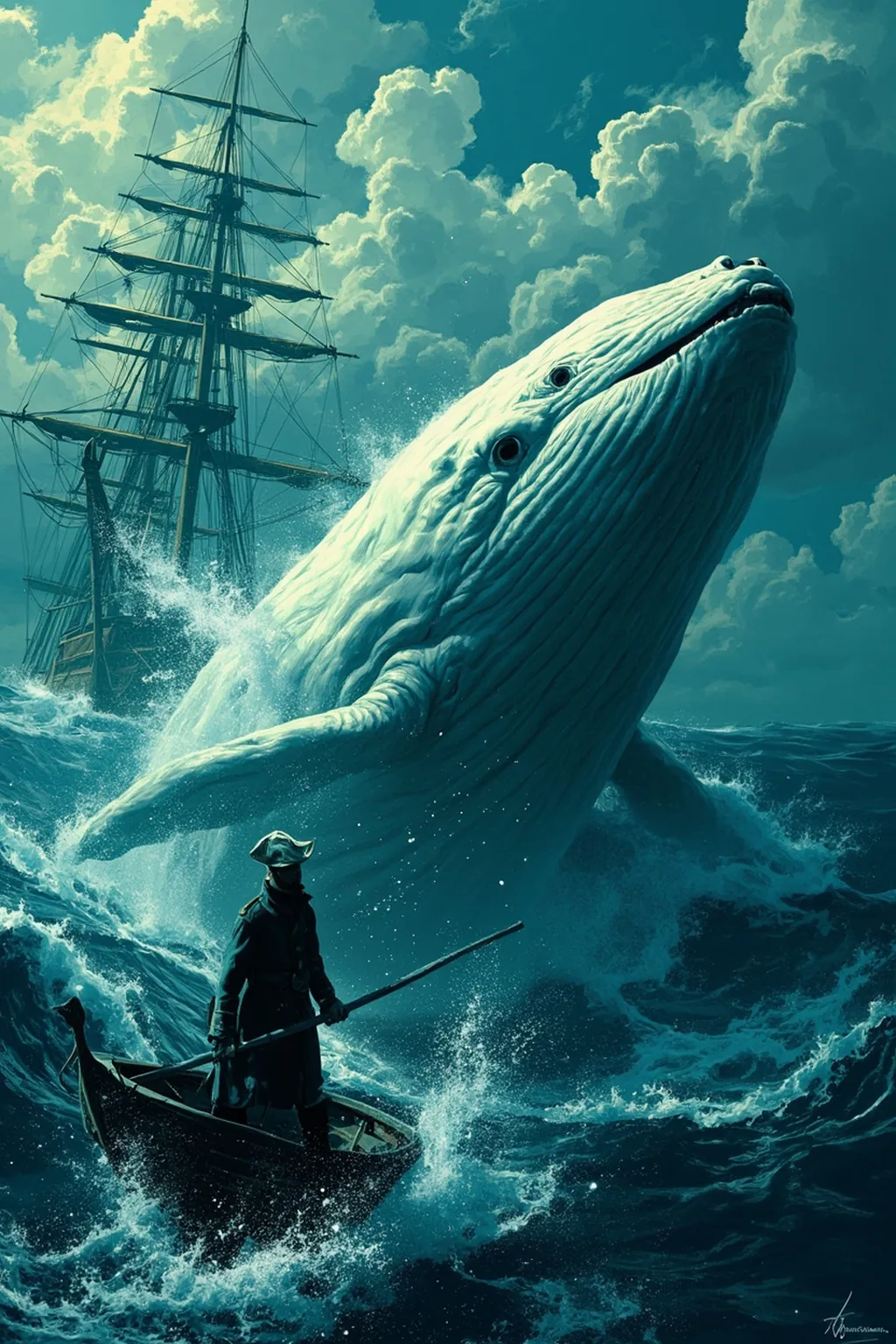
The Vengeful Ghost
Though desecrated, the whale’s corpse generates a “vengeful ghost” that haunts maritime navigation. Distant ships mistake the white mass floating in sunlight for dangerous shoals or rocks, and captains dutifully record these phantom hazards in their logs. Ships then avoid these places for years afterward, leaping over them like sheep following their leader over a stick—a metaphor for how superstitions and false precedents perpetuate themselves without rational foundation.
Ghosts and Belief
The chapter ends by asking directly whether the reader believes in ghosts, challenging the assumption that only the credulous accept such spirits. Melville notes that there are ghosts beyond the famous Cock-Lane apparition, and that men deeper and more skeptical than Dr. Johnson have believed in them.
第七十章 The Sphynx.
After the sperm whale is decapitated, its massive head—comprising nearly one-third of the entire bulk of the leviathan—is hoisted against the ship’s side, hanging there like the severed head of Holofernes from Judith’s girdle. In the eerie stillness of noon, with the sea transformed into a calm like a universal yellow lotus, Ahab emerges alone to confront this hooded, blood-dripping head, which he compares to the Sphynx standing in the desert, and addresses it as a being that has witnessed all the mysteries and tragedies of the oceanic depths, from drowned hopes and rusted navies to murdered mates and parted lovers. Ahab demands the secrets of the deep from this silent witness, lamenting that though it has seen enough to shake faith itself, not one syllable emerges from its mute depths, until the cry of “Sail ho!” from the main-mast-head shatters both the deadly calm and Ahab’s solitary communion with the drowned world’s secrets.
The original text of this work is in the public domain. This page focuses on a guided summary article, reading notes, selected quotes, and visual learning materials for educational purposes.