The Skull Deformity
When Bunger mentions a dent in his skull, he reveals a bowl-like cavity with no scar tissue, indicating it was a congenital condition rather than an injury. Captain Boomer explains that Bunger was born with it,调侃ing the surgeon as “a solemn rogue” who “ought to die in pickle” and should be “preserved to future ages.” This exchange reveals the casual camaraderie among whalemen who have shared years at sea together.
Ahab’s Obsession
As the conversation turns to Moby Dick, Ahab’s intensity becomes increasingly evident. When Bunger suggests the whale’s malicious attacks are actually awkwardness rather than intent, Ahab’s blood runs hot, his pulse making the ship’s planks beat. Bunger observes that Ahab’s blood is “at the boiling point” and approaches with a lancet, but Ahab violently pushes him away. The contrast between Boomer’s contentment with his loss and Ahab’s consuming obsession becomes starkly apparent.
Departure
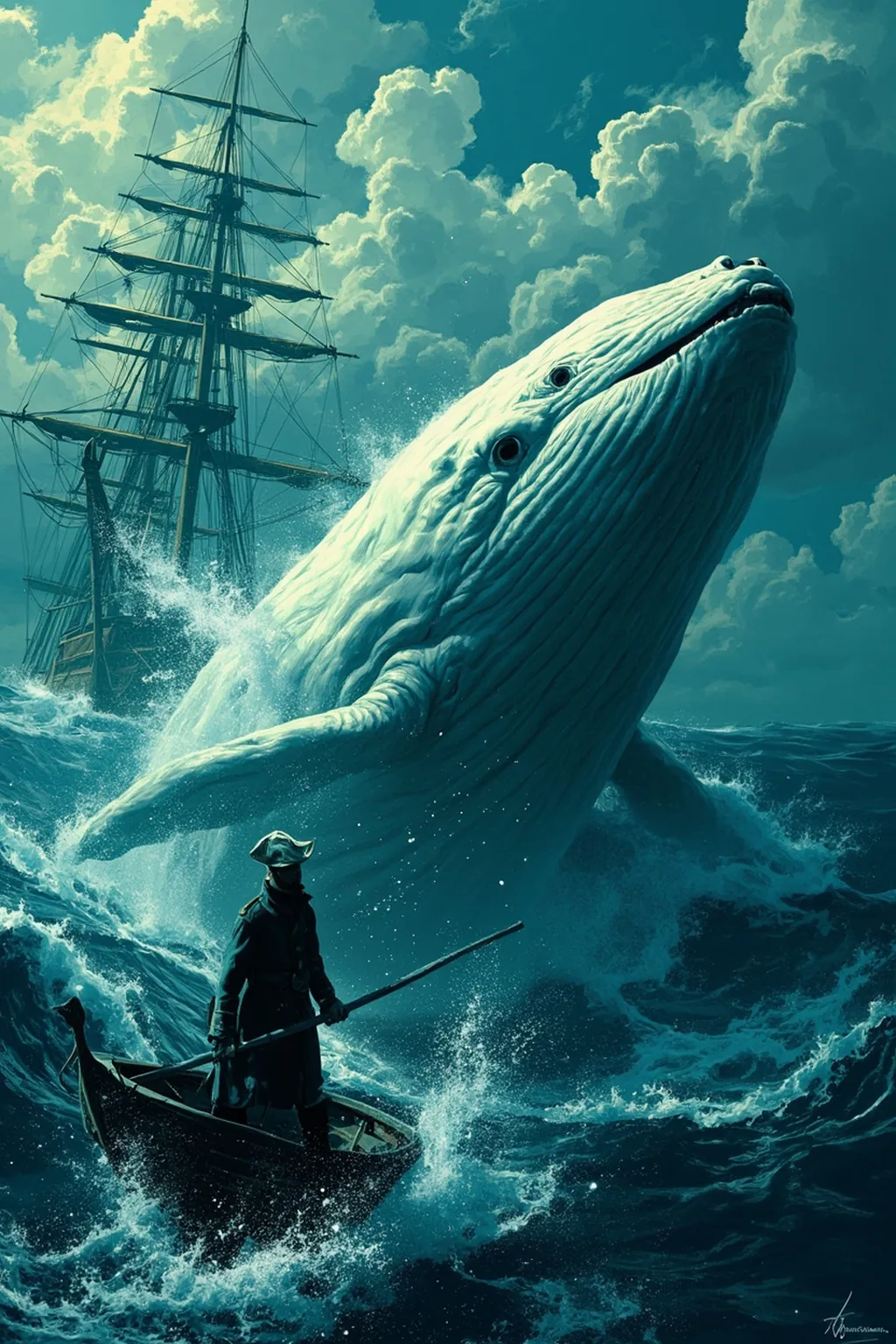
When Ahab learns the White Whale was heading east, he immediately departs. Ignoring the English captain’s hails and his own men, Ahab swings the cutting-tackle toward Fedallah and commands the ship to stand by to lower. In a moment, he stands in the boat’s stern while the Manilla men spring to their oars. With his back to the stranger ship and face set like flint toward his own vessel, Ahab returns to the Pequod, abandoning further conversation for the hunt.
第一百零一章 The Decanter.
The chapter opens with an account of the Samuel Enderby, an English whaling ship named for the merchant whose family house, Enderby & Sons, played a pioneering role in the development of the sperm whale fishery, fitting out vessels as early as 1775 and sending the Amelia around Cape Horn in 1778 to open the vast South Sea grounds. The narrator recounts a memorable visit aboard the ship off the Patagonian coast, describing the hearty provisions of beef and dumplings, the consumption of vast quantities of flip, and a lively encounter that highlights the celebrated hospitality of English whalers. This hospitality is traced back to Dutch whaling traditions, exemplified by a detailed inventory of provisions for a fleet of 180 Dutch whalers that included hundreds of thousands of pounds of beef and biscuit alongside thousands of barrels of beer and ankers of gin, suggesting that the tradition of abundant good cheer on whaling ships derived from Dutch practices and survived in the English fishery to the narrator’s time, concluding with the punning reference to the decanter’s emptying.
The original text of this work is in the public domain. This page focuses on a guided summary article, reading notes, selected quotes, and visual learning materials for educational purposes.