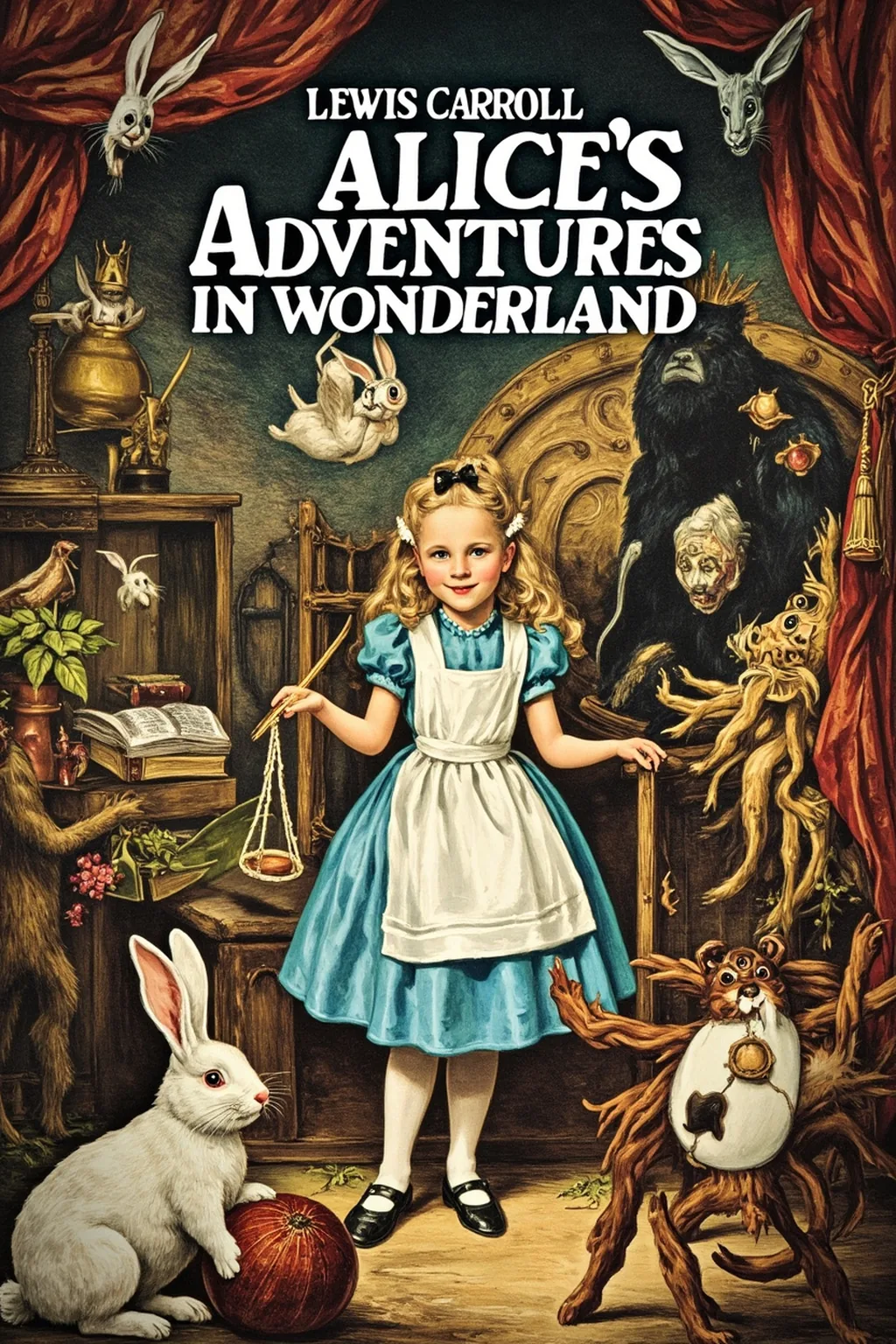
Study Guide: Alice’s Adventures in Wonderland
Introduction: The Logic of Nonsense
Lewis Carroll’s Alice’s Adventures in Wonderland is often mistaken for a chaotic collection of random events, but a closer reading reveals a tightly structured narrative governed by a rigorous internal logic—the logic of nonsense. The book is not merely a fantasy; it is a satire of the rigid Victorian education system, the absurdity of adult social conventions, and the anxiety of a child navigating a world where rules constantly shift. This study guide explores the major movements of the novel, examining how Alice’s physical transformations mirror her psychological development and how the “dream” structure serves as a vehicle for social critique.
Part I: The Descent and the Crisis of Identity
The narrative begins with a rejection of the mundane. Alice’s boredom on the riverbank represents the stifling nature of a reality devoid of “pictures or conversation.” Her pursuit of the White Rabbit is an act of agency, a plunge from the ordered world of Victorian childhood into the subconscious.
The Hall of Doors and the Fluid Self The early chapters establish the primary tension of the book: the struggle for physical and mental stability in a world of flux. The Hall of Doors, with its locked portals and consumables marked “DRINK ME” and “EAT ME,” introduces the theme of perspective. Alice’s inability to fit through the door into the beautiful garden symbolizes the child’s frustration with a world designed for adults.
This section triggers Alice’s first major identity crisis. As she oscillates between giant and midget, she questions who she is: “I’m sure I’m not Ada… for her hair goes in such long ringlets, and mine doesn’t go in ringlets at all.” Here, Carroll links physical size to knowledge and selfhood. When Alice shrinks, she fears she has lost her intellect (forgetting her lessons); when she grows, she becomes physically unwieldy. The “Pool of Tears” is a direct consequence of this instability—Alice’s emotional distress creates the very environment she must navigate.
The Caucus-Race and Social Satire The “Caucus-Race and a Long Tale” introduces the political dimension of Wonderland. The Dodo’s solution to getting dry—a race with no start, no finish, and everyone winning—parodies the inefficiency of political processes where everyone is a winner, and consequently, no one achieves anything. The prize-giving ceremony, where Alice gives her own thimble back to herself, highlights the circularity and futility of social rituals.
Part II: Domestic Intrusion and Philosophical Confrontation
As Alice moves deeper into Wonderland, the settings shift from open landscapes to domestic interiors, mirroring Alice’s approach to adult society.
The Rabbit’s House In “The Rabbit Sends in a Little Bill,” Alice invades the domestic sphere of the White Rabbit. Mistaken for the maid Mary Ann, Alice is thrust into a role of servitude. Her massive growth inside the house represents the awkwardness of the child trying to inhabit adult responsibilities. The conflict with Bill the Lizard and the animals throwing pebbles (which become cakes) reinforces the theme of danger in transformation: food is never just sustenance; it is a tool for alteration.
The Caterpillar and the Self The encounter with the Caterpillar is the philosophical core of the early narrative. The Caterpillar’s cryptic question—“Who are you?”—forces Alice to articulate an identity that is currently in flux. The Caterpillar represents the lethargic, drug-induced wisdom of the adult world; he is unhelpful, condescending, and contemptuous of Alice’s confusion. His advice regarding the mushroom gives Alice the tool to control her size, marking a shift from passive victimhood to active manipulation of her environment. She learns to navigate the world by balancing opposing forces (the two sides of the mushroom), a metaphor for finding balance in a contradictory world.
Part III: The Tyranny of Rules
The third movement of the book introduces the highest authority figures in Wonderland: the Duchess and the Queen of Hearts. Here, the absurdity escalates from physical puzzles to social and legal tyranny.
The Duchess and Morality In “Pig and Pepper,” the Duchess’s kitchen is a scene of sensory overload and violence. The Duchess’s incessant moralizing (“Everything’s got a moral, if only you can find it”) satirizes the Victorian tendency to force didactic lessons onto every aspect of life. The transformation of the baby into a pig suggests that when adults try to force nature (or children) into unnatural shapes, the result is monstrous. The Cheshire Cat, who appears here, serves as a guide to the madness, explaining that “we’re all mad here,” thus validating Alice’s confusion.
The Mad Tea-Party The tea party is a masterclass in the violation of social norms. Time is literally a person (the Hatter’s friend) who has stopped, creating an eternal tea-time (6 PM). The Hatter, March Hare, and Dormouse represent the sterility of intellectual discourse when divorced from meaning. The riddle (“Why is a raven like a writing-desk?”) has no answer, mocking the human desire for knowledge where none exists. Alice’s eventual departure—disgusted by the rudeness and nonsense—marks her growing maturity; she is no longer content to be a passive victim of their bad manners.
The Queen’s Croquet-Ground The Queen of Hearts represents the ultimate adult authority: capricious, violent, and irrational. Her solution to every problem is “Off with his head!” The croquet game is a nightmare version of a sport, where the equipment (flamingos and hedgehogs) is alive and uncooperative. This scene illustrates the chaos that ensues when rigid rules are applied to a living, breathing world. Alice’s survival here depends not on skill, but on her ability to remain unnoticed and to quietly subvert the Queen’s orders (such as hiding the gardeners).
Part IV: The Mock Turtle and the Education System
Before the trial, Alice is subjected to the “Mock Turtle’s Story.” This section is a direct critique of the Victorian educational system. The Mock Turtle’s schooling—under the titles “Reeling and Writhing” and “Arithmetic” (Ambition, Distraction, Uglification, and Derision)—uses puns to expose the pain and absurdity of rote learning. The “Lobster Quadrille” further mocks the rigid structures of dance and art. Alice is forced to recite “’Tis the Voice of the Lobster,” a mangled version of a moralistic poem by Isaac Watts, signifying her rejection of the didactic poetry she was taught in the real world.
Part V: The Trial and the Rebellion
The climax of the novel takes place in the courtroom, where the legal system—a pillar of adult civilization—is revealed to be a complete farce.
The Courtroom Farce The trial of the Knave of Hearts for stealing tarts is devoid of logic. The King and Queen act as judge and jury, prioritizing their own whims over evidence. The rule “Rule Forty-two” (“All persons more than a mile high to leave the court”) is an invention of the moment, showing how authority figures make up rules to maintain power.
Alice’s Awakening The turning point occurs when Alice begins to grow. Throughout the book, her size changes have been dictated by external items (cake, mushroom, pebbles). Now, she grows spontaneously, symbolizing her internal maturation and the return of her confidence. When the King demands she leave, she refuses. When the Queen screams “Off with her head!”, Alice retorts, “Who cares for you? You’re nothing but a pack of cards!”
This moment is crucial. Alice realizes that the terrifying figures of authority have no power over her that she does not grant them. By recognizing them as “cards,” she sees through the illusion of the dream. The physical attack of the cards triggers her awakening, but the psychological victory has already been won.
Conclusion: The Return to Reality
The ending of the novel serves as a bridge between the dream world and reality. Alice wakes on the riverbank, the “pack of cards” transformed into dead leaves. However, the experience has changed her. Her sister’s final meditation on Alice’s “simple, loving heart” suggests that the ability to dream, to imagine, and to question the absurdity of the world is the essence of childhood.
Key Interpretive Stakes
- Identity as Fluid: Alice’s journey suggests that identity is not fixed but is constantly negotiated through interaction with the environment and others.
- The Failure of Language: Throughout the book, language fails to communicate (the Mouse’s tale, the Hatter’s riddle, the trial’s evidence). Carroll highlights the gap between words and meaning.
- Critique of Authority: Adulthood is depicted as a series of arbitrary rules and violent punishments. Alice’s growth is defined by her ability to politely but firmly resist this nonsense.
By understanding these tensions, the reader moves beyond the whimsy of the story to see it as a profound commentary on the difficulty of growing up.