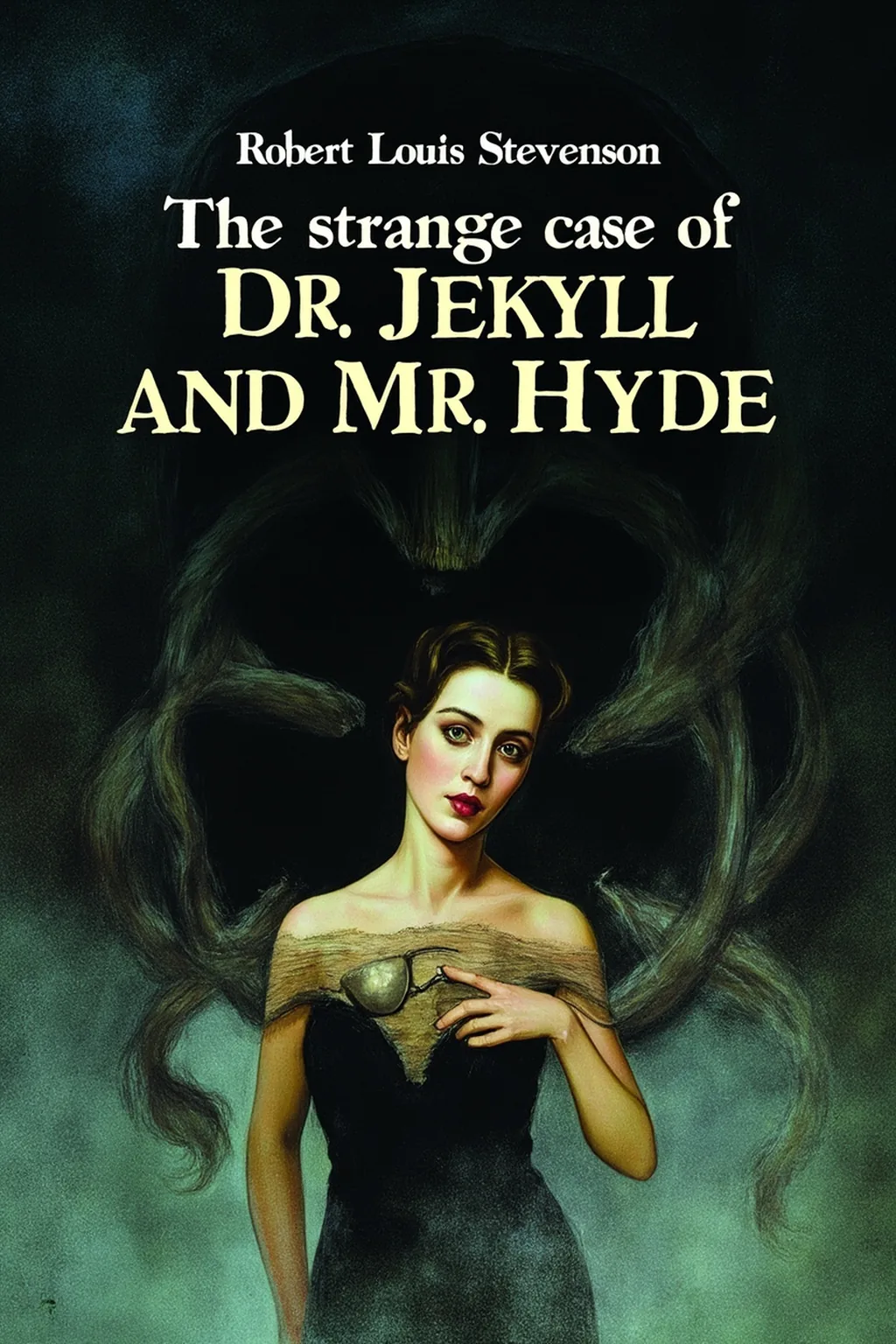
When Mr. Utterson, a London solicitor, learns that his old friend Dr. Jekyll has secretly bequeathed everything to the detestable Mr. Hyde, he embarks on an investigation that leads from fog-shrouded doorways to murder and finally to a terrible revelation: Jekyll has been chemically transforming himself into his own darker counterpart, only to find that Hyde grows stronger with each emergence while the drug that sustains him slowly fails. The consequences of playing God with one's own soul unfold with relentless inevitability toward a conclusion where neither self survives intact.
Mr. Utterson, a lawyer of rugged countenance and reserved habits, walks the streets of London on a Sunday with his distant kinsman, Mr. Enfield. Though the men share little conversation, they value these weekly rambles above all other engagements, often resisting the calls of business to enjoy them uninterrupted. During one such walk, a prosperous neighborhood with freshly painted shutters and well-polished brasses draws their attention to a sinister, blistered door that stands out amidst the general cleanliness for its air of prolonged sordid negligence. Enfield relates a disturbing tale connected to this door, recounting how he witnessed a small, detestable man trample a young girl in the dark morning hours. The figure, who moved with a hellish lack of humanity like a damned Juggernaut, was collared by Enfield and confronted by the child’s angry family and their doctor. Although the victim suffered no serious physical injury, the gathered crowd felt a collective, murderous loathing for the assailant. To avoid a scandal, the man agreed to pay compensation, leading the group to the ominous door. Producing a key, he entered and returned with a cheque signed by a reputable gentleman and ten pounds in gold. The next day, the cheque proved genuine, suggesting a blackmail arrangement where a man of high standing was paying for the misdeeds of this monster, whom Enfield identifies as Mr. Hyde.
Enfield explains the mystery of the building, which he calls he calls Black Mail House. He notes it seems scarcely a house with no other door and no traffic save for the gentleman of the adventure. He observes three clean but always shut windows on the first floor and a smoking chimney that suggests an occupant, though the buildings are so packed together that the structure’s boundaries are indistinct. Utterson is deeply troubled by the story, particularly the description of Hyde, who inspires a vague but powerful sense of deformity and hatred that no one can quite specify. The lawyer realizes that he knows the identity of the man who signed the cheque, and he confirms that Hyde possesses a key to the sinister door. This revelation connects the detestable stranger to the residence of Utterson’s friend, Dr. Jekyll. Disturbed by this connection, Utterson returns home and retrieves Dr. Jekyll’s will from his safe. The document reveals a troubling clause: in the event of Dr. Jekyll’s death or unexplained absence exceeding three months, all possessions are to pass to Edward Hyde. What was once merely a legal curiosity now transforms into a source of fear and potential disgrace in Utterson’s eyes. Abandoning his rest, the lawyer dons his greatcoat and sets out into the night to visit Dr. Lanyon, hoping to find an explanation for his friend’s association with such a fiend.
Determined to find answers, Utterson visited his old friend Dr. Lanyon, but left the visit with more questions than he had arrived with. Returning home, he found no rest and instead took to the streets to watch for Hyde himself.
Mr. Utterson calls upon Dr. Lanyon, seeking intelligence about the mysterious Hyde and the troubling will that would leave everything to such a man. The visit yields little. Lanyon, a robust and genial man with prematurely white hair, greets his old friend warmly, but has not seen Jekyll in a decade. The rupture came over Jekyll’s drift into what Lanyon dismisses as fanciful nonsense—unscientific notions that would have divided the closest of friends. When Utterson inquires about a protégé named Hyde, Lanyon has never heard the name. The lawyer returns home burdened only by fresh questions.
That night, Utterson lies awake until dawn, his mind besieged. What had been an intellectual puzzle now enslaves his imagination. Visions unroll before him: lamplit streets, a running child, a brutal figure that strikes her down and passes on. He sees his friend Henry Jekyll asleep in a fine house, smiling at pleasant dreams—until the bed-curtains are torn open and a figure with power over him appears at the bedside, compelling obedience even at that dead hour. Through every dream the figure pursues him, faceless, melting away whenever he tries to see it clearly. An obsessive need takes root: he must look upon the real Mr. Hyde’s features.
From then on, Utterson keeps watch over the sinister door. Morning, noon, and night, through fog and lamplight, he haunts the by-street. At last, on a crisp evening when frost hangs in the air and the shops stand shuttered, he hears a light, quick step approaching. A small, plainly dressed man comes down the street, key in hand, making straight for the door. Utterson steps from the shadows and touches his shoulder, asking if he is Mr. Hyde.
The man recoils with a sharp hiss of alarm, but quickly masters himself. He answers coolly, refusing to meet Utterson’s gaze. The lawyer introduces himself as Jekyll’s old friend and asks to be admitted. Hyde refuses—Jekyll is away—then demands to know how Utterson recognized him. Utterson deflects and asks instead to see the man’s face. After a moment’s hesitation, Hyde turns with a defiant air and lets the lawyer study his features. Utterson now has what he came for. Hyde gives an address in Soho, then laughs savagely and slips through the door.
Left alone in the silent street, Utterson stands shaken. Hyde appeared pale and stunted, radiating some quality of distortion though no specific deformity could be named. He had carried himself with a strange compound of fear and aggression. Yet none of this explained the profound revulsion the lawyer felt—a loathing that seemed to rise from somewhere deeper than the senses. Utterson tells himself that if ever a face bore the mark of evil, it is this one.
He goes directly to Jekyll’s residence. The butler, Poole, informs him that the doctor is out, but confirms that Hyde possesses his own key and that the entire household has been ordered to obey him. Utterson walks home through the dark streets, his suspicions hardening into dread. Hyde must be blackmailing Jekyll over some buried transgression, and the creature’s eagerness to inherit may put his friend’s life in danger.
A fortnight later, Utterson remains behind after one of Jekyll’s agreeable dinners. The doctor sits across from him by the fire—a large, smooth-faced man of fifty, his expression marked by intelligence and warmth. But when Utterson raises the will and mentions that he has been making inquiries about Hyde, Jekyll’s countenance changes. The color drains from his face; a darkness gathers around his eyes. He refuses to discuss the matter further. His situation, he insists, is strange and painful, beyond remedy by conversation. Utterson offers his absolute discretion and help, but Jekyll will say no more.
Despite Jekyll’s refusal to discuss the matter further, Utterson continued to worry about the troubling connection between Jekyll and Hyde. Nearly a year later, the situation took a deadly turn when Hyde committed the murder of Sir Danvers Carew.
Dr. Jekyll attempts to reassure Mr. Utterson regarding the dangerous Mr. Hyde, claiming the situation is private and not as dire as the lawyer fears. He asserts with confidence that he possesses the absolute power to be rid of Hyde the moment he chooses, urging Utterson to let the matter sleep. Despite this display of control, Jekyll extracts a solemn promise from Utterson to secure Hyde’s rights and inheritance should Jekyll die, revealing a strange, protective compulsion toward the man he claims to dismiss. Utterson reluctantly agrees to this request, though he cannot feign any affection for Hyde and leaves with a heavy sense of foreboding.
Nearly a year passes, but the fragile calm is shattered when Hyde commits a savage, public murder. A maid servant witnesses the encounter from her window under the bright light of a full moon. She observes an aged and beautiful gentleman, Sir Danvers Carew, stop to accost a small man she recognizes as Mr. Hyde. Carew speaks with a pretty, old-world politeness, but without provocation, Hyde flies into an ape-like fury. He clubs the older man to the ground and tramples him with such brutality that the bones are audibly shattered. The murder weapon, a heavy cane of rare and tough wood, breaks under the assault, leaving half behind while the killer flees into the night.
Utterson is summoned to the police station and immediately identifies the victim as the highly respected Sir Danvers Carew. Upon seeing the broken stick, he recognizes it as a gift he once presented to Henry Jekyll. Realizing the gravity of the situation, Utterson leads Inspector Newcomen through the foggy, nightmare streets of Soho to Hyde’s residence. They navigate a district that seems lifted from a bad dream, arriving at a dingy building that houses the wealthy fugitive. Inside, they find the luxurious rooms in disarray, with drawers ransacked and a pile of grey ashes in the grate where papers have been burned. The discovery of the remaining half of the murder weapon and the remnants of a cheque book confirms Hyde’s hurried flight and his criminality.
Later that afternoon, Utterson visits Dr. Jekyll in his laboratory to discuss the catastrophe. Jekyll appears deathly sick and swears he is done with Hyde forever, claiming the fugitive is safe and will never be heard from again. He produces a letter from Hyde stating he has escaped and that Jekyll need not worry. Jekyll claims the note was handed in by a messenger, though he admits he burned the envelope. Utterson is initially relieved by the letter, which seems to exonerate Jekyll, but his suspicions are revived when he questions the butler, Poole, on his way out. Poole denies that any messenger arrived at the house that day—only circulars came by post. The contradiction chills Utterson: if no messenger came and the letter bore no postmark, it could not have been delivered from outside. The letter must have been written within the house itself. Jekyll, not Hyde, may have forged it, and Utterson is left with the unsettling suspicion that his friend is concealing something far darker than he has admitted.
With Utterson’s suspicions now thoroughly awakened by the damning absence of any messenger and the letter that must have been written from within Jekyll’s own chambers, the narrative pauses to examine the evidence more closely. The solicitor’s next step—consulting his clerk Mr. Guest, a skilled graphologist—represents a natural progression of his investigation, transforming suspicion into something approaching certainty. Yet even as Guest confirms what Utterson already fears, the immediate crisis appears to have passed; Hyde has vanished, Jekyll reemerges into society, and a fragile peace descends upon the house in the square. This deceptive calm, however, proves short-lived. The doctor’s retreat into isolation, Dr. Lanyon’s mysterious decline, and that final haunting glimpse through Jekyll’s window hint that whatever darkness was temporarily banished has merely retreated—not been defeated. The narrative thus shifts from the external pursuit of Hyde to the internal deterioration of Jekyll himself, setting the stage for the tragic unraveling to come.
Utterson, deeply troubled by the murder of Sir Danvers Carew and the mysterious letter purportedly from Hyde, seeks the counsel of his head clerk, Mr. Guest. Sharing a rare bottle of old wine by the fire, Utterson shows Guest the letter, knowing the clerk is an expert in handwriting. When a servant enters with an invitation to dinner from Dr. Jekyll, Guest instinctively compares the two documents. He reveals a singular resemblance between the scripts, noting they are identical in many points and only differently sloped. The implication chills Utterson to the bone: Henry Jekyll has forged a letter for a murderer. He locks the note away, horrified by the realization that his friend is protecting Hyde.
Following Hyde’s disappearance, Dr. Jekyll enjoys a period of renewed social engagement and religious devotion, appearing restored to his old self for two months. However, this peace shatters abruptly. Jekyll suddenly refuses visitors, retreating into seclusion, while his old friend Dr. Lanyon falls into a swift and terrifying physical decline. When Utterson visits Lanyon, he finds a man ruined in body and mind, bearing a look of deep-seated terror. Lanyon speaks of a shock from which he will never recover and vehemently refuses to hear Jekyll’s name, regarding him as effectively dead. Utterson writes to Jekyll for an explanation and receives a pathetic, darkly mysterious reply. Jekyll confesses that the breach with Lanyon is incurable and declares his intention to lead a life of extreme seclusion to endure a nameless punishment and danger.
Within a fortnight, Lanyon is dead. After the funeral, Utterson opens a sealed envelope left by his friend. Inside is another enclosure, strictly marked not to be opened until the death or disappearance of Dr. Henry Jekyll. Though consumed by curiosity, Utterson honors his professional obligation and his dead friend’s instructions, locking the packet away in his safe. His subsequent attempts to visit Jekyll grow less frequent, partly relieved by the butler Poole’s reports that the doctor remains morose, silent, and confined to his cabinet over the laboratory.
Weeks later, while walking with Enfield, Utterson stops by Jekyll’s deserted court and persuades his companion to look at the windows. They spot Dr. Jekyll sitting by the open window, looking like a disconsolate prisoner. Jekyll speaks with them sadly, confessing he is very low and daring not to join them outside. For a moment, he smiles, but the expression is instantly obliterated by one of abject terror and despair. He slams the window shut, leaving Utterson and Enfield horrified and pale as they flee the scene in silence, whispering prayers for forgiveness.
That evening, Poole arrives at Utterson’s house in a state of panic. The butler confesses that he has been afraid for a week and can bear the situation no longer, declaring plainly that something is terribly wrong with the doctor.
After hearing Poole’s alarming confession, Utterson agrees to accompany the butler to Jekyll’s house to investigate the source of his master’s mysterious seclusion. Together they make their way through the fog-shrouded streets to Jekyll’s residence, where the door and the servants’ quarters present an unsettling picture of isolation and unease. Upon reaching the house, they find the atmosphere heavy with dread as the servants whisper among themselves, confirming their shared suspicion that something is terribly amiss with the doctor. The tension reaches its peak as Poole prepares to carry out what he believes to be the unthinkable—a final attempt to break down the laboratory door where Jekyll has confined himself, convinced that foul play has befallen his master.
Poole arrives at Utterson’s house in a state of visible terror, leaving his wine untasted to declare that he can bear the situation no longer and suspects foul play. Utterson, observing the butler’s extreme distress and the moisture of anguish on his brow, agrees to accompany him back to the doctor’s house. They traverse a wild, cold, and deserted London night, with Utterson feeling a crushing anticipation of calamity as the wind sweeps the streets bare of passengers. Upon arrival, they find the servants huddled in the hall like frightened sheep, and the housemaid breaks into hysterical whimpering at the sight of the lawyer.
Poole leads Utterson through the back garden to the laboratory and cautiously knocks on the red baize cabinet door. A voice from within complains that it cannot see anyone. Poole asserts that this altered voice is not his master’s and claims Jekyll was made away with eight days ago when he cried out upon the name of God. To prove his suspicion, Poole reveals that the occupant has been frantically ordering a specific chemical, writing notes that complain of impure samples and beg for the old batch. He recounts seeing a masked figure digging among the crates who fled like a rat at the sight of him. Poole insists the figure was a dwarf, not the tall Dr. Jekyll. As they discuss the intruder, Utterson asks if Poole recognized the masked figure. The butler confirms that while the sight was brief, the creature’s size and quick, light movements matched Mr. Hyde perfectly. Poole reminds Utterson of the chilling, cold nature of Hyde’s presence, a feeling that struck him like ice when the figure jumped up. Utterson, recalling his own encounter with the man, agrees that the description fits and concludes that Hyde is indeed the one hiding in the cabinet.
Convinced that Jekyll has been murdered and that Hyde is lurking within, Utterson resolves to break in, despite the lack of legal proof. He and Poole arm themselves with an axe and a kitchen poker, acknowledging the peril they face, and post servants at the laboratory door to prevent escape. Waiting in the theatre, they hear the occupant pacing with a strange, light step unlike Jekyll’s heavy tread. Poole whispers that he once heard the creature weeping like a woman or a lost soul. When the ten minutes have passed, they approach the door. Utterson demands entry, warning that he will see Jekyll by fair means or foul. A terrified voice pleads for mercy in the name of God, but Utterson recognizes it as Hyde’s. He orders Poole to attack. The butler swings the axe, and after several blows that shake the building and elicit a screech of animal terror, the lock finally bursts and the wreck of the door falls inward.
The door, violently wrenched from its frame, fell inward, and the besiegers, expecting violence, instead encountered only silence and a scene of domesticity—a fire burning, a kettle singing, tea things laid as if for a visitor who would never arrive. Yet their momentary relief gave way to horror as they discovered Hyde’s body crumpled upon the floor, his features contorted in a final grimace of agony, a half-empty vial of poison beside him. Jekyll was nowhere to be found within the cabinet, and their search would soon reveal what horrors the room truly held.
The besiegers fell back from the door they had forced, startled by the silence that followed their violence. The cabinet before them seemed impossibly domestic—fire crackling on the hearth, kettle singing, tea things arranged beside an easy chair, papers stacked neatly on the desk. Only the glazed presses of chemicals suggested anything unusual.
Then they saw the body. It lay contorted in the center of the room, still twitching with fading life. They turned it over and found Edward Hyde’s face, his frame swallowed by clothes that belonged to a larger man. The crushed glass in his hand and the bitter-almond smell told the story: poison, self-administered. Utterson pronounced them too late for either rescue or retribution.
The search for Jekyll proved fruitless. The theatre, the corridor, the dark closets, the cellar—all empty. Dust fell from closet doors that had stood unopened for months; cobwebs sealed the cellar entrance. Poole stamped the floor, convinced his master lay buried beneath the stones. But Utterson found the street door locked, its key lying nearby—snapped in two and already rusted at the breaks. Neither man could explain how anyone had entered or departed.
They returned to examine the cabinet more closely. White salt measured on glass saucers suggested chemical work interrupted mid-experiment—the same substance Poole had delivered countless times. By the fire lay a religious text Jekyll had once prized, its margins now scrawled with blasphemies in his own hand. A cheval-glass had been turned to face the wall, as though whatever it had reflected was too terrible to witness. Utterson found himself asking what Jekyll—not Hyde—could have wanted with such an object.
On the desk sat an envelope addressed to Utterson. Inside lay three documents: a will replacing Hyde’s name with his own, a note dated that very morning, and a sealed packet with instructions to read Dr. Lanyon’s narrative before opening the final confession. That Hyde, in possession for days and hostile to Utterson, had left the will untouched seemed inexplicable. The dated note proved Jekyll alive hours earlier—had he fled, or worse? Utterson pocketed the papers, determined to protect his friend’s reputation while uncovering the truth.
What followed was Lanyon’s account. Four days earlier, he had received a registered letter from Jekyll—odd, given they had dined together the night before. The contents were stranger still: a desperate plea couched in terms of life, honor, and reason. Jekyll begged Lanyon to force entry to his cabinet, retrieve a specific drawer containing powders and a phial, and deliver it to a messenger arriving at midnight. The terror in every line was unmistakable.
Lanyon suspected madness but felt bound by their old friendship. He drove to Jekyll’s house, supervised the breaking of the cabinet door, and carried the drawer home. Its contents puzzled him: a white crystalline salt, a vial of blood-red liquid sharp with phosphorus, and a notebook recording years of experiments—most marked as failures, a few cryptically labeled “double.” Nothing explained why Jekyll’s sanity depended on these items reaching a midnight stranger.
Lanyon dismissed his servants and armed himself. When the knocker sounded at twelve, he found a small figure huddled against the portico—crouching, glancing fearfully at a passing policeman before slipping inside. In the lamplight, Lanyon saw the visitor clearly: small, with a horrifying expression, combining muscular vigor with constitutional frailty. Then came the physical reaction—a pulse that faltered, a rigour that spread through his limbs, something deeper than aversion. His whole nature recoiled from what stood before him.
Having uncovered Lanyon’s damning account among Jekyll’s papers, Utterson now possessed the final piece of the puzzle—one that would illuminate the horror Lanyon had witnessed and could not survive. The physician’s narrative described, with trembling precision, how Hyde had arrived at his door on that fateful night, frantic and desperate, already measuring out a strange compound from a vial he carried. Lanyon recorded with clinical detachment how he had observed Hyde drinking the substance, and what followed was so shocking to his rational sensibilities that it had driven him to the brink of madness and ultimately to his grave. For in that moment, the hunched and twisted figure of Hyde underwent a most remarkable and terrible metamorphosis, becoming once again the respectable Dr. Jekyll—a transformation so complete yet so fundamentally impossible that Lanyon declared he would never recover from the shock of witnessing it.
The visitor who entered Lanyon’s consulting room wore rich, sober clothes that hung grotesquely from his frame—trousers rolled up, coat descending below his haunches, collar sprawling wide. The effect should have been comic, but Lanyon felt no impulse to laughter. Something fundamentally wrong emanated from the creature, something abnormal and misbegotten that seized the observer with revulsion and curiosity alike.
Hyde’s impatience bordered on hysteria. He demanded the drawer with frantic urgency, his hand clutching his heart, teeth grinding in a convulsive jaw, face ghastly pale. When Lanyon pointed to where it lay, Hyde sprang forward, then paused, struggling to compose himself. He measured the red tincture, added the white powder, and watched the mixture effervesce through red to purple to watery green. Then he turned to Lanyon with an offer.
Would the doctor be wise and let him leave with the glass? Or would curiosity command him to stay and witness something that would blast his sight and stagger the disbelief of Satan? Lanyon, having come too far to turn back, chose to remain.
Hyde raised the glass and drank. A cry tore from him; he reeled, clutched the table, and seemed to swell. His face blackened, his features melted and altered. Lanyon sprang back against the wall, arms raised against the prodigy, screaming to God. Where Hyde had stood, Henry Jekyll now swayed—pale, shaken, half-fainting, groping like a man restored from death.
What Jekyll told him in the next hour, Lanyon could not bring himself to write. His soul sickened; sleep abandoned him; deadly terror sat with him at all hours. He knew he would die soon, shaken to his roots, yet still half-incredulous. One fact alone he would state: the creature who had entered his house that night was Edward Hyde, hunted throughout England as the murderer of Sir Danvers Carew.
Then came Jekyll’s own confession. Born to fortune and endowed with talent, he had seemed guaranteed an honorable future. Yet from early manhood he had concealed his pleasures behind a grave public countenance, creating a profound duplicity. He was no hypocrite—both sides were earnest—but the division between his aspirations and his indulgences cut deeper than in most men.
His scientific studies, tending toward the mystic and transcendental, illuminated this inner war. He concluded that man is not truly one but truly two—perhaps even a “polity of multifarious denizens.” The separation of these elements became his cherished daydream: if each nature could be housed in a separate identity, life would be relieved of all that was unbearable.
Jekyll discovered that certain agents could shake and pluck back the fleshly vestment, as wind tosses curtains. He compounded a drug that could dethrone the ruling nature and substitute another form—one no less natural because it expressed the lower elements of his soul. He hesitated, knowing he risked death, but the temptation of discovery overcame fear.
Late one accursed night, he drank the potion. Grinding pain, deadly nausea, and spiritual horror seized him. Then the agony subsided, and he felt strangely renewed—lighter, younger, filled with a heady recklessness and a solution of the bonds of obligation. He knew himself to be more wicked, and the thought delighted him.
Venturing to his bedroom, he saw Hyde’s face for the first time: smaller, slighter, younger than Jekyll, with evil written broadly upon it. Yet he felt no repugnance—only welcome. This, too, was himself, more “express and single” than his divided former countenance. Hyde, alone among mankind, was pure evil.
The final test awaited. He hurried back to his cabinet, prepared and drank the cup again, suffered once more the pangs of dissolution—and emerged as Henry Jekyll, restored in character, stature, and face. The experiment had succeeded. The door to a double life stood open.
With the experiment now proven successful and the door to this double existence opened, Jekyll’s initial exhilaration at his newfound freedom would soon curdle into something far darker, as the very act of liberation had bound him to a creature of pure selfishness and malice.
Jekyll stood at a fatal crossroads. The drug itself carried no moral weight—it simply unlocked whatever lay caged within. Had he approached his experiment with generous purpose, he might have emerged purified. Instead, his better nature slept while ambition sharpened his darker impulses. Edward Hyde was born—a second self devoted entirely to wickedness, while Jekyll remained the same flawed compound he had always despaired of reforming.
The arrangement entrapped him. His private corruptions chafed against his public dignity; the potion promised release. He prepared with meticulous care—rooms in Soho, a silent housekeeper, servants instructed to grant Hyde full liberty, a will preserving his fortune should anything befall Dr. Jekyll. For the first time, a man could indulge every forbidden impulse while his respectable self remained untouched. Hyde existed nowhere in records; he could dissolve at will, leaving only the upright physician.
But Hyde’s pleasures curdled. The creature Jekyll had summoned proved fundamentally twisted—every thought bent toward self, drinking satisfaction from cruelty, relentless as stone. Jekyll returned from these excursions sickened, yet the strangeness of the arrangement blunted his conscience. Hyde alone was guilty; Jekyll could even make amends for his shadow’s deeds. Moral responsibility dissolved into convenient fiction.
A brutal incident exposed the danger. Hyde’s trampling of a child enraged witnesses; to placate them, he paid with a check signed in Jekyll’s name—a foolish link between identities. Jekyll opened a bank account in Hyde’s name and forged his double’s signature, believing himself now beyond reach.
Then came the morning he woke to find a stranger’s hand upon his bedclothes—lean, corded, hairy, dark. He had gone to sleep as Jekyll and awakened as Hyde. The servants were stirring; the antidote waited in his cabinet. Dressed in clothes that hung loose on Hyde’s smaller frame, he navigated his own house, enduring the butler’s startled stare. Ten minutes later, the transformation reversed. Jekyll sat before breakfast he could not eat, reading the warning: the balance had shifted.
Hyde was gaining strength. Wearing that form, Jekyll felt a fuller tide of blood; the body itself seemed to have grown. More troubling, the difficulty of transformation had migrated: once hard to shed Jekyll’s body, now it grew hard to shed Hyde’s. He was slowly losing his grip on his better self. He faced an impossible choice: remain Jekyll and abandon his secret corruptions, or surrender permanently to Hyde and become universally contemptible—though Hyde would never feel the loss.
He chose the better part. For two months he lived with rigorous self-denial, finding genuine satisfaction in an untroubled conscience. But the sharp edge of fear dulled; routine virtue lost its savor; old cravings stirred. In a moment of weakness, he drank the draught once more.
He had not reckoned with what confinement would do to Hyde’s nature. The suppressed evil erupted with unprecedented violence. A chance encounter with Sir Danvers Carew proved fatal—the old man’s polite greeting triggered a storm of rage. Hyde struck without reason, mauling the unresisting body with savage joy until exhaustion brought a cold wash of terror.
Hyde saw his life forfeit. He fled, destroyed his papers in Soho, compounded the transforming draught. As he drank, he raised his glass to the dead man. Before the change had finished, Jekyll fell to his knees with tears of gratitude and remorse. The self-deception lay in ruins. He saw his life whole—from childhood walks with his father through years of professional labor, all leading to this damned horror.
Yet from remorse emerged strange consolation. News came that Hyde was hunted for the murder of a man high in public esteem. Jekyll found himself glad: the scaffold’s threat now enforced his better nature. Hyde could never emerge again without being destroyed. With genuine resolve, Jekyll locked the cabinet door through which he had passed so often and ground the key beneath his heel.
Jekyll’s precautions proved futile as Hyde’s control over his host began to strengthen, eventually allowing him to emerge without the draught. Desperate to maintain his redemption, Jekyll found the salt for his formula running dangerously low, but new supplies proved entirely useless.
After the murder, Jekyll threw himself into redemption. Months of charitable work brought quiet satisfaction, even happiness. But his divided nature would not rest. As the sharp edge of remorse dulled, something baser stirred—not a desire to resurrect Hyde, but the familiar temptation to compromise with conscience. That small concession proved fatal.
On a bright January morning in Regent’s Park, Jekyll sat warming himself in the sun, congratulating his own active benevolence against the lazy indifference of others. Pride swelled within him. At that instant, nausea and violent trembling seized his body. When the faintness passed, his mind had altered—bold now, contemptuous of consequence, freed from obligation. He stared at his lap: withered limbs, a dark and corded hand. He had become Hyde without the draught, a hunted murderer exposed in daylight.
Hyde’s mind sharpened to the emergency. Home was impossible—servants would deliver him to justice. But he retained one fragment of Jekyll: the handwriting. He found a cab, fought down murderous rage at the driver’s amusement, and reached an inn. There he composed desperate letters to Lanyon and Poole, dispatching them by registered post. Through the day he waited, consumed by dread. At night he rode the streets in a closed carriage, then walked alone through darkened roads—a figure muttering to himself, striking down a woman who approached him.
The transformation at Lanyon’s house returned him to himself. His old friend’s horrified condemnation reached him as if in a dream; the journey home passed in the same fog. He fell into deep sleep, though terrible dreams tormented him, and woke weakened but desperately relieved—safe, near his drugs, the fear of the noose replaced by dread of becoming Hyde again.
The reprieve lasted hours. Crossing his courtyard after breakfast, the warning sensations returned. He barely gained the cabinet before Hyde seized him. A double dose restored Jekyll; six hours later, the change came again. Now began the true torture. Transformations struck at any moment, especially in sleep—he always woke as Hyde. Jekyll condemned himself to sleeplessness, his body and mind wasting away, possessed by fear of his other self.
Hyde grew stronger as Jekyll sickened. Jekyll saw him as something from the pit—formless evil given voice and motion, bound into his flesh more intimately than marriage, struggling to be born at every weakness. Hyde answered with spite: defacing Jekyll’s books, burning correspondence, destroying his father’s portrait. Only terror of death restrained him from ruining them both.
Then the final blow fell. The salt that empowered the draught ran low. New supplies proved useless—the original batch had contained some unknown contaminant essential to the transformation. Without it, no return from Hyde was possible.
Jekyll writes these last words under the influence of his final powder. Within minutes, Hyde will claim him forever. He races to finish, knowing Hyde might destroy these pages if the change catches him writing, but his other self’s narrow focus on the present may preserve them. Whether Hyde dies on the scaffold or by his own hand, Jekyll no longer cares. This is his true death. He sets down the pen and seals his confession, ending the unhappy existence of Henry Jekyll.
The original text of this work is in the public domain. This page focuses on a guided summary article, reading notes, selected quotes, and visual learning materials for educational purposes.