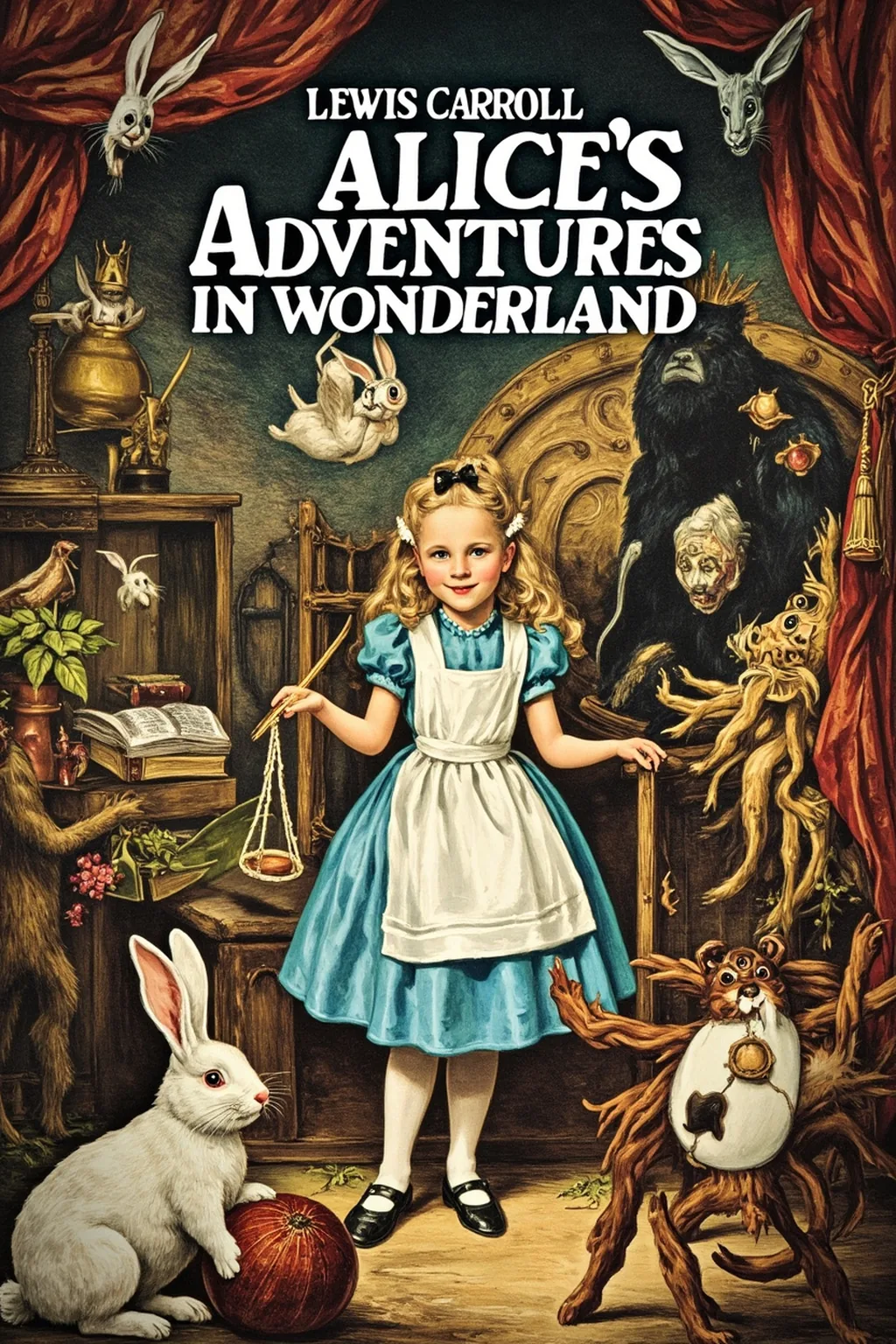
Alice's Adventures in Wonderland cover
Childhood vs. Adulthood

Alice's Adventures in Wonderland

A bored young girl tumbles down a rabbit hole into a chaotic realm of nonsense, navigating a labyrinth of illogical creatures and arbitrary justice before waking from her dream.

Carroll, Lewis 2008 23 min

Chasing a White Rabbit leads Alice into a fantastical world where logic dissolves. She fluctuates wildly in size, encounters rude and eccentric inhabitants, and survives a terrifying royal trial, ultimately realizing the absurdity of the fantasy is nothing more than a pack of cards.

Alice sits idly by the riverbank, growing drowsy and bored by her sister’s book, which lacks pictures or conversation. While considering the effort of making a daisy-chain, she is startled by a White Rabbit with pink eyes. The animal checks a pocket watch and exclaims that it is late, sparking Alice’s burning curiosity. She chases the Rabbit across a field and watches it disappear down a large rabbit-hole. Without considering how she might escape, Alice plunges in after it.

Her fall is slow and dreamlike, giving her ample time to observe the well’s walls, which are lined with cupboards and bookshelves. She takes down an empty jar of orange marmalade and returns it to a shelf. As she descends, she ruminates on her bravery regarding falling, recites geographical lessons, and wonders if she will pass through the earth to the other side. Eventually, she begins to doze off, thinking of her cat Dinah and whether cats eat bats. Just as she starts dreaming of asking Dinah this question, she lands softly on a heap of sticks and dry leaves.

Alice spots the White Rabbit again and hurries down a passage, but loses it in a long, low hall lit by hanging lamps. She finds herself surrounded by locked doors. On a glass table, she discovers a tiny golden key. Although it does not fit any of the main doors, it unlocks a small curtain behind which lies a little door about fifteen inches high. Through this door, she sees a beautiful garden of bright flowers and cool fountains, but she is too large to enter.

Alice returns to the table and finds a bottle marked “DRINK ME.” After checking that it is not poison, she drinks it and shrinks to ten inches high. However, she realizes she has left the key on the table and is now too small to reach it. Overcome by frustration, she sits down and cries. Her tears are interrupted when she discovers a small cake marked “EAT ME” under the table. Hoping it will make her grow large enough to reach the key or small enough to creep under the door, she eats the cake.

With the cake consumed, Alice waited to see what effect it would have. Soon, the effects became impossible to ignore as she began to grow rapidly, soon standing more than nine feet tall.

Alice grows rapidly until she is more than nine feet tall, her neck stretching like a telescope while her feet seem to vanish in the distance. She takes the little golden key and rushes to the garden door, but she is now too large to pass through. Despairing, she sits down and cries gallons of tears until a large pool, four inches deep, surrounds her.

The White Rabbit returns, dressed splendidly and muttering anxiously about the Duchess. Alice desperately asks for help, but the Rabbit drops his gloves and fan in fright and scurries away. Alice picks up the fan and gloves to cool herself, and as she fans herself, she begins to shrink. While shrinking, she questions her identity, fearing she has turned into a different child named Mabel because she can no longer recite her multiplication tables or geography lessons correctly. She realizes the fan is causing her to shrink and drops it just in time to avoid vanishing completely.

Now tiny, she runs with all speed back to the little door, but alas, it is locked and the golden key lies on the glass table far out of reach. Things seem worse than ever, for she has never been so small. Suddenly, she slips and falls into the pool of tears she cried when she was large. As she swims about, she encounters a Mouse. She attempts to converse with it in English and French, but repeatedly offends the rodent by mentioning her cat Dinah and a dog that a farmer says kills rats. The Mouse swims away in anger, but Alice coaxes it back by promising not to speak of cats or dogs.

The pool becomes crowded with various birds and animals that have fallen in, including a Duck, a Dodo, a Lory, and an Eaglet. The Mouse suggests they swim to shore so he can explain his history. Alice leads the way, and the strange party swims together through the water toward the bank.

Having swum to shore with the motley company of birds and beasts, Alice now found herself on dry land once more—but hardly in better circumstances, for she and all her companions were thoroughly soaked, their fur and feathers dripping as they gathered together on the mossy bank. The chill of the water made them shiver, and some began to complain of the discomfort, while others shook themselves vigorously in an attempt to get dry. It was at this awkward moment, with the whole ridiculous assembly standing about in puddles and debating how on earth to warm themselves, that the Dodo proposed what seemed to everyone a most singular solution to their predicament.

The dripping wet party gathers on the bank, arguing uncomfortably about how to get dry. The Mouse, assuming a position of authority, begins reciting a dry history of William the Conqueror, but the narrative is interrupted by the Lory and the Duck with questions and complaints. When Alice notes that she is still wet, the Dodo interrupts to propose a more energetic remedy: a Caucus-race.

The Dodo marks out a circular course where the participants start and stop whenever they like. After running for half an hour, they are dry, and the Dodo abruptly declares the race over. Unable to determine a winner, the Dodo solemnly decrees that everyone has won and demands prizes. Alice produces a box of comfits from her pocket, distributing one to each animal. The Dodo then insists Alice receive a prize as well, and she solemnly accepts her own thimble back from the bird.

Once the comfits are eaten, Alice asks the Mouse to tell his history, whispering to avoid mentioning cats and dogs. The Mouse begins a tale about a Fury and a mouse, but Alice becomes distracted by the shape of the Mouse’s tail, confusing the story with the animal’s anatomy. She offers to undo a “knot” in the tale, which the Mouse finds insulting. The rodent storms off in a huff, while the Lory and a Crab offer unsolicited advice on temper.

Wishing her cat Dinah were present to fetch the Mouse, Alice describes Dinah’s prowess at catching birds and mice to the Lory. This description causes immediate panic among the avian party. The birds hurriedly disperse on various pretexts, leaving Alice alone and melancholy. She weeps with loneliness until she hears pattering footsteps approaching in the distance.

The pattering footsteps belong to the White Rabbit, who mistakes the weeping Alice for his housemaid, Mary Ann, and orders her to fetch his lost fan and gloves from his house nearby.

Alice encounters the White Rabbit again, who is anxiously searching for his lost fan and gloves. Mistaking her for his housemaid, Mary Ann, the Rabbit orders her to fetch the items immediately. Frightened but compliant, Alice runs to the Rabbit’s house and enters without knocking. She finds the fan and gloves in a bedroom, but she also discovers an unlabelled bottle. Hoping to grow large again, she drinks it, but the effect is far stronger than anticipated. Her head strikes the ceiling, forcing her to kneel, and she continues to expand until she must lie down with one elbow against the door and one foot up the chimney, completely filling the room.

Trapped and uncomfortable, Alice muses on the absurdity of her situation, wondering if she will ever grow up or learn lessons in such a confined space. The Rabbit soon arrives, but his attempts to enter are blocked by Alice’s enormous elbow. When he tries the window, Alice snatches at him, causing a crash. The animals outside, led by the Rabbit, resort to sending Bill the Lizard down the chimney. Alice draws her foot up and gives a sharp kick, sending Bill flying back out. The Rabbit then threatens to burn the house down, but Alice retorts that she will set her cat Dinah upon them.

Instead of fire, the animals bombard Alice with a shower of little pebbles that rattle in through the window. Alice notices the pebbles are turning into little cakes. Reasoning that eating one must make her smaller, she swallows a cake and begins to shrink rapidly. Once small enough to fit through the door, she runs out of the house, past the waiting crowd of animals, and escapes into a thick wood.

Alice wanders through the woods, intent on regaining her proper size and finding the lovely garden. Her search is interrupted when a large puppy bounds over her. Alice, fearing she might be eaten, plays with the puppy using a stick, dodging behind a thistle to avoid being trampled. Exhausted by the encounter, she rests against a buttercup and looks around for something to eat or drink to change her size. Spotting a large mushroom her own height, she stretches up on tiptoe to peer over the top. There, she sees a large blue Caterpillar sitting on the mushroom, smoking a long hookah and paying her no attention.

Having observed the silent Caterpillar from afar, Alice stepped closer to the mushroom, and the two regarded each other quietly until the creature finally spoke, demanding to know who she was.

Alice and the Caterpillar regard each other in silence until the insect demands to know who she is. Alice explains that she has changed sizes several times since morning and hardly knows her own identity. The Caterpillar sternly rejects her confusion, insisting that such changes are not queer. When Alice suggests he might feel differently when transforming into a butterfly, he contemptuously asks who she is again. Irritated by his short remarks, Alice demands to know his identity, but he merely tells her to keep her temper.

The Caterpillar then asks Alice to recite a poem. She attempts “You are old, Father William,” but the words come out altered. The Caterpillar condemns the recitation as wrong from beginning to end. Alice expresses a desire to be a little larger, as three inches is a wretched height, but the Caterpillar takes offense, declaring three inches a very good height. He crawls away, remarking that one side of the mushroom will make her grow taller and the other shorter.

Alice breaks off pieces of the mushroom and nibbles one, shrinking so rapidly that her chin strikes her foot. She quickly eats the other piece, which causes her neck to stretch immensely until her shoulders are lost to sight. As she tries to navigate the trees, a Pigeon attacks her, screaming “Serpent!” The Pigeon insists that Alice’s long neck proves she is a serpent looking for eggs. Alice argues that she is a little girl who sometimes eats eggs, but the Pigeon retorts that any egg-eater is a kind of serpent.

Alice crouches among the trees, carefully nibbling the mushroom pieces until she successfully returns to her usual height. She feels strange to be the right size again and focuses on her plan to enter the beautiful garden. She comes upon a little house about four feet high, realizing she must shrink to avoid frightening the inhabitants. Alice nibbles the mushroom until she is nine inches high and then approaches the house.

Having shrunk to nine inches, Alice approaches the little glass house, but before she can reach the garden, she encounters a Fish-Footman and a Frog-Footman outside the door, and after some difficulty gaining entry, she finds herself in the Duchess’s kitchen.

Alice stands before the little house when a Fish-Footman emerges from the wood to deliver a letter to a Frog-Footman. They exchange the Queen’s invitation for croquet with solemn formality, bowing until their curls entangle. Alice laughs at the spectacle, but when she attempts to enter, the Frog-Footman argues that knocking is useless because he is on the same side of the door and the noise inside is too loud. He ignores her questions to stare vacantly at the sky, proving perfectly idiotic. Exasperated by his nonsense, Alice opens the door herself and steps into a kitchen filled with thick smoke and pepper.

Inside, the Duchess nurses a howling baby while the Cook throws pots and crockery at them. The air is so thick with pepper that everyone sneezes violently except the Cook and a grinning Cheshire Cat. Alice tries to converse with the Duchess about grinning cats, but the woman interrupts Alice’s lecture on the earth’s rotation with violent threats and a lullaby about beating children. Suddenly, the Duchess flings the baby at Alice so she can prepare for croquet, and the Cook hurls a frying-pan after her as she departs.

Alice carries the strange, howling baby into the fresh air, fearing for its safety in such a violent environment. As she watches, the child’s features contort; its nose turns into a snout, its eyes shrink, and it begins to grunt. Realizing it has turned into a pig, Alice sets it down, relieved to see it trot away into the woods. She reflects that it makes a rather handsome pig compared to the ugly child it was.

A short distance away, Alice encounters the Cheshire Cat sitting in a tree. The Cat explains that everyone in Wonderland is mad, including Alice herself, using a logical loop involving dogs and his own reversed behavior. When Alice asks for directions, the Cat suggests she visit either the Hatter or the March Hare, noting that they are both mad. The Cat vanishes and reappears, confirming the baby’s fate as a pig, before slowly disappearing again until only its grin remains floating in the air.

Alice proceeds toward the March Hare’s house, which she identifies by its ear-shaped chimneys and thatched fur roof. She nibbles the mushroom to grow to about two feet high, then approaches the house timidly, hoping the Hare will not be raving mad.

She arrived to find the March Hare, the Hatter, and a Dormouse seated at a table beneath a nearby tree, engaged in their perpetual tea party.

Alice approaches a table set out under a tree where the March Hare, the Hatter, and a sleeping Dormouse are having tea. Upon seeing her, the trio shouts that there is no room, despite the large table, forcing Alice to sit in an armchair at the end. The March Hare offers wine that does not exist, then criticizes Alice for sitting without an invitation. When the Hatter rudely comments on her hair, Alice scolds him, only to be met with the unanswerable riddle of why a raven is like a writing-desk. The conversation devolves into a nonsensical debate about the difference between saying what one means and meaning what one says.

The Hatter soon breaks the silence to consult his pocket watch, which he claims is two days wrong because the March Hare put butter in the works. Alice is puzzled to see the watch tells the day but not the time. The Hatter explains that he quarreled with Time itself during a concert for the Queen of Hearts, where he sang a distorted song. Accused of “murdering time,” he is now trapped in a perpetual six o’clock, explaining why the tea-party never ends and they must constantly change seats to find clean cups.

Growing tired of the riddles, the Hatter and March Hare wake the Dormouse to tell a story. The Dormouse recounts a tale of three sisters who live at the bottom of a treacle-well, eating nothing but treacle and consequently falling ill. Alice’s logical questions about the well frustrate the group, and the Dormouse explains the sisters were learning to draw things beginning with M, including “muchness.” When Alice attempts to understand, the Hatter rudely tells her she should not talk. Fed up with the madness, Alice walks off, vowing never to return, while the occupants try to stuff the Dormouse into a teapot.

Wandering through the wood, Alice discovers a door in a tree leading back to the long hall. She takes the golden key from the glass table and unlocks the door to the garden. Using a piece of mushroom she kept in her pocket, she nibbles until she shrinks to about a foot high. Finally the right size, she walks down the passage and steps into the beautiful garden, surrounded by bright flower-beds and cool fountains.

Alice had barely stepped into the garden when she came upon three gardeners nervously painting white roses red, a mistake they clearly dreaded. The Queen of Hearts arrives with a grand procession and invites Alice to play croquet.

Alice enters the garden and discovers three gardeners frantically painting white roses red, arguing anxiously as they work to hide their mistake from the Queen. They fear losing their heads if the mistake is discovered, but a grand procession soon interrupts them. Soldiers shaped like playing cards march in, followed by ornamented courtiers and royal children, culminating in the arrival of the King and Queen of Hearts. The Queen stops and demands to know who Alice is, but Alice stands her ground, realizing they are only a pack of cards. When the Queen notices the gardeners and orders their execution, Alice bravely hides them in a large flower-pot, tricking the soldiers into reporting the deed done.

Invited to play croquet, Alice joins the Queen while the White Rabbit whispers that the Duchess is under sentence of execution for boxing the Queen’s ears. The game proves to be a chaotic impossibility. The mallets are live flamingoes that continually twist their necks to look at Alice with puzzled expressions, the balls are uncooperative hedgehogs that crawl away or unroll, and the arches are soldiers who wander off. There are no rules; everyone plays at once, quarreling violently while the Queen stampedes about shouting “Off with his head!” or “Off with her head!” at anyone who displeases her.

Desperate for a distraction from the dangerous game, Alice welcomes the appearance of the Cheshire Cat. She complains to the Cat about the unfairness of the match and the living equipment, carefully avoiding insulting the Queen when the monarch wanders near. The King approaches, objecting to the Cat’s presence and demanding it be removed. The Cat refuses to kiss the King’s hand, leading the Queen to sentence it to death once again.

A dispute arises as the executioner argues he cannot behead a creature without a body, while the King insists anything with a head can be executed. Alice suggests asking the Duchess, as the Cat belongs to her. The executioner runs off like an arrow to fetch the prisoner, but by the time he returns, the Cheshire Cat has faded away completely, leaving the King and executioner running wildly in search of a vanished victim while the rest of the party returns to the tumultuous game.

With the Cheshire Cat’s grin the last trace of that peculiar conversation to vanish, Alice found herself whisked back into the chaos of the Queen’s croquet game. The game continued with its peculiar rules—flamingoes as mallets, hedgehogs as balls, and soldiers as wickets—everything in perpetual motion and nothing quite making sense. Yet amid this beautiful confusion, a new face emerged from the crowd: the Duchess, who had apparently been released from prison for reasons that remained unclear, though the Queen had demanded her execution before Alice had even finished her mushroom experiments in the previous chapter. This sudden appearance would lead Alice into one of the most memorable encounters of her journey, a meeting with characters so peculiar that even the generally bewildered inhabitants of Wonderland seemed to find them strange. The transition from the vanished cat and the chaotic croquet ground to this unexpected reunion set the stage for another layer of Wonderland’s endless absurdities, where the boundary between danger and friendship remained perpetually blurred.

Alice is relieved to find the Duchess in a pleasant temper, linking arms affectionately, though her sharp chin digs uncomfortably into Alice’s shoulder. The Duchess aggressively forces a moral onto every topic of conversation, from the effects of pepper on temper to the nature of mustard, which she confuses for a bird, a mineral, and a vegetable. When Alice attempts to correct her, the Duchess offers a convoluted moral about appearance and being what one seems. Their philosophical stroll is abruptly cut short when the Queen appears, furiously demanding the Duchess’s execution. The Duchess vanishes instantly, leaving Alice to tremble and follow the Queen back to the croquet ground.

The game has resumed in chaos. The Queen, absent for only a moment, returns to find the guests resting in the shade and immediately orders them back to play under threat of death. She continues her rampage, sentencing players to execution so frequently that the soldiers, acting as both arches and jailers, eventually arrest everyone except Alice, the King, and herself. As the Queen drags Alice away to meet the Mock Turtle, Alice overhears the King quietly pardoning all the prisoners, much to her relief.

They soon encounter a sleeping Gryphon, whom the Queen wakes and orders to escort Alice. Once the Queen leaves to supervise more executions, the Gryphon reveals that her threats are hollow; nobody is ever actually beheaded. They find the Mock Turtle sitting on a rock, sighing deeply, though the Gryphon insists this sorrow is merely fancy. The Turtle begins his history, explaining that he was once a real Turtle who attended school in the sea. He describes a ridiculous curriculum taught by a Tortoise, punning on the word “taught.” The subjects include Reeling, Writhing, and branches of Arithmetic like Ambition, Distraction, Uglification, and Derision. He further lists Mystery, ancient and modern, with Seaography, followed by Drawling, Stretching, and Fainting in Coils taught by an old conger-eel. The Gryphon adds that he studied under a Classics master, an old crab who taught Laughing and Grief. Alice struggles to understand the puns, particularly when the Turtle mentions lessons that “lessen” in duration each day. Just as she asks about the twelfth day, the Gryphon interrupts to demand they hear about the games instead.

The Gryphon’s interruption shifts the conversation from lessons to games, prompting the Mock Turtle to recover from his melancholy and demonstrate the Lobster Quadrille, a peculiar sea-shore dance involving lobsters and a complicated series of figures that the two creatures perform around Alice while

The Mock Turtle recovers from his sobs to describe the Lobster Quadrille, a complex dance performed on the sea-shore involving lobsters, turtles, and seals. He and the Gryphon interrupt each other to explain the figures: forming two lines, clearing away jellyfish, advancing with partners, throwing lobsters out to sea, and somersaulting in the water. Alice agrees to watch a demonstration, and the two creatures solemnly dance around her, often treading on her toes, while the Mock Turtle sings a slow ballad about a whiting inviting a snail to join the dance. The snail refuses because the distance to France is too great, a geographical concept that puzzles Alice.

After the dance, the Gryphon explains that whitings hold their tails in their mouths because they were thrown out to sea during the dance and fell a long way. He further confuses Alice with wordplay, claiming that whitings are used to blacken boots under the sea and that shoes are made of soles and eels. When Alice mentions a porpoise, the Mock Turtle insists that no wise fish would travel without a “porpoise,” punning on the word “purpose,” and grows offended when Alice attempts to correct him.

The creatures then demand to hear Alice’s adventures, but they are less interested in her narrative than in her ability to recite lessons. Ordered to stand and repeat “’Tis the Voice of the Sluggard,” Alice finds her head so full of the Lobster Quadrille that she mangles the verses, substituting lines about a lobster baking his hair and trimming his belt. The Mock Turtle is baffled by the nonsense and demands an explanation, but the Gryphon forces her to continue. She recites a garbled poem about an Owl and a Panther sharing a pie before the Gryphon finally stops her.

Alice asks the Mock Turtle to sing instead, and he begins a melodramatic song praising the beauty and richness of turtle soup. Just as the Gryphon calls for a chorus, a distant cry announces that the trial is beginning. The Gryphon seizes Alice’s hand and rushes her away, leaving the Mock Turtle’s voice fading in the distance as he sings the final words of the soup song.

When the distant cry announced the beginning of the trial, the Gryphon rushed Alice away from the beach, and by the time the next chapter begins, she has arrived in a chaotic courtroom where the King and Queen of Hearts preside over proceedings, the Hatter has just finished testifying as the first witness, and Alice is about to be called to the stand.

The King and Queen of Hearts preside over a chaotic court populated by birds, beasts, and a pack of cards to try the Knave for stealing the tarts. Alice observes the ridiculous proceedings, noting the King’s uncomfortable crown-over-wig ensemble and the jury’s frantic attempts to write down their names simply to avoid forgetting them. One juror, Bill the Lizard, even loses his pencil to Alice, forcing him to write with a finger for the rest of the day. When the White Rabbit reads the accusation in verse, the King immediately demands a verdict, but is interrupted by the call for the first witness. The Hatter arrives carrying tea and bread-and-butter, offering confused testimony about the date. As the jury busily sums the contradictory dates provided by the Hatter, March Hare, and Dormouse, Alice begins to grow rapidly, squeezing the Dormouse, who complains about her lack of reasonable pace. The King’s cross-examination descends into nonsense over twinkling tea, and a cheering guinea-pig is literally suppressed by officers stuffing it into a canvas bag. Alice finally understands this newspaper phrase as she watches the bag being tied up. The Hatter is dismissed just as the Duchess’s cook appears, sneezing pepper. She refuses to speak, forcing the King to ask what tarts are made of. When she answers “pepper,” the Dormouse sleepily adds “treacle,” prompting the Queen to order the rodent’s removal. Amidst the confusion, the cook vanishes, much to the King’s relief. Desperate to avoid a headache, the King delegates the next cross-examination to the Queen. Alice watches the White Rabbit fumble with the list, wondering what evidence remains, only to hear him shrill out her own name as the next witness.

And so our story finds itself suspended at the precise moment when young Alice’s name is bellowed across the crowded courtroom—a threshold between one chapter of absurdity and another. The Queen of Hearts, with her crimson lips and impatient temperament, has demanded the witness stand, and our bewildered protagonist must now navigate the increasingly surreal landscape of Wonderland’s legal system, where verdicts seem mere afterthoughts and sentences are pronounced before any crime is fully established. What follows is perhaps the most theatrical and bewildering spectacle of Alice’s entire dream: a trial that spirals magnificently out of control, punctuated by impossible rules, disputed measurements, and the ever-present threat of decapitation. The White Rabbit’s shrill announcements, the jury’s frantic scribbling, and the King’s increasingly desperate attempts at judicial procedure will all converge upon this singular moment when Alice finally declares, with all the indignation a seven-year-old can muster, that such proceedings are nothing more than the ravings of a common pack of cards. And indeed, as the dream dissolves into waking and the cards flutter down like autumn leaves, we are reminded that Wonderland itself is as insubstantial as the imagination of a child resting by the riverbank—real only while the dreamer sleeps, and gone forever with the opening of eyes.

Alice jumps up in a hurry to answer the summons, forgetting her recent growth, and accidentally tips the jury-box over the edge of her skirt. The jurors tumble onto the heads of the crowd below, sprawling about like goldfish. Alice hastily picks them up, though she places Bill the Lizard head downwards, reasoning it makes little difference to the trial. Once the jury recovers and resumes writing, the King demands to know what Alice knows about the business. She admits to knowing nothing whatever, leading to a confused debate over whether this is important or unimportant.

Suddenly, the King reads from his notebook “Rule Forty-two,” stating that all persons more than a mile high must leave the court. Alice refuses to go, arguing she is not a mile high and that he invented the rule just now. Flustered by her logic, the King shuts his book and asks the jury for a verdict, but the White Rabbit interrupts with new evidence: a set of unsigned verses found in the Knave’s possession. The King argues the lack of a signature proves the Knave’s guilt, but when the Rabbit reads the nonsensical poem, Alice loudly declares it has no meaning and offers a reward to anyone who can explain it. The King attempts to interpret the verses as a confession regarding the tarts, but Alice points out the text does not fit the facts.

As the King prepares to ask for a verdict again, the Queen insists on “Sentence first—verdict afterwards.” Alice, having grown to her full size, boldly interrupts this nonsense. When the Queen orders her beheading, Alice retorts that the Queen is nothing but a pack of cards. At this, the entire pack rises into the air and flies down upon her. The chaos abruptly transitions into reality, and Alice finds herself on the riverbank, her head in her sister’s lap. She wakes and recounts her curious dream before running off for tea. Her sister remains by the river, musing on Alice’s adventures and dreaming of how Alice will preserve the simple, loving heart of childhood in her adult years, sharing the magic of Wonderland with future generations.

The original text of this work is in the public domain. This page focuses on a guided summary article, reading notes, selected quotes, and visual learning materials for educational purposes.

Project Gutenberg