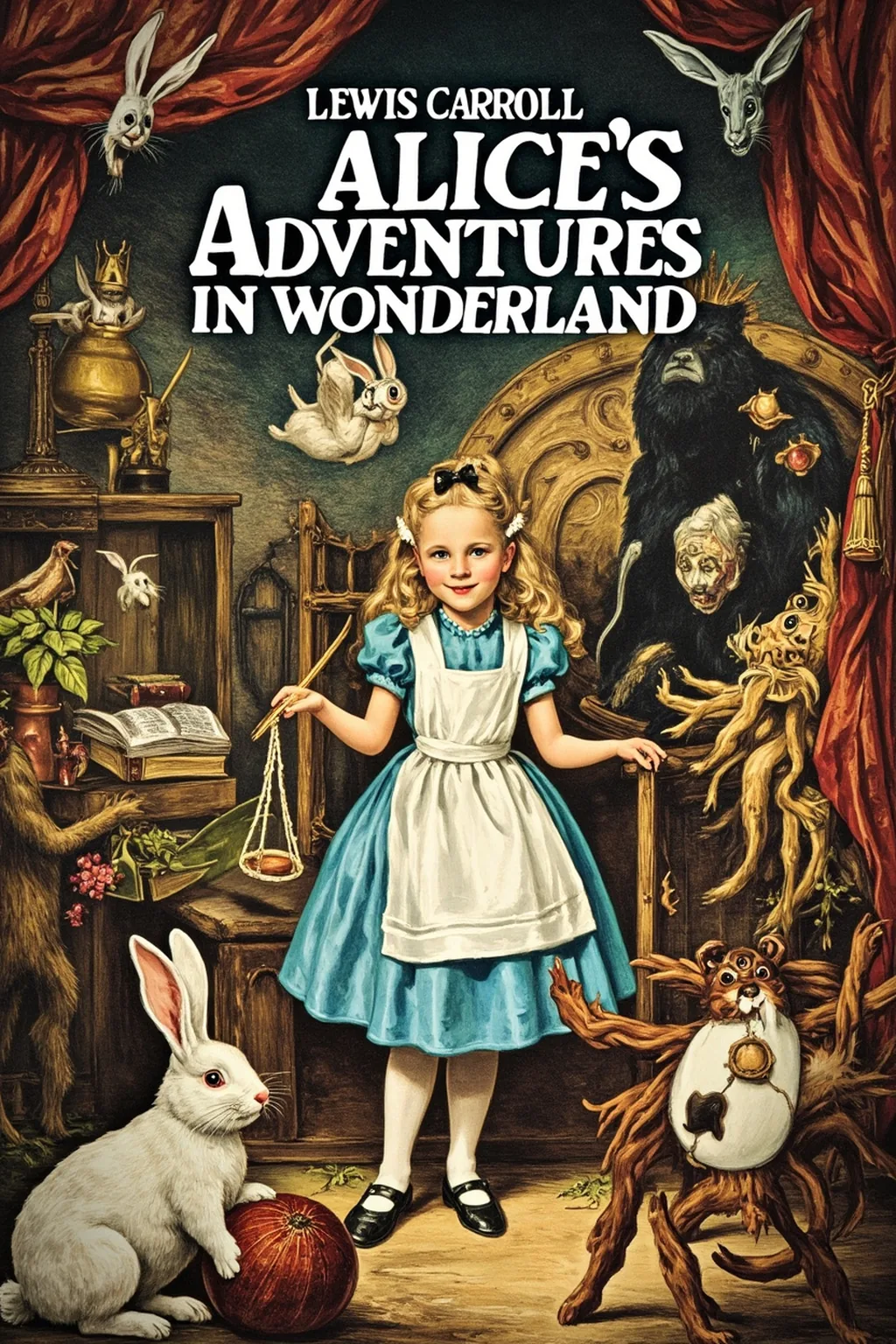
Alice’s boredom with the real world is the catalyst for her journey, revealing a child’s preference for engagement over dry instruction.
“and what is the use of a book,” thought Alice “without pictures or conversations?”
but when the Rabbit actually took a watch out of its waistcoat-pocket, and looked at it, and then hurried on, Alice started to her feet, for it flashed across her mind that she had never before seen a rabbit with either a waistcoat-pocket, or a watch to take out of it, and burning with curiosity, she ran across the field after it, and fortunately was just in time to see it pop down a large rabbit-hole under the hedge.
Read interpretation
This is the inciting incident of the novel, where the mundane world is breached by the impossible. The specific detail of the waistcoat-pocket transforms the rabbit from a mere animal into a civilized, punctual creature, igniting the “burning curiosity” that drives the entire plot.
Alice’s reckless plunge into the unknown marks the definitive point of no return, leaving the rational world behind without a thought for the consequences.
In another moment down went Alice after it, never once considering how in the world she was to get out again.
Read interpretation
This quote captures the reckless innocence and wonder of childhood. Alice’s plunge into the unknown is motivated entirely by impulse, marking the definitive point of no return as she leaves the rational world behind.
As she falls slowly through the earth, Alice attempts to process the absurdity through the lens of her everyday life, maintaining a sense of normalcy amidst the chaos.
“Well!” thought Alice to herself, “after such a fall as this, I shall think nothing of tumbling down stairs! How brave they’ll all think me at home! Why, I wouldn’t say anything about it, even if I fell off the top of the house!”
Read interpretation
During the surreal fall, Alice’s internal monologue reveals her attempt to process the absurdity through the lens of her everyday life. It showcases her resilience and her tendency to frame extraordinary events as accomplishments that will impress her peers, maintaining a sense of normalcy amidst chaos.
Trapped by her size, Alice begins to accept that the laws of physics are fluid in Wonderland, discarding the concept of impossibility.
“Oh, how I wish I could shut up like a telescope! I think I could, if I only knew how to begin.” For, you see, so many out-of-the-way things had happened lately, that Alice had begun to think that very few things indeed were really impossible.
Read interpretation
This passage marks a crucial psychological shift for Alice. Encountering the physical barrier of the tiny door, she adapts her understanding of reality, accepting that the laws of physics are fluid in Wonderland and that impossibility is a concept she must discard.
Faced with a dilemma, Alice embraces pragmatic optimism, constructing a logical win-win scenario to propel herself forward toward her goal.
“Well, I’ll eat it,” said Alice, “and if it makes me grow larger, I can reach the key; and if it makes me grow smaller, I can creep under the door; so either way I’ll get into the garden, and I don’t care which happens!”
Read interpretation
Faced with a dilemma, Alice embraces pragmatic optimism. This quote illustrates her adaptability; rather than fearing the unknown outcome of the cake, she constructs a logical win-win scenario that propels her forward toward her goal.
Alice’s shock at her rapid growth is so intense that it momentarily breaks her grasp of proper English, emphasizing the surreal nature of her transformation.
“Curiouser and curiouser!” cried Alice (she was so much surprised, that for the moment she quite forgot how to speak good English); “now I’m opening out like the largest telescope that ever was!”
Read interpretation
This exclamation captures the essence of Alice’s transformation and the surreal nature of Wonderland. Her deliberate misuse of grammar emphasizes her overwhelming shock, while the metaphor of the telescope visually connects her rapid physical growth to her earlier desire to see the garden.
Alice’s inability to regulate her emotions leads to a physical manifestation of her sorrow that floods her environment, trapping her in a pool of her own making.
“You ought to be ashamed of yourself,” said Alice, “a great girl like you,” (she might well say this), “to go on crying in this way! Stop this moment, I tell you!” But she went on all the same, shedding gallons of tears, until there was a large pool all round her, about four inches deep and reaching half down the hall.
Read interpretation
Alice’s inability to regulate her emotions leads to a physical manifestation of her sorrow that floods her environment. This hyperbole of shedding “gallons of tears” sets the stage for the chapter’s central conflict, trapping her and the other creatures in a pool of her own making.
Stripped of her familiar size and surroundings, Alice grapples with the philosophical instability of self, a theme that recurs throughout her journey.
“I wonder if I’ve been changed in the night? Let me think: was I the same when I got up this morning? I almost think I can remember feeling a little different. But if I’m not the same, the next question is, Who in the world am I? Ah, that’s the great puzzle!”
Read interpretation
This moment marks the onset of a profound identity crisis. Stripped of her familiar size and surroundings, Alice grapples with the philosophical instability of self, a theme that recurs throughout her journey as the world challenges her understanding of who she is.
Alice attempts to use logic and comparison to anchor her identity, but her reasoning is flawed and desperate, highlighting the fragility of her self-conception.
“I’m sure I’m not Ada,” she said, “for her hair goes in such long ringlets, and mine doesn’t go in ringlets at all; and I’m sure I can’t be Mabel, for I know all sorts of things, and she, oh! she knows such a very little! Besides, she’s she, and I’m I, and—oh dear, how puzzling it all is!”
Read interpretation
Alice attempts to use logic and comparison to anchor her identity, but her reasoning is flawed and desperate. Her reliance on superficial traits like hair and knowledge to distinguish herself from others highlights the fragility of her self-conception in a world where facts are fluid.
The Mouse attempts to solve the physical problem of being wet with a linguistic pun, offering a “dry” history lesson that highlights the absurdity of Wonderland.
“Ahem!” said the Mouse with an important air, “are you all ready? This is the driest thing I know. Silence all round, if you please! ‘William the Conqueror, whose cause was favoured by the pope, was soon submitted to by the English, who wanted leaders, and had been of late much accustomed to usurpation and conquest. Edwin and Morcar, the earls of Mercia and Northumbria—’”
Read interpretation
The Mouse attempts to solve the physical problem of being wet with a linguistic pun, offering a “dry” history lesson. This highlights the absurdity of Wonderland, where academic pedantry is applied to immediate physical discomfort, resulting in a comical failure to actually help anyone.
The race concludes with a subversion of competition where the concept of losing is abolished to avoid conflict, creating a scene of absurd fairness.
At last the Dodo said, “Everybody has won, and all must have prizes.”
Read interpretation
The race concludes with a subversion of competition where the concept of losing is abolished to avoid conflict. This satirical take on sporting events and the need to reward everyone equally creates a scene of absurd fairness that burdens Alice with the logistics.
Carroll utilizes a classic pun to bridge the gap between the Mouse’s biography and its anatomy, frustrating the Mouse and showcasing Alice’s inability to grasp figurative language.
“Mine is a long and a sad tale!” said the Mouse, turning to Alice, and sighing. “It is a long tail, certainly,” said Alice, looking down with wonder at the Mouse’s tail; “but why do you call it sad?”
Read interpretation
Carroll utilizes a classic pun to bridge the gap between the Mouse’s biography and its anatomy. Alice’s literal interpretation of the word “tale” as the animal’s physical tail frustrates the Mouse and showcases her inability to grasp the figurative language of this world.
Alice’s resignation to the constant unpredictability of Wonderland highlights her adaptation to its rules, anticipating change with a weary curiosity.
“I know something interesting is sure to happen,” she said to herself, “whenever I eat or drink anything; so I’ll just see what this bottle does.”
Read interpretation
Alice’s resignation to the constant unpredictability of Wonderland highlights her adaptation to its rules. She no longer fears the unknown but anticipates it with a weary curiosity, a necessary shift in mindset for her survival.
Alice experiences a rare moment of genuine homesickness and regret, yet immediately undercuts it with her characteristic curiosity.
“It was much pleasanter at home,” thought poor Alice, “when one wasn’t always growing larger and smaller, and being ordered about by mice and rabbits. I almost wish I hadn’t gone down that rabbit-hole—and yet—and yet—it’s rather curious, you know, this sort of life!”
Read interpretation
Alice experiences a rare moment of genuine homesickness and regret, yet immediately undercuts it with her characteristic curiosity. This internal conflict defines her character: she longs for the safety of the known world but is irresistibly drawn to the chaos of the unknown.
This moment represents Alice using logic to master the rules of Wonderland, turning a weapon used against her into a tool for escape.
“If I eat one of these cakes,” she thought, “it’s sure to make some change in my size; and as it can’t possibly make me larger, it must make me smaller, I suppose.”
Read interpretation
This moment represents Alice using logic to master the rules of Wonderland. By deducing the function of the magic pebbles, she takes control of her own size for the first time, turning a weapon used against her into a tool for escape.
The chapter concludes with the introduction of one of the story’s most iconic figures, signaling a shift from physical chaos to philosophical stagnation.
She stretched herself up on tiptoe, and peeped over the edge of the mushroom, and her eyes immediately met those of a large blue caterpillar, that was sitting on the top with its arms folded, quietly smoking a long hookah, and taking not the smallest notice of her or of anything else.
Read interpretation
The chapter concludes with the introduction of one of the story’s most iconic figures. The Caterpillar’s languid, indifferent posture contrasts sharply with Alice’s frantic movement, signaling a shift from physical chaos to philosophical stagnation.
The Caterpillar opens with a direct challenge to Alice’s identity, highlighting the central theme of transformation and the loss of self.
“Who are you?” said the Caterpillar.
This was not an encouraging opening for a conversation. Alice replied, rather shyly, “I—I hardly know, sir, just at present—at least I know who I was when I got up this morning, but I think I must have been changed several times since then.”
Read interpretation
The chapter opens with a direct challenge to Alice’s identity, highlighting the central theme of transformation and the loss of self that has plagued her journey. Her inability to answer definitively marks the peak of her existential crisis.
Alice’s tautological explanation captures the absurd logic of Wonderland, where physical changes have eroded her psychological stability.
“I can’t explain myself, I’m afraid, sir,” said Alice, “because I’m not myself, you see.”
Read interpretation
Alice’s tautological explanation captures the absurd logic of Wonderland, where physical changes have eroded her psychological stability. The Caterpillar’s refusal to accept this reasoning only deepens her confusion and frustration.
The imagery of Alice’s neck stretching like a stalk illustrates the grotesque and surreal nature of her physical alterations, blurring the line between human and animal.
“Come, my head’s free at last!” said Alice in a tone of delight, which changed into alarm in another moment, when she found that her shoulders were nowhere to be found: all she could see, when she looked down, was an immense length of neck, which seemed to rise like a stalk out of a sea of green leaves that lay far below her.
Read interpretation
The imagery of Alice’s neck stretching like a stalk illustrates the grotesque and surreal nature of her physical alterations. This moment of extreme distortion leads directly to the conflict with the Pigeon, blurring the line between human and animal.
The Pigeon’s attack on Alice creates a tense situation where her physical form dictates how others perceive her, forcing her to defend her identity against visual evidence.
“Serpent!” screamed the Pigeon.
“I’m not a serpent!” said Alice indignantly. “Let me alone!”
Read interpretation
The Pigeon’s attack on Alice creates a tense situation where her physical form dictates how others perceive her. Despite her protests, the Pigeon insists on defining her by her appearance, forcing Alice to defend her identity against visual evidence.
This quote marks the resolution of the immediate chaos and a return to Alice’s primary motivation: reaching the garden.
“Come, there’s half my plan done now! How puzzling all these changes are! I’m never sure what I’m going to be, from one minute to another! However, I’ve got back to my right size: the next thing is, to get into that beautiful garden—how is that to be done, I wonder?”
Read interpretation
This quote marks the resolution of the immediate chaos and a return to Alice’s primary motivation: reaching the garden. It signifies a momentary restoration of order and purpose, allowing her to focus on her goal rather than her disoriented self.
The Footman’s pedantic logic serves as a barrier to Alice’s progress, highlighting the absurdity of Wonderland where social norms and physical laws are twisted into nonsensical riddles.
“There’s no sort of use in knocking,” said the Footman, “and that for two reasons. First, because I’m on the same side of the door as you are; secondly, because they’re making such a noise inside, no one could possibly hear you.”
Read interpretation
The Footman’s pedantic logic serves as a barrier to Alice’s progress, highlighting the absurdity of Wonderland where social norms and physical laws are twisted into nonsensical riddles. His refusal to assist her sets the tone for the chaotic interactions to follow.
Alice attempts to apply rational, scientific knowledge to correct the Duchess, but the conversation pivots violently from astronomy to a capital punishment based on a pun.
“If everybody minded their own business,” the Duchess said in a hoarse growl, “the world would go round a deal faster than it does.”
“Which would not be an advantage,” said Alice, who felt very glad to get an opportunity of showing off a little of her knowledge. “Just think of what work it would make with the day and night! You see the earth takes twenty-four hours to turn round on its axis—”
“Talking of axes,” said the Duchess, “chop off her head!”
Read interpretation
Alice attempts to apply rational, scientific knowledge to correct the Duchess, but the conversation pivots violently from astronomy to a capital punishment based on a pun. This abrupt shift underscores the danger and volatility of the Duchess’s character.
The Duchess’s lullaby perverts the traditional role of a nurturing caregiver, transforming a soothing song into a violent manual for child-rearing.
“Speak roughly to your little boy, And beat him when he sneezes: He only does it to annoy, Because he knows it teases.”
Read interpretation
The Duchess’s lullaby perverts the traditional role of a nurturing caregiver, transforming a soothing song into a violent manual for child-rearing. It emphasizes the cruelty and nonsense that govern the domestic sphere in this world.
Alice addresses the baby’s transformation with a mix of resignation and practicality, accepting the impossible logic of the situation.
“If you’re going to turn into a pig, my dear,” said Alice, seriously, “I’ll have nothing more to do with you. Mind now!”
Read interpretation
Alice addresses the baby’s transformation with a mix of resignation and practicality, accepting the impossible logic of the situation. This moment marks the completion of the baby’s metamorphosis, stripping away the last illusion of normalcy in the Duchess’s household.
The Cheshire Cat provides a rare moment by defining the madness of Wonderland as a prerequisite for entry.
“Oh, you can’t help that,” said the Cat: “we’re all mad here. I’m mad. You’re mad.”
“How do you know I’m mad?” said Alice.
“You must be,” said the Cat, “or you wouldn’t have come here.”
Read interpretation
The Cheshire Cat provides a rare moment of clarity by defining the madness of Wonderland as a prerequisite for entry. The circular logic confirms Alice’s inseparable connection to this absurd reality.
The visual surrealism of the vanishing cat, leaving behind a disembodied grin, is one of the most iconic images in the book.
“All right,” said the Cat; and this time it vanished quite slowly, beginning with the end of the tail, and ending with the grin, which remained some time after the rest of it had gone.
“Well! I’ve often seen a cat without a grin,” thought Alice; “but a grin without a cat! It’s the most curious thing I ever saw in my life!”
Read interpretation
The visual surrealism of the vanishing cat, leaving behind a disembodied grin, is one of the most iconic images in the book. It perfectly encapsulates the theme of existence without substance that permeates Alice’s adventure.
The Hatter pivots from a rude insult to a famous riddle with no answer, establishing the chapter’s tone of nonsensical etiquette and circular logic.
“Your hair wants cutting,” said the Hatter. He had been looking at Alice for some time with great curiosity, and this was his first speech.
“You should learn not to make personal remarks,” Alice said with some severity; “it’s very rude.”
The Hatter opened his eyes very wide on hearing this; but all he said was, “Why is a raven like a writing-desk?”
Read interpretation
The Hatter pivots from a rude insult to a famous riddle with no answer, establishing the chapter’s tone of nonsensical etiquette and circular logic. Alice’s attempt to enforce social norms is instantly deflected by unanswerable absurdity.
The Hatter blames the broken state of his watch on the March Hare putting butter in the mechanism, highlighting the dream logic where physical causality is replaced by nonsense.
“Two days wrong!” sighed the Hatter. “I told you butter wouldn’t suit the works!” he added looking angrily at the March Hare.
“It was the best butter,” the March Hare meekly replied.
Read interpretation
The Hatter blames the broken state of his watch—which tells the day but not the hour—on the March Hare putting butter in the mechanism. This surreal explanation for a mechanical failure highlights the dream logic where physical causality is replaced by nonsense.
Personifying Time as an entity one can quarrel with adds a layer of mythological absurdity to the Hatter’s predicament.
“If you knew Time as well as I do,” said the Hatter, “you wouldn’t talk about wasting it. It’s him.”
Read interpretation
Personifying Time as an entity one can quarrel with or “murder” adds a layer of mythological absurdity to the Hatter’s predicament. It explains the eternal tea-time as a punishment for a social slight against a cosmic force.
The Hatter reveals the consequence of his “crime” at the Queen’s concert: being trapped in a perpetual moment of tea-time.
“And ever since that,” the Hatter went on in a mournful tone, “he won’t do a thing I ask! It’s always six o’clock now.”
Read interpretation
The Hatter reveals the consequence of his “crime” at the Queen’s concert: being trapped in a perpetual moment of tea-time. This static existence underscores the theme of arrested development and the futility of their repetitive actions.
Alice is caught in a linguistic trap when she says she can’t take more tea because she has had none, emphasizing the hostility and pedantry that govern the conversation.
“You mean you can’t take less,” said the Hatter: “it’s very easy to take more than nothing.”
Read interpretation
Alice is caught in a linguistic trap when she says she can’t take more tea because she has had none. The Hatter’s semantic quibble emphasizes the hostility and pedantry that govern the conversation, leaving Alice with no logical ground to stand on.
The final dismissal breaks Alice’s patience, serving as the climax of the scene where she rejects the madness of the tea party.
“Then you shouldn’t talk,” said the Hatter.
This piece of rudeness was more than Alice could bear: she got up in great disgust, and walked off; the Dormouse fell asleep instantly, and neither of the others took the least notice of her going.
Read interpretation
The final dismissal breaks Alice’s patience, serving as the climax of the scene where she rejects the madness of the tea party. Her departure goes unnoticed, reinforcing her insignificance in their world and allowing her to finally move forward.
Alice finally achieves her long-standing goal by applying the lessons she learned earlier in the book, marking the transition into the courtly, yet equally dangerous, next phase of her adventure.
“Now, I’ll manage better this time,” she said to herself, and began by taking the little golden key, and unlocking the door that led into the garden. Then she went to work nibbling at the mushroom (she had kept a piece of it in her pocket) till she was about a foot high: then she walked down the little passage: and then—she found herself at last in the beautiful garden, among the bright flower-beds and the cool fountains.
Read interpretation
Alice finally achieves her long-standing goal by applying the lessons she learned earlier in the book. This moment marks the successful conclusion of her initial quest and the transition into the courtly, yet equally dangerous, next phase of her adventure.
This confession reveals the terrifyingly arbitrary nature of justice in Wonderland, where a trivial gardening error is punishable by death.
“Why the fact is, you see, Miss, this here ought to have been a red rose-tree, and we put a white one in by mistake; and if the Queen was to find it out, we should all have our heads cut off, you know.”
Read interpretation
This confession reveals the terrifyingly arbitrary nature of justice in Wonderland, where a trivial gardening error is punishable by death. It highlights the environment of fear that drives the characters’ frantic behavior.
Alice reaches a crucial turning point in her confidence, realizing the physical limitations of the characters surrounding her.
“My name is Alice, so please your Majesty,” said Alice very politely; but she added, to herself, “Why, they’re only a pack of cards, after all. I needn’t be afraid of them!”
Read interpretation
Alice reaches a crucial turning point in her confidence, realizing the physical limitations of the characters surrounding her. This internal shift empowers her to stand up to the Queen’s tyranny in the subsequent moments.
This is a definitive moment of rebellion where Alice’s common sense overrides the Queen’s bluster.
“Nonsense!” said Alice, very loudly and decidedly, and the Queen was silent.
Read interpretation
This is a definitive moment of rebellion where Alice’s common sense overrides the Queen’s bluster. It highlights the fragility of the Queen’s power when confronted with a child who refuses to be intimidated.
Alice attempts to apply logic to the game, only to find that rules and fairness are entirely absent.
“I don’t think they play at all fairly,” Alice began, in a rather a complaining tone, “and they all quarrel so dreadfully one can’t hear oneself speak—and they don’t seem to have any rules in particular; at least, if there are, nobody attends to them—and you’ve no idea how confusing it is all the things being alive;”
Read interpretation
Alice attempts to apply logic to the game, only to find that rules and fairness are entirely absent. This quote summarizes the core conflict of the chapter: the futility of trying to navigate a world governed by impulse rather than order.
Alice uses a proverb to assert her knowledge and subtly defy the King’s demand for subservience.
“A cat may look at a king,” said Alice. “I’ve read that in some book, but I don’t remember where.”
Read interpretation
Alice uses a proverb to assert her knowledge and subtly defy the King’s demand for subservience. It connects her back to the real world of books and education, serving as a shield against the madness surrounding her.
The executioner attempts to use bureaucratic logic to avoid an impossible task, grounding the magical absurdity in mundane practicality.
“The executioner’s argument was, that you couldn’t cut off a head unless there was a body to cut it off from: that he had never had to do such a thing before, and he wasn’t going to begin at his time of life.”
Read interpretation
The executioner attempts to use bureaucratic logic to avoid an impossible task, grounding the magical absurdity in mundane practicality. His resistance highlights the sheer ridiculousness of the Queen’s demand to behead a bodiless grin.
The Duchess’s relentless need to extract a lesson from every interaction highlights the absurdity of adult didacticism.
“Tut, tut, child!” said the Duchess. “Everything’s got a moral, if only you can find it.”
Read interpretation
The Duchess’s relentless need to extract a lesson from every interaction highlights the absurdity of adult didacticism. Her aggressive application of morals to mundane situations creates a suffocating atmosphere for Alice, contrasting sharply with the child’s desire for simple conversation.
This convoluted sentence is a masterpiece of linguistic nonsense, parodying the complex and often hypocritical moral instructions adults give children.
“Be what you would seem to be”—or if you’d like it put more simply—“Never imagine yourself not to be otherwise than what it might appear to others that what you were or might have been was not otherwise than what you had been would have appeared to them to be otherwise.”
Read interpretation
This convoluted sentence is a masterpiece of linguistic nonsense, parodying the complex and often hypocritical moral instructions adults give children. It effectively traps Alice in a web of words that sounds profound but signifies nothing, emphasizing the chaotic logic of Wonderland.
The Gryphon’s revelation that the Queen’s executions are merely performative changes the stakes of the story entirely.
“Why, she,” said the Gryphon. “It’s all her fancy, that: they never executes nobody, you know. Come on!”
Read interpretation
The Gryphon’s revelation that the Queen’s executions are merely performative changes the stakes of the story entirely. It transforms the terrifying atmosphere into a farce, suggesting that the brutal laws of Wonderland are just another form of the nonsense Alice has been encountering.
The Mock Turtle’s description of his school curriculum parodies the Victorian education system by twisting standard subjects into negative emotional states.
“Reeling and Writhing, of course, to begin with,” the Mock Turtle replied; “and then the different branches of Arithmetic—Ambition, Distraction, Uglification, and Derision.”
Read interpretation
The Mock Turtle’s description of his school curriculum parodies the Victorian education system by twisting standard subjects into negative emotional states. “Uglification” and “Derision” suggest that growing up in Wonderland involves learning to be ugly and mocked rather than enlightened.
This pun provides a rare moment of logical consistency within the nonsense, defining the word “lesson” by its etymological root rather than its educational function.
“That’s the reason they’re called lessons,” the Gryphon remarked: “because they lessen from day to day.”
Read interpretation
This pun provides a rare moment of logical consistency within the nonsense, defining the word “lesson” by its etymological root rather than its educational function. It captures the Mock Turtle’s worldview where concepts are defined by how they feel or change over time, rather than by rigid utility.
Alice’s near-slip about tasting lobster highlights the absurdity of the Mock Turtle’s sentimentality toward sea creatures, which are usually food.
“You may not have lived much under the sea—” (“I haven’t,” said Alice)—“and perhaps you were never even introduced to a lobster—” (Alice began to say “I once tasted—” but checked herself hastily, and said “No, never”) “—so you can have no idea what a delightful thing a Lobster Quadrille is!”
Read interpretation
Alice’s near-slip about tasting lobster highlights the absurdity of the Mock Turtle’s sentimentality toward sea creatures, which are usually food. Her correction to “No, never” is a polite social maneuver to avoid offending a creature that might otherwise be dinner, emphasizing the inverted logic of Wonderland.
This pun conflates the marine mammal “porpoise” with the word “purpose,” a joke the Mock Turtle treats with absolute seriousness.
“Of course not,” said the Mock Turtle: “why, if a fish came to me, and told me he was going a journey, I should say ‘With what porpoise?’”
Read interpretation
This pun conflates the marine mammal “porpoise” with the word “purpose,” a joke the Mock Turtle treats with absolute seriousness. It exemplifies the chapter’s theme of language being twisted into physical reality, where a grammatical inquiry becomes a question about travel companions.
Alice’s reflection on her identity captures the psychological toll of her constant physical changes.
“I could tell you my adventures—beginning from this morning,” said Alice a little timidly: “but it’s no use going back to yesterday, because I was a different person then.”
Read interpretation
Alice’s reflection on her identity captures the psychological toll of her constant physical changes. She accepts her mutability as a fact of life, recognizing that her experiences have fundamentally altered her sense of self in a very short amount of time.
The Mock Turtle’s melodramatic ode to soup is a darkly comic irony, as he is singing the praises of a dish made of his own kind.
“Beautiful Soup, so rich and green, Waiting in a hot tureen!”
Read interpretation
The Mock Turtle’s melodramatic ode to soup is a darkly comic irony, as he is singing the praises of a dish made of his own kind. It highlights the disconnect between the character’s emotional state and the reality of his existence, performed with a solemnity that borders on the tragic.
The abrupt interruption of the song by the cry of the trial shifts the narrative from the whimsical stagnation of the beach to the high stakes of the courtroom.
“Come on!” cried the Gryphon, and, taking Alice by the hand, it hurried off, without waiting for the end of the song.
Read interpretation
The abrupt interruption of the song by the cry of the trial shifts the narrative from the whimsical stagnation of the beach to the high stakes of the courtroom. It propels Alice into the final act of the story, leaving the nonsense of the dance behind for the nonsense of the law.
Alice’s inability to contain her frustration at the jury’s incompetence immediately draws the court’s attention, highlighting the absurdity of the proceedings.
“Stupid things!” Alice began in a loud, indignant voice, but she stopped hastily, for the White Rabbit cried out, “Silence in the court!”
Read interpretation
Alice’s inability to contain her frustration at the jury’s incompetence immediately draws the court’s attention, highlighting the absurdity of the proceedings where silence is enforced more strictly than justice.
The King’s eagerness to skip the trial entirely and jump straight to the verdict underscores the arbitrary nature of the justice being served.
“Consider your verdict,” the King said to the jury.
Read interpretation
“Not yet, not yet!” the Rabbit hastily interrupted. “There’s a great deal to come before that!”
The King’s eagerness to skip the trial entirely and jump straight to the verdict underscores the arbitrary nature of the justice being served, contrasting sharply with the White Rabbit’s frantic adherence to procedure.
The Hatter’s testimony begins with immediate disrespect for the court’s gravity, treating a capital trial as a minor inconvenience to his tea party.
“I beg pardon, your Majesty,” he began, “for bringing these in: but I hadn’t quite finished my tea when I was sent for.”
Read interpretation
“You ought to have finished,” said the King. “When did you begin?”
The Hatter’s testimony begins with immediate disrespect for the court’s gravity, treating a capital trial as a minor inconvenience to his tea party.
The witnesses provide contradictory dates that the jury blindly attempts to calculate, emphasizing the chaos over facts and the futility of seeking truth in Wonderland.
“Fourteenth of March, I think it was,” he said.
Read interpretation
“Fifteenth,” said the March Hare.
“Sixteenth,” added the Dormouse.
The witnesses provide contradictory dates that the jury blindly attempts to calculate, emphasizing the chaos over facts and the futility of seeking truth in Wonderland.
The King engages in a nonsensical linguistic argument, prioritizing pedantry over the actual content of the testimony and revealing his own stupidity.
“The twinkling of the what?” said the King.
Read interpretation
“It began with the tea,” the Hatter replied.
“Of course twinkling begins with a T!” said the King sharply. “Do you take me for a dunce? Go on!”
The King engages in a nonsensical linguistic argument, prioritizing pedantry over the actual content of the testimony and revealing his own stupidity.
Alice connects the surreal violence of the court—stuffing a cheering guinea-pig into a bag—with the dry, bureaucratic language she has read in the real world.
“I’m glad I’ve seen that done,” thought Alice. “I’ve so often read in the newspapers, at the end of trials, ‘There was some attempts at applause, which was immediately suppressed by the officers of the court,’ and I never understood what it meant till now.”
Read interpretation
Alice connects the surreal violence of the court—stuffing a cheering guinea-pig into a bag—with the dry, bureaucratic language she has read in the real world, bridging the gap between Wonderland and reality.
The Cook’s single-word refusal epitomizes the total lack of respect for the King’s authority, rendering his power completely ineffective.
“Give your evidence,” said the King.
Read interpretation
“Shan’t,” said the cook.
The Cook’s single-word refusal epitomizes the total lack of respect for the King’s authority, rendering his power completely ineffective.
The chapter reaches a turning point when Alice, the observer of the madness, is suddenly pulled into the center of the trial as a witness.
“Call the next witness!” said the King.
Read interpretation
Alice watched the White Rabbit as he fumbled over the list, feeling very curious to see what the next witness would be like, “—for they haven’t got much evidence yet,” she said to herself. Imagine her surprise, when the White Rabbit read out, at the top of his shrill little voice, the name “Alice!”
The chapter reaches a turning point when Alice, the observer of the madness, is suddenly pulled into the center of the trial as a witness, shifting the narrative focus from the absurdity of the court to her own fate.
Alice’s physical growth disrupts the court’s proceedings, literally scattering the authority figures and highlighting her increasing dominance over the absurd world she has entered.
“Here!” cried Alice, quite forgetting in the flurry of the moment how large she had grown in the last few minutes, and she jumped up in such a hurry that she tipped over the jury-box with the edge of her skirt, upsetting all the jurymen on to the heads of the crowd below, and there they lay sprawling about, reminding her very much of a globe of goldfish she had accidentally upset the week before.
Read interpretation
Alice’s physical growth disrupts the court’s proceedings, literally scattering the authority figures and highlighting her increasing dominance over the absurd world she has entered.
The King’s logic is inverted, treating a complete lack of knowledge as vital evidence, which underscores the arbitrary and nonsensical nature of the trial.
“What do you know about this business?” the King said to Alice. “Nothing,” said Alice. “Nothing whatever?” persisted the King. “Nothing whatever,” said Alice. “That’s very important,” the King said, turning to the jury.
Read interpretation
The King’s logic is inverted, treating a complete lack of knowledge as vital evidence, which underscores the arbitrary and nonsensical nature of the trial.
Alice challenges the King’s authority by pointing out the logical inconsistency of his invented rule, demonstrating her return to rational thinking amidst the madness.
“Rule Forty-two. All persons more than a mile high to leave the court.” “I’m not a mile high,” said Alice. “You are,” said the King. “Nearly two miles high,” added the Queen. “Well, I shan’t go, at any rate,” said Alice: “besides, that’s not a regular rule: you invented it just now.”
Read interpretation
Alice challenges the King’s authority by pointing out the logical inconsistency of his invented rule, demonstrating her return to rational thinking amidst the madness.
Alice openly mocks the court’s attempt to find meaning in the Knave’s nonsensical letter, signaling her final rejection of Wonderland’s twisted logic.
“If any one of them can explain it,” said Alice, (she had grown so large in the last few minutes that she wasn’t a bit afraid of interrupting him,) “I’ll give him sixpence. I don’t believe there’s an atom of meaning in it.”
Read interpretation
Alice openly mocks the court’s attempt to find meaning in the Knave’s nonsensical letter, signaling her final rejection of Wonderland’s twisted logic.
This is the climax of Alice’s rebellion; she asserts her full size and maturity, denouncing the Queen’s tyranny and recognizing the court figures as mere inanimate objects.
“Who cares for you?” said Alice, (she had grown to her full size by this time.) “You’re nothing but a pack of cards!”
Read interpretation
This is the climax of Alice’s rebellion; she asserts her full size and maturity, denouncing the Queen’s tyranny and recognizing the court figures as mere inanimate objects.
The chaotic attack of the cards transitions instantly into the peace of the real world, marking the abrupt end of the dream and Alice’s return to reality.
At this the whole pack rose up into the air, and came flying down upon her: she gave a little scream, half of fright and half of anger, and tried to beat them off, and found herself lying on the bank, with her head in the lap of her sister, who was gently brushing away some dead leaves that had fluttered down from the trees upon her face.
Read interpretation
The chaotic attack of the cards transitions instantly into the peace of the real world, marking the abrupt end of the dream and Alice’s return to reality.
The narrative captures the delicate threshold between dream and reality, where the vibrant chaos of Wonderland fades into the familiar, pastoral sounds of the waking world.
So she sat on, with closed eyes, and half believed herself in Wonderland, though she knew she had but to open them again, and all would change to dull reality—the grass would be only rustling in the wind, and the pool rippling to the waving of the reeds—the rattling teacups would change to tinkling sheep-bells, and the Queen’s shrill cries to the voice of the shepherd boy—and the sneeze of the baby, the shriek of the Gryphon, and all the other queer noises, would change (she knew) to the confused clamour of the busy farm-yard—while the lowing of the cattle in the distance would take the place of the Mock Turtle’s heavy sobs.
Read interpretation
The narrative captures the delicate threshold between dream and reality, where the vibrant chaos of Wonderland fades into the familiar, pastoral sounds of the waking world.
Read interpretation
This opening line establishes Alice’s character and the book’s thematic rejection of dry, didactic learning in favor of imagination and engagement. It highlights her desire for a world that is visually stimulating and interactive, setting the stage for the fantastical adventure to come.
The mundane world is suddenly breached by the impossible, igniting a curiosity that overrides her common sense.