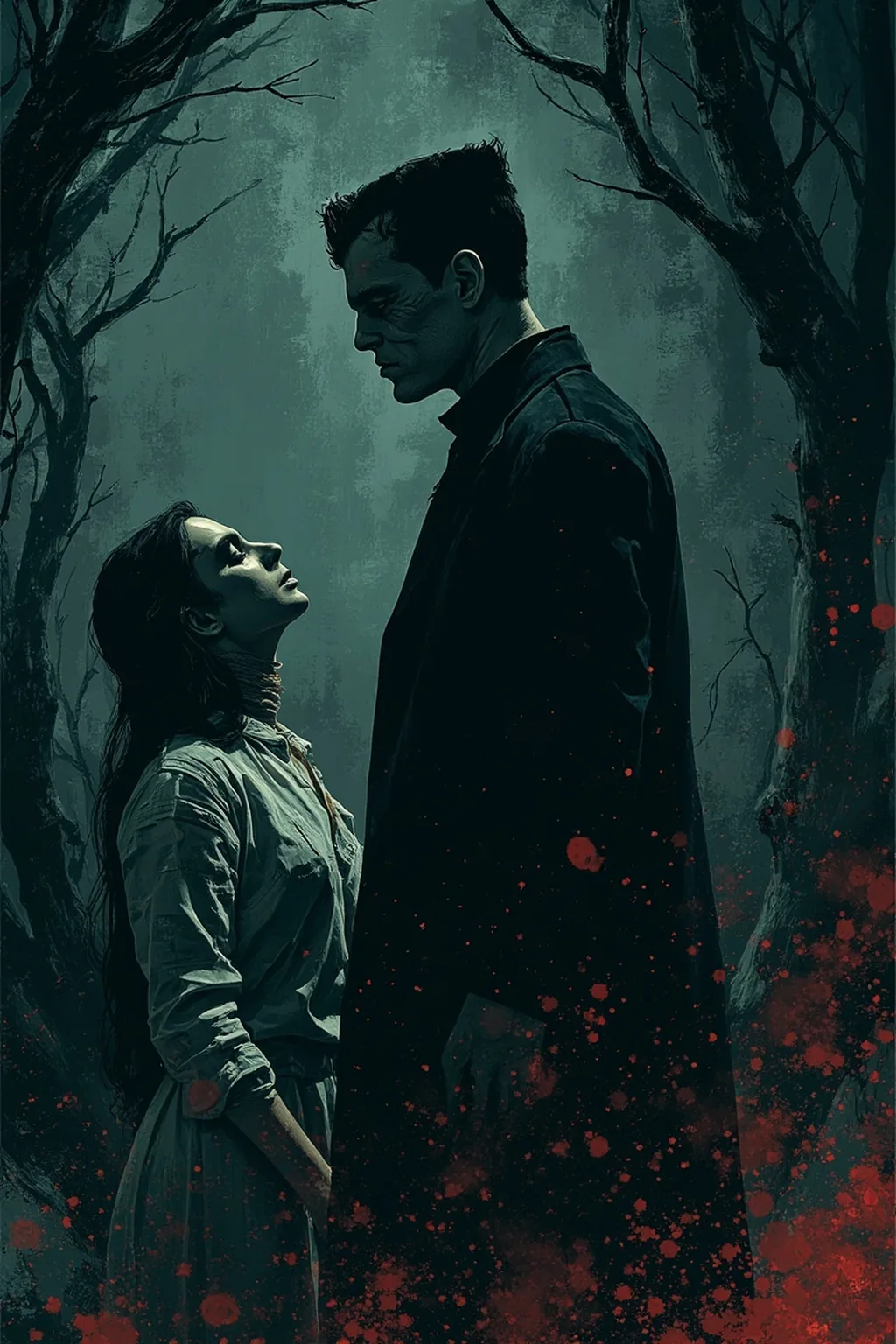
Victor Frankenstein, driven by a desire to transcend natural limits, assembles a humanoid creature from dead matter. Horrified by his creation, he abandons it, prompting the being to seek revenge for its isolation. The narrative follows the catastrophic fallout of this broken bond, moving from the icy Arctic to the serene Swiss Alps, as creator and creation are locked in a mutual pursuit of ruin.
Walton was left to grieve the untimely extinction of this glorious spirit. Later that night, he was interrupted by a hoarse sound from the cabin where Victor’s remains lay. Entering he beheld a gigantic form over the coffin. The being’s face was concealed by ragged hair, one vast hand extended. At the sound of Walton’s approach, the Creature sprang toward the window, revealing a face of such loathsome yet appalling hideousness that Walton shut his eyes involuntarily. He called on the being to stay.
The Creature paused, looking at Walton with wonder, then turned back to the lifeless form of his creator, seemingly instigated by the wildest rage. He exclaimed that in Victor’s murder, his crimes were consummated and the miserable series of his being was wound to its close. He addressed the corpse, asking what it availed to ask for pardon now that he had destroyed all Victor loved. His voice seemed suffocated. Walton, suspended by a mixture of curiosity and compassion, attempted to speak, addressing the Creature’s repentance as superfluous.
The Creature retorted that Walton did not dream, asserting that he was not dead to agony and remorse during the execution of his deeds. He claimed that Victor had not suffered the ten-thousandth portion of the anguish that he, the Creature, had endured. He explained that his heart was fashioned to be susceptible of love and sympathy, and when wrenched by misery to vice and hatred, it did not endure the violence of the change without torture. After the murder of Clerval, he had pitied Victor, but when he discovered Victor daring to hope for happiness while heaping misery upon him, impotent envy and bitter indignation filled him. He admitted that he was the slave of an impulse he detested but could not disobey. When Elizabeth died, he cast off all feeling to riot in the excess of despair, and evil became his good.
Walton, indignant by the recollection of his friend’s suffering, called him a hypocritical fiend, accusing the monster of lamenting only because his victim was withdrawn from his power. The Creature interrupted, denying the charge. He stated that he sought no fellow feeling in his misery, content to suffer alone. He recalled how he had once sought love and virtue, but now crime had degraded him beneath the meanest animal. He declared that no guilt could be found comparable to his, comparing himself to a fallen angel who became a malignant devil, yet even the devil had friends, while he was alone. He railed against the injustice of humankind sinning against him, from Felix to the rustic who attacked him, yet he was the one branded as the abortion.
The original text of this work is in the public domain. This page focuses on a guided summary article, reading notes, selected quotes, and visual learning materials for educational purposes.