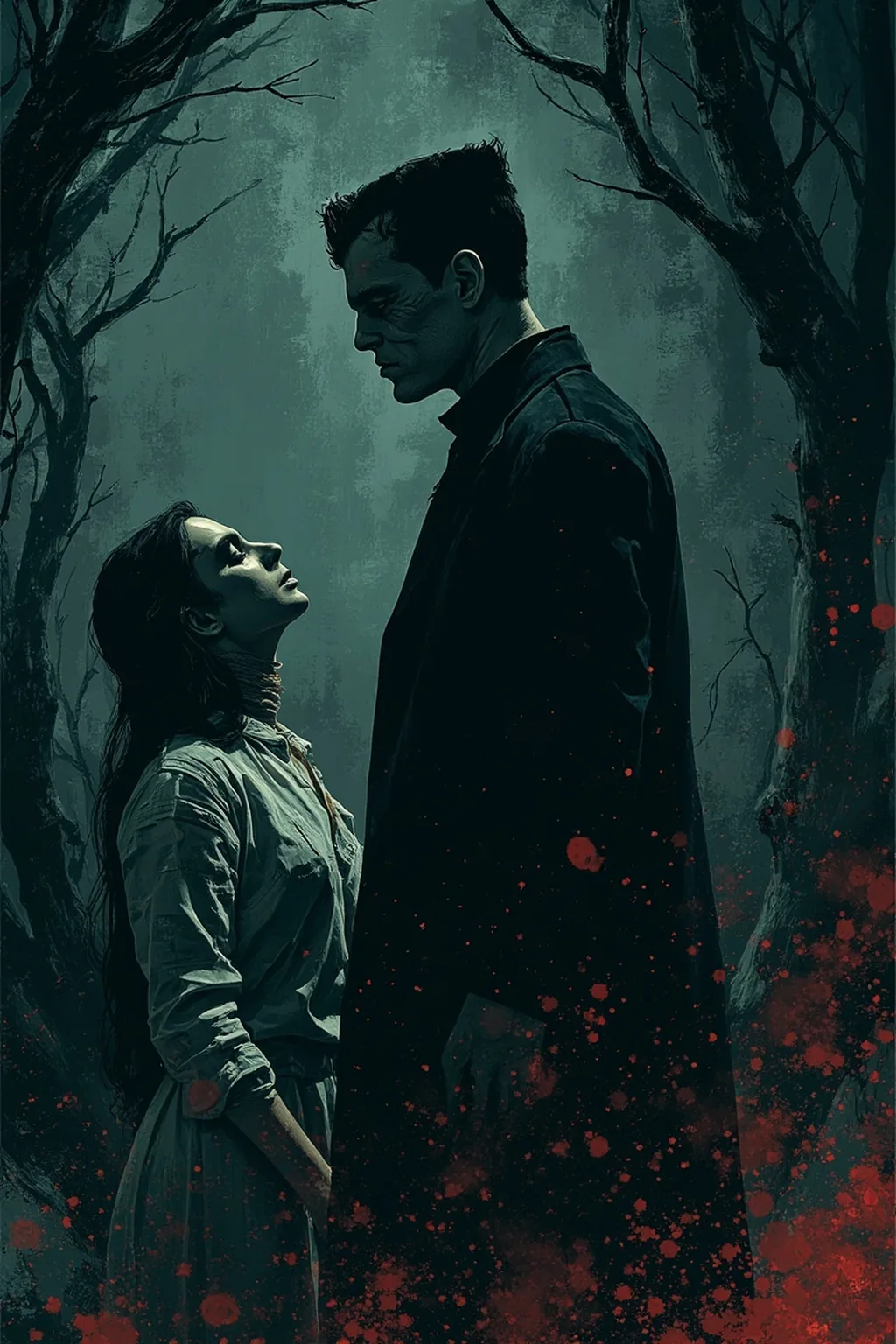
Frankenstein; or, The Modern Prometheus
Mary Wollstonecraft Shelley
Overview
Mary Shelley’s seminal Gothic novel follows Victor Frankenstein, a young Swiss scientist who creates a monstrous being and is subsequently haunted by the catastrophic consequences of his ambition. Through an epistolary frame narrated by explorer Robert Walton, Shelley weaves together the stories of creator and creation, exploring themes of responsibility, knowledge, isolation, and the dangers of playing God. The novel’s dual narrative structure gives voice to both Victor and his Creature, allowing readers to confront the moral complexity of creation and abandonment.
The Epistolary Frame: Walton’s Arctic Voyage
Letter 1: December 11, St. Petersburg
Robert Walton opens his correspondence to his sister Margaret Saville with news of his safe arrival in Russia. He shares his romantic vision of discovering the North Pole—a place he imagines not as desolation but as eternal light where the sun perpetually skirts the horizon. Walton traces his ambitions to childhood, when he devoured accounts of polar voyages despite his father’s prohibition against seafaring life. After discovering poetry and attempting to become a poet himself, he abandoned this path upon inheriting his cousin’s fortune six years prior. Since then, he has prepared himself through rigorous physical conditioning, studying mathematics and medicine, and accompanying whalers on Arctic expeditions. He plans to depart for Archangel within a fortnight to purchase a ship and recruit an experienced crew.
Letter 2: March 28, Archangel
Walton reports significant progress—having hired a vessel and collected sailors who appear dependable and courageous. He introduces his lieutenant as a man of wonderful courage and enterprise, an Englishman with noble endowments despite his lack of cultivation. Walton confesses a deep longing for companionship, particularly a true friend with a cultivated and capacious mind who could approve or amend his plans. He critiques himself as self-educated, having run wild on a common until age fourteen with only his uncle’s books of voyages. He describes his attachment to dangerous ocean mysteries as stemming from Coleridge’s “Ancient Mariner,” acknowledging a love for the marvelous intertwined in his projects that hurries him beyond common pathways.
Letter 3: July 7, Arctic Seas
Written from the ship surrounded by ice, Walton reassures his sister of safety despite the growing dangers of the polar region. The crew appears bold and resolute, undeterred by floating ice sheets. Despite reaching a very high latitude, southern gales provide surprising warmth. Walton concludes with passionate assertions that success shall crown his endeavors and that nothing can stop a determined heart and resolved will.
Letter 4: August 5–19
The narrative takes a dramatic turn as the ship becomes trapped in ice near the Arctic. On July 31st, the crew witnesses a mysterious sight: a sledge drawn by dogs and guided by a being with the shape of a man but of gigantic stature, heading north at half a mile distance. The next morning, sailors discover and rescue a dying European traveler from another sledge drifting on an ice fragment. Walton describes him as the most wretched man he has ever seen—nearly frozen and emaciated by suffering. Before boarding, the stranger asked about the ship’s destination; upon hearing “a voyage of discovery towards the northern pole,” he appeared satisfied and agreed to be rescued.
Over the following weeks, Walton develops deep affection for the stranger, whom he describes as a noble creature destroyed by misery with eloquent speech and a cultivated mind. When Walton speaks of his ambitions to sacrifice everything for the “acquirement of knowledge,” the stranger’s face grows dark with grief. He warns Walton: “Unhappy man! Do you share my madness? Have you drunk also of the intoxicating draught?” The stranger offers to reveal his own disasters so Walton might “deduce an apt moral” and avoid the same fate.
Victor Frankenstein’s Origins
Early Family History and Adoption
Victor establishes his noble Genevan heritage as a member of one of the most distinguished families in the republic. His father, Alphonse, filled several public positions with honor and reputation, delaying marriage until the decline of his life. The circumstances of his parents’ marriage reveal his father’s deep friendship with Beaufort, a once-flourishing merchant who fell into poverty. When Alphonse finally found his dying friend, Beaufort’s daughter Caroline demonstrated remarkable courage during months of desperate survival—procuring plain work, plaiting straw, employing various means to earn a pittance barely sufficient for survival.
Victor was born in Naples and accompanied his parents during their wanderings through Italy, Germany, and France. His childhood was marked by exceptional happiness; his parents embodied kindness rather than tyranny, and Victor recognized how peculiarly fortunate his lot was. His mother’s tender caresses and his father’s benevolent smile became his first recollections.
When Victor was about five, the family discovered Elizabeth Lavenza during an excursion beyond Italy’s frontiers. While visiting a poor cottage, his mother found a fair child with the brightest living gold hair, blue eyes, and features expressing “such sensibility and sweetness that all who beheld her thought of her as a distinct being, heaven-sent with a celestial stamp.” Elizabeth was the daughter of a Milanese nobleman whose mother, a German, had died in childbirth. The father had been a victim of Italy’s political weakness, and his property had been confiscated, leaving the child an orphan. Caroline prevailed upon the child’s rustic guardians to yield their charge, and Elizabeth became Victor’s “more than sister.”
Childhood and Friendship
Victor and Elizabeth were raised together, with contrasting temperaments that drew them closer rather than apart. Elizabeth possessed a calm, poetic nature, while Victor burned with an intense thirst for knowledge, eager to uncover the hidden laws behind the world’s wonders. When Victor’s younger brother was born, the family settled permanently in Geneva at a house near Belrive on the eastern shore of the lake. Victor formed an especially close bond with Henry Clerval, who loved enterprise, hardship, and even danger for its own sake. Deeply read in books of chivalry and romance, Clerval composed heroic songs and organized plays featuring characters from King Arthur’s Round Table and knights who fought to redeem the holy sepulchre.
Victor describes his temper as sometimes violent with vehement passions, but these were directed not toward childish pursuits but toward an eager desire to learn the secrets of heaven and earth—the metaphysical and physical mysteries of creation. At age thirteen, during inclement weather that confined his family to an inn, Victor discovered Cornelius Agrippa’s works. The theory and wonderful facts transformed his feeling into enthusiasm—a new light seemed to dawn upon his mind. Despite his father’s dismissive remark that Agrippa was “sad trash,” Victor continued reading with the greatest avidly.
After returning home, Victor procured the complete works of Agrippa, later expanding to include Paracelsus and Albertus Magnus. He studied these writers’ wild fancies with delight, viewing their knowledge as treasures known to few. He considered himself like Newton picking up shells beside the ocean of truth, and believed natural philosophy had only partially unveiled nature’s face while her immortal lineaments remained mysterious.
Around fifteen, Victor witnessed a terrifying thunderstorm that struck an old oak tree near his family’s house with a bolt of lightning, reducing it to a stump of thin ribbons of wood. A visiting natural philosopher explained new theories of electricity and galvanism, which displaced Victor’s interest in the ancient alchemical works. He turned to mathematics as a refuge, viewing them as built upon secure foundations. However, despite this attempt to find solid ground, destiny was too potent—Victor’s ultimate fate was predetermined.
Ingolstadt and the Creation
University Studies
Victor departed for the University of Ingolstadt at seventeen years old, leaving behind his beloved family and friends. As he journeyed, his spirits rose; he had long felt confined during his youth and yearned to enter the world. At Ingolstadt, chance led him first to M. Krempe, who stared in disbelief upon learning Victor had studied alchemists. “Have you,” he demanded, “really spent your time in studying such nonsense?” Krempe pronounced every instant Victor had wasted on those books to be “utterly and entirely lost.” Victor returned home not inclined toward Krempe’s pursuits.
However, when Victor attended M. Waldman’s lectures, he found a man of the greatest benevolence whose words would ignite within him a soul grappling with a “palpable enemy.” Waldman spoke of how modern philosophers, through meticulous work—“dabbling in dirt, poring over microscopes and crucibles”—had performed miracles. They penetrated nature’s recesses, discovered how blood circulates, understood the nature of the air breathed, acquired almost unlimited powers, commanded thunder, mimicked earthquakes, and mocked the invisible world. These were the words of fate to destroy him. Victor’s mind filled with a single thought: “So much has been done… more, far more, will I achieve; treading in the steps already marked, I will pioneer a new way, explore unknown powers, and unfold to the world the deepest mysteries of creation.”
The Discovery of Animation
From the day of his arrival, natural philosophy became Victor’s nearly sole occupation. He studied the works of modern inquirers with great ardor, attended university lectures, and cultivated relationships with men of science. His application was so ardent that he often worked through the night until morning. His rapid progress astonished fellow students and masters alike. Over two years, he neglected visiting Geneva, devoted entirely to scientific discovery.
One phenomenon particularly attracted his attention: the structure of the human frame and any living animal. He asked himself repeatedly: whence does the principle of life proceed? He determined to apply himself more particularly to the branches of natural philosophy relating to physiology. To examine the causes of life, he knew he must first have recourse to death. Though educated without supernatural fears, Victor found himself examining decay and corruption, spending days and nights in vaults and charnel-houses. After days and nights of incredible labor, he succeeded in discovering the cause of generation and life and became capable of bestowing animation upon lifeless matter.
Creation Night
On a dreary November night at one in the morning, Victor completes his two-year endeavor. As the half-extinguished candle gutters, he watches the dull yellow eyes of his creation open. He had intended to create a beautiful being with proportional limbs and pleasing features, but the result proved horrifying. The Creature’s yellow skin barely covers its muscles and arteries, its lustrous black hair contrasts grotesquely with watery eyes the color of dun-white sockets, and its shriveled complexion and straight black lips complete a visage more terrible than Dante could have imagined.
Unable to endure the sight of what he has made, Victor rushes from the room and paces through the night. Sleep brings only the wildest nightmares—dreams of Elizabeth transforming into a corpse in his arms. When he wakes, he discovers the Creature standing at the bed curtain, watching him with terrible eyes. Victor flees downstairs and spends the remainder of the night in the courtyard.
The next morning, Victor encounters Henry Clerval arriving at an inn. Their reunion brings momentary joy until Victor rushes upstairs and discovers, to his immense relief, that the monster has fled. However, his terror proves overwhelming; he imagines he sees the specter of the monster and collapses in a fit, beginning a prolonged nervous fever that will confine him for months.
The Creature’s Education
Awakening and Survival
The Creature describes his earliest moments with difficulty—a confusing multiplicity of simultaneous sensations. Over time, he learned to distinguish between the operations of his various senses. He found a forest near Ingolstadt, lay by a brook to rest, and was soon tormented by hunger and thirst. He ate berries and drank from the brook, overcoming sleep.
Upon waking in darkness, he felt cold and desolate. A radiant moon rising among the trees filled him with pleasure. He gathered berries and found a huge cloak beneath a tree. His mind held no distinct ideas; all was confused. Only the bright moon held his attention. Several changes of day and night passed, and he began to distinguish his sensations from one another. He discovered pleasant sounds proceeded from the throats of little winged animals—birds whose songs had often intercepted the light from his eyes.
One day, oppressed by cold, the Creature discovered a fire left by wandering beggars. He experienced delight at the warmth, but in his joy thrust his hand into the live embers, quickly drawing it out with a cry of pain. He reflected on the strange paradox that the same cause could produce opposite effects. Examining the fire’s materials, he discovered it was composed of wood. He observed that wet wood placed near the heat dried and became inflamed. He learned to preserve his fire by covering it with dry wood and leaves, and discovered that fire provided light as well as heat.
The De Lacey Family
Unable to sleep, the Creature reflects on the day’s events and the gentle manners of the cottagers he has observed. Despite his strong desire to join them, he vividly remembers the brutal treatment he suffered at the hands of villagers. This convinces him that he must remain concealed in his hovel while watching the family and studying their actions.
The De Lacey family consists of an elderly blind father, his son Felix, daughter Agatha, and a young Arabian woman named Safie who arrives during spring. The Creature observes their daily rhythm with fascination. He notices that despite their comfortable home, the young cottagers are not entirely happy—they frequently go apart together and appear to weep. After considerable observation, he discovers the cause: abject poverty. Their nourishment consists only of garden vegetables and the milk of a single cow.
Upon discovering their poverty, the Creature resolves to help. During the night, he steals Felix’s tools and brings home sufficient firewood for several days. He observes that Felix no longer needs to go to the forest that day and instead spends his time repairing the cottage and cultivating the garden.
Through careful observation over several months, the Creature makes his most significant discovery: human beings communicate through articulate sounds that convey ideas, pleasure, pain, smiles, and sadness. He describes this as a “godlike science” and ardently desires to master it. Initially baffled by quick pronunciation and the lack of apparent connection between words and visible objects, he eventually learns the names of familiar things: fire, milk, bread, and wood. He also learns the family members’ names and forms of address.
Having admired the perfect forms, grace, beauty, and delicate complexions of his cottagers, the Creature experiences a horrifying revelation when he sees his reflection in a transparent pool. At first, he cannot believe that the monster reflected is actually himself. Once fully convinced, he is filled with the bitterest sensations of despondence and mortification.
Knowledge and Identity
Felix teaches Safie to read using Volney’s Ruins of Empires. The Creature absorbs this instruction alongside Safie, gaining a broad overview of global history and empires—Greek genius, Roman virtue, chivalry, Christianity, European monarchies, and the European discovery of the Americas. He weeps with Safie at the suffering of the Indigenous peoples.
These accounts lead the Creature to grapple with humanity’s contradictory nature: how can people be both powerful, virtuous, and magnificent, yet also vicious and base? He concludes that great virtue is the highest honor for a sensitive being, while base vice is a degradation worse than that of lowly creatures.
Listening to Felix’s lessons, the Creature learns the structure of human society: the division of property, vast wealth and extreme poverty, systems of rank, lineage, and noble birth. He realizes humans prize high, untainted ancestry and wealth above all else; those lacking both are almost universally treated as vagabonds or slaves. Comparing this to his own circumstances—no known creator or family, no money, property, or friends, a hideously deformed, solitary form unlike any human—he is horrified to conclude he is a monster shunned by all of humanity.
The Discovery of Victor’s Journal
During a routine trip to the forest, the Creature stumbles on a leather portmanteau holding clothing and several books written in the European language he learned from observing the family. He devotes himself to studying three books that shape his emerging worldview: The Sorrows of Werther aligns with his deep longing for connection; Plutarch’s Lives fosters his admiration for moral goodness; Paradise Lost moves him profoundly as he reads it as literal history, leading him to identify with both Adam’s profound loneliness and Satan’s bitter resentment.
While sorting through the clothing, the Creature finds Victor’s laboratory journal, which records the full, step-by-step process of his creation. The journal’s explicit, horrified descriptions of his own origins and repulsive form fill him with agony and rage, leading him to curse Victor as his “accursed creator.”
The Failed Introduction
After processing the pain of learning his origins, the Creature resolves to introduce himself to the De Lacey family, hoping their established kindness will lead them to overlook his physical deformity. Seizing the opportunity when the De Lacey children and Safie leave the cottage for a long walk, leaving the elderly blind father alone, the Creature approaches and is welcomed inside by De Lacey. As he attempts to confide in the old man about his identity, the rest of the household returns. Horrified by his appearance, Felix violently attacks him, Agatha faints, and Safie flees in terror. The Creature escapes back to his hovel before he can finish his plea for acceptance.
Consequences and Confrontation
Murder and Blame
The Creature, overwhelmed by rage after his rejection, declares eternal war on all humanity, and especially on Victor. He burns the De Lacey cottage and resolves to travel to Geneva to confront his creator. During his journey, he encounters Victor’s young brother William, who flees from him screaming and calls him a monster. Remembering William is Victor’s relative, the Creature kills him and takes the miniature portrait of Elizabeth Lavenza that William wears, captivated by her beauty but enraged that she would only see him with disgust and fear.
After murdering William, the Creature finds Justine Moritz sleeping in a barn and plants Elizabeth’s portrait on her to frame her for the killing. Victor recognizes that the murder of William and the impending execution of Justine stem directly from his own scientific pursuit and subsequent abandonment of the creature. At Justine’s trial, Victor wishes desperately to confess his guilt and save her, but knows such a declaration would be dismissed as madness. After Justine’s execution, Victor is consumed by unbearable guilt and remorse, retreating like “an evil spirit” from the world.
The Alpine Confrontation
Victor, seeking solace in the grandeur of the Alps, encounters the Creature on the glacier of Montanvert. The Creature appeals to Victor’s sympathy, explaining his malicious impulses stem solely from being shunned and hated by all of humanity. He frames his request as reasonable and moderate: a female companion of equal hideousness, with whom he will live in permanent, isolated exile in the South American wilds. He promises they will survive on simple plant-based food, live harmlessly apart from all human society, and never again trouble mankind.
Victor is moved by the Creature’s reasoning, and after reflecting on his duty as the Creature’s creator to grant him whatever small happiness is within his power, he reluctantly agrees. He extracts a solemn oath from the Creature to permanently leave Europe and all areas inhabited by humans immediately after receiving the female companion.
The Destruction in Orkney
Victor travels to England to gather knowledge for his work, eventually settling in one of the remotest Orkney islands—a bare rock battered by waves, with soil so barren it barely supports five miserable inhabitants. As work progresses, it becomes “more horrible and irksome” each day. Sometimes Victor cannot enter his laboratory for days; other times he toils day and night. The work is “filthy,” and unlike his first experiment when enthusiasm blinded him to horror, now he approaches it “in cold blood” and his “heart often sickened at the work of my hands.”
Sitting alone one evening as the sun sets and the moon rises, Victor reflects on the consequences of his current work. He fears the female creature might become far more malignant than her mate, or might refuse to comply with the compact, or might be disgusted by the monster’s deformity. He recognizes that one of the first results of the daemon’s thirst for sympathy would be children—a race of devils propagated upon the earth. The wickedness of his promise bursts upon him for the first time.
As Victor trembles with his heart failing within him, he looks up and sees by the moonlight the daemon at the casement. Victor, “trembling with passion,” tears to pieces the being on which he was engaged. The daemon sees Victor destroy the creature on whose future existence he depended for happiness, and with a howl of “devilish despair and revenge,” withdraws.
The daemon confronts Victor, demanding fulfillment of his promise. Victor refuses, declaring he breaks his promise and will never create another creature equal in deformity and wickedness. The daemon warns that Victor has proven himself unworthy of his condescension and reminds Victor that he has power to make him wretched beyond imagination. Victor remains firm, stating the hour of irresolution has passed. The daemon gnashes his teeth, declaring: “It is well. I go; but remember, I shall be with you on your wedding-night.”
Final Losses
On Victor’s wedding night at an inn by the lake, a violent storm rises as Victor is paralyzed by terror of the creature’s promised attack. After sending Elizabeth to her room alone, Victor hears a bloodcurdling scream. He rushes in to find Elizabeth’s lifeless body thrown across the bed, the creature’s murderous mark on her neck. The creature grins at him from the open window before fleeing across the lake with superhuman speed.
Victor arrives in Geneva to find his father Alphonse broken by the news of Elizabeth’s murder. Alphonse wastes away from grief and dies in Victor’s arms just days after Victor’s return. Victor descends into madness, held in solitary confinement for months before gradually regaining his reason. He goes to a local criminal judge to report that he knows the identity of the murderer, but the magistrate claims the creature’s supernatural abilities make capture impossible and refuses to commit resources. Victor declares he will pursue the creature alone, dedicating his entire life to revenge.
The Arctic Conclusion
Victor follows faint clues across continents—from the Rhone to the Black Sea, through Tartary and Russia. He tracks the creature northward, aided by inexplicable provisions and mysterious assistance. In the frozen Arctic, he obtains a sledge and dogs, gaining ground on the monster. He spots the creature’s sledge ahead and presses forward, only to be caught by a sudden ground sea that cracks the ice between them. Victor is stranded on a shrinking ice raft until Walton’s ship appears, offering rescue.
On his deathbed, Frankenstein justifies his refusal to create a companion for the creature, explaining his duty to humanity superseded his duty to the creature. With his dying breath, he warns Walton to seek happiness in tranquillity and avoid ambition, even the apparently innocent ambition of distinguishing oneself in science.
At midnight, Walton discovers the Creature mourning over Frankenstein’s remains. The Creature explains that his heart was tortured when wrenched from love to hatred, and recounts how envy and indignation drove him to vengeance. He laments that even the fallen angel had friends and associates in his desolation, but he is alone.
The Creature declares he will not act as an instrument of future harm, and his own death is required to complete the arc of his existence. He plans to travel to the northernmost point on Earth, build a funeral pyre, and burn his body to ash. He frames death as his only possible rest, as it will free him from the constant agony and unfulfilled, burning emotions that have tormented him. After delivering his final farewell, he leaps from the cabin window onto the ice raft and is carried away into darkness.
Thematic Resonance
Shelley’s novel presents a profound meditation on creation, responsibility, and the consequences of abandonment. Both Victor and his Creature share the experience of isolation—Victor isolates himself in his scientific pursuits and eventually from his family, while the Creature is physically isolated by his appearance and is abandoned by his creator at the moment of his birth. The novel’s epistolary frame creates layers of narration that complicate the question of truth and perspective. Walton’s ambition mirrors Victor’s, suggesting the perpetual cycle of destructive knowledge-seeking. The Creature’s education and eventual corruption raise questions about nature versus nurture—if Victor had embraced his creation, might the monster have remained benevolent? Shelley questions the limits of scientific ambition and the moral responsibilities that accompany the power to create.