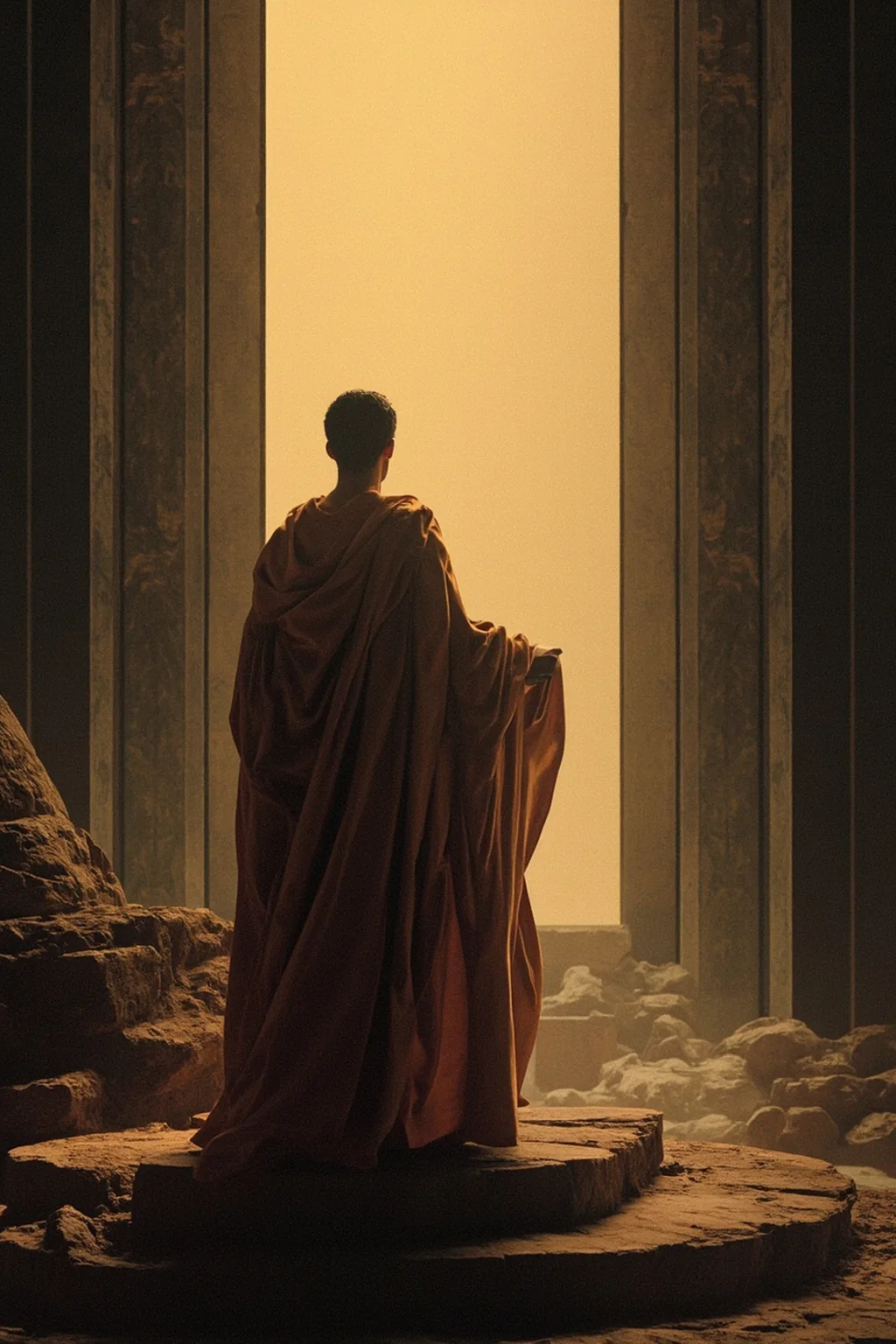
Written during military campaigns at the edges of the empire, the *Meditations* represent a private dialogue between a ruler and his conscience. Marcus Aurelius does not seek to teach a system, but to fortify his own mind against the corruption of power and the fear of death. The work moves from a catalog of gratitude to his teachers to a rigorous metaphysical examination of change, duty, and the rational soul, ultimately concluding that the good life consists in acting justly and accepting fate as a necessary part of the cosmic whole.
The final sections emphasize the unity of the rational mind and the cosmic perspective. Marcus states that the happiness of life consists in knowing thoroughly the true nature of everything—its matter and form—and with all one’s heart and soul ever doing that which is just and speaking the truth. What remains is to enjoy life in a coherent succession of good actions, one immediately succeeding another without interruption. He draws analogies from nature: there is one light of the sun, though intercepted by walls; one common substance of the world, though divided into bodies; and one common intellectual soul, though divided into innumerable essences. As the light and substance are one, so is the intellectual soul one. Every reasonable mind has a natural reference to whatever is of its own kind and desires to be united; this common affection cannot be intercepted by physical separation.
He asks what one desires: to live long? To enjoy the operations of the sensitive soul? To grow and decrease? To talk and reason? If these are found to be little worth in themselves, one should proceed to the last end: in all things to follow God and reason. To grieve that death deprives one of these things is against God and reason. Marcus reminds the reader of the small portion of vast and infinite eternity allowed to us, how soon it vanishes into the general age of the world, and what a small portion of the common substance and soul is allotted to us. In what a little clod of the earth do we crawl? Having considered this, one should fancy nothing else of weight but to do what one’s own nature requires and conform to the common nature.
The original text of this work is in the public domain. This page focuses on a guided summary article, reading notes, selected quotes, and visual learning materials for educational purposes.