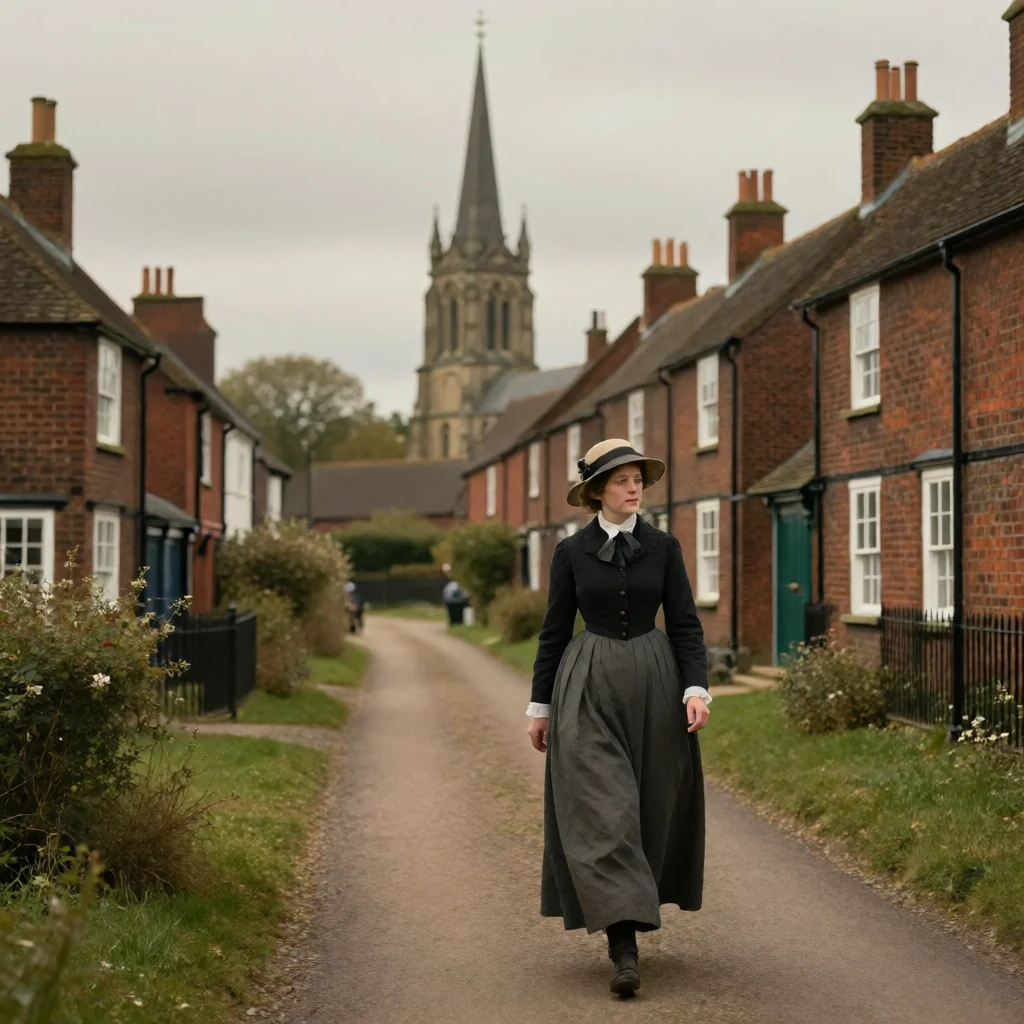
Lady Chettam’s Approval
In this section, Lady Chettam expresses her strong approval of Mr. Lydgate to Mr. Brooke, initially referring to him as her protégé before clarifying she only learned of him through a family connection. Mr. Brooke agrees Lydgate is likely to be an exceptional doctor, noting his new ideas about hospital ventilation and dietary care for patients.
Medical Knowledge at a Low Ebb
This section depicts local debate over Mr. Lydgate’s innovative medical approaches. Mr. Standish rejects untested new treatments, preferring long-established methods, while Mr. Bulstrode argues local medical knowledge is underdeveloped and supports Lydgate’s appointment to run the new hospital to advance care. Other locals, including the mayor Mr. Vincy, weigh in with their own preferences for treatment that avoids extreme weight loss.
Mr. Lydgate’s Impression of Miss Brooke
This section shares Mr. Lydgate’s perspective on his meeting with Miss Brooke. He finds her youthful and earnest, but frustrating to converse with, as she seeks rational explanations for issues she lacks the background to understand, defaulting to moral judgment instead. He views her engagement to the older, scholarly Mr. Casaubon as a poor match, and does not consider her his ideal type of woman, though he is young enough that his views may shift with experience. The section notes she will soon marry Casaubon and travel to Rome, so this is the last time Lydgate will encounter her as Miss Brooke.
CHAPTER XI.
This chapter, opening with a Ben Jonson epigram about comedy’s mirror of human folly, redirects attention from Dorothea Brooke to the budding entanglement between the young surgeon Lydgate and Rosamond Vincy. The narrative expands to survey the fluid social hierarchies of provincial Middlemarch before settling into the Vincy household, where a leisurely October morning brings family banter, gossip about the new doctor, and pointed speculation about Mary Garth’s place in Featherstone’s household.
Lydgate’s Fascination with Rosamond
Lydgate acknowledges to himself that he is fascinated by a woman strikingly unlike Dorothea Brooke. Though he insists he has not fallen in love, he pronounces Rosamond Vincy “grace itself” and “perfectly lovely and accomplished,” comparing her effect to exquisite music. Plain women he treats as objects of philosophical and scientific inquiry, but Rosamond possesses the true melodic charm. He plans not to marry for several years until he has forged his own path, contrasting his own poverty and ambition with Casaubon’s fortune and already-assembled reputation. Whereas Casaubon chose a wife to adorn his later course, Lydgate believes marriage is a more serious matter, and though he admires Dorothea’s beauty, he judges that she does not view things from the “proper feminine angle,” her company being more taxing than relaxing.
The Shifting Bounds of Provincial Society
The narrator observes that destinies intersect in stealthy, ironic ways, and old provincial society is no exception to this subtle movement. Beyond the spectacular downfalls of brilliant professional men, countless less dramatic shifts constantly redraw the boundaries of social intercourse, producing new awareness of interdependence. Some families rise while others slip, aspirates are lost or gained, fortunes shift, and even solidly entrenched households gradually assume new aspects. As savings-banks replace old stockings and the worship of the solar guinea fades, squires and lords acquire the faults of closer acquaintance, and settlers from distant counties bring alarming skill or offensive cunning. The narrator compares this mingling to Herodotus’s choice to begin his history with a woman’s lot, drawing a parallel between Io, beguiled by attractive merchandise, and Rosamond’s own susceptibility to finery.
Mrs. Lemon’s Star Pupil
Rosamond’s charming nymph-like figure and pure blondness give her exceptional range in the flow and color of drapery, but these are only part of her appeal. She stands as the acknowledged flower of Mrs. Lemon’s school, the chief in the county, whose curriculum extends even to the proper technique for entering and exiting a carriage. Mrs. Lemon herself has held up Miss Vincy as a paragon of mental acquisition, propriety of speech, and exceptional musical execution. The narrator concedes that we cannot control how people speak of us, and that any heroine described by Mrs. Lemon would likely seem unpoetical, but insists that the first sight of Rosamond would dispel any prejudice aroused by such praise.
The original text of this work is in the public domain. This page offers a compressed quick-read summary for educational purposes.