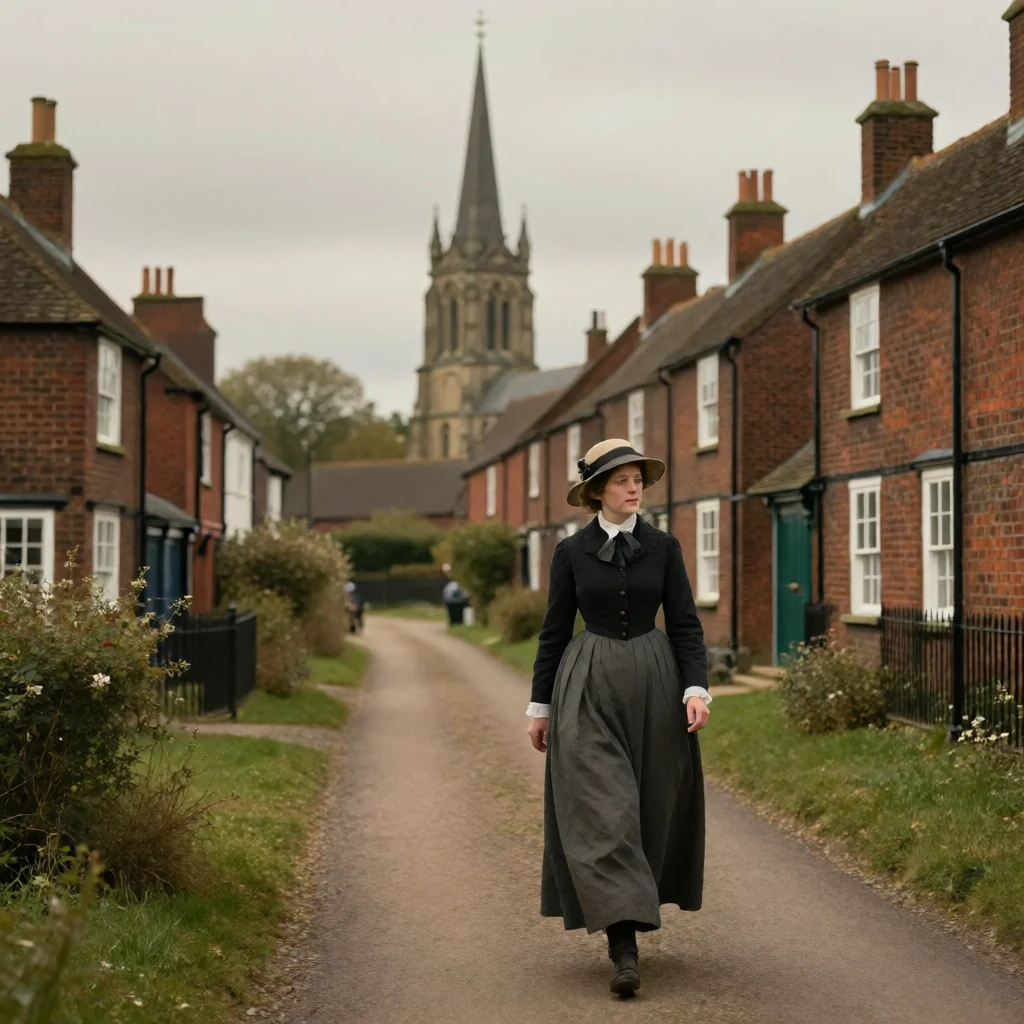
She locked herself in her room. She needed time to get used to her maimed consciousness before she could walk steadily to the place allotted her. A new searching light had fallen on her husband’s character, and she could not judge him leniently. The twenty years in which she had believed in him and venerated him by virtue of his concealments came back with particulars that made them seem an odious deceit. He had married her with that bad past life hidden behind him, and she had no faith left to protest his innocence of the worst that was imputed to him. Her honest ostentatious nature made the sharing of a merited dishonor as bitter as it could be to any mortal. But this imperfectly taught woman, whose phrases and habits were an odd patchwork, had a loyal spirit within her. The man whose prosperity she had shared through nearly half a life, now that punishment had befallen him it was not possible to her in any sense to forsake him. She knew, when she locked her door, that she should unlock it ready to go down to her unhappy husband and espouse his sorrow. But she needed time to gather up her strength; she needed to sob out her farewell to all the gladness and pride of her life. When she had resolved to go down, she prepared herself by some little acts which might seem mere folly to a hard onlooker; they were her way of expressing to all spectators visible or invisible that she had begun a new life in which she embraced humiliation. She took off all her ornaments and put on a plain black gown, and instead of wearing her much-adorned cap, she brushed her hair down and put on a plain bonnet-cap, which made her look suddenly like an early Methodist.
Bulstrode, who knew that his wife had been out and had come in saying she was not well, had spent the time in an agitation equal to hers. He had looked forward to her learning the truth from others. He felt himself perishing slowly in unpitied misery. It was eight o’clock in the evening before the door opened and his wife entered. He dared not look up at her. He sat with his eyes bent down. A movement of new compassion and old tenderness went through her like a great wave, and putting one hand on his which rested on the arm of the chair, and the other on his shoulder, she said solemnly but kindly, look up, Nicholas. He raised his eyes with a little start; her pale face, her changed mourning dress, the trembling about her mouth, all said, I know. He burst out crying and they cried together, she sitting at his side. They could not yet speak to each other of the shame which she was bearing with him, or of the acts which had brought it down on them. His confession was silent, and her promise of faithfulness was silent.
CHAPTER LXXV.
The chapter opens with Pascal’s maxim about the feeling of the falseness of present pleasures and the ignorance of the vanity of absent pleasures causing inconstancy. Rosamond had a gleam of returning cheerfulness when the house was freed from the threatening figure, and when all the disagreeable creditors were paid. But she was not joyous: her married life had fulfilled none of her hopes, and had been quite spoiled for her imagination. In this brief interval of calm, Lydgate, remembering that he had often been stormy in his hours of perturbation, was carefully gentle towards her; but he, too, had lost some of his old spirit. When she did not make this answer, she listened languidly, and wondered what she had that was worth living for. The hard and contemptuous words which had fallen from her husband in his anger had deeply offended that vanity which he had at first called into active enjoyment. She had felt stung and disappointed by Will’s resolution to quit Middlemarch; Rosamond being one of those women who live much in the idea that each man they meet would have preferred them if the preference had not been hopeless. Men and women make sad mistakes about their own symptoms, taking their vague uneasy longings, sometimes for genius, sometimes for religion, and oftener still for a mighty love. The change she now most longed for was that Lydgate should go to live in London; everything would be agreeable in London. She had set to work with quiet determination to win this result, when there came a sudden, delightful promise which inspirited her. It came shortly before the memorable meeting at the town-hall, and was nothing less than a letter from Will Ladislaw to Lydgate, mentioning incidentally that he might find it necessary to pay a visit to Middlemarch within the next few weeks. While Lydgate was reading the letter to Rosamond, her face looked like a reviving flower. There was nothing unendurable now: the debts were paid, Mr. Ladislaw was coming, and Lydgate would be persuaded to leave Middlemarch.
But soon the sky became black over poor Rosamond. The presence of a new gloom in her husband soon received a painfully strange explanation, alien to all her previous notions of what could affect her happiness. She chose, a few days after the meeting, to send out notes of invitation for a small evening party, feeling convinced that this was a judicious step. But all the invitations were declined, and the last answer came into Lydgate’s hands. He said, why on earth have you been sending out invitations without telling me, Rosamond? I beg, I insist that you will not invite any one to this house. Rosamond’s thought was that he was getting more and more unbearable. He was in ignorance of everything connected with the thousand pounds except that the loan had come from her uncle Bulstrode. It was after the dinner hour, and she found her father and mother seated together alone in the drawing-room. They greeted her with sad looks, saying well, my dear, and no more. Her father told her everything, saying at the end, it’s better for you to know, my dear. The shock to Rosamond was terrible. It seemed to her that no lot could be so cruelly hard as hers to have married a man who had become the centre of infamous suspicions. All the shame seemed to be there. She showed her usual reticence to her parents, and only said that if Lydgate had done as she wished he would have left Middlemarch long ago.
The original text of this work is in the public domain. This page focuses on a guided summary article, reading notes, selected quotes, and visual learning materials for educational purposes.