Preliminaries of Marriage
Mr. Casaubon’s arrangements regarding the marriage settlements satisfy Mr. Brooke, and the practical preliminaries of the wedding proceed smoothly, shortening the weeks of courtship. The narrator observes that brides traditionally dictate changes to their future homes before marriage in order to develop an appetite for submission afterward, though the freedom of having one’s own way often leads to mistakes.
Arrival at Lowick Manor
On a dry, gray November morning, Dorothea, Celia, and Mr. Brooke travel together to Lowick to inspect Mr. Casaubon’s home. The manor-house, inherited by Casaubon after his brother’s death, is situated near a small church and an old parsonage, forming the center of the estate.
The House and Grounds
The manor sits within a small park featuring scattered oaks and a southwest avenue of limes. From the drawing-room windows, the lawn slopes uninterruptedly toward fields of corn and pasture that often seem to melt into a lake at sunset. The south and east sides, by contrast, look melancholy, with confined grounds, neglected flower-beds, and towering somber yews. Built of greenish stone in the old English style, the small-windowed house requires children, flowers, and bright openings to feel joyful. In late autumn, with yellow leaves drifting across dark evergreens, the estate takes on an air of decline that suits Mr. Casaubon’s own lack of bloom.
Celia’s Disappointment
Celia privately despairs at the house, comparing it unfavorably to Freshitt Hall with its white freestone, pillared portico, flowered terrace, and Sir James Chettam. She prefers light, pleasant, common-sensible men to scholars, and is glad that Casaubon’s tastes pointed him instead toward Dorothea.
Dorothea’s Approval
Dorothea finds both the house and grounds entirely to her liking. The aged library, time-faded carpets, antique maps, and old vases feel cheerful to her, in stark contrast to the puzzling classical casts and Renaissance pictures Mr. Brooke brought back from his travels. She walks through the home with delighted, reverent emotion, accepting everything as it stands, trusting that the life awaiting her here will be one of worthy devotion.
The Boudoir
Mr. Casaubon, wishing to honor what he imagines are Dorothea’s feminine preferences, invites her to choose her own boudoir. She declines, preferring to let all arrangements remain as they are, content to fit herself to his existing life. Celia, however, suggests the bow-windowed room upstairs.
The Miniatures
In the faded blue bow-windowed room, a group of miniatures shows ladies and gentlemen in powdered hair. Dorothea identifies Mr. Casaubon’s mother, whose tiny portrait she had seen before, and observes that the elder sister beside her is plain, with deep gray eyes, an irregular nose, and a peculiar rather than pretty face. Celia finds the mother less attractive, and Dorothea notes there is no family resemblance between the sisters.
Aunt Julia
Dorothea learns that the elder sister, Mr. Casaubon’s aunt, made an unfortunate marriage and was never seen by her nephew. The remark leaves the family history tinged with an unexamined sadness, though Dorothea feels it indelicate to press for details and turns to admire the view of the lime avenue instead.
The Garden Walk
Proceeding through the grounds toward the church, the party pauses at the gate while Mr. Casaubon fetches the key from the parsonage. In his absence, Celia mentions having glimpsed a young man, not a gardener but a gentleman with a sketch-book and light-brown curls, walking nearby.
Mr. Tucker
Mr. Casaubon returns accompanied by Mr. Tucker, the middle-aged curate, whom he introduces. Tucker is old and musty-looking, with an unpleasant mouth, and Celia privately disapproves of him. The conversation, however, centers on the village rather than the curate’s family, and the mysterious youthful figure is forgotten by all but Celia.
The Village of Lowick
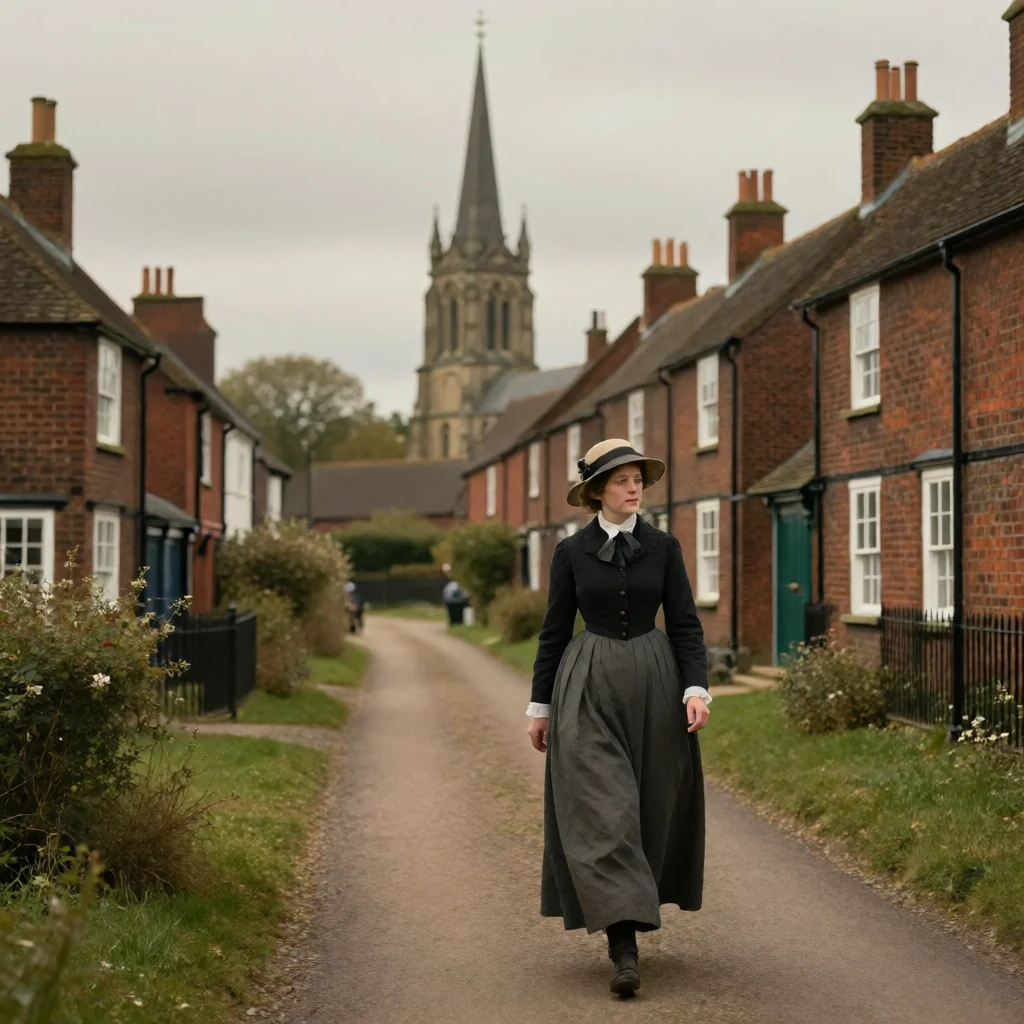
During their walk, the curate answers Dorothea’s questions about the parishioners. The villagers of Lowick are comfortably off, with double cottages, pigs, well-tended gardens, sturdy corduroy for the boys, and tidy servant girls; there are no looms, no Dissent, and not much vice, though the public temper leans toward saving rather than spirituality.
The original text of this work is in the public domain. This page offers a compressed quick-read summary for educational purposes.