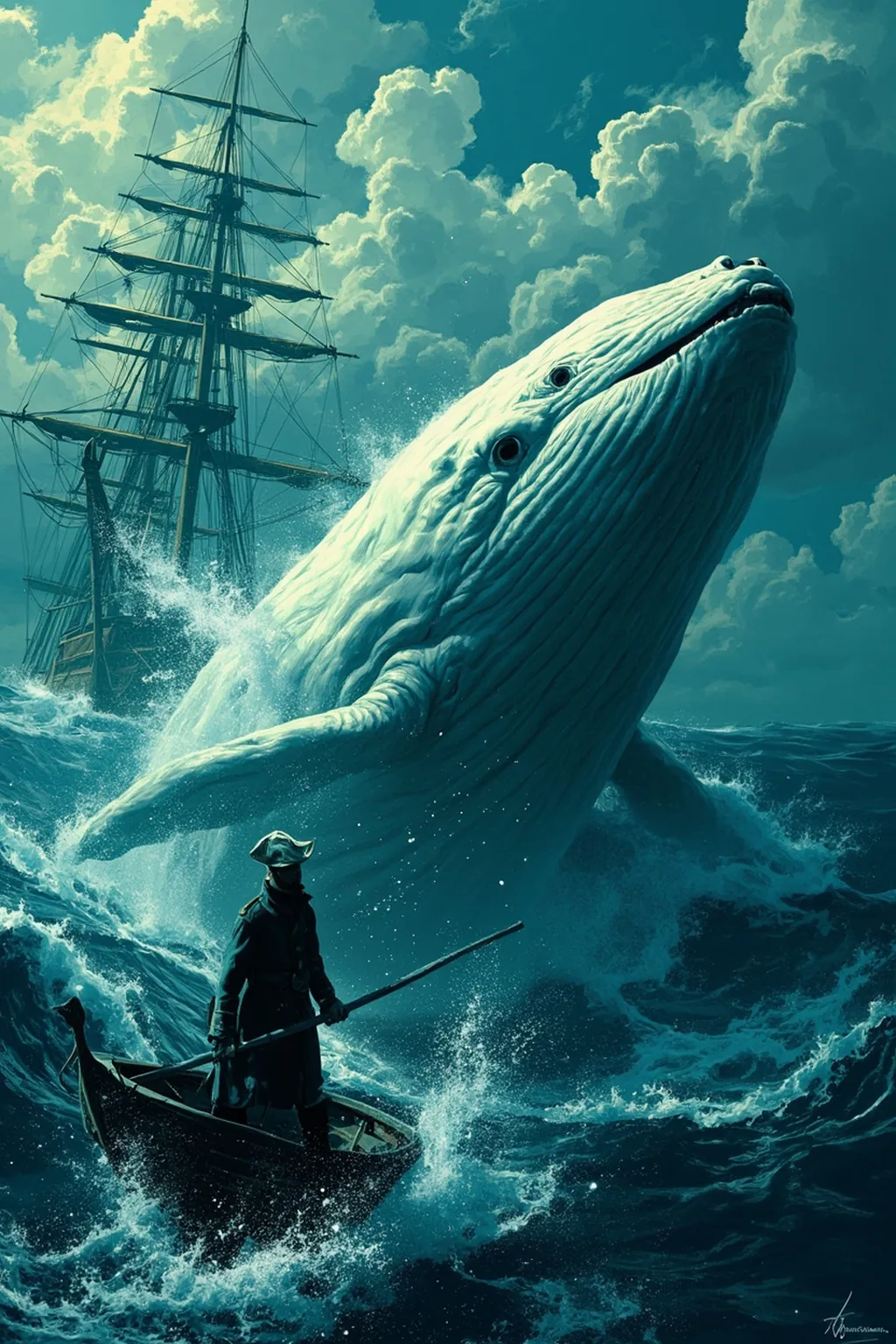
Boarding the Moss, Sailing the Acushnet River, and Reflections on New Bedford’s Whaling Industry
After paying passage and securing their luggage, they board the schooner Moss. As the vessel glides down the Acushnet River, New Bedford rises on one side in terraces of streets with ice-covered trees glittering in the cold air. The wharves are piled with enormous hills and mountains of casks, while whale ships lie silent and safely moored alongside others from which sounds of carpenters and coopers emerge, accompanied by the blended noises of fires and forges melting pitch. All of this betokens that new cruises are beginning, for when one perilous voyage ends, another immediately begins, and then another after that—an endless, eternal cycle of whaling effort.
Sailing Open Water, Ishmael’s Exhilaration, and the Mocking Greenhorn Incident
As they gain more open water and the bracing breeze waxes fresh, Ishmael experiences a rush of exhilaration, snuffing the Tartar air and spurning the common earth with its marks of slavish heels and hoofs, turning instead to admire the magnanimity of the sea. So caught up are they in the reeling scene that they initially fail to notice the jeering glances of fellow passengers who marvel that two beings should be so companionable—as though a white man were anything more dignified than a whitewashed negro. When Queequeg catches one young bumpkin mimicking him behind his back, he drops his harpoon and catches the fellow in his arms, sending him high into the air with almost miraculous strength. The man lands on his feet, breathless but unharmed, after Queequeg gently taps his stern during a mid-somerset descent. Queequeg then turns his back, lights his tomahawk pipe, and offers it to Ishmael for a puff.
Boom Accident, Queequeg’s Rescue of the Greenhorn, and Ishmael’s Loyalty to Queequeg
The greenhorn immediately runs to the captain to report the incident, but before matters can escalate, disaster strikes. The main-sail’s weather-sheet parts under prodigious strain, and the tremendous boom flies wildly from side to side, completely sweeping the after part of the deck. The same passenger whom Queequeg had handled roughly is swept overboard, and all hands panic as the boom threatens to snap into splinters. In the midst of this chaos, Queequeg drops to his knees, crawls under the boom’s path, and secures a rope to the bulwarks, then lassos the boom as it sweeps overhead, trapping the spar and securing safety. The greenhorn is recovered and restored to health. The captain apologizes to Queequeg, and all hands vote him a noble trump. From that hour, Ishmael clings to Queequeg like a barnacle, a loyalty that endures until Queequeg takes his last long dive. Notably, Queequeg shows no consciousness of deserving medals from Humane and Magnanimous Societies—he merely asks for fresh water to wipe off the brine, then dresses, lights his pipe, and seems to say to himself that it is a mutual, joint-stock world, and that cannibals must help Christians.
CHAPTER 14. Nantucket.
This chapter describes the narrator’s arrival at Nantucket after a fine run, introducing the island through a series of playful anecdotes and contrasts that establish its unique character as a remote, sandy outpost distinctly different from places like Illinois.
Nantucket Geography and Local Anecdotes
Nantucket occupies a solitary position off the shore, described as more lonely than the Eddystone lighthouse. The island is characterized as a mere hillock and elbow of sand with no background, composed almost entirely of beach. The narrator employs humorous exaggeration to emphasize the abundance of sand, claiming there is more than would be used in twenty years as blotting paper. Various whimsical anecdotes follow: residents must plant weeds since they don’t grow naturally, import Canada thistles, send beyond seas for a spile to repair oil casks, and treasure pieces of wood like relics of the true cross in Rome. Additional playful details include planting toadstools for shade, one blade of grass constituting an oasis, wearing quicksand shoes like Laplander snow-shoes, and finding small clams adhering to furniture as they would to sea turtles. These extravaganzas serve to illustrate that Nantucket is fundamentally different from the prairie states.
The original text of this work is in the public domain. This page offers a compressed quick-read summary for educational purposes.