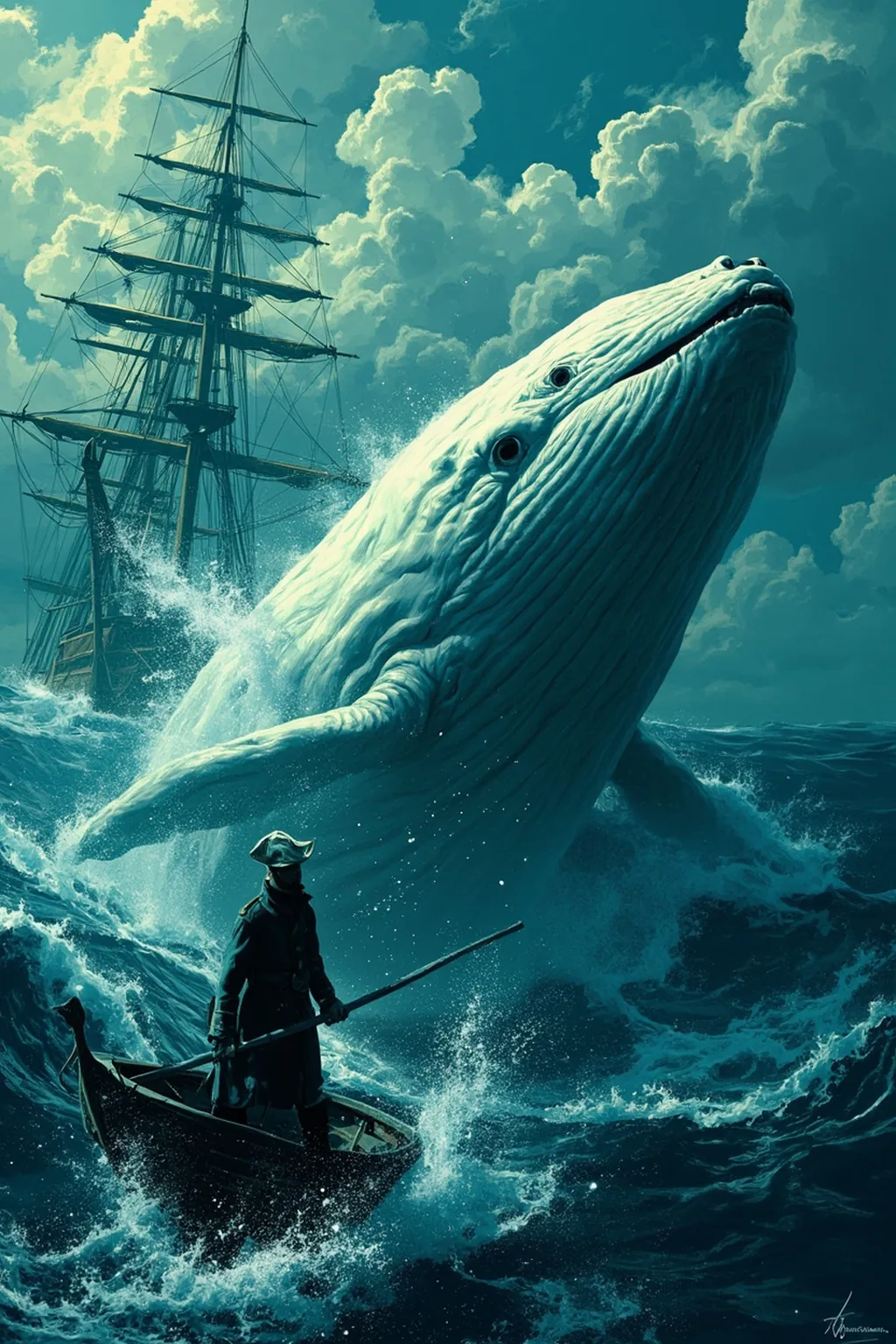
First Sighting of Captain Ahab on the Quarterdeck
On a grey, transition morning with a fair wind, as the Pequod rushes through the water with vindictive rapidity, the narrator ascends to the deck at the call of the forenoon watch. As he levels his glance toward the taffrail, foreboding shivers run over him. Reality outruns apprehension: Captain Ahab stands upon his quarter-deck. There appeared to be no sign of common bodily illness about him, nor of recovery from any—he seems a man cut away from the stake, where fire has overrunningly wasted all the limbs without consuming them. His whole high, broad form seems made of solid bronze, shaped in an unalterable mould like Cellini’s cast Perseus.
Ahab’s Physical Description: Livid Scar and Ivory Prosthetic Leg
Threading its way from among his grey hairs and continuing down one side of his tawny, scorched face and neck, a slender rod-like mark stretches in a lividly whitish line. This mark resembles the perpendicular seam made in a great tree when lightning tears down it, peeling and grooving out the bark from top to bottom while leaving the tree still greenly alive but branded. The origin of this mark—whether born with him or the scar of a desperate wound—remains uncertain. Superstitious crew members offer conflicting accounts: an old Gay-Head Indian claims Ahab was branded at forty in an elemental strife at sea, while a grey Manxman suggests a birth-mark covers him from crown to sole. The narrator also notes the barbaric white leg upon which Ahab partly stands—an ivory prosthetic fashioned from the polished bone of a sperm whale’s jaw. As one crew member observed: “He was dismasted off Japan… but like his dismasted craft, he shipped another mast without coming home for it. He has a quiver of ’em.”
Ahab’s Fixed Pivot-Hole Posture and Commanding Demeanor
The narrator is struck by Ahab’s singular posture. On each side of the Pequod’s quarter deck, near the mizzen shrouds, auger holes are bored into the planks. Ahab steadies his bone leg in one of these holes, one arm elevated and holding by a shroud, standing erect and looking straight out beyond the ship’s ever-pitching prow. An infinity of firmest fortitude, a determinate unsurrenderable wilfulness, emanates from the fixed and fearless forward dedication of his gaze. He speaks no word; his officers say nothing to him, yet through their minutest gestures and expressions, they plainly show the uneasy consciousness of being under a troubled master-eye. The narrator perceives in Ahab’s face something of the crucifixion—some mighty woe expressed in nameless regal overbearing dignity.
Ahab’s Gradual Increase in Deck Visibility
After his first morning appearance, Ahab withdraws into his cabin, but every subsequent day he becomes visible to the crew. He is seen either standing in his pivot-hole, seated upon an ivory stool, or heavily walking the deck. As the sky grows less gloomy, Ahab becomes less and less a recluse, as if the dead wintry bleakness of the sea had initially kept him so secluded. Eventually he is almost continually in the air, on deck—yet for all his silence and lack of perceptible action, he seems as unnecessary there as another mast. The narrator observes that since the Pequod is merely making a passage rather than cruising, and since the mates are fully competent to handle whaling preparations, there is little to employ or excite Ahab, allowing the clouds that layer upon layer are piled upon his brow to remain undisturbed.
Warm Weather’s Subtle Softening of Ahab’s Grim Demeanor
Ere long, the warm, warbling persuasiveness of pleasant holiday weather seems gradually to charm Ahab from his mood. The narrator draws an analogy: as when April and May trip home to the wintry, misanthropic woods, even the barest, ruggedest, most thunder-cloven old oak will send forth green sprouts to welcome such glad-hearted visitants—so Ahab does, in the end, respond a little to the playful allurings of that girlish air. More than once he puts forth the faint blossom of a look, which in any other man would have soon flowered out in a smile. This subtle softening in Ahab’s grim demeanor suggests the beginning of a thaw in his formidable exterior as the voyage progresses into warmer waters.
The original text of this work is in the public domain. This page offers a compressed quick-read summary for educational purposes.