The Chick Pecks the Shell
Stubb whispers to Flask, noting the intensity within Ahab, saying “the chick that’s in him pecks the shell”—that his inner thought is about to emerge into action. The hours wear on with this tension building, Ahab shuttling between his cabin and the deck, his expression showing intense bigotry of purpose.
The Summons Aft
Near the close of day, Ahab halts by the bulwarks, inserts his bone leg into an auger-hole for stability, and orders Starbuck to send everybody aft. Starbuck is astonished at this unusual order, as such commands are given only in extraordinary circumstances. Ahab repeats the command, calling down the mast-heads as well. When the entire ship’s company assembles, they regard him with curious and somewhat apprehensive faces, for his appearance resembles a weather horizon before a storm.
The Interrogation
Ahab stands apart, ignoring the assembled crew and resuming his heavy pacing with bent head and half-slouched hat. After allowing them to whisper in wonder, he stops abruptly and asks what they do when they see a whale. The crew responds with enthusiasm that they sing out and then lower away to pursue it. He asks what tune they pull to, and they answer “A dead whale or a stove boat!” The more strange and fierce the questions become, the more glad and approving Ahab becomes, his countenance growing more animated with each response, to the mariners’ own surprise at their own excitement.
The Gold Coin
Ahab produces a Spanish gold coin—a sixteen-dollar piece—and orders Starbuck to fetch a top-maul. Without speaking, he slowly rubs the gold piece against his jacket, heightening its luster while humming to himself in a strangely muffled, mechanical way, as if the wheels of his vitality are turning. With the hammer in hand, he advances to the main-mast holding up the gold to the sun, proclaiming that whoever raises him a white-headed whale with a wrinkled brow and crooked jaw, with three holes in his starboard fluke, shall receive this gold ounce.
The Bounty
The seamen hail the act with “Huzza!” as Ahab nails the gold piece to the mast. He reiterates that it is a white whale, ordering them to skin their eyes for him, look sharp for white water, and sing out if they see even a bubble. Tashtego, Daggoo, and Queequeg watch with even more intense interest than the rest, particularly when Ahab mentions the wrinkled brow and crooked jaw—they seem to have specific recollections of this whale.
Moby Dick Identified
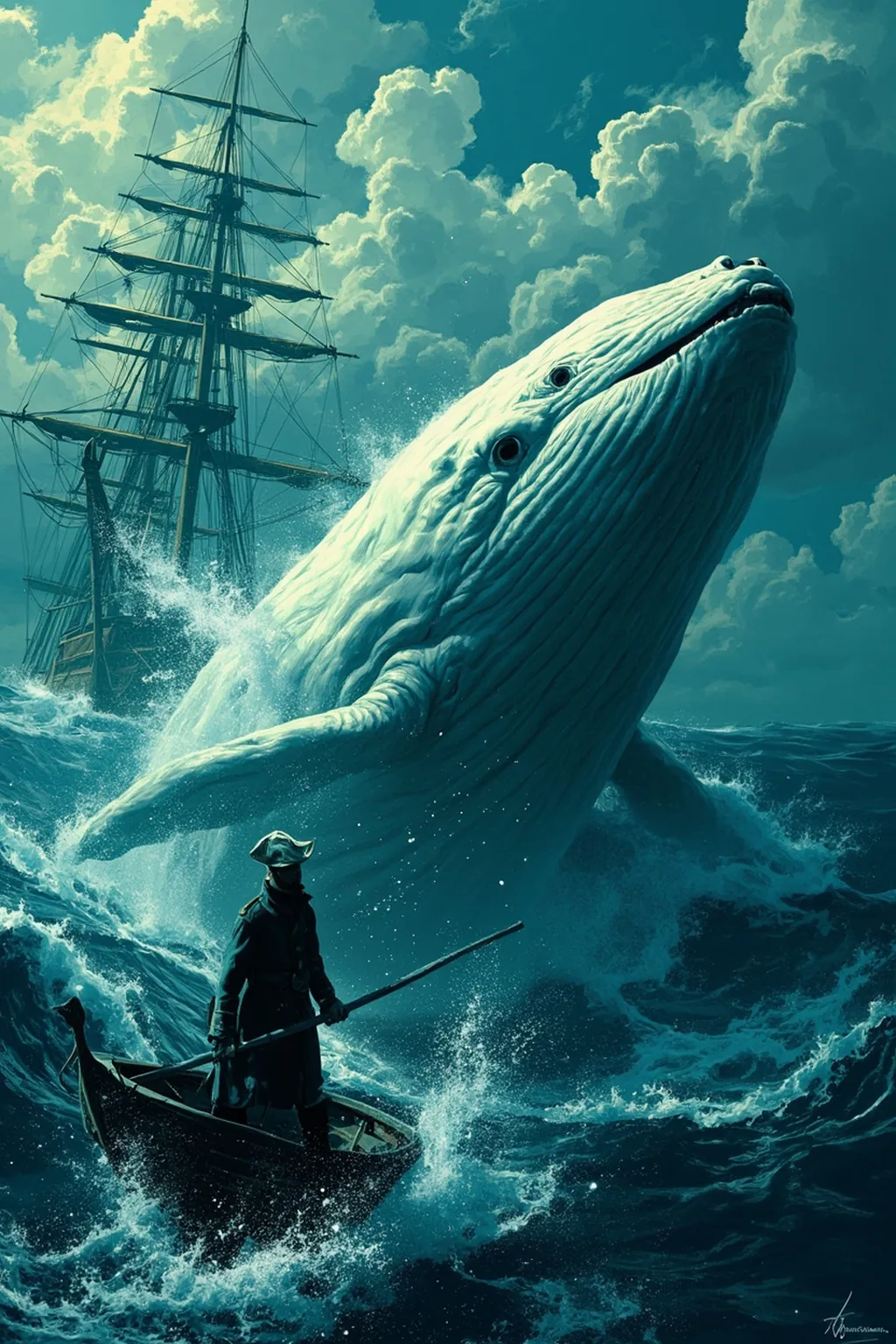
Tashtego asks if this is the whale some call Moby Dick. Ahab seizes on this, questioning them to confirm they know this whale. Tashtego asks if it fan-tails before diving, Daggoo inquires about its bushy spout, and Queequeg describes the many irons twisted and wrenched in its hide, comparing it to a corkscrew. Ahab confirms all these details, identifying the spout as like a shock of wheat, white as Nantucket wool after the sheep-shearing, and its tail like a split jib in a squall. He declares that this is indeed Moby Dick they have seen.
The Lost Leg
Starbuck, who has been watching with increasing surprise, asks if it was Moby Dick that took off Ahab’s leg. Ahab demands who told him this, then confirms it: Moby Dick dismasted him, Moby Dick brought him to this dead stump he stands on. He shouts with a terrific, loud, animal sob like a heart-stricken moose that it was that accursed white whale that razeed him and made a poor pegging lubber of him forever and a day.
The Vow of Vengeance
Ahab tosses both arms aloft and declares with measureless imprecations that he will chase Moby Dick round Good Hope, round the Horn, round the Norway Maelstrom, and round perdition’s flames before he gives him up. He declares that this is what they have shipped for—to chase that white whale on both sides of land and over all sides of earth till he spouts black blood and rolls fin out. He asks if they will splice hands on it, saying he thinks they look brave.
The original text of this work is in the public domain. This page offers a compressed quick-read summary for educational purposes.