CHAPTER 81. The Pequod Meets The Virgin.
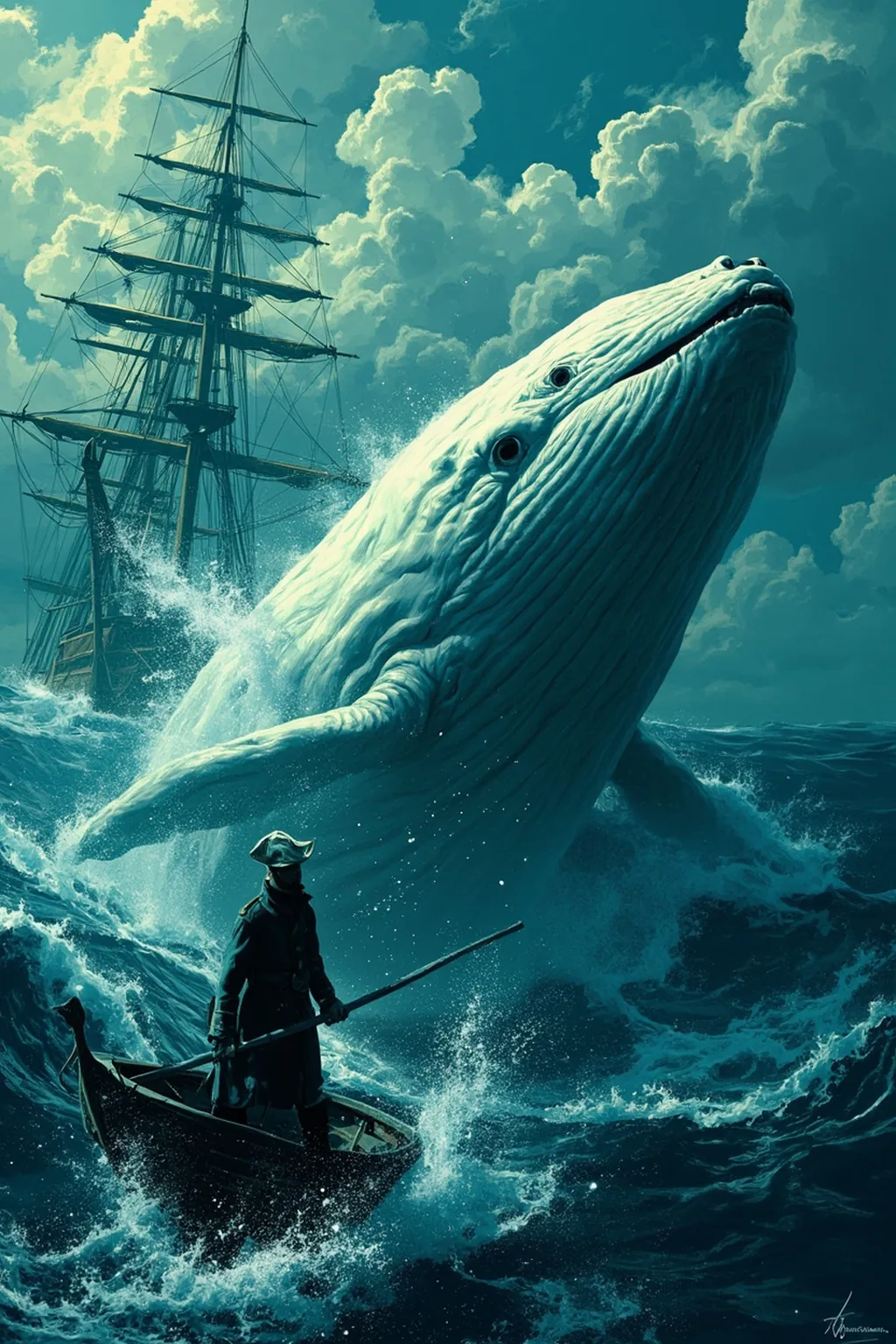
The predestinated day arrived, and the Pequod met the Jungfrau, the Virgin, a German whaler out of Bremen captained by Derick De Deer. The Dutch and Germans were once the greatest whalers, but now rare sights. The Jungfrau rounded to and lowered a boat, but when the ladder was rigged, Derick waved it off, holding up a lamp-feeder and oil can. His ship was “clean”—empty, his lamp-feeders dry, nights spent in darkness. Ahab asked if he had seen the White Whale; Derick had not. He took oil and rowed back; no sooner aboard than both ships raised whales. Derick chased a pod of eight; the Pequod went after a huge, jaundiced bull whale, slow, missing a starboard fin, spout short and choking. “He’s got half an acre of stomach-ache,” Stubb joked. “Wait a bit, old chap, and I’ll give ye a sling for that wounded arm.”
The three Pequod boats closed on the bull, but Derick’s boat was ahead, mocking them, shaking his lamp-feeder, throwing his oil can. “The ungracious dog!” Starbuck cursed. “Give way, greyhounds! Don’t let that Yarman beat you!” The three harpooneers darted their irons all at once, the bars flying over the German harpooneer’s head, sending Derick and his man spilling from their boat as the Pequod’s keels bumped past. The whale sounded, lines gouging the loggerheads, boats pulled down until gunwales were almost awash. Then the lines vibrated; the whale rose, exhausted, blind, eyes gone, one fin flailing. Flask wanted to lance him, but Starbuck held back—too late; Flask’s lance found a sore, the creature spouted thick blood, capsized Flask’s boat, then rolled over dead.
They secured the carcass, but it began to sink, pulling the Pequod over until her deck sloped like a gabled roof, ivory inlay popping from the bulwarks. The fluke chains would not budge. “Cut the chains!” Stubb yelled. Queequeg seized the carpenter’s axe, leaned from a porthole, slashed at the iron until the strain broke the rest. The ship righted; the carcass sank. Why some whales sink even in health is a mystery, but no time to puzzle: the Jungfrau was lowering boats again, chasing a Fin-Back. Derick and his four boats raced after it and disappeared over the horizon. “Oh! many are the Fin-Backs, and many are the Dericks, my friend,” the narrator murmured, as the Pequod sailed on.
CHAPTER 82. The Honor and Glory of Whaling.
The more I dive into the matter of whaling, the more am I impressed with its great honorableness and antiquity. So many demi-gods and heroes, prophets of all sorts, have shed distinction upon it that I am transported with the reflection that I myself belong, though but subordinately, to so emblazoned a fraternity. The gallant Perseus, a son of Jupiter, was the first whaleman; and to the eternal honor of our calling be it said, that the first whale attacked by our brotherhood was not killed with any sordid intent. Those were the knightly days of our profession, when we only bore arms to succor the distressed. Every one knows the fine story of Perseus and Andromeda; how the lovely Andromeda was tied to a rock on the sea-coast, and as Leviathan was in the very act of carrying her off, Perseus, the prince of whalemen, intrepidly advancing, harpooned the monster, and delivered and married the maid. The Romans carried that very skeleton to Italy in triumph when they took Joppa. And what seems most singular and suggestively important in this story is this: it was from Joppa that Jonah set sail. Akin to the adventure of Perseus is that famous story of St. George and the Dragon; which dragon I maintain to have been a whale. The true form of the whale was unknown to artists in those times, and the animal ridden by St. George might have been only a large seal. Thus, then, one of our own noble stamp, even a whaleman, is the tutelary guardian of England; and by good rights, we harpooneers of Nantucket should be enrolled in the most noble order of St. George. As for Hercules, I claim him for one of our clan, even if the Grecian story is considered derived from the more ancient Hebrew story of Jonah. Nor do heroes, saints, demigods, and prophets alone comprise the whole roll of our order. Our grand master is still to be named; we find the head waters of our fraternity in nothing short of the great gods themselves. That wondrous oriental story is now to be rehearsed from the Shaster, which gives us the dread Vishnoo, who, by the first of his ten earthly incarnations, has for ever set apart and sanctified the whale. When Brahma resolved to recreate the world, he gave birth to Vishnoo, but the sacred Vedas were lying at the bottom of the waters; so Vishnoo became incarnate in a whale, and sounding down in him to the uttermost depths, rescued the sacred volumes. Was not this Vishnoo a whaleman, then? Perseus, St. George, Hercules, Jonah, and Vishnoo! there’s a member-roll for you!
The original text of this work is in the public domain. This page focuses on a guided summary article, reading notes, selected quotes, and visual learning materials for educational purposes.