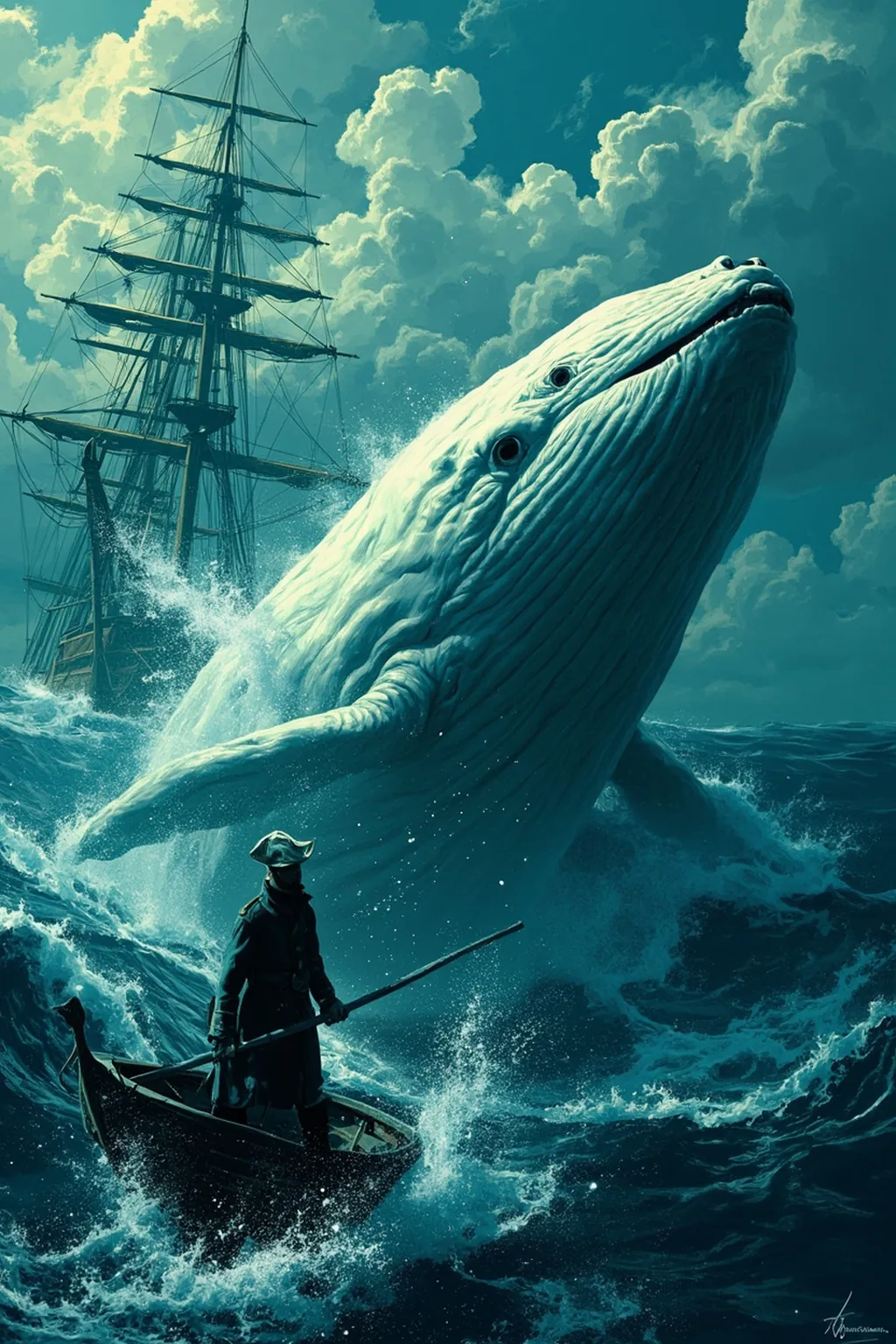
Ahab’s Monomaniacal Obsession With Moby Dick
The loss of his leg transformed Ahab’s anger at Moby Dick into a consuming monomania. During the long, painful voyage back to port after the attack, his physical agony and mental distress merged, driving him to brief bouts of raving madness. Though he appeared to recover his composure as the ship sailed through warmer waters, his obsession only deepened and contracted, focusing all his vast intellect and strength on the single goal of destroying Moby Dick, whom he came to see as the physical embodiment of all evil and suffering in the world.
CHAPITRE 41. Moby Dick.
This chapter details Captain Ahab’s hidden monomaniacal obsession with hunting the white whale Moby Dick, his carefully constructed public performance of grief over his lost leg, the Nantucket community’s widespread misperception of his fitness to lead the Pequod, the moral weakness of the ship’s crew that leaves them open to aligning with his rage, and Ishmael’s own capitulation to the hunt’s momentum.
Ahab’s Concealed Madness and Public Grief
Ahab internally acknowledges that while his methods and resources are rational, his core motive and target are mad, and he is powerless to change or escape this obsession. He successfully hides his inner torment from the public, so when he returns to Nantucket with his ivory prosthetic leg, islanders believe he is only experiencing natural, intense grief over his severe injury. His reported delirium at sea and the brooding moodiness that plagued him in the lead-up to the Pequod’s departure are also popularly attributed to his physical trauma rather than his hidden vengeful fixation.
Perceptions of Ahab’s Fitness for Whaling
The pragmatic, profit-focused people of Nantucket do not see Ahab’s dark moods and past delirium as reasons to distrust his ability to command a whaling voyage. Instead, they believe his rage and edginess make him uniquely well-suited for the violent, brutal work of whale hunting, reasoning that even if he were physically incapacitated, he would be supremely capable of directing his crew to carry out the attack.
Ahab’s Singular White Whale Revenge Quest
Ahab has deliberately chosen to sail on the Pequod with the single, all-consuming objective of hunting Moby Dick to exact an unrelenting, supernatural revenge for the whale taking his leg. He conceals this goal from those on shore, and if any of his old acquaintances had even half guessed the depth of his obsession, they would have seized control of the ship to stop his fiendish mission, as he prioritizes this personal vengeance over the profitable whaling cruise the crew expected.
The Pequod Crew’s Moral Compromise
The Pequod’s crew is largely composed of mongrel renegades, castaways, and cannibals, and its officer corps is morally compromised: Starbuck’s unassisted virtue is insufficient to counter Ahab’s influence, Stubb’s reckless indifference leaves him unmoored from moral judgment, and Flask’s pervasive mediocrity fails to provide steady leadership. This flawed, morally weakened crew, paired with Ahab’s command, appears to have been selected by dark fate to enable his monomaniacal quest for revenge.
Crew Alignment with Ahab’s Rage
The crew responds to Ahab’s rage in overwhelming measure, with their souls seemingly taken over by the same hatred of Moby Dick that drives Ahab, to the point that the whale becomes their shared, insufferable enemy. Ishmael notes that he cannot fully explain how this alignment came to pass, or what unconscious, symbolic role the whale plays as a gliding great demon of the seas of life for the crew, a mystery he cannot unpack.
Ishmael’s Submission to the Whale Hunt
Ishmael uses the metaphor of a small skiff towed by a massive warship unable to resist being pulled, and an underground miner’s pick leading to an unknown destination, to describe the crew’s irresistible pull toward the whale hunt. He admits he surrendered himself to the abandon of the time and place, and even as he rushed to confront the whale, he could see only the creature as the embodiment of the deadliest ill.
The original text of this work is in the public domain. This page focuses on a guided summary article, reading notes, selected quotes, and visual learning materials for educational purposes.