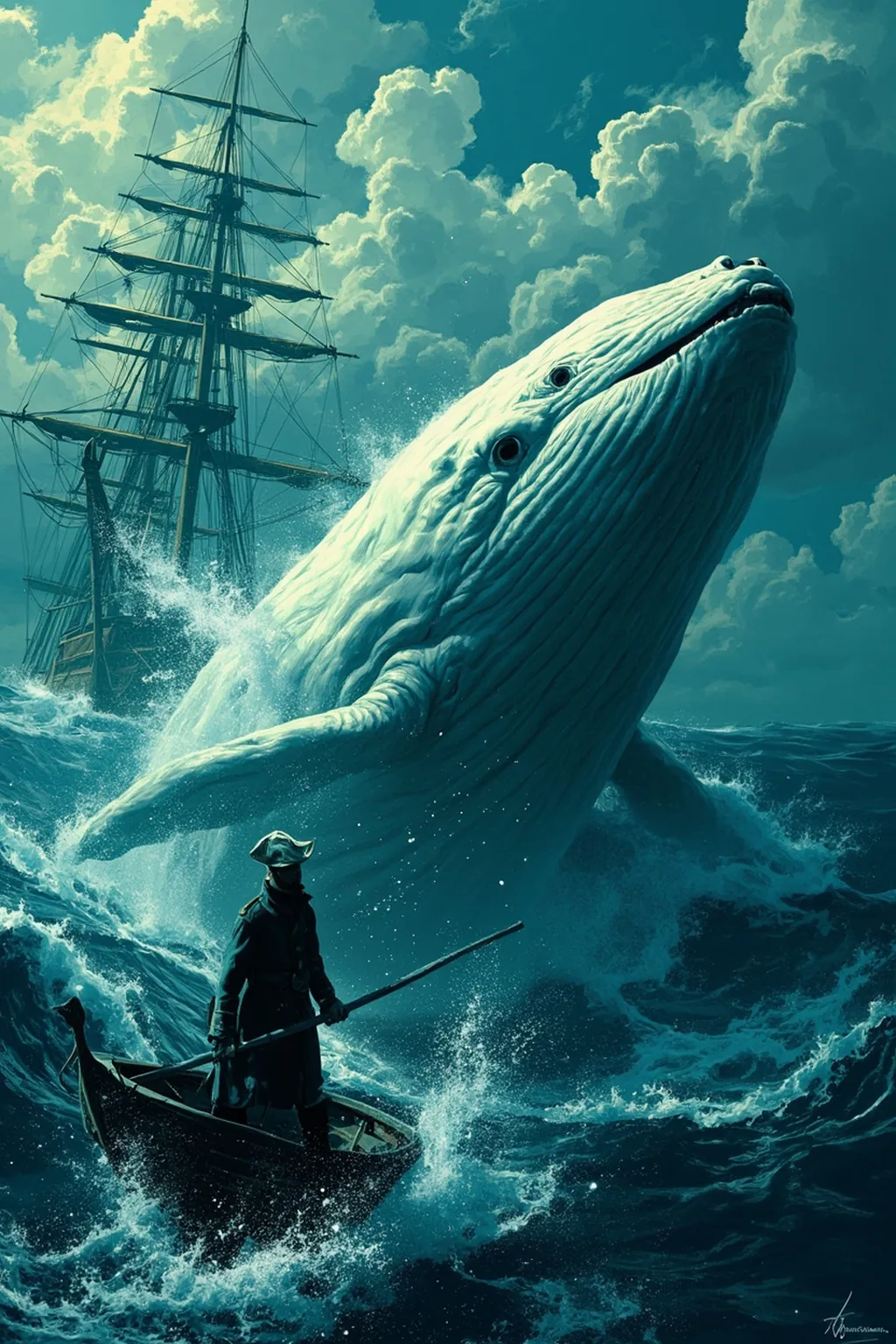
CHAPTER 87. The Grand Armada.
The long and narrow peninsula of Malacca forms the most southerly point of all Asia. This rampart is pierced by several sally-ports for the convenience of ships and whales; conspicuous among which are the straits of Sunda and Malacca. With a fair, fresh wind, the Pequod was now drawing nigh to these straits; Ahab purposing to pass through them into the Javan sea, and thence, cruising northwards, sweep inshore by the Philippine Islands, and gain the far coast of Japan. Time out of mind the piratical proas of the Malays, lurking among the low shaded coves and islets of Sumatra, have sallied out upon the vessels sailing through the straits, fiercely demanding tribute. With a fair, fresh wind, the Pequod was now drawing nigh to these straits. Not a single jet was descried. Almost renouncing all thought of falling in with any game hereabouts, the ship had well nigh entered the straits, when the customary cheering cry was heard from aloft, and ere long a spectacle of singular magnificence saluted us. Owing to the unwearied activity with which of late they have been hunted, the Sperm Whales, instead of almost invariably sailing in small detached companies, as in former times, are now frequently met with in extensive herds, sometimes embracing so great a multitude. Broad on both bows, at the distance of some two or three miles, a continuous chain of whale-jets were up-playing and sparkling in the noon-day air. Crowding all sail the Pequod pressed after them; the harpooneers handling their weapons, and loudly cheering. Corresponding to the crescent in our van, we beheld another in our rear. It seemed formed of detached white vapors. “Aloft there, and rig whips and buckets to wet the sails;—Malays, sir, and after us!” Ahab to-and-fro paced the deck. The harpooneers seemed more to grieve that the swift whales had been gaining upon the ship. The herd, by some presumed wonderful instinct of the Sperm Whale, became notified of the three keels that were after them. Stripped to our shirts and drawers, we sprang to the white-ash, and after several hours’ pulling were almost disposed to renounce the chase, when a general pausing commotion among the whales gave animating token that they were now at last under the influence of that strange perplexity of inert irresolution, which, when the fishermen perceive it in the whale, they say he is gallied. The compact martial columns broke up in one measureless rout. In about three minutes’ time, Queequeg’s harpoon was flung; the stricken fish darted blinding spray in our faces, and then running away with us like light, steered straight for the heart of the herd. Not a bit daunted, Queequeg steered us manfully. All whaleboats carry certain curious contrivances, originally invented by the Nantucket Indians, called druggs. Two thick squares of wood of equal size are stoutly clenched together; a line of considerable length is then attached to the middle of this block. It is chiefly among gallied whales that this drugg is used. Our boat was furnished with three of them. The first and second were successfully darted. So that when at last the jerking harpoon drew out, and the towing whale sideways vanished, then, with the tapering force of his parting momentum, we glided between two whales into the innermost heart of the shoal, as if from some mountain torrent we had slid into a serene valley lake. Here the storms in the roaring glens between the outermost whales, were heard but not felt. The entire area at this juncture, embraced by the whole multitude, must have contained at least two or three square miles. Floating on their sides, the mothers also seemed quietly eyeing us. But far beneath this wondrous world upon the surface, another and still stranger world met our eyes as we gazed over the side. For, suspended in those watery vaults, floated the forms of the nursing mothers of the whales. The delicate side-fins, and the palms of his flukes, still freshly retained the plaited crumpled appearance of a baby’s ears newly arrived from foreign parts. “Line! line!” cried Queequeg. As when the stricken whale, that from the tub has reeled out hundreds of fathoms of rope, so now, Starbuck saw long coils of the umbilical cord of Madame Leviathan. We saw young Leviathan amours in the deep. But the sight of the enraged drugged whales now and then blindly darting to and fro across the circles, was nothing to what at last met our eyes. A whale wounded in the tail-tendon had broken away from the boat, carrying along with him half of the harpoon line. Tormented to madness, he was now churning through the water, violently flailing with his flexible tail, and tossing the keen spade about him, wounding and murdering his own comrades. This terrific object seemed to recall the whole herd from their stationary fright. The boat was now all but jammed between two vast black bulks, leaving a narrow Dardanelles between their long lengths. After many similar hair-breadth escapes, we at last swiftly glided into what had just been one of the outer circles. The result of this lowering was somewhat illustrative of that sagacious saying in the Fishery,—the more whales the less fish. Of all the drugged whales only one was captured.
The original text of this work is in the public domain. This page focuses on a guided summary article, reading notes, selected quotes, and visual learning materials for educational purposes.