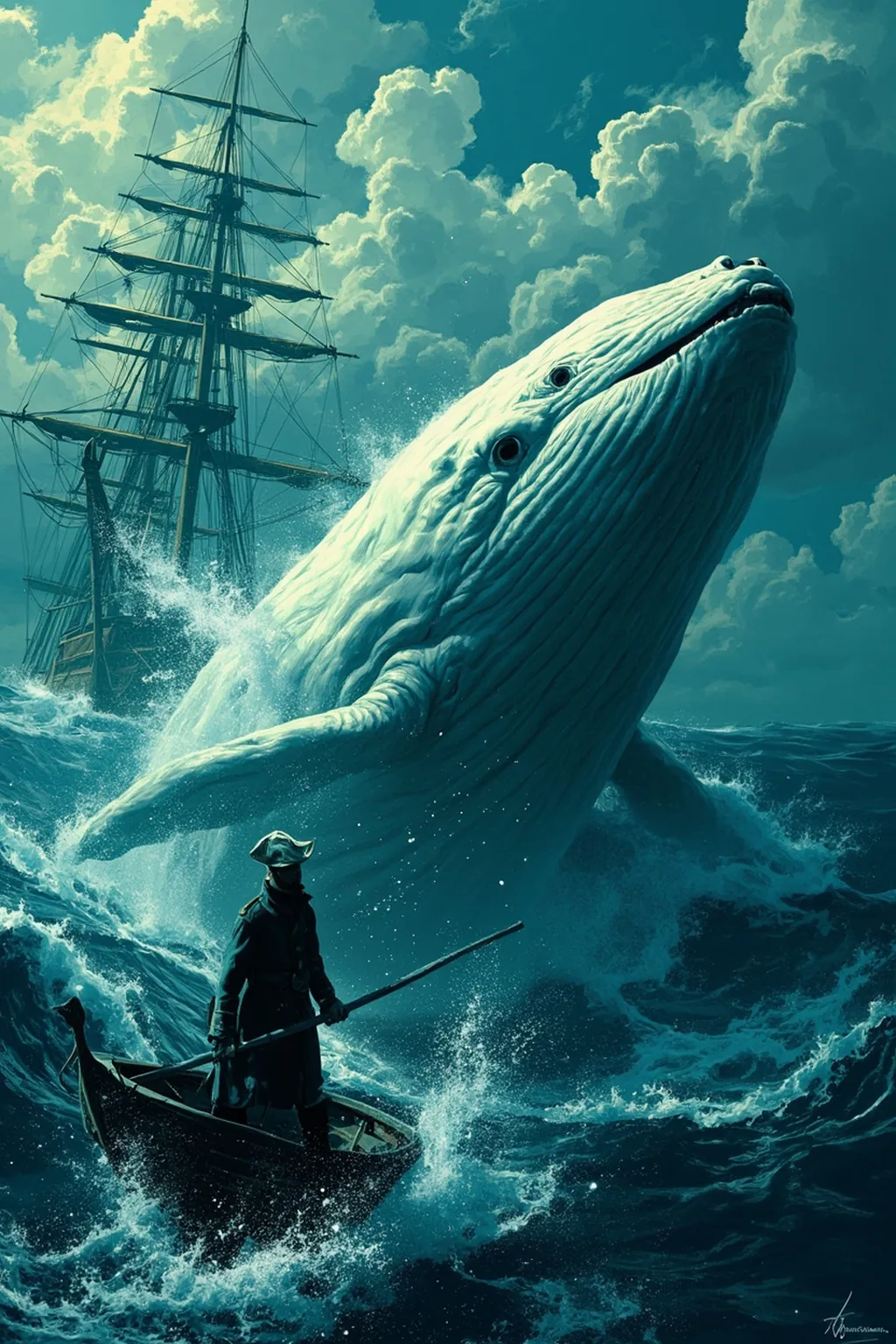
Dual Nature of Visible and Invisible Spheres
The chapter establishes a dual framework for understanding existence: while many facets of the visible, earthly world appear to be formed in love, the invisible, spiritual spheres were formed in fright, laying the groundwork for the contradictory symbolism of whiteness explored in the following sections.
Dual Power of the Whale’s Whiteness
Whiteness holds a dual, contradictory power over the human soul: it is simultaneously the most potent symbol of spiritual and divine things, and the intensifying agent of the most appalling, terrifying experiences humanity can encounter, a paradox the chapter seeks to unpack.
Whiteness as Symbol of Cosmic Annihilation
One explanation for whiteness’s terrifying power is its indefiniteness: it evokes the empty, heartless immensities of the universe, triggering a visceral fear of annihilation when people gaze at vast white expanses such as the Milky Way.
Whiteness as Colourless Sum of All Hues
A second explanation for whiteness’s unsettling impact is its unique nature: it is not a true color, but the visible absence of color and the concrete sum of all hues, creating a “dumb blankness full of meaning” in wide snowy landscapes that feels like a colorless, atheistic void that humanity instinctively shrinks from.
Earthly Hues as Deceptive Natural Veils
The chapter lays out a natural philosophical theory that all earthly hues—including sunset skies, forest colors, butterfly wings, and the complexions of young people—are not inherent to the substances they appear on, but superficial, externally applied deceptions, making deified nature akin to a harlot whose alluring appearance hides a hollow, charnel-house-like core. The fundamental principle of light that produces all these hues is itself white and colorless, and would strip all objects of their color if it operated without a medium, leaving the universe as a pale, leprous blank; those who refuse to acknowledge this truth, like willful Lapland travelers who reject colored glasses or blind infidels, are left staring at this universal white shroud.
Albino Whale as Symbol of Blank Terror
The albino whale is identified as the ultimate symbol of this all-encompassing, blank terror evoked by whiteness, providing the core explanation for the fierce, fiery hunt that drives the narrative of the story.
CHAPITRE 43. Hark!
This chapter opens with Archy urgently whispering to his shipmate Cabaco during a tense, silent procedure aboard ship—a quiet midnight water bucket transfer under moonlight, conducted with careful deference to the quarter-deck’s sanctity.
CHAPITRE 43. Hark!
The middle-watch is underway: a fair moonlight illuminates the scene as seamen form a cordon extending from a fresh-water butt in the waist to the scuttle-butt near the taffrail. Buckets are passed hand to hand in deepest silence, punctuated only by occasional sail flaps and the steady hum of the advancing keel. The men are careful not to speak or rustle their feet.
Midwatch Silent Water Bucket Transfer
Archy stands near the after-hatches as part of the silent cordon. His whispered question breaks the solemn hush: “Hist! Did you hear that noise, Cabaco?” The atmosphere is one of reverent discipline, with the crew mindful of their position on the quarter-deck.
Archy Alerts Cabaco to Under-Hatch Noise
Archy insists he hears something beneath the hatches—described as a cough, then as the sound of sleepers turning over. He presses Cabaco to listen, asserting, “There it is again—under the hatches—don’t you hear it—a cough—it sounded like a cough.”
Cabaco Attributes Noise to Supper Biscuits
Dismissive and pragmatic, Cabaco attributes the sounds to Archy’s three soaked supper biscuits “turning over inside of ye.” He reminds Archy of his reputation for sharp hearing—the same ears that supposedly detected the hum of a Quakeress’s knitting-needles fifty miles from Nantucket—and orders him to focus on the bucket.
Archy Suspects Unseen After-Hold Person
Despite Cabaco’s ridicule, Archy reveals his deeper suspicion: that someone unseen currently resides in the after-hold. He recalls overhearing Stubb tell Flask during morning watch that “there was something of that sort in the wind,” suggesting Captain Ahab (“our old Mogul”) may know more about the matter.
The original text of this work is in the public domain. This page focuses on a guided summary article, reading notes, selected quotes, and visual learning materials for educational purposes.