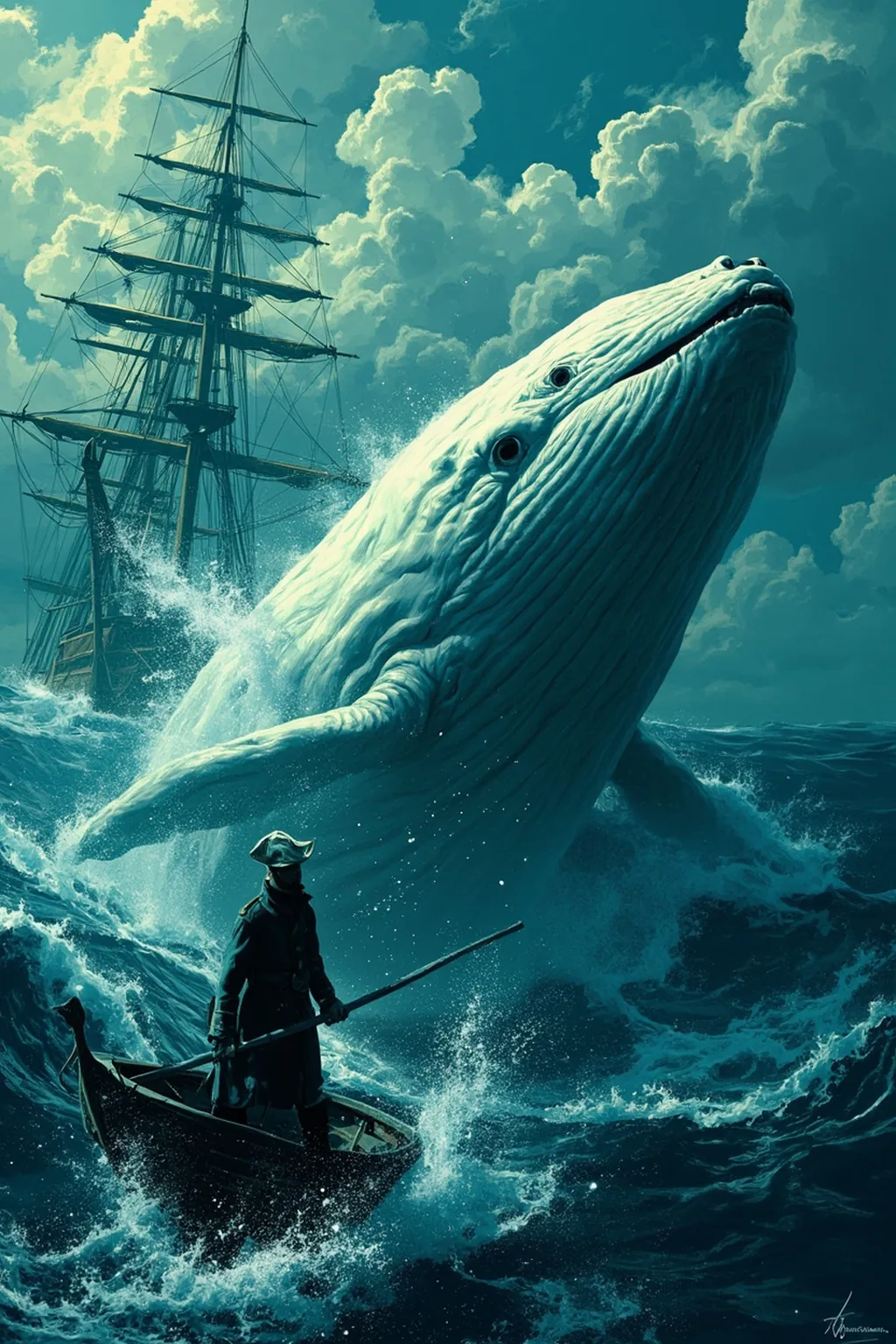
CHAPTER 90. Heads or Tails.
“De balena vero sufficit, si rex habeat caput, et regina caudam.” Latin from the books of the Laws of England, which taken along with the context, means, that of all whales captured by anybody on the coast of that land, the King, as Honorary Grand Harpooneer, must have the head, and the Queen be respectfully presented with the tail. A division which, in the whale, is much like halving an apple. Now as this law, under a modified form, is to this day in force in England, it is here treated of in a separate chapter. It seems that some honest mariners of Dover, or Sandwich, or some one of the Cinque Ports, had after a hard chase succeeded in killing and beaching a fine whale which they had originally descried afar off from the shore. The Cinque Ports are partially or somehow under the jurisdiction of a sort of policeman or beadle, called a Lord Warden. Holding the office directly from the crown, all the royal emoluments incident to the Cinque Port territories become by assignment his. Now when these poor sun-burnt mariners, bare-footed, had wearily hauled their fat fish high and dry, promising themselves a good £150 from the precious oil; up steps a very learned and most Christian and charitable gentleman, with a copy of Blackstone under his arm; and laying it upon the whale’s head, he says—“Hands off! this fish, my masters, is a Fast-Fish. I seize it as the Lord Warden’s.” Upon this the poor mariners in their respectful consternation fall to vigorously scratching their heads all round. At length one of them made bold to speak, “Please, sir, who is the Lord Warden?” “The Duke.” “But the duke had nothing to do with taking this fish?” “It is his.” The whale was seized and sold, and his Grace the Duke of Wellington received the money. But why should the King have the head, and the Queen the tail? In his treatise on “Queen-Gold,” or Queen-pinmoney, an old King’s Bench author, one William Prynne, thus discourseth: “Ye tail is ye Queen’s, that ye Queen’s wardrobe may be supplied with ye whalebone.” Now this was written at a time when the black limber bone of the Greenland or Right whale was largely used in ladies’ bodices. But this same bone is not in the tail; it is in the head, which is a sad mistake for a sagacious lawyer like Prynne. There are two royal fish so styled by the English law writers—the whale and the sturgeon.
CHAPTER 91. The Pequod Meets The Rose-Bud.
It was a week or two after the last whaling scene recounted that the many noses on the Pequod’s deck proved more vigilant discoverers than the three pairs of eyes aloft. A peculiar and not very pleasant smell was smelt in the sea. “I will bet something now,” said Stubb, “that somewhere hereabouts are some of those drugged whales we tickled the other day.” Presently, the vapors in advance slid aside; and there in the distance lay a ship, whose furled sails betokened that some sort of whale must be alongside. As we glided nearer, the stranger showed French colours from his peak; and by the eddying cloud of vulture sea-fowl that circled, and hovered, and swooped around him, it was plain that the whale alongside must be what the fishermen call a blasted whale, that is, a whale that has died unmolested on the sea, and so floated an unappropriated corpse. The Pequod had now swept so nigh to the stranger, that Stubb vowed he recognised his cutting spade-pole entangled in the lines that were knotted round the tail of one of these whales. By this time the faint air had become a complete calm. Drawing across her bow, he perceived that in accordance with the fanciful French taste, the upper part of her stem-piece was carved in the likeness of a huge drooping stalk. Upon her head boards, in large gilt letters, he read “Bouton de Rose,”—Rose-button, or Rose-bud; and this was the romantic name of this aromatic ship. “Bouton-de-Rose, ahoy! are there any of you Bouton-de-Roses that speak English?” “Yes,” rejoined a Guernsey-man from the bulwarks. “Well, then, my Bouton-de-Rose-bud, have you seen the White Whale?” “What whale?” “The White Whale—a Sperm Whale—Moby Dick, have ye seen him?” “Never heard of such a whale. Cachalot Blanche! White Whale—no.” Upon which Ahab retired, and Stubb returned to the Frenchman. Stubb was now over the side, and getting into his boat, hailed the Guernsey-man. A queer scene presented itself. The sailors, in tasselled caps of red worsted, were getting the heavy tackles in readiness for the whales. But they worked rather slow and talked very fast. Marking all this, Stubb argued well for his scheme, and turning to the Guernsey-man had a little chat with him, during which the stranger mate expressed his detestation of his Captain. According to this little plan of theirs, the Guernsey-man was to tell the Captain what he pleased, but as coming from Stubb. Upon this the captain ran forward, and commanded his crew to desist from hoisting the cutting-tackles, and at once cast loose the cables and chains confining the whales to the ship. While the Frenchman’s boats were engaged in towing the ship one way, Stubb benevolently towed away at his whale the other way. Seizing his sharp boat-spade, he commenced an excavation in the body. “I have it, I have it,” cried Stubb, with delight, striking something in the subterranean regions, “a purse! a purse!” Dropping his spade, he thrust both hands in, and drew out handfuls of something that looked like ripe Windsor soap, or rich mottled old cheese; very unctuous and savory withal. And this, good friends, is ambergris, worth a gold guinea an ounce to any druggist. Some six handfuls were obtained; but more was unavoidably lost in the sea.
The original text of this work is in the public domain. This page focuses on a guided summary article, reading notes, selected quotes, and visual learning materials for educational purposes.