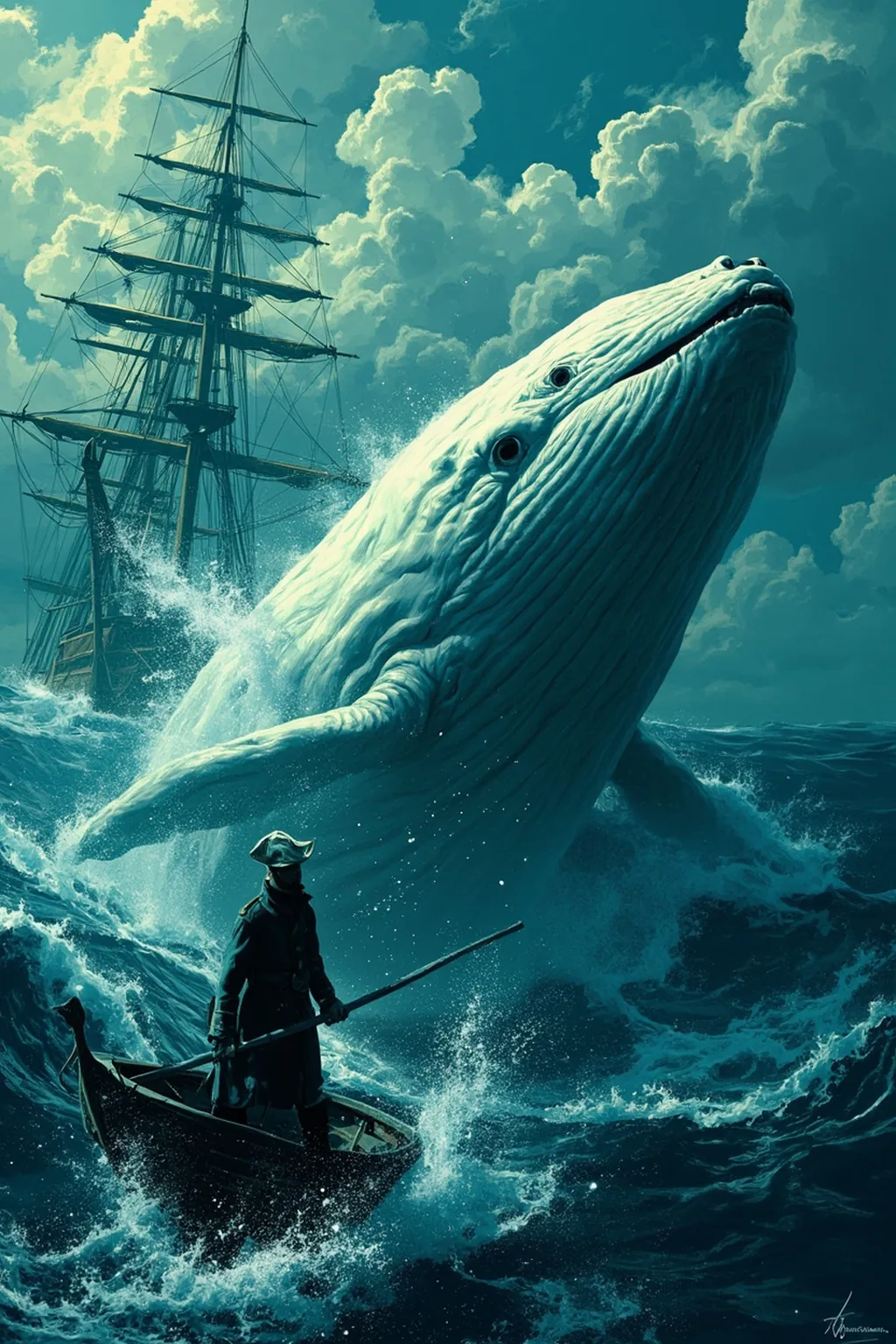
Tallying Moby Dick
Ahab mutters to himself that he has tallied the whale and asks rhetorically whether he shall escape. The white brow and snow-white hump of Moby Dick are unmistakable identifiers. Ahab recalls the whale’s broad fins bored and scalloped out like a lost sheep’s ear, confirming the individual recognition possible for a hunter who knows what to look for.
Dreams of Vengeance
After long nights studying his charts, Ahab throws himself into reveries where his mind races breathlessly through thoughts of vengeance. These exhausting and intolerably vivid dreams resume his intense daytime thoughts, carrying them onward amid clashing phrensies, whirling them through his blazing brain until the throbbing of his life-spot becomes insufferable anguish.
The Tormented Mind
The chapter’s conclusion explores the psychological toll of Ahab’s obsession. When his spirit grows so intense that it seems to open a chasm in him from which forked flames and lightnings shoot, Ahab bursts from his state room with a wild cry, escaping as though from a burning bed. The living soul in him rebels against the characterizing mind that has yielded all thoughts to the one supreme purpose—which has become an independent entity, burning while the common vitality flees horror-stricken. The creature Ahab has created in his thoughts becomes a vulture that feeds upon his heart forever, the very embodiment of his obsessive vengeance turned inward.
CAPÍTULO 45. The Affidavit.
This opening section of Chapter 45 outlines the chapter’s core purpose: to corroborate the central narrative of the volume (especially the story of the White Whale) with verified, practical evidence drawn from the narrator’s experience as a whaleman, in order to eliminate doubt from readers unfamiliar with sperm whale habits and the realities of the whaling industry. This chapter centers on a documented 6th century account of a long-destructive Propontis (Sea of Marmora) sea monster, and builds a reasoned case that the creature was a sperm whale, drawing on the credibility of the original historian, evidence of sperm whale presence in connected waters, feasible access routes, and available local prey.
CAPÍTULO 45. The Affidavit.
This opening section of Chapter 45 outlines the chapter’s core purpose: to corroborate the central narrative of the volume (especially the story of the White Whale) with verified, practical evidence drawn from the narrator’s experience as a whaleman, in order to eliminate doubt from readers unfamiliar with sperm whale habits and the realities of the whaling industry.
Purpose of Narrative Corroboration
The narrator states he will not present corroborating evidence in a rigid, methodical format, but will share separate, reliably attested anecdotes from his whaling career, with the conclusion about the truth of the narrative’s core claims intended to emerge naturally from these examples.
Recaptured Marked Whale Incidents
The first set of personal verified anecdotes details three instances where a harpooned whale that escaped was later recaptured and killed by the same whaler, with both original marked harpoons recovered from its body. One case involved a gap of more than three years between strikes: during this interval, the whaler traveled to Africa and explored the interior for nearly two years, while the whale circumnavigated the globe. The narrator was present for both strikes in this case and confirmed a unique mole under the whale’s eye from the first encounter. He notes he has also heard many other credible, verified reports of similar incidents.
Famous Renowned Sperm Whales
The second set of anecdotes describes several individual sperm whales that gained widespread, ocean-wide fame among whalers due to their extremely dangerous reputations, rather than just unusual physical traits (which would typically lead to their quick killing and rendering into oil). Examples include Timor Tom of the Oriental straits, New Zealand Jack of Tattoo Land, Morquan the King of Japan, and Don Miguel of Chile, who were as well known to whalemen as famous historical figures like Marius or Sylla. Some of these whales, including New Zealand Jack and Don Miguel, were systematically hunted and killed by determined whaling captains after attacking multiple whaling boats.
The original text of this work is in the public domain. This page focuses on a guided summary article, reading notes, selected quotes, and visual learning materials for educational purposes.