The old Manxman, the former hearse-driver, luffs up before the doubloon, walks round to the other side of the mast where a horseshoe is nailed, then back again, muttering in a voice like a worn-out coffee-mill: “If the White Whale be raised, it must be in a month and a day, when the sun stands in some one of these signs. I’ve studied signs, and know their marks; they were taught me two score years ago, by the old witch in Copenhagen. Now, in what sign will the sun then be? The horse-shoe sign; for there it is, right opposite the gold. And what’s the horse-shoe sign? The lion is the horse-shoe sign—the roaring and devouring lion. Ship, old ship! my old head shakes to think of thee.”
Stubb watches Queequeg next, comparing the coin to the tattoo marks on his thigh, muttering that he thinks the sun is in his thigh or calf, maybe his bowels, like the old back-country women who practice surgeon’s astronomy. “And by Jove, he’s found something there in the vicinity of his thigh—I guess it’s Sagittarius, or the Archer. No: he don’t know what to make of the doubloon; he takes it for an old button off some king’s trowsers.” Then Fedallah glides up, bows to the sun on the coin, and Stubb writes him off as a fire-worshipper. Finally Pip comes, half-crazed, staring at all the interpreters, and repeats over and over, in his idiot voice: “I look, you look, he looks; we look, ye look, they look.” Stubb leaves in frustration, muttering that the doubloon is the ship’s navel, and if you unscrew your navel the consequences are ugly; when a thing is nailed to the mast, it’s a sign things are desperate. “Ha, ha! old Ahab! the White Whale; he’ll nail ye! This is a pine tree. My father, in old Tolland county, cut down a pine tree once, and found a silver ring grown over in it; some old darkey’s wedding ring. How did it get there? And so they’ll say in the resurrection, when they come to fish up this old mast, and find a doubloon lodged in it, with bedded oysters for the shaggy bark. Oh, the gold! the precious, precious, gold! the green miser’ll hoard ye soon! Hish! hish! God goes ’mong the worlds blackberrying. Cook! ho, cook! and cook us! Jenny! hey, hey, hey, hey, hey, Jenny, Jenny! and get your hoe-cake done!”
CHAPTER 100. Leg and Arm.
The Pequod of Nantucket had just met the Samuel Enderby of London, flying English colours, when Ahab leaned over the rail of his hoisted quarter-boat, ivory leg plain to see, and hailed the stranger: “Ship, ahoy! Hast seen the White Whale?” The English captain, reclining in his boat’s bow, was a darkly-tanned, burly, good-natured man of sixty, dressed in a spacious blue pilot-cloth roundabout whose empty arm streamed behind him like a hussar’s broidered surcoat sleeve. He held up a white arm carved from sperm whale bone, ending in a wooden mallet-like head. “See you this?” he said.
Ahab cried “Man my boat!” at once, and he and his crew were dropped into the water alongside the stranger within a minute—until he remembered he had not set foot on any ship but the Pequod since losing his leg, and only with a custom mechanical lift rigged for him. Clambering up a stranger’s side from a heaving boat is hard enough for an able-bodied man, with swells lifting the boat to the bulwarks then dropping it halfway to the keelson; for a one-legged man, it was impossible, and he stood abjectly, a landsman again, staring hopelessly at the cleated ladder the officers had lowered, with tastefully ornamented man-ropes swinging beside it. The officers had not realized at first that a cripple could not use their sea bannisters, but the awkwardness only lasted a minute: Captain Boomer, the Englishman, spotted the problem at a glance. “I see, I see!—avast heaving there! Jump, boys, and swing over the cutting-tackle.” They had had a whale alongside a day or two prior, so the great curved blubber hook was still aloft, clean and dry. They lowered it to Ahab, who slid his solitary thigh into its curve like sitting in an anchor fluke or apple tree crotch, pulled hand-over-hand on the tackle to help hoist his own weight, and was soon swung gently over the bulwarks to land on the capstan head. The two captains met, ivory limbs thrust forward in welcome, Ahab crossing his ivory leg and arm like two swordfish blades, calling out in his walrus way: “Aye, aye, hearty! let us shake bones together!—an arm and a leg!—an arm that never can shrink, d’ye see; and a leg that never can run. Where did’st thou see the White Whale?—how long ago?”
“The White Whale,” Boomer said, pointing his ivory arm east like a telescope, “there I saw him, on the Line, last season.”
“And he took that arm off, did he?” Ahab asked, sliding down from the capstan to rest on Boomer’s shoulder.
“Aye, he was the cause of it, at least; and that leg, too?”
“Spin me the yarn,” Ahab said. “how was it?”
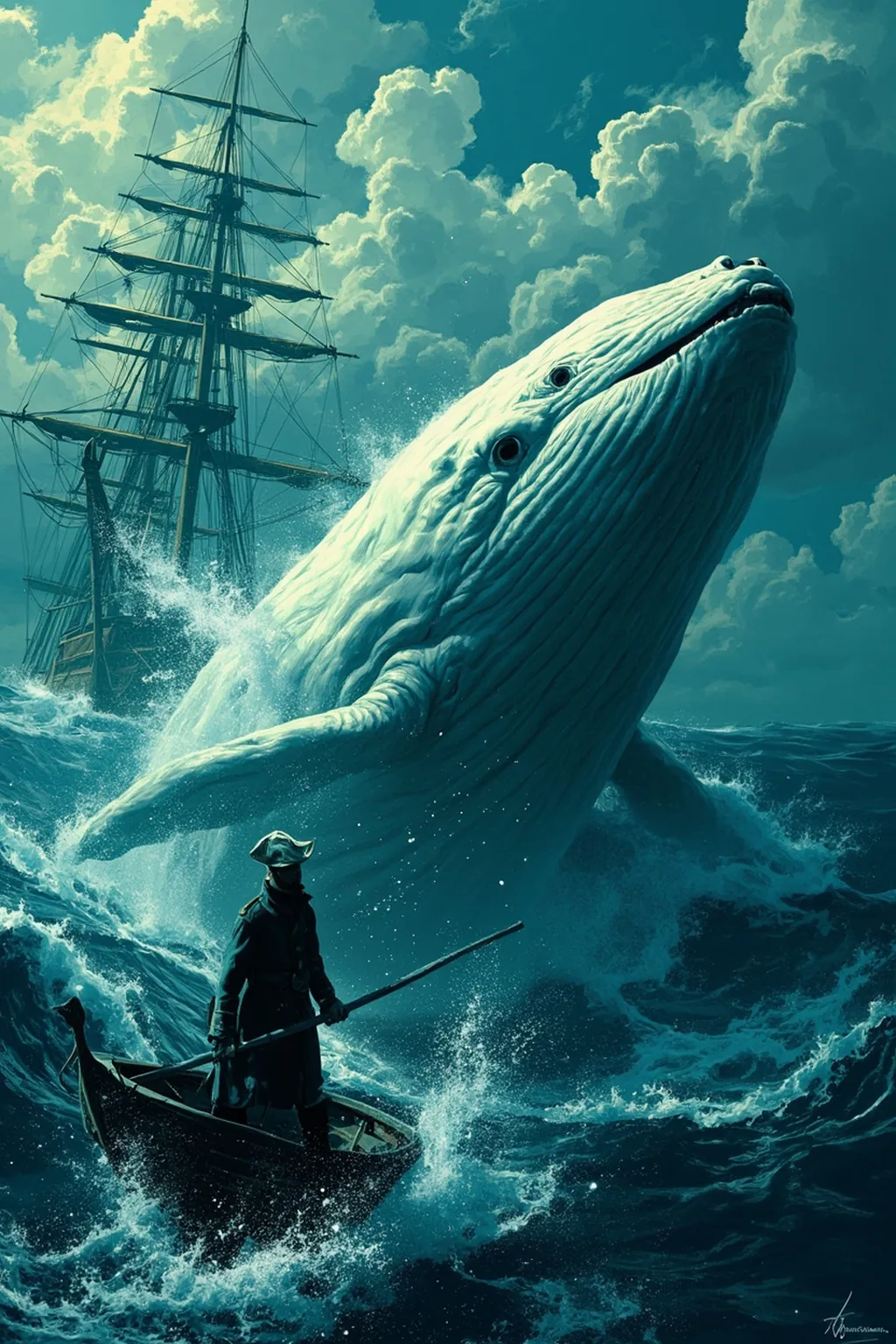
“It was the first time in my life that I ever cruised on the Line,” Boomer began. “I was ignorant of the White Whale at that time. Well, one day we lowered for a pod of four or five whales, and my boat fastened to one of them; a regular circus horse he was, too, that went milling and milling round so, that my boat’s crew could only trim dish, by sitting all their sterns on the outer gunwale. Presently up breaches from the bottom of the sea a bouncing great whale, with a milky-white head and hump, all crows’ feet and wrinkles.”
“It was he, it was he!” Ahab cried, letting out his suspended breath.
“And harpoons sticking in near his starboard fin.”
“Aye, aye—they were mine—my irons,” Ahab exulted. “but on!”
“Give me a chance, then,” Boomer said good-humoredly. “Well, this old great-grandfather, with the white head and hump, runs all afoam into the pod, and goes to snapping furiously at my fast-line!”
“Aye, I see!—wanted to part it; free the fast-fish—an old trick—I know him.”
The original text of this work is in the public domain. This page focuses on a guided summary article, reading notes, selected quotes, and visual learning materials for educational purposes.