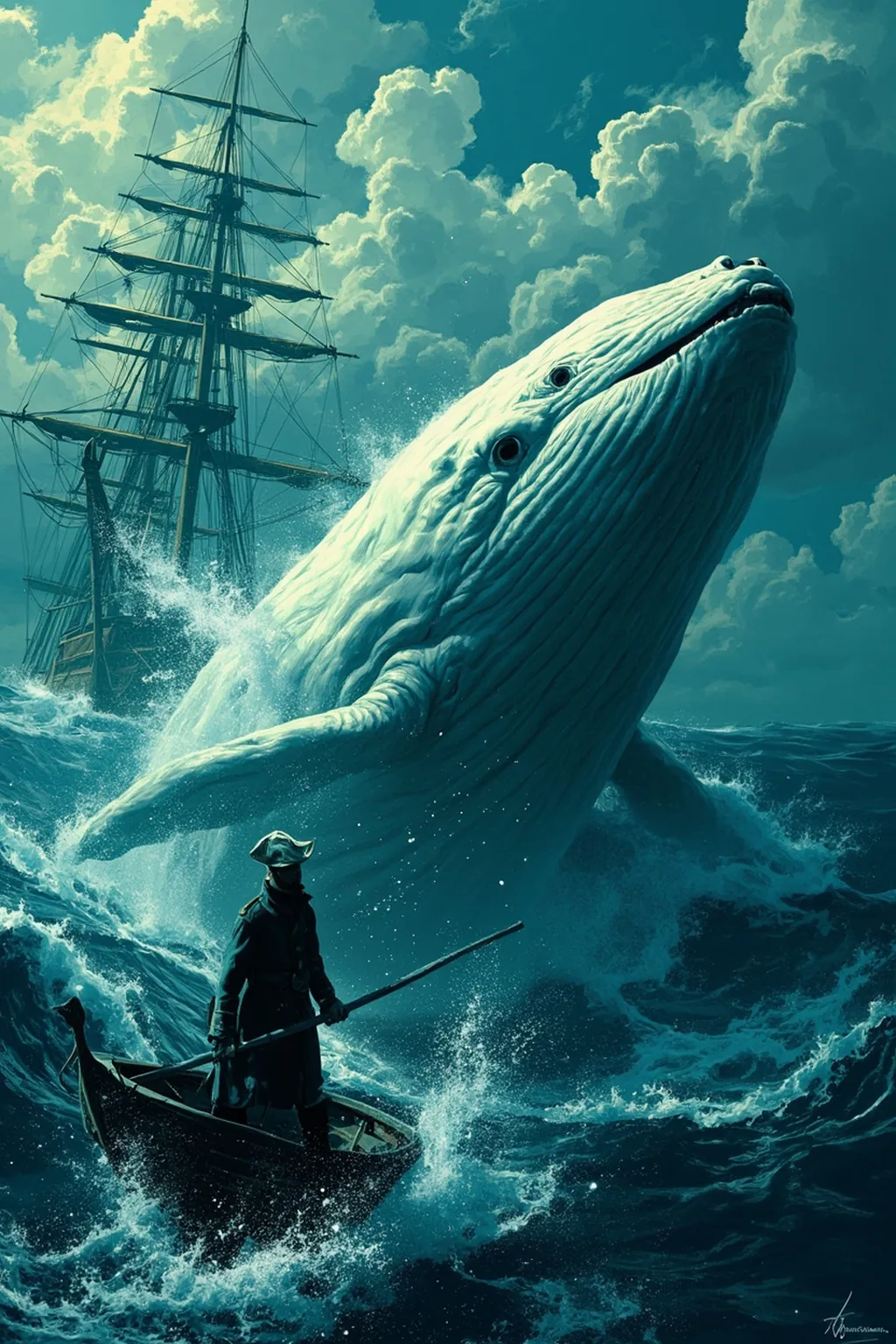
“How it was exactly, I do not know,” Boomer continued, “but in biting the line, it got foul of his teeth, caught there somehow; but we didn’t know it then; so that when we afterwards pulled on the line, bounce we came plump on to his hump! instead of the other whale’s; that went off to windward, all fluking. Seeing how matters stood, and what a noble great whale it was—the noblest and biggest I ever saw, sir, in my life—I resolved to capture him, spite of the boiling rage he seemed to be in. And thinking the hap-hazard line would get loose, or the tooth it was tangled to might draw—I jumped into my first mate’s boat—Mr. Mounttop’s here (by the way, Captain—Mounttop; Mounttop—the captain); as I was saying, I jumped into Mounttop’s boat, which, d’ye see, was gunwale and gunwale with mine, then; and snatching the first harpoon, let this old great-grandfather have it. But, Lord, look you, sir—hearts and souls alive, man—the next instant, in a jiff, I was blind as a bat—both eyes out—all befogged and bedeadened with black foam—the whale’s tail looming straight up out of it, perpendicular in the air, like a marble steeple. No use sterning all, then; but as I was groping at midday, with a blinding sun, all crown-jewels; as I was groping, I say, after the second iron, to toss it overboard—down comes the tail like a Lima tower, cutting my boat in two, leaving each half in splinters; and, flukes first, the white hump backed through the wreck, as though it was all chips. We all struck out. To escape his terrible flailings, I seized hold of my harpoon-pole sticking in him, and for a moment clung to that like a sucking fish. But a combing sea dashed me off, and at the same instant, the fish, taking one good dart forwards, went down like a flash; and the barb of that cursed second iron towing along near me caught me here” (clapping his hand just below his shoulder) “yes, caught me just here, I say, and bore me down to Hell’s flames, I was thinking; when, when, all of a sudden, thank the good God, the barb ript its way along the flesh—clear along the whole length of my arm—came out nigh my wrist, and up I floated;—and that gentleman there will tell you the rest (by the way, captain—Dr. Bunger, ship’s surgeon: Bunger, my lad,—the captain). Now, Bunger boy, spin your part of the yarn.”
Dr. Bunger, the ship’s surgeon, had been standing nearby the whole time, dressed in a faded blue woollen frock and patched trousers, half paying attention to Boomer’s story, half playing with a marlingspike and pill-box, casting critical glances at the two captains’ ivory limbs. At Boomer’s introduction, he bowed politely and took up the story. “It was a shocking bad wound,” he began, “and, taking my advice, Captain Boomer here, stood our old Sammy—”
“Samuel Enderby is the name of my ship,” Boomer interrupted, “go on, boy.”
“Stood our old Sammy off to the northward, to get out of the blazing hot weather there on the Line. But it was no use—I did all I could; sat up with him nights; was very severe with him in the matter of diet—”
“Oh, very severe!” Boomer chimed in, then altered his voice to a teasing drawl: “Drinking hot rum toddies with me every night, till he couldn’t see to put on the bandages; and sending me to bed, half seas over, about three o’clock in the morning. Oh! ye stars! he sat up with me indeed, and was very severe in my diet. Oh! a great watcher, and very dietetically severe, is Dr. Bunger. (Bunger, you dog, laugh out! why don’t ye? You know you’re a precious jolly rascal.) But, heave ahead, boy, I’d rather be killed by you than kept alive by any other man.”
“My captain, you must have ere this perceived, respected sir,” Bunger said, slightly bowing to Ahab, “is apt to be facetious at times; he spins us many clever things of that sort. But I may as well say—en passant, as the French remark—that I myself—that is to say, Jack Bunger, late of the reverend clergy—am a strict total abstinence man; I never drink—”
“Water!” Boomer cried. “he never drinks it; it’s a sort of fits to him; fresh water throws him into the hydrophobia; but go on—go on with the arm story.”
“Yes, I may as well,” Bunger said coolly. “I was about observing, sir, before Captain Boomer’s facetious interruption, that spite of my best and severest endeavors, the wound kept getting worse and worse; the truth was, sir, it was as ugly gaping wound as surgeon ever saw; more than two feet and several inches long. I measured it with the lead line. In short, it grew black; I knew what was threatened, and off it came. But I had no hand in shipping that ivory arm there; that thing is against all rule”—pointing at it with the marlingspike—“that is the captain’s work, not mine; he ordered the carpenter to make it; he had that club-hammer there put to the end, to knock some one’s brains out with, I suppose, as he tried mine once. He flies into diabolical passions sometimes. Do ye see this dent, sir”—removing his hat, brushing aside his hair, exposing a bowl-like cavity in his skull, with no scar tissue—“Well, the captain there will tell you how that came here; he knows.”
“No, I don’t,” Boomer said, “but his mother did; he was born with it. Oh, you solemn rogue, you—you Bunger! was there ever such another Bunger in the watery world? Bunger, when you die, you ought to die in pickle, you dog; you should be preserved to future ages, you rascal.”
Ahab, who had been listening impatiently to the byplay, cut in: “What became of the White Whale?”
“Oh!” Boomer cried. “after he sounded, we didn’t see him again for some time; in fact, as I before hinted, I didn’t then know what whale it was that had served me such a trick, till some time afterwards, when coming back to the Line, we heard about Moby Dick—as some call him—and then I knew it was he.”
“Did’st thou cross his wake again?”
“Twice.”
“But could not fasten?”
“Didn’t want to try to: ain’t one limb enough? What should I do without this other arm? And I’m thinking Moby Dick doesn’t bite so much as he swallows.”
The original text of this work is in the public domain. This page focuses on a guided summary article, reading notes, selected quotes, and visual learning materials for educational purposes.