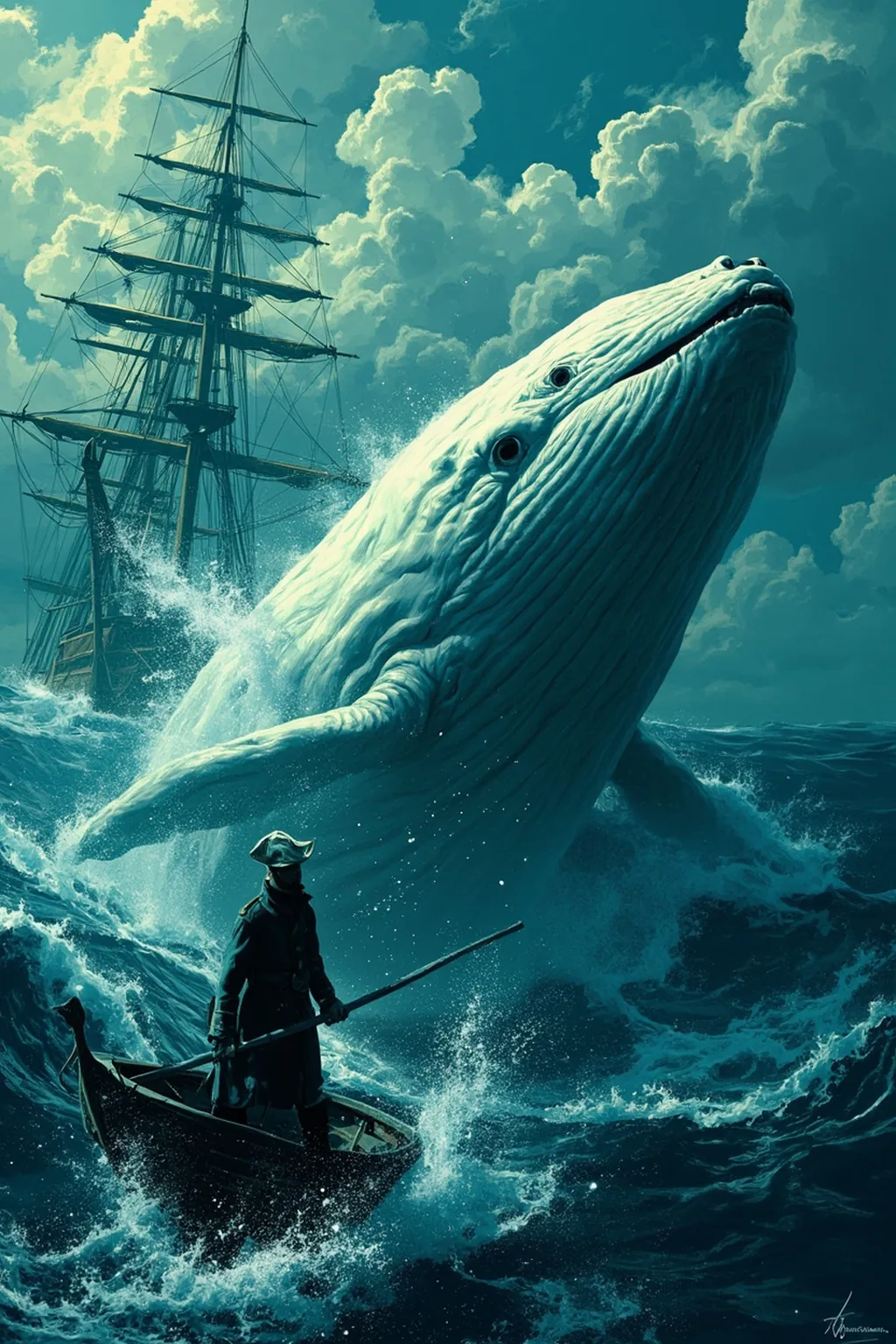
Amid that green, life-restless loom, the great white worshipped skeleton lay lounging, a gigantic idler; yet as the verdant warp and woof intermixed and hummed around him, the mighty idler seemed the cunning weaver, himself woven over with vines, every month growing greener and fresher, but still a skeleton: Life folded Death, Death trellised Life, the grim god wived with youthful Life and begat curly-headed glories. When Ishmael visited the wondrous whale with Tranquo, he marvelled that the king regarded a chapel as an object of vertu; Tranquo laughed. He marvelled more that the priests swore the smoky jet from the skull was genuine. Ishmael paced before the skeleton, brushed vines aside, broke through the ribs, wandered with a ball of Arsacidean twine through its winding, shaded colonnades and arbours, until his line ran out and he had to follow it back to the entrance. He saw no living thing within, only bones. He cut a green measuring rod, dived back in to take the altitude of the final rib; the priests saw him through the skull’s arrow-slit and shouted, “Dar’st thou measure this our god! That’s for us.” A fierce contest rose among them over feet and inches, they cracked each other’s sconces with yard-sticks, the great skull echoing, and Ishmael used the distraction to finish his own measurements. He notes he is not free to make up any measurement he pleases: there are skeleton authorities to test his accuracy, like the Leviathanic Museum in Hull, England, the “only perfect specimen” of a Greenland whale in Manchester, New Hampshire, and Sir Clifford Constable’s moderate-sized sperm whale skeleton at Burton Constable in Yorkshire, which is fully articulated, ribs spread like a fan, with locks on the trapdoors, a footman showing visitors round for twopence to peek at the spinal column’s whispering gallery, threepence for the cerebellum echo, sixpence for the forehead view. Ishmael’s measurements are tattooed verbatim on his right arm, where he recorded them during his wild wanderings when he had no paper; he left his left arm blank for a poem he was composing at the time.
CHAPTER 103. Measurement of The Whale’s Skeleton.
First, a plain statement of the living bulk of the leviathan whose skeleton we are about to examine: according to Ishmael’s careful calculation, partly based on Captain Scoresby’s estimate of seventy tons for a 60-foot Greenland whale, a large sperm whale of 85 to 90 feet in length, with a fullest circumference of less than forty feet, will weigh at least ninety tons. Reckoning thirteen men to a ton, that means a single whale outweighs the combined population of a village of 1,100 inhabitants. Think you not, then, that brains should be yoked to this leviathan to make him budge to any landsman’s imagination?
We have already examined his skull, spout-hole, jaw, teeth, tail, forehead, fins, and other parts, so now we will focus on the general bulk of his unobstructed bones. Keep the skull in mind, though: it makes up such a large proportion of the skeleton, is so complicated, that you must carry it with you to understand the structure we are about to view. The Tranque sperm whale skeleton measured seventy-two feet in length; when fully invested in flesh and blubber in life, he would have been ninety feet long, as the skeleton loses about one-fifth of the living body’s length. Of those seventy-two feet, the skull and jaw took up twenty, leaving fifty feet of plain backbone. Attached to that backbone for less than a third of its length was the mighty circular basket of ribs that once enclosed the whale’s vitals. To Ishmael, that vast ivory-ribbed chest, with the long, unrelieved spine extending far from it in a straight line, resembled the hull of a great ship new-laid on the stocks, with only twenty of her naked bow-ribs inserted and the keel otherwise a long, disconnected timber.
The ribs numbered ten to a side. The first, starting from the neck, was nearly six feet long; the second, third, and fourth grew successively longer, until the fifth, one of the middle ribs, measured eight feet and some inches. From there, the remaining ribs diminished, until the tenth and last spanned only five feet and some inches. All were proportionally thick, the middle ribs the most arched; in some of the Arsacides, they are used as beams for footpath bridges over small streams. Ishmael could not help but be struck again by the fact, repeated so often in this book, that the whale’s skeleton is not the mould of his invested form. The largest Tranque rib, a middle one, corresponded to the part of the whale’s body that was sixteen feet deep in life, yet the rib itself measured only a little over eight feet: half the true notion of the living magnitude. Where he saw only a naked spine, in life there had been tons of flesh, muscle, blood, and bowels wrapped round it; where he saw only a few disordered joints, in life there had been ample, powerful fins; where there was only an utter blank, the weighty, majestic, boneless flukes had been. How vain and foolish, then, for timid, untravelled men to try to comprehend the wondrous whale by poring over his dead, attenuated skeleton stretched in a peaceful wood. Only in the heart of quickest perils, only when within the eddy of his angry flukes, only on the profound unbounded sea can the fully invested whale be truly, livingly found out. As for the spine, if you piled its bones high on end with a crane, they would look much like Pompey’s Pillar: forty and odd vertebræ, not locked together, lying like knobbed blocks on a Gothic spire, forming solid courses of heavy masonry. The largest middle vertebræ is less than three feet wide, more than four deep; the smallest, where the spine tapers into the tail, is only two inches wide, like a white billiard-ball. The priests’ children had stolen even smaller ones to play marbles, so the spine of even the hugest living thing tapers off at last into simple child’s play.
The original text of this work is in the public domain. This page focuses on a guided summary article, reading notes, selected quotes, and visual learning materials for educational purposes.