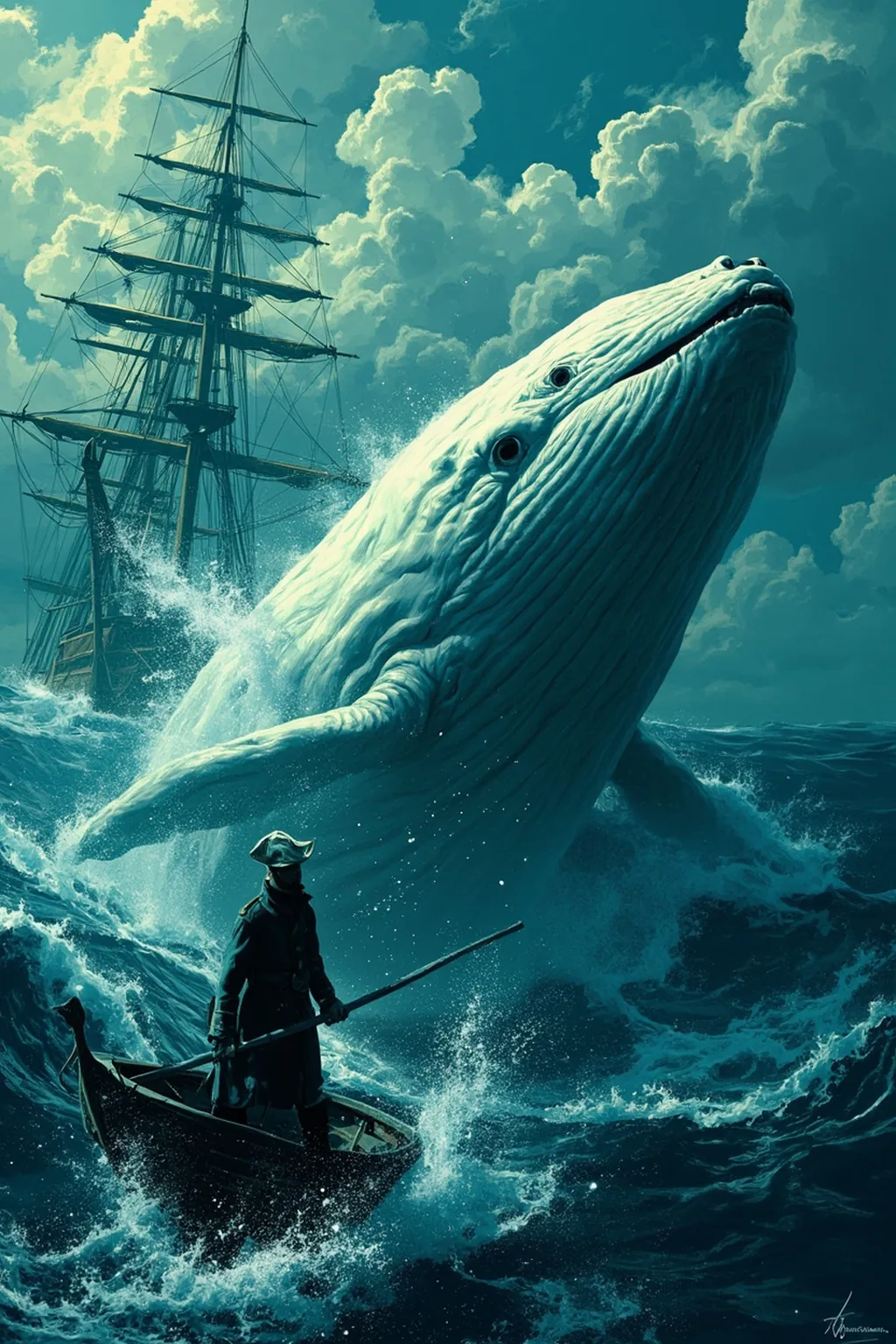
CHAPTER 104. The Fossil Whale.
The whale’s mighty bulk affords a most congenial theme to enlarge upon, amplify, expatiate upon: you cannot compress him. By good rights he should only be treated in imperial folio, with a condor’s quill for a pen and Vesuvius’s crater for an inkstand. Friends, hold my arms! For in the mere act of writing about this Leviathan, he wearies me, makes me faint with his outreaching comprehensiveness, as if to include the whole circle of the sciences, all generations of whales and men and mastodons past, present, and to come, all the revolving panoramas of earthly empire and the whole universe, suburbs not excluded. Such is the virtue of a large and liberal theme: we expand to its bulk. To produce a mighty book, you must choose a mighty theme; no great enduring volume can ever be written on a flea, though many have tried.
Before entering the subject of fossil whales, Ishmael presents his credentials as a geologist: in his miscellaneous time, he has been a stone mason, a great digger of ditches, canals, wells, wine vaults, cellars, and cisterns of all sorts. As a preliminary, he reminds the reader that while earlier geological strata hold fossils of monsters now almost completely extinct, the Tertiary formations (the last period before superficial, modern formations) hold relics that are connecting links between those ancient creatures and the animals that entered the Ark. All fossil whales discovered so far belong to the Tertiary period, sufficiently akin to modern whales to be classed as Cetacean fossils, even if they match no known living species. Detached broken fossils of pre-Adamite whales have been found in the last thirty years at the base of the Alps, in Lombardy, France, England, Scotland, Louisiana, Mississippi, and Alabama: part of a skull unearthed in 1779 in Paris’s Rue Dauphine, near the Tuileries, bones dug up from the great Antwerp docks in Napoleon’s time, which Cuvier pronounced to belong to an utterly unknown Leviathanic species. The most wonderful of all Cetacean relics, however, was the almost complete vast skeleton of an extinct monster found in 1842 on Judge Creagh’s Alabama plantation. The awe-stricken slaves in the area took it for the bones of a fallen angel; the local doctors declared it a huge reptile and named it Basilosaurus, but when specimen bones were sent to the English anatomist Owen, he found it was a whale of a departed species, rechristened it Zeuglodon, and pronounced it one of the most extraordinary creatures the mutations of the globe had blotted out of existence.
When Ishmael stands among these mighty Leviathan skeletons, skulls, tusks, jaws, ribs, and vertebræ, bearing partial resemblances to modern sea-monsters and similar affinities to the annihilated antichronical Leviathans, their incalculable seniors, he is borne back by a flood to that wondrous period ere time itself can be said to have begun, for time began with man. Saturn’s grey chaos rolls over him, he gets dim, shuddering glimpses into those Polar eternities when wedged bastions of ice pressed hard on what are now the Tropics, and not an inhabitable hand’s breadth of land was visible across the world’s 25,000 miles of circumference. Then the whole world was the whale’s; king of creation, he left his wake along the present lines of the Andes and Himalayas. Who has a pedigree like Leviathan? Ahab’s harpoon had shed older blood than the Pharaoh’s, Methuselah seems a school-boy, Ishmael looks round to shake hands with Shem, horror-struck at the antemosaic, unsourced existence of the unspeakable terrors of the whale, which, having been before all time, must exist after all humane ages are over. The Leviathan has left his pre-Adamite traces not only in nature’s stereotype plates and limestone and marl, but on Egyptian tablets of almost fossiliferous antiquity: in a temple of Denderah, a sculptured planisphere on the granite ceiling abounding in centaurs, griffins, and dolphins shows old Leviathan swimming among them, centuries before Solomon was cradled. There is also the account of the venerable John Leo, the old Barbary traveller, who wrote of a temple on the sea-shore whose rafters and beams are made of whale bones, for monstrous whales are oftentimes cast up dead on that shore. The common people imagine a secret God-given power in the temple kills any whale that passes it, but the truth is rocks shoot two miles into the sea on either side, wounding the whales that light upon them. They keep a whale’s rib of incredible length as a miracle: lying convex side up, it makes an arch whose top cannot be reached by a man on a camel’s back. John Leo says the rib had lain there a hundred years before he saw it, and their historians affirm a prophet who prophesied of Mahomet came from the temple, some even asserting that Jonah was cast forth by the whale at the temple’s base. Ishmael leaves the reader in this Afric Temple of the Whale, and if they are a Nantucketer and whaleman, they will silently worship there.
The original text of this work is in the public domain. This page focuses on a guided summary article, reading notes, selected quotes, and visual learning materials for educational purposes.