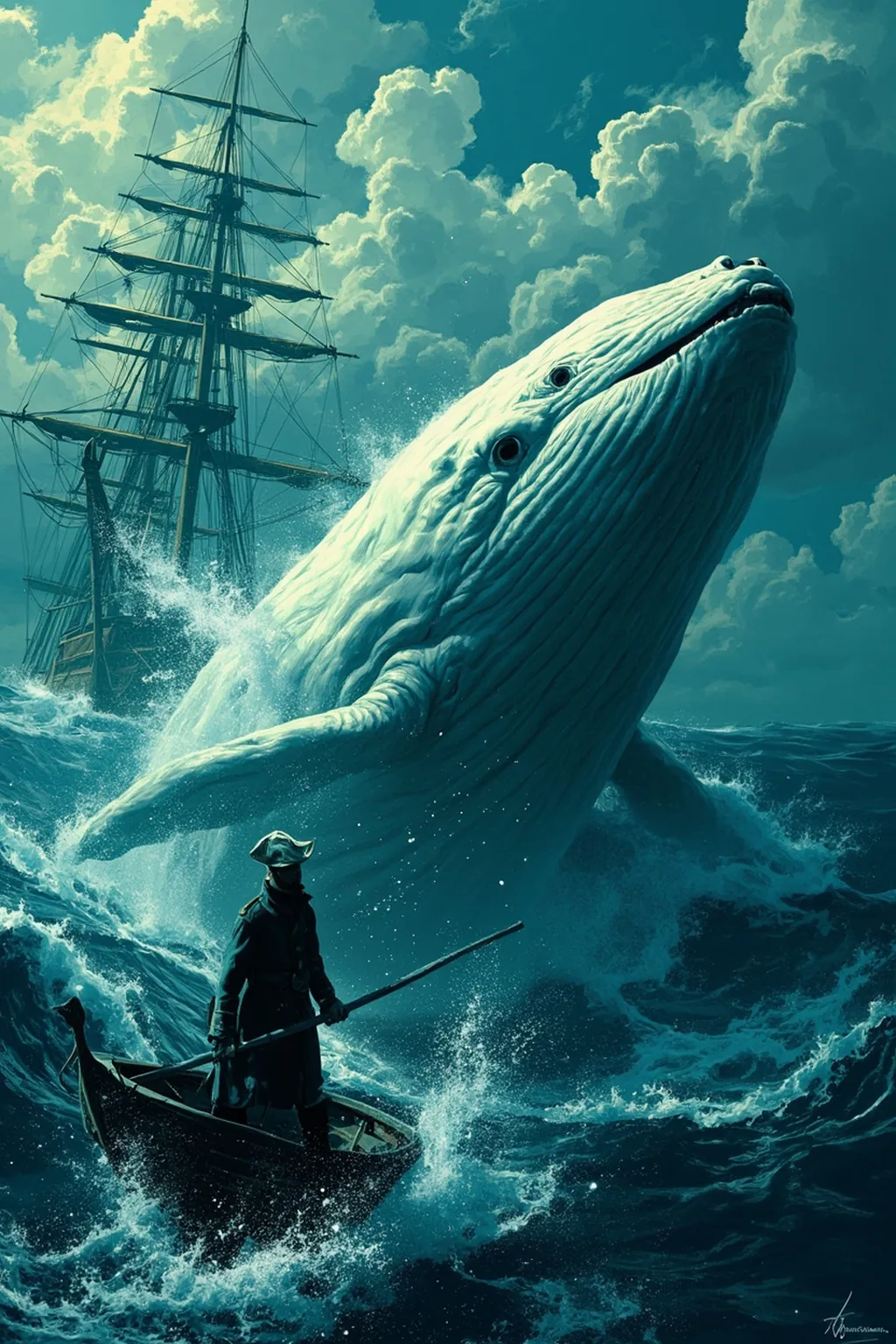
CHAPTER 105. Does the Whale’s Magnitude Diminish?—Will He Perish?
Since this Leviathan comes floundering down to us from the head-waters of the Eternities, it is fit to ask whether, over the long course of his generations, he has degenerated from the original bulk of his sires. Investigation shows he has not: not only are modern whales larger than those whose fossil remains are found in the Tertiary system (the geological period prior to man), but of the Tertiary whales, those from later formations are larger than those from earlier ones. The largest pre-Adamite whale yet exhumed is the Alabama one mentioned in the last chapter, with a skeleton less than seventy feet long; the large modern Tranque whale skeleton measured seventy-two feet, and Ishmael has heard on whalemen’s authority that sperm whales have been captured near a hundred feet long at the time of capture.
But may it be that while modern whales are larger than all previous geological periods, they have degenerated since Adam’s time? Assuredly not, if we credit accounts from gentlemen like Pliny and ancient naturalists. Pliny tells of whales that embraced acres of living bulk; Aldrovandus of whales eight hundred feet long, “Rope Walks and Thames Tunnels of Whales!” Even in the days of Banks and Solander, Cooke’s naturalists, a Danish member of the Academy of Sciences set down Iceland whales at one hundred and twenty yards, three hundred and sixty feet; Lacépède, the French naturalist, set the Right Whale at one hundred metres, three hundred and twenty-eight feet, in his 1825 work. But no whaleman believes these stories. The whale of today is as big as his ancestors in Pliny’s time, and if Ishmael ever goes where Pliny is, he will tell him so, as a whaleman who knows more than Pliny did. He cannot understand why, when Egyptian mummies buried thousands of years before Pliny was born do not measure as much in their coffins as a modern Kentuckian in his socks, and when cattle and animals sculptured on the oldest Egyptian and Nineveh tablets plainly prove that Smithfield prize cattle equal and far exceed Pharaoh’s fat kine in size, the whale alone should have degenerated. The evidence does not support it.
The more recondite Nantucketters, however, agitate a second question: with lookouts spying whales from the remotest corners of the world, thousands of harpoons and lances darted along every continental coast, can leviathan long endure such a wide chase and remorseless havoc? Will he not be exterminated from the waters at last, the last whale smoking his last pipe before evaporating into the final puff? A comparison to the buffalo seems to support this: only forty years ago, herds of tens of thousands overspread the Illinois and Missouri prairies, shook their iron manes at the sites of modern river capitals where land now sells for a dollar an inch; not one horn or hoof remains in all that region, killed by the spears of men. But the whale hunt is entirely different. Forty men in one ship hunting sperm whales for forty-eight months consider themselves extremely fortunate if they carry home the oil of forty fish. The old Canadian and Indian hunters and trappers of the West, for the same number of men and months, mounted on horse instead of sailing in ships, would have slain not forty, but forty thousand buffalo. The fact can be statistically stated if need be. Nor is it an argument for extinction that whales were encountered more often in small pods in the latter part of the last century, making voyages shorter and more remunerative: whales have simply aggregated into vast, widely separated, unfrequent caravans for safety, rather than disappearing. The claim that whale-bone whales are declining because they no longer haunt many former grounds is equally fallacious: they are only being driven from promontory to cape, and if one coast no longer has jets, some remoter strand has just been startled by their unfamiliar spectacle. Whale-bone whales have two impregnable polar fortresses: hunted from the middle seas, they can retreat under the ultimate glassy ice barriers, come up among icy fields and floes in a charmed circle of everlasting December, bid defiance to all human pursuit.
Some forecastle philosophers conclude that the positive havoc of 13,000 whales killed annually on the nor’west coast by Americans alone has seriously diminished their battalions, but this argument holds no weight. What shall we say to Harto, historian of Goa, who tells us the King of Siam took 4,000 elephants at one hunt, and that elephants are as numerous as cattle droves in temperate climes? Those elephants have been hunted for thousands of years by Semiramis, Porus, Hannibal, and all the successive monarchs of the East, yet still survive in great numbers. How much more may the great whale outlast all hunting, when his pasture is precisely twice as large as all Asia, both Americas, Europe and Africa, New Holland, and all the Isles of the sea combined? Whales also have a presumed great longevity, attaining ages of a century or more, so multiple distinct adult generations are contemporary at any one time: imagine all the graveyards, cemeteries, and family vaults of creation yielding up the live bodies of all people alive seventy-five years ago, adding that countless host to the current global population, and you get some idea of the whale’s generational abundance.
For all these things, the whale is immortal in his species, however perishable in his individuality. He swam the seas before the continents broke water; he once swam over the site of the Tuileries, Windsor Castle, the Kremlin. In Noah’s flood he despised Noah’s Ark; and if ever the world is flooded again, like the Netherlands to kill off its rats, the eternal whale will still survive, rearing on the topmost crest of the equatorial flood, spouting his froth of defiance to the skies.
The original text of this work is in the public domain. This page focuses on a guided summary article, reading notes, selected quotes, and visual learning materials for educational purposes.