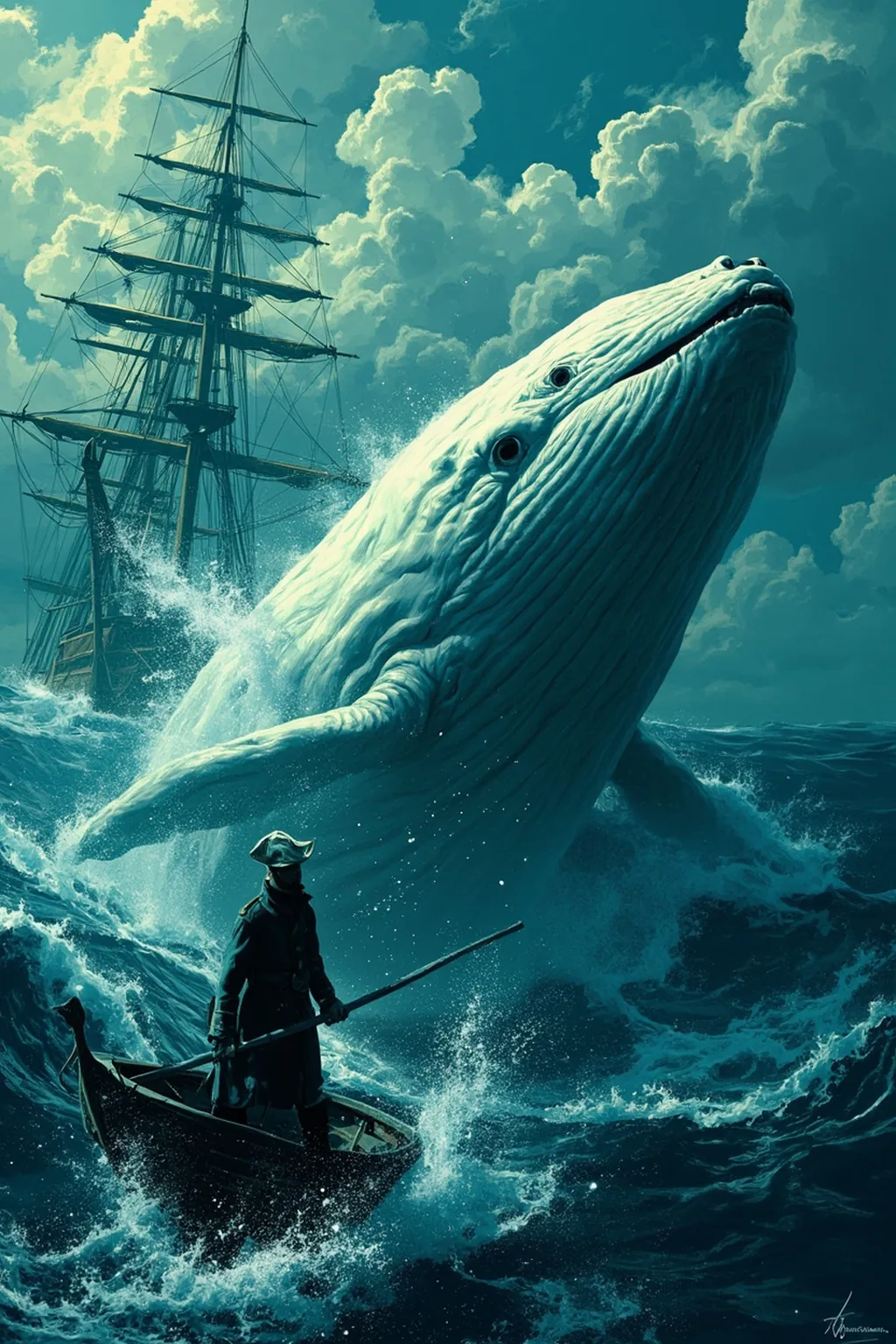
CHAPTER 109. Ahab and Starbuck in the Cabin.
The next morning, the crew was pumping the ship as part of their regular semi-weekly duty to drench the oil casks with seawater, keeping them damply tight, the changed character of the bilge water the only way to detect leaks in the precious cargo. And lo—no inconsiderable quantity of oil came up with the bilge water. The casks in the hold had sprung a serious leak, and Starbuck went aft to report the disaster to Ahab, who was hunched over a chart of the Japanese archipelagoes, his new snow-white ivory leg braced against the table leg, a long pruning-hook jack-knife in his hand. “Who’s there?” Ahab called, not turning around. “On deck! Begone!” “Captain Ahab mistakes; it is I. The oil in the hold is leaking, sir. We must up Burtons and break out the casks at once.” “Up Burtons and break out? Now that we are nearing Japan, heave-to for a week to tinker old hoops?” “Either do that, sir, or waste more oil in a single day than we can make good in a year. What we came twenty thousand miles for is worth saving, sir.” “So it is—if we get it.” “I was speaking of the oil already in the hold, sir.” “And I was not speaking or thinking of that at all. Begone! Let it leak! I’m all aleak myself. Aye! Leaks in leaks! Not only full of leaky casks, but those casks are in a leaky ship; that’s a far worse plight than the Pequod’s, man. Yet I don’t stop to plug my leak; for who can find it in the deep-loaded hull, or how hope to plug it even if found, in this life’s howling gale? Starbuck! I’ll not have the Burtons hoisted.” “What will the owners say, sir?” “Let the owners stand on Nantucket beach and outyell the typhoons. What cares Ahab? Owners, owners? Thou art always prating to me of those miserly owners, as if they were my conscience. But look ye: the only real owner of anything is its commander; and hark ye, my conscience is in this ship’s keel. On deck!” Starbuck’s face flushed red, and he took a half-step further into the cabin, his voice low and shaking with a strange, cautious respect that was half distrust of itself. “A better man than I might well pass over in thee what he would quickly resent in a younger, happier man, Captain Ahab.” Ahab seized a loaded musket from the rack, pointed it straight at his first mate, and roared: “There is one God that is Lord over the earth, and one Captain that is lord over the Pequod! On deck!” For an instant, Starbuck’s flashing eyes and fiery cheeks made it seem he’d been hit by the musket’s blast. But he mastered himself, rose half calmly, and paused at the cabin door to say, quiet as a murmur: “Thou hast outraged, not insulted me, sir; but for that I ask thee not to beware of Starbuck; thou wouldst but laugh. But let Ahab beware of Ahab; beware of thyself, old man.” “He waxes brave, but nevertheless obeys; most careful bravery that!” Ahab muttered as Starbuck disappeared. “What’s that he said—Ahab beware of Ahab? There’s something there.” He leaned on the musket like a staff, his iron brow furrowed, pacing the small cabin back and forth, until his forehead relaxed. He returned the gun to the rack, went to the deck, and murmured lowly to himself: “Thou art but too good a fellow, Starbuck.” Then he raised his voice to the crew: “Furl the t’gallant-sails, close-reef the top-sails fore and aft, back the main-yard, up Burton, and break out in the main-hold.” Whether he’d acted out of a rare flash of honesty, or mere prudential policy that forbade even a hint of open disaffection from his chief officer, no one could say. But the orders were carried out, the Burtons hoisted, and the leaky casks dragged up into the light.
The original text of this work is in the public domain. This page focuses on a guided summary article, reading notes, selected quotes, and visual learning materials for educational purposes.