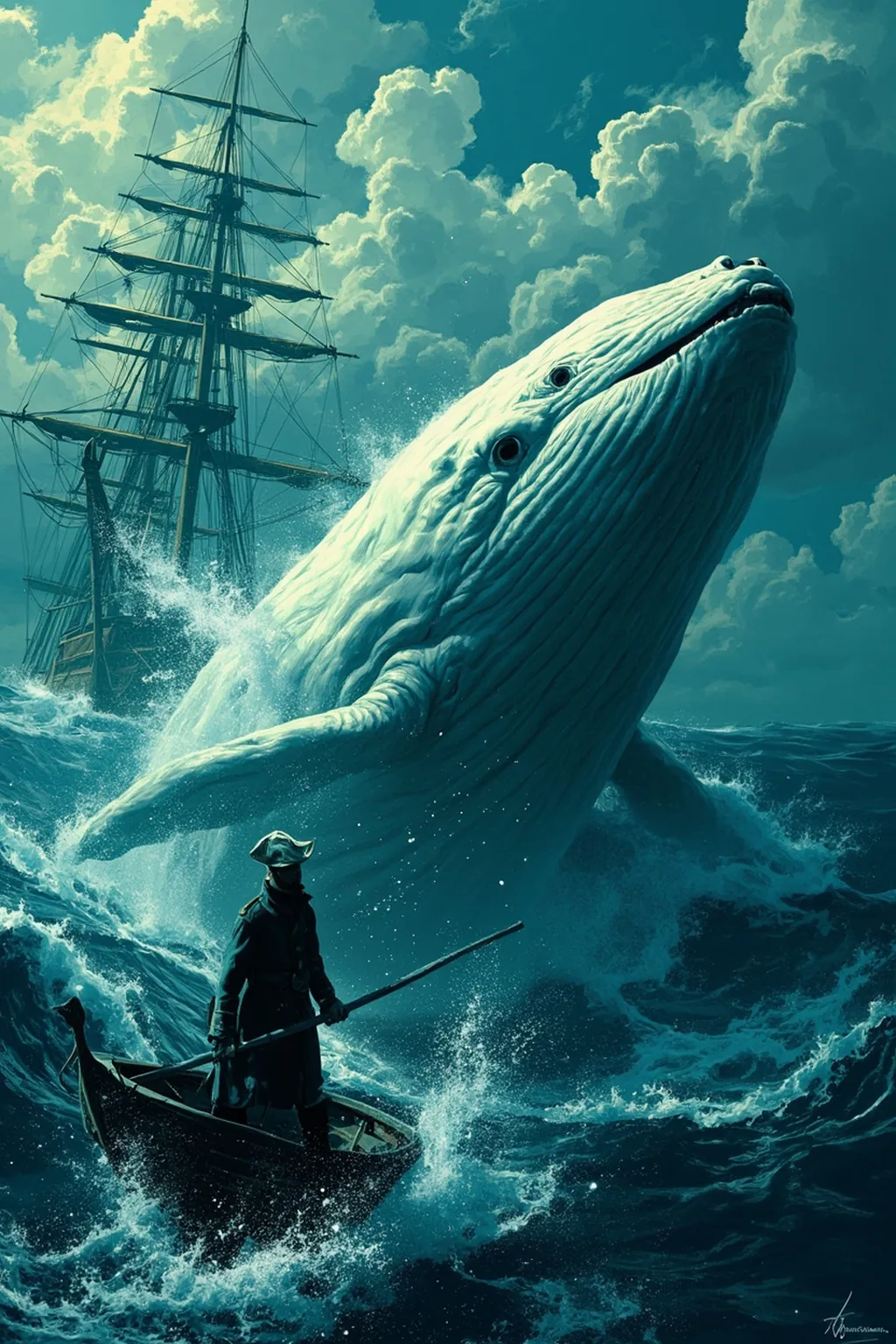
Scratches on the Sperm Whale’s Flanks
Besides the regular linear markings, the whale frequently displays his back and flanks partially effaced by numerous rude scratches of irregular, random appearance. These scratches resemble marks that geologist Louis Agassiz believed were left by floating icebergs on New England coastal rocks. The narrator suggests such scratches result from hostile contact with other whales, as they are most often observed on large, full-grown bulls of the species.
The Whale’s Blubber as a Natural Blanket
The skin or blubber is stripped from the whale in long pieces called “blanket-pieces”—a term the narrator considers apt and expressive. The whale is indeed wrapped in his blubber as in a genuine blanket or poncho slipped over his head and skirting his extremities. This cozy blanketing enables the whale to remain comfortable in all weather conditions, seas, times, and tides.
The Whale’s Adaptation to Arctic Cold
Without this cozy coating, a Greenland whale could not survive the shuddering, icy northern seas. While other fish thrive in Hyperborean waters, these are cold-blooded, lungless creatures whose bellies themselves act as refrigerators—they warm themselves under iceberg lee like travelers before fires. The whale, by contrast, has lungs and warm blood like humans; freezing his blood would be fatal. Yet remarkably, the Polar whale not only survives but maintains blood warmer than that of a Borneo native during summer.
The Virtue of the Whale’s Strong Vitality
The narrator sees in the whale the rare virtues of strong individual vitality, thick walls, and interior spaciousness. He implores humanity to admire and model itself after the whale—to remain warm among ice, to live in the world without being of it, to stay cool at the equator and fluid at the Pole. Yet he acknowledges the futility of such instruction, since few erections are domed like St. Peter’s and few creatures are as vast as the whale.
CHAPTER 69. The Funeral.
This chapter describes the aftermath of the whale’s death as its massive body is cut loose and drifts away into the sea. The chapter presents this as a grotesque funeral ceremony, with sharks and seabirds as mourners, and explores how superstitions arise from such scenes—sailors mistaking the floating corpse for dangerous shoals, creating false legends that persist for years. The chapter concludes by questioning whether readers believe in ghosts, suggesting that even rational men acknowledge deeper mysteries.
The Floating Carcass
The whale’s beheaded body, pale as marble, floats away from the ship while sharks tear at it beneath the surface and screaming seabirds attack from above. Despite its decapitation, the corpse remains colossal in size. For hours, the ship remains nearly stationary as observers watch this terrible spectacle unfold across the calm, sunny sea until the massive carcass disappears into the distance.
The Mock Funeral
The text describes a “most doleful and most mocking funeral” where the sea-vultures and air-sharks act as mourners in black and speckled plumage. Melville ironically notes that few of these creatures would have aided the living whale had it needed help, yet they piously descend upon its funeral feast. The author excoriates this “horrible vultureism of earth” from which not even the mightiest whale is exempt.
The Vengeful Ghost
Though desecrated, the whale’s corpse generates a “vengeful ghost” that haunts maritime navigation. Distant ships mistake the white mass floating in sunlight for dangerous shoals or rocks, and captains dutifully record these phantom hazards in their logs. Ships then avoid these places for years afterward, leaping over them like sheep following their leader over a stick—a metaphor for how superstitions and false precedents perpetuate themselves without rational foundation.
Ghosts and Belief
The chapter ends by asking directly whether the reader believes in ghosts, challenging the assumption that only the credulous accept such spirits. Melville notes that there are ghosts beyond the famous Cock-Lane apparition, and that men deeper and more skeptical than Dr. Johnson have believed in them.
CHAPTER 70. The Sphynx.
After the sperm whale is decapitated, its massive head—comprising nearly one-third of the entire bulk of the leviathan—is hoisted against the ship’s side, hanging there like the severed head of Holofernes from Judith’s girdle. In the eerie stillness of noon, with the sea transformed into a calm like a universal yellow lotus, Ahab emerges alone to confront this hooded, blood-dripping head, which he compares to the Sphynx standing in the desert, and addresses it as a being that has witnessed all the mysteries and tragedies of the oceanic depths, from drowned hopes and rusted navies to murdered mates and parted lovers. Ahab demands the secrets of the deep from this silent witness, lamenting that though it has seen enough to shake faith itself, not one syllable emerges from its mute depths, until the cry of “Sail ho!” from the main-mast-head shatters both the deadly calm and Ahab’s solitary communion with the drowned world’s secrets.
The original text of this work is in the public domain. This page focuses on a guided summary article, reading notes, selected quotes, and visual learning materials for educational purposes.