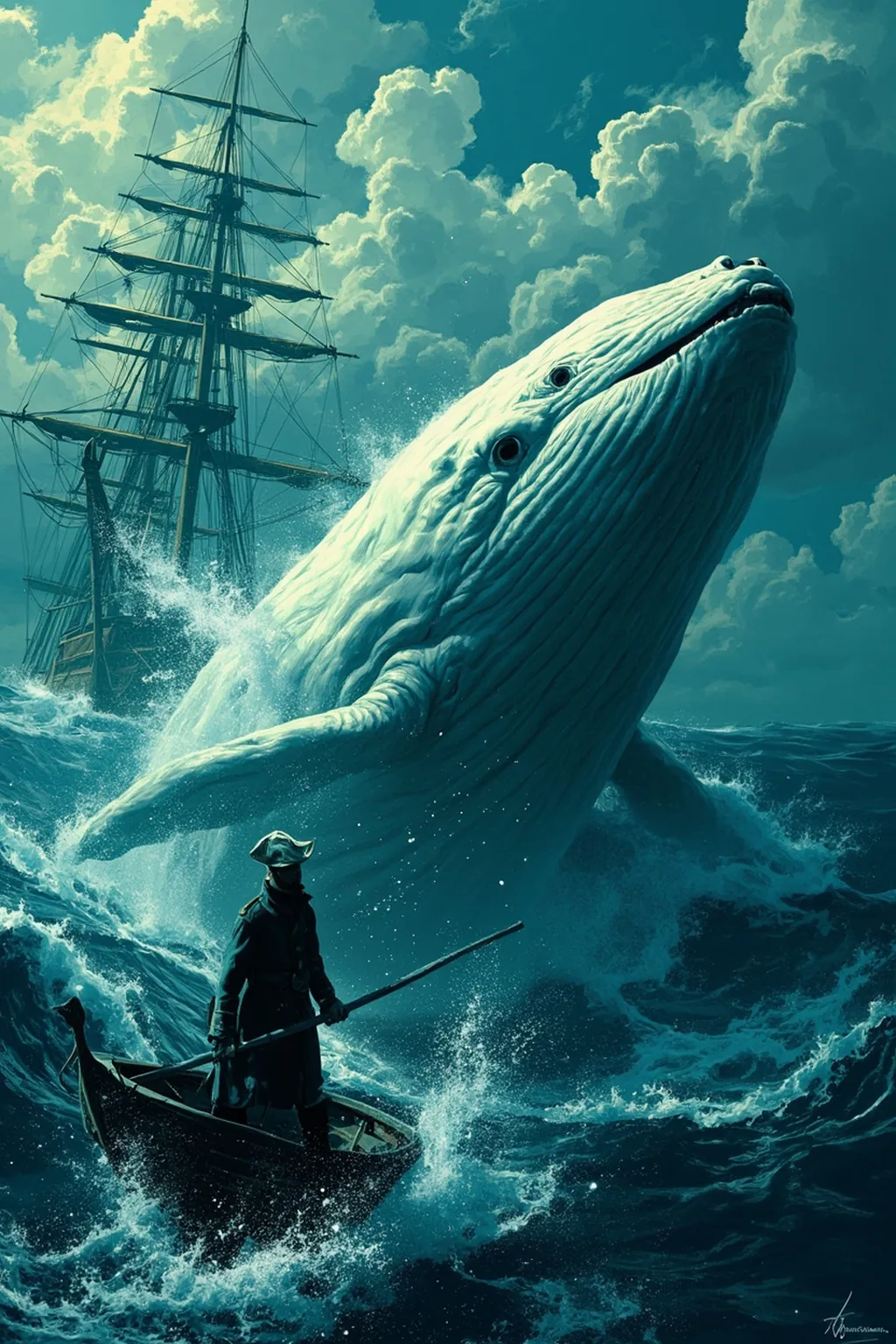
第5章:第1章 潮騒
Call me Ishmael. Some years ago—never mind how long precisely—having little or no money in my purse, and nothing particular to interest me on shore, I thought I would sail about a little and see the watery part of the world.
Whenever I find myself growing grim about the mouth; whenever it is a damp, drizzly November in my soul; whenever I find myself involuntarily pausing before coffin warehouses, and bringing up the rear of every funeral I meet; and especially whenever my hypos get such an upper hand of me, that it requires a strong moral principle to prevent me from deliberately stepping into the street, and methodically knocking people’s hats off—then, I account it high time to get to sea as soon as I can.
解説を読む
イシュマエルは深いうつ病と Restlessness の諸症状を生々しく列挙する。比喩的な「魂における湿っぽく小雨降る十一月」は、男性たちを海への妙薬として駆り立てる内的不全感捉らえる。
With a philosophical flourish Cato throws himself upon his sword; I quietly take to the ship.
解説を読む
ローマの政治家カトの劇的な自殺と自らの静かな出発を対比させ、イシュマエルは航海を自己破壊への Stoic な代替手段として位置づける。それは彼の Escape に inherent な生存本能を浮き彫りにする。
Posted like silent sentinels all around the town, stand thousands upon thousands of mortal men fixed in ocean reveries.
解説を読む
この力強い形象的描写は、都市生活者への水の磁石的引力を記述する。それは、街の単調な日常を超越した、崇高なものへの普遍的・潜在的な欲求を Suggest する。
And still deeper the meaning of that story of Narcissus, who because he could not grasp the tormenting, mild image he saw in the fountain, plunged into it and was drowned. But that same image, we ourselves see in all rivers and oceans. It is the image of the ungraspable phantom of life; and this is the key to it all.
解説を読む
イシュマエルは Narciusus の神話を reinterpret し、人間の水への執着を説明する。波に見られる「 жизнь の把握不可能な亡霊」は、男性が追いかけながらも完全には捉えられない存在の意味の Elusive さをを表す。
What of it, if some old hunks of a sea-captain orders me to get a broom and sweep down the decks? What does that indignity amount to, weighed, I mean, in the scales of the New Testament? Who ain’t a slave?
解説を読む
ここでイシュマエルは、 Pride と肉体労働の辛苦を調整し、普遍的な隷属を Invoke する。彼はすべての男性が何かしらの形而上学的意味で僕隷属であるため、船長の命令に従うことは恥辱ではないと論じる。
Chief among these motives was the overwhelming idea of the great whale himself. Such a portentous and mysterious monster roused all my curiosity.
解説を読む
物語は一般的な哲学からこの旅の原因へと移行する。鯨は単なる獲物としてではなく、語り手の全注意を 요구する宇宙的存在として紹介される。
I am tormented with an everlasting itch for things remote. I love to sail forbidden seas, and land on barbarous coasts.
解説を読む
イシュマエルは危险的で未知のものへの心理的 Drive を告白する。この「かゆみ」は Conventional な生活の安全よりも捕鯨の危険を Risk する彼の willingness を説明する。
…mid most of them all, one grand hooded phantom, like a snow hill in the air.
解説を読む
章は白い鯨の幽霊的で雄大な形象的描写で締めくくられる。それはモビー・ディックをイシュマエルの魂における SPECTRAL で圧倒的な存在として提示し、書の中心的な Conflict の伏線となる。
第6章:第2章 旅行鞄
For my mind was made up to sail in no other than a Nantucket craft, because there was a fine, boisterous something about everything connected with that famous old island, which amazingly pleased me.
解説を読む
イシュマエルは出発地点に関して浪漫的な頑固さを示す。彼はニューベッドフォードの実践性を退け、nantucket の歴史的威望と Wild な性格を好むことで「オリジナル」を単なる便利さよりも優先することestablishing する。
With anxious grapnels I had sounded my pocket, and only brought up a few pieces of silver,—So, wherever you go, Ishmael, said I to myself, as I stood in the middle of a dreary street shouldering my bag… wherever in your wisdom you may conclude to lodge for the night, my dear Ishmael, be sure to inquire the price, and don’t be too particular.
解説を読む
「不安々しい碇」の船乗りの比喩は、空っぽのポケットを確認する彼の絶望を強調する。この自己への呼びかけの瞬間は、彼の孤立と、彼的城市の暗い中での動きを決定する即時の・ Grindng 的な貧しさを浮き彫りにする。
It seemed the great Black Parliament sitting in Tophet. A hundred black faces turned round in their rows to peer; and beyond, a black Angel of Doom was beating a book in a pulpit.
解説を読む
宿と誤認した騒がしい黒人教会について、イシュマエルは幻覚的な scene の description を提供する。トフェット——地獄の業火の聖書的な谷——の imagery は彼の Orientation の喪失と彼のmistake の予想外の・ Terrifying な性質をunderscore する。
Coffin?—Spouter?—Rather ominous in that particular connexion, thought I.
解説を読む
宿の看板と大家の名前のイシュマエルの反応は、書の смертность テーマを foreshadow する。彼の貧乏ゆえにこれらの悪い予兆を受け入れることは、迷信よりも必然性が優先することを示している。
“In judging of that tempestuous wind called Euroclydon,” says an old writer—of whose works I possess the only copy extant—“it maketh a marvellous difference, whether thou lookest out at it from a glass window where the frost is all on the outside, or whether thou observest it from that sashless window, where the frost is on both sides, and of which the wight Death is the only glazier.”
解説を読む
イシュマエルは金持ちと貧者の Exposure の違いを区別するために形而上的な作家を引用する。窓のない額縁の唯一のガラス職人が death であるとの形象的描写は、避難所のない人々の脆弱性へのgrim な memento mori である。
The universe is finished; the copestone is on, and the chips were carted off a million years ago.
解説を読む
この宿命論的な statement は、イシュマエルの要素に対する無力感,反映する。彼は世界が完成した・無差別な構造であり、彼の苦しみを緩和するために改良や修理ができないことを受け入れる。
Now, that Lazarus should lie stranded there on the curbstone before the door of Dives, this is more wonderful than that an iceberg should be moored to one of the Moluccas.
解説を読む
聖書のたとえを Invoke して、イシュマエルは Rich な男のドアの氷った乞食を対比させる。彼はこの极端な苦しみと無関心に近いことの類似性が、いかなる自然現象よりも更大的異常であると論じる。
第7章:第3章 噴出孔の宿
In fact, the artist’s design seemed this: a final theory of my own, partly based upon the aggregated opinions of many aged persons with whom I conversed upon the subject. The picture represents a Cape-Horner in a great hurricane; the half-foundered ship weltering there with its three dismantled masts alone visible; and an exasperated whale, purposing to spring clean over the craft, is in the enormous act of impaling himself upon the three mast-heads.
解説を読む
イシュマエルは入口の混沌とした・煙たい絵を解読し、カタストロフィックな暴力の scene を明らかにする。鯨が三本のマストに身を串刺しにして自杀するこの形象的描写は、彼がまさに参入しようとしている自然界の破壊的な力と Fury の不吉な予兆として機能する。
Within are shabby shelves, ranged round with old decanters, bottles, flasks; and in those jaws of swift destruction, like another cursed Jonah (by which name indeed they called him), bustles a little withered old man, who, for their money, dearly sells the sailors deliriums and death.
解説を読む
鯨の顎から造られたバーは、亭主が船乗りに毒を売る象徴的な口become する。鯨の中のヨナに例えることは、彼らが海の辛苦に Face する前に集まる setting に聖書的な皮肉の一層を加える。
“Can’t sell his head?—What sort of a bamboozingly story is this you are telling me?” getting into a towering rage. “Do you pretend to say, landlord, that this harpooneer is actually engaged this blessed Saturday night, or rather Sunday morning, in peddling his head around this town?”
解説を読む
harpooneer が彼の頭を売っているという大家の謎めいた冗談に関するイシュマエルの高まるパニックと混乱は、語り手の vivid imagination と不安をhighlight する。この野蛮な誤解は、見知らぬ人の到着前の Suspense を buildup する。
There was no hair on his head—none to speak of at least—nothing but a small scalp-knot twisted up on his forehead. His bald purplish head now looked for all the world like a mildewed skull. Had not the stranger stood between me and the door, I would have bolted out of it quicker than ever I bolted a dinner.
解説を読む
クークィージの物理的描写は彼を非人間化し、禿げた・刺青だらけの頭を霉臭い頭蓋骨に例える。イシュマエルの逃走本能は、彼がクークィージを理解する前に「野蛮人」に向けて感じた deep-seated な偏見と Terror をunderscore する。
First he takes about a double handful of shavings out of his grego pocket, and places them carefully before the idol; then laying a bit of ship biscuit on top and applying the flame from the lamp, he kindled the shavings into a sacrificial blaze.
解説を読む
クークィージの異教徒の儀式、黑い偶像への焦げたビスケットの供物はイシュマエルを Fascinate しながらも Horror させる。この瞬間は harpooneer の otherness をestablishing し、イシュマエルのキリスト教徒の目には彼を異教徒としてmark する。
Taking up his tomahawk from the table, he examined the head of it for an instant, and then holding it to the light, with his mouth at the handle, he puffed out great clouds of tobacco smoke. The next moment the light was extinguished, and this wild cannibal, tomahawk between his teeth, sprang into bed with me.
解説を読む
緊張の頂点として、灯りが消え武装した見知らぬ人がベッドに飛び込む。歯間の戦斧の形象的描写は、ベッドを原初的な危険の場所に変え、イシュマエルの悲鳴を引き起こすら。
“Don’t be afraid now,” said he, grinning again, “Queequeg here wouldn’t harm a hair of your head.”
解説を読む
大家の無頓着な安心は生命を脅かす状況を即座に緩和する。それは Terrifying な「怪物」が無害な男であることが 밝혀かれる転換点をmark し、章のトーンを恐怖から喜劇へとshift する。
Better sleep with a sober cannibal than a drunken Christian.
解説を読む
深い enlightenment の瞬間に、イシュマエルは偏見を捨てクークィージを相ベッド提供者として受け入れる。この 유명な一文は、表面的な違いを超えて共通の人間性を見つける書のテーマを encapsulate する。
第8章:第4章 キルト
Upon waking next morning about daylight, I found Queequeg’s arm thrown over me in the most loving and affectionate manner. You had almost thought I had been his wife. The counterpane was of patchwork, full of odd little parti-coloured squares and triangles; and this arm of his tattooed all over with an interminable Cretan labyrinth of a figure, no two parts of which were of one precise shade—owing I suppose to his keeping his arm at sea unmethodically in sun and shade, his shirt sleeves irregularly rolled up at various times—this same arm of his, I say, looked for all the world like a strip of that same patchwork quilt.
解説を読む
この opening は章の親密さと視覚的混合の中心的な Motif をestablishing する。クークィージの刺青だらけの腕をキルトの断片に例えることは、「野蛮人」と家庭的ものの間の境界を溶解し、目覚めた時のイシュマエルの Orientation の舞台を設定する。
Instantly I felt a shock running through all my frame; nothing was to be seen, and nothing was to be heard; but a supernatural hand seemed placed in mine. My arm hung over the counterpane, and the nameless, unimaginable, silent form or phantom, to which the hand belonged, seemed closely seated by my bed-side. For what seemed ages piled on ages, I lay there, frozen with the most awful fears, not daring to drag away my hand; yet ever thinking that if I could but stir it one single inch, the horrid spell would be broken.
解説を読む
イシュマエルの childhood terror の回想は現在の状況に対する心理的鏡として機能する。この passage は未知のものへの原初的な恐怖と、彼の imagination の麻痺をhighlight する——それを overcome して「食人族」との相ベッドの Reality を受け入れなければならない。
Throwing aside the counterpane, there lay the tomahawk sleeping by the savage’s side, as if it were a hatchet-faced baby. A pretty pickle, truly, thought I; abed here in a strange house in the broad day, with a cannibal and a tomahawk!
解説を読む
武器の発見は超自然的な dread から身体的危険とダークな喜劇へとトーンをshift する。致命的な戦斧を「斧のような顔、赤ん坊」に例えることは、 lethal と infantile を juxtaposition させ、イシュマエルの状況の Absurdity をunderscore する。
But Queequeg, do you see, was a creature in the transition stage—neither caterpillar nor butterfly. He was just enough civilized to show off his outlandishness in the strangest possible manners. His education was not yet completed. He was an undergraduate.
解説を読む
この observation は文化的相対主義と「野蛮-文明」的 continuum の複雑なテーマを捉える。イシュマエルはクークィージの奇妙な行動——ベッドの下にもぐってブーツを履くなど——を単なる蛮性ではなく、一つの Unique な hybrid な state of becoming として framing する。
I was watching to see where he kept his razor, when lo and behold, he takes the harpoon from the bed corner, slips out the long wooden stock, unsheathes the head, whets it a little on his boot, and striding up to the bit of mirror against the wall, begins a vigorous scraping, or rather harpooning of his cheeks.
解説を読む
クークィージが彼の harpoon の研がれた Head で髭を剃る形象的描写は、書の中でもっとも象徴的な彼の性格の illustration の一つである。それは狩りの暴力と身じたくの儀式を融合し、彼の職業と日常生活の Seamless な統合を symbolizing する。
第9章:第5章 朝食
However, a good laugh is a mighty good thing, and rather too scarce a good thing; the more’s the pity. So, if any one man, in his own proper person, afford stuff for a good joke to anybody, let him not be backward, but let him cheerfully allow himself to spend and be spent in that way. And the man that has anything bountifully laughable about him, be sure there is more in that man than you perhaps think for.
解説を読む
イシュマエルは「野蛮人」とベッドを共にする羽目になった後、彼の resilience と良い心境いのための哲学的正当化を提供する。この sentiment は upcoming な航海に essential な適応力と不快における価値を見つける willingness をestablishing する。
But who could show a cheek like Queequeg? which, barred with various tints, seemed like the Andes’ western slope, to show forth in one array, contrasting climates, zone by zone.
解説を読む
メルヴィルはクークィージの刺青だらけの顔を記述するために grand な地理的 imagery を Employ し、harpooneer を単なる curiosity から広大な複雑さの Landscape へと elevate する。アンデスとの比較は、クークィージが彼自身の中に多数の世界を contains し、単純な分類を拒むことを Suggest する。
They say that men who have seen the world, thereby become quite at ease in manner, quite self-possessed in company. Not always, though: Ledyard, the great New England traveller, and Mungo Park, the Scotch one; of all men, they possessed the least assurance in the parlor.
解説を読む
この observation は extensive な旅が social sophistication を産むというロマンチックな仮定を deconstruct する。有名な探検家たちが domestic な設定で awkward だったことを引用して、イシュマエルは捕鯨者たちの逆説的な行動に対する読者の準備をする。
Yes
解説を読む
この象徴的な冒頭の一文は、語り手のペルソナを確立し、書全体を Existential なトーンに設定する。それは即座に社会からの撤退と、未知なるものへの拥抱を告げるものである。