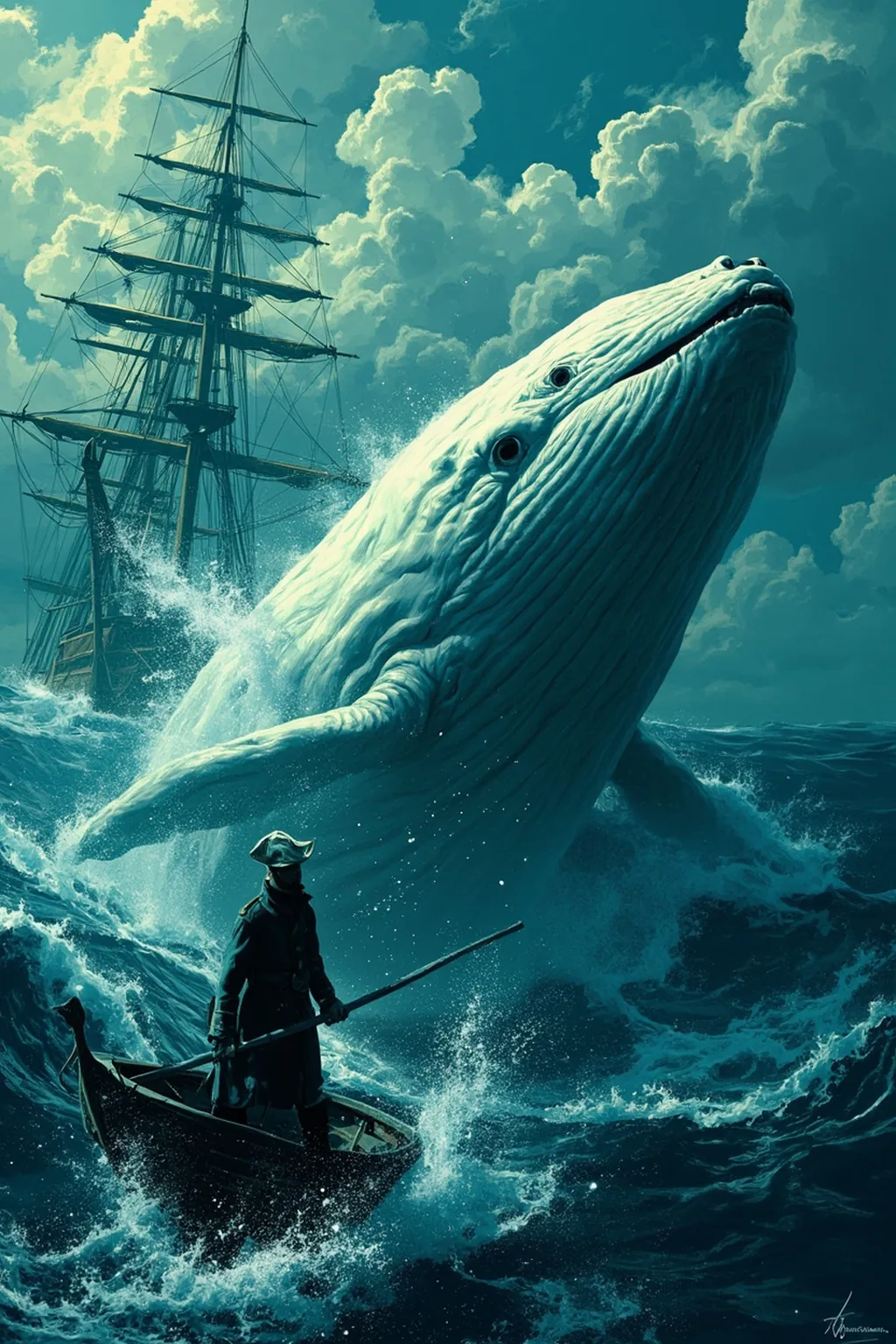
Moby Dick; Or, The Whale cover
Narrative Pressure Citations marquantes

Moby Dick; Or, The Whale

Des passages à relire dans les classiques de la littérature.

Melville, Herman 2001 204 min

Chapitre 5 : CHAPITRE 1. Loomings.

Citations

Call me Ishmael. Some years ago—never mind how long precisely—having little or no money in my purse, and nothing particular to interest me on shore, I thought I would sail about a little and see the watery part of the world.

Lire l'interprétation

Cette phrase d’ouverture emblématique établit le persona du narrateur et pose le ton existentiel de tout le roman. Elle signale immédiatement un retrait de la société et une embrassade de l’inconnu.

Citations

Whenever I find myself growing grim about the mouth; whenever it is a damp, drizzly November in my soul; whenever I find myself involuntarily pausing before coffin warehouses, and bringing up the rear of every funeral I meet; and especially whenever my hypos get such an upper hand of me, that it requires a strong moral principle to prevent me from deliberately stepping into the street, and methodically knocking people’s hats off—then, I account it high time to get to sea as soon as I can.

Lire l'interprétation

Ishmael catalogue avec vivacité les symptômes de sa profonde dépression et de son agitation. La métaphore du « novembre humide et brumeux dans mon âme » capture le malaise intérieur qui pousse les hommes vers la mer comme remède.

Citations

With a philosophical flourish Cato throws himself upon his sword; I quietly take to the ship.

Lire l'interprétation

En opposant le suicide dramatique du Romain Caton à son propre départ discret, Ishmael présente le voyage comme une alternative stoïcienne à l’autodestruction. Cela met en lumière l’instinct de survie inhérent à sa fuite.

Citations

Posted like silent sentinels all around the town, stand thousands upon thousands of mortal men fixed in ocean reveries.

Lire l'interprétation

Cette image puissante décrit l’attraction magnétique de l’eau sur les citadins. Elle suggère un désir universel et inconscient du sublime qui transcende les routines banales de la vie citadine.

Citations

And still deeper the meaning of that story of Narcissus, who because he could not grasp the tormenting, mild image he saw in the fountain, plunged into it and was drowned. But that same image, we ourselves see in all rivers and oceans. It is the image of the ungraspable phantom of life; and this is the key to it all.

Lire l'interprétation

Ishmael réinterprète le mythe de Narcisse pour expliquer l’obsession humaine pour l’eau. Le « fantôme insaisissable de la vie » vu dans les vagues représente le sens insaisissable de l’existence que les hommes poursuivent sans jamais pouvoir完全 saisir.

Citations

What of it, if some old hunks of a sea-captain orders me to get a broom and sweep down the decks? What does that indignity amount to, weighed, I mean, in the scales of the New Testament? Who ain’t a slave?

Lire l'interprétation

Ici, Ishmael réconcilie son orgueil avec la corvée du travail manuel en invoquant une servitude universelle. Il soutient que puisque tous les hommes sont serviteurs dans un certain sens métaphysique, recevoir des ordres d’un capitaine n’est aucune indignité.

Citations

Chief among these motives was the overwhelming idea of the great whale himself. Such a portentous and mysterious monster roused all my curiosity.

Lire l'interprétation

Le récit passe de la philosophie générale au Mobile précis de ce voyage. La baleine est présentée non seulement comme une proie, mais comme une entité cosmique qui commande l’attention totale du narrateur.

Citations

I am tormented with an everlasting itch for things remote. I love to sail forbidden seas, and land on barbarous coasts.

Lire l'interprétation

Ishmael confesse un驱动 psychologique vers le dangereux et l’inconnu. Cette « démangeaison » explique sa volonté de risquer les périls de la chasse à la baleine plutôt que la sécurité d’une vie conventionnelle.

Citations

…mid most of them all, one grand hooded phantom, like a snow hill in the air.

Lire l'interprétation

Le chapitre se conclut par une image terrifiante et majestueuse de la Baleine Blanche. Cela présage le conflit central du roman, présentant Moby Dick comme une présence spectrale et accablante dans l’âme d’Ishmael.

Chapitre 6 : CHAPITRE 2. The Carpet-Bag.

Citations

For my mind was made up to sail in no other than a Nantucket craft, because there was a fine, boisterous something about everything connected with that famous old island, which amazingly pleased me.

Lire l'interprétation

Ishmael révèle un entêtement romantique concernant son point de départ. Il rejette le pragmatisme de New Bedford pour le prestige historique et le caractère sauvage de Nantucket, établissant sa préférence pour l’« original » sur le simplement pratique.

Citations

With anxious grapnels I had sounded my pocket, and only brought up a few pieces of silver,—So, wherever you go, Ishmael, said I to myself, as I stood in the middle of a dreary street shouldering my bag… wherever in your wisdom you may conclude to lodge for the night, my dear Ishmael, be sure to inquire the price, and don’t be too particular.

Lire l'interprétation

La métaphore nautique des « grappins anxieux » souligne son désespoir lorsqu’il vérifie ses poches vides. Ce moment d’auto-adresse met en lumière son isolement et la pauvreté immédiate et grinding qui dicte ses mouvements à travers la ville sombre.

Citations

It seemed the great Black Parliament sitting in Tophet. A hundred black faces turned round in their rows to peer; and beyond, a black Angel of Doom was beating a book in a pulpit.

Lire l'interprétation

En prenant une église noire bruyante pour une auberge, Ishmael offre une description hallucinatoire de la scène. L’imagerie de Tophet — une vallée biblique d’enfer — souligne sa désorientation et la nature terrifiante et inattendue de son erreur.

Citations

Coffin?—Spouter?—Rather ominous in that particular connexion, thought I.

Lire l'interprétation

La réaction d’Ishmael au panneau de l’auberge et au nom de l’aubergiste présage le thème de la mortalité du roman. Son acceptation de ces mauvais présages debido à sa pauvreté montre comment la nécessité取代 la superstition.

Citations

“In judging of that tempestuous wind called Euroclydon,” says an old writer—of whose works I possess the only copy extant—“it maketh a marvellous difference, whether thou lookest out at it from a glass window where the frost is all on the outside, or whether thou observest it from that sashless window, where the frost is on both sides, and of which the wight Death is the only glazier.”

Lire l'interprétation

Ishmael cite un écrivain métaphysique pour distinguer le confort des riches de l’exposition des pauvres. L’image de la Mort comme seul vitrier d’un cadre sans fenêtre est un lugubre memento mori, soulignant la vulnérabilité de ceux sans abri.

Citations

The universe is finished; the copestone is on, and the chips were carted off a million years ago.

Lire l'interprétation

Cette déclaration fataliste reflète le sentiment d’impuissance d’Ishmael contre les éléments. Il accepte que le monde soit une structure terminée et indifférente où aucune amélioration ne peut être faite pour soulager ses souffrances.

Citations

Now, that Lazarus should lie stranded there on the curbstone before the door of Dives, this is more wonderful than that an iceberg should be moored to one of the Moluccas.

Lire l'interprétation

En invoquant la parabole biblique, Ishmael contraste le mendiant gelant à la porte avec l’homme riche à l’intérieur. Il soutient que la proximité d’une telle souffrance et indifférence extrêmes est une anomalie plus grande que n’importe quelle merveille naturelle.

Chapitre 7 : CHAPITRE 3. The Spouter-Inn.

Citations

In fact, the artist’s design seemed this: a final theory of my own, partly based upon the aggregated opinions of many aged persons with whom I conversed upon the subject. The picture represents a Cape-Horner in a great hurricane; the half-foundered ship weltering there with its three dismantled masts alone visible; and an exasperated whale, purposing to spring clean over the craft, is in the enormous act of impaling himself upon the three mast-heads.

Lire l'interprétation

Ishmael décode la peinture chaotique et enfumée de l’entrée, révélant une scène de violence catastrophique. Cette image d’une baleine se suicidant par empalement sert de funeste présage de la puissance destructive et de la fureur inhérentes au monde naturel qu’il s’apprête à entrer.

Citations

Within are shabby shelves, ranged round with old decanters, bottles, flasks; and in those jaws of swift destruction, like another cursed Jonah (by which name indeed they called him), bustles a little withered old man, who, for their money, dearly sells the sailors deliriums and death.

Lire l'interprétation

Le bar, construit à partir d’une mâchoire de baleine, devient une gueule symbolique où l’aubergiste vend du poison aux marins. Comparer l’aubergiste à Jonas dans le ventre de la baleine ajoute une couche d’ironie biblique au cadre où les hommes se réunissent avant d’affronter les périls de la mer.

Citations

“Can’t sell his head?—What sort of a bamboozingly story is this you are telling me?” getting into a towering rage. “Do you pretend to say, landlord, that this harpooneer is actually engaged this blessed Saturday night, or rather Sunday morning, in peddling his head around this town?”

Lire l'interprétation

La panique croissante et la confusion d’Ishmael concernant la blague cryptique de l’aubergiste sur le harponneur vendant sa tête soulignent l’imagination vive et l’anxiété du narrateur. Ce malentendu macabre crée de la suspense avant l’arrivée de l’étranger.

Citations

There was no hair on his head—none to speak of at least—nothing but a small scalp-knot twisted up on his forehead. His bald purplish head now looked for all the world like a mildewed skull. Had not the stranger stood between me and the door, I would have bolted out of it quicker than ever I bolted a dinner.

Lire l'interprétation

La description physique de Queequeg le déshumanise, comparant sa tête chauve et tatouée à un crâne moisi. L’instinct d’Ishmael de fuir souligne les préjugés profondément ancrés et la terreur qu’il ressent envers le « sauvage » avant de le comprendre.

Citations

First he takes about a double handful of shavings out of his grego pocket, and places them carefully before the idol; then laying a bit of ship biscuit on top and applying the flame from the lamp, he kindled the shavings into a sacrificial blaze.

Lire l'interprétation

Le rituel païen de Queequeg, offrant un biscuit grillé à son idole d’ébène, fascine et horrifie Ishmael. Ce moment établit l’altérité du harponneur, le marquant comme un païen aux yeux d’Ishmael.

Citations

Taking up his tomahawk from the table, he examined the head of it for an instant, and then holding it to the light, with his mouth at the handle, he puffed out great clouds of tobacco smoke. The next moment the light was extinguished, and this wild cannibal, tomahawk between his teeth, sprang into bed with me.

Lire l'interprétation

La tension atteint son paroxysme alors que les lumières s’éteignent et l’étranger armé saute dans le lit. L’image du tomahawk entre ses dents transforme le lit en lieu de danger primal, provoquant le cri d’Ishmael pour obtenir de l’aide.

Citations

“Don’t be afraid now,” said he, grinning again, “Queequeg here wouldn’t harm a hair of your head.”

Lire l'interprétation

Le reassurance décontractée de l’aubergiste désamorce immédiatement la situation potentiellement mortelle. Cela marque le tournant où le « monstre » terrifiant se révèle être un homme inoffensif, déplaçant le ton du chapitre de l’horreur à la comédie.

Citations

Better sleep with a sober cannibal than a drunken Christian.

Lire l'interprétation

En un moment de profonde révélation, Ishmael abandonne ses préjugés et embrasse Queequeg comme cododo. Cette ligne célèbre encapsule le thème du roman : regarder au-delà des différences superficielles pour trouver l’humanité commune.

Chapitre 8 : CHAPITRE 4. The Counterpane.

Citations

Upon waking next morning about daylight, I found Queequeg’s arm thrown over me in the most loving and affectionate manner. You had almost thought I had been his wife. The counterpane was of patchwork, full of odd little parti-coloured squares and triangles; and this arm of his tattooed all over with an interminable Cretan labyrinth of a figure, no two parts of which were of one precise shade—owing I suppose to his keeping his arm at sea unmethodically in sun and shade, his shirt sleeves irregularly rolled up at various times—this same arm of his, I say, looked for all the world like a strip of that same patchwork quilt.

Lire l'interprétation

Cela établit le motif central du chapitre de l’intimité confuse et de la fusion visuelle. La comparaison du bras tatoué de Queequeg à la couverture patchwork dissout la frontière entre le « sauvage » et le domestique, préparant la désorientation d’Ishmael au réveil.

Citations

Instantly I felt a shock running through all my frame; nothing was to be seen, and nothing was to be heard; but a supernatural hand seemed placed in mine. My arm hung over the counterpane, and the nameless, unimaginable, silent form or phantom, to which the hand belonged, seemed closely seated by my bed-side. For what seemed ages piled on ages, I lay there, frozen with the most awful fears, not daring to drag away my hand; yet ever thinking that if I could but stir it one single inch, the horrid spell would be broken.

Lire l'interprétation

Le souvenir d’Ishmael de la terreur enfantine sert de miroir psychologique à sa situation actuelle. Ce passage met en lumière la peur primale de l’inconnu et la paralysie de l’imagination, qu’il doit surmonter pour accepter la réalité du « cannibale » dans son lit.

Citations

Throwing aside the counterpane, there lay the tomahawk sleeping by the savage’s side, as if it were a hatchet-faced baby. A pretty pickle, truly, thought I; abed here in a strange house in the broad day, with a cannibal and a tomahawk!

Lire l'interprétation

La découverte de l’arme fait passer le ton de la terreur surnaturelle au danger physique et à la comédie noire. Décrire le tomahawk mortel comme un « bébé au visage de hachette » juxtapose le léthal et l’infantile, soulignant l’absurdité de la situation d’Ishmael.

Citations

But Queequeg, do you see, was a creature in the transition stage—neither caterpillar nor butterfly. He was just enough civilized to show off his outlandishness in the strangest possible manners. His education was not yet completed. He was an undergraduate.

Lire l'interprétation

Cette observation capture le thème complexe du relativisme culturel et du continuum « sauvage-civilisé » du roman. Ishmael présente le comportement bizarre de Queequeg — ramper sous le lit pour enfiler ses bottes — non pas comme une simple sauvagerie, mais comme un état unique et hybride de devenir.

Citations

I was watching to see where he kept his razor, when lo and behold, he takes the harpoon from the bed corner, slips out the long wooden stock, unsheathes the head, whets it a little on his boot, and striding up to the bit of mirror against the wall, begins a vigorous scraping, or rather harpooning of his cheeks.

Lire l'interprétation

L’image de Queequeg se rasant avec la tête aiguisée de son harpon est l’une des illustrations les plus emblématiques de son personnage dans le livre. Elle fusionne la violence de la chasse avec les rituels de toilettage, symbolisant l’intégration transparente de sa profession et de sa vie quotidienne.

Chapitre 9 : CHAPITRE 5. Breakfast.

Citations

However, a good laugh is a mighty good thing, and rather too scarce a good thing; the more’s the pity. So, if any one man, in his own proper person, afford stuff for a good joke to anybody, let him not be backward, but let him cheerfully allow himself to spend and be spent in that way. And the man that has anything bountifully laughable about him, be sure there is more in that man than you perhaps think for.

Lire l'interprétation

Ishmael offre une justification philosophique de sa résilience et de sa bonne humeur après avoir été trompé pour partager un lit avec un « sauvage ». Ce sentiment établit sa capacité d’adaptation et sa volonté de trouver de la valeur dans l’inconfort, un trait essentiel pour son prochain voyage.

Citations

But who could show a cheek like Queequeg? which, barred with various tints, seemed like the Andes’ western slope, to show forth in one array, contrasting climates, zone by zone.

Lire l'interprétation

Melville emploie une imagerie géographique grandiose pour décrire le visage tatoué de Queequeg, élevant le harponneur d’une simple curiosité à un paysage de vaste complexité. La comparaison aux Andes suggère que Queequeg contient des multitudes et des mondes en sa personne, défiant toute catégorisation simple.

Citations

They say that men who have seen the world, thereby become quite at ease in manner, quite self-possessed in company. Not always, though: Ledyard, the great New England traveller, and Mungo Park, the Scotch one; of all men, they possessed the least assurance in the parlor.

Lire l'interprétation

Cette observation déconstruit le romantique supposition que les voyages extensifs engendrent la sophistication sociale. En citant des explorateurs famosos awkward in domestic settings, Ishmael prépare le lecteur au comportement paradoxal des chasseurs de baleines, intrépides sur l’océan mais timides au petit-déjeuner.

Citations

Yes, here were a set of sea-dogs, many of whom without the slightest bashfulness had