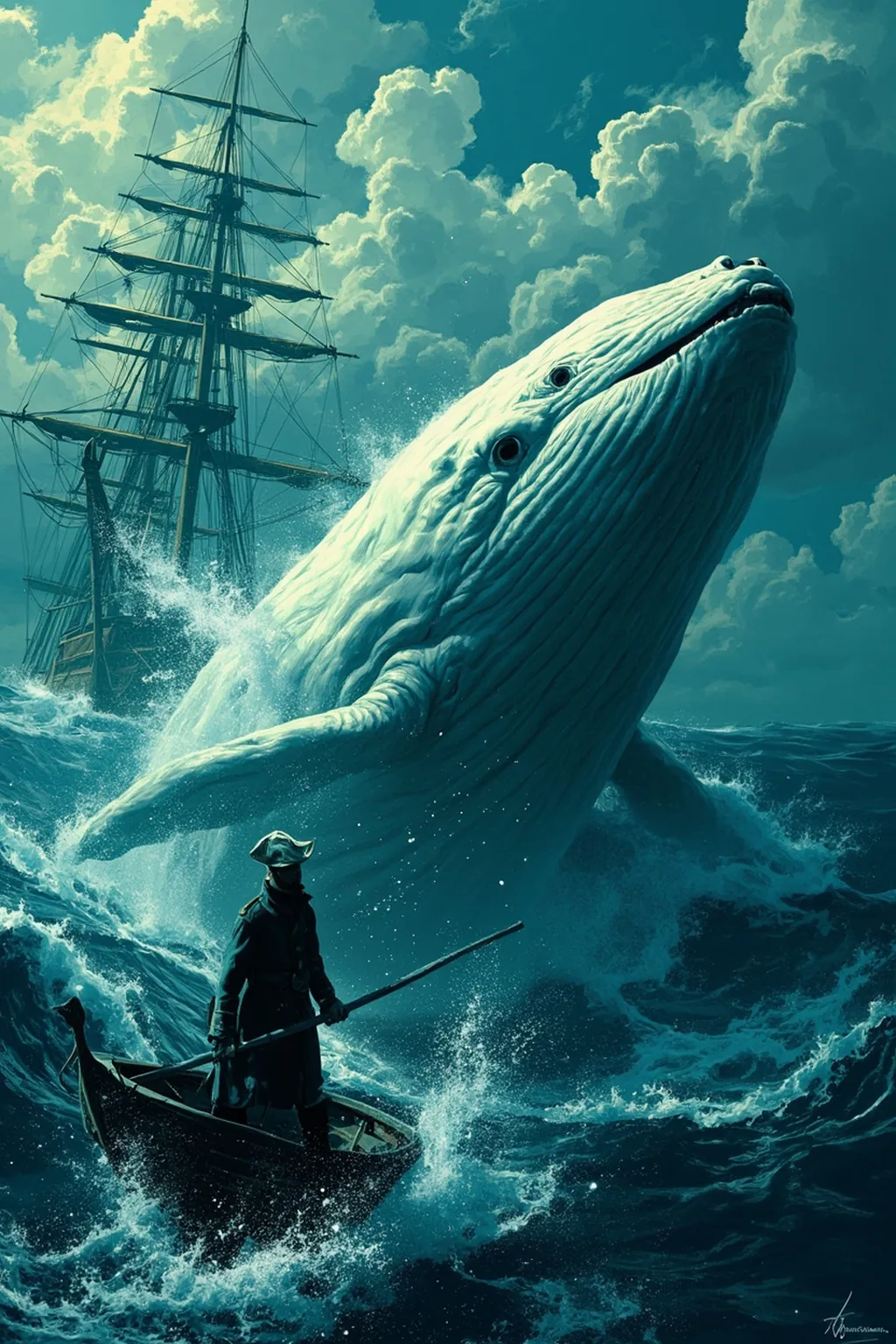
Moby Dick; Or, The Whale cover
Narrative Pressure Citas destacadas

Moby Dick; Or, The Whale

Pasajes que merece la pena revisitar de la literatura clásica.

Melville, Herman 2001 204 min

Capítulo 5: CAPÍTULO 1. Loomings.

Citas

Call me Ishmael. Some years ago—never mind how long precisely—having little or no money in my purse, and nothing particular to interest me on shore, I thought I would sail about a little and see the watery part of the world.

Leer interpretación

Esta icónica línea inicial establece la personalidad del narrador y marca el tono existencial para toda la novela. Señala inmediatamente un retiro de la sociedad y una aceptación de lo desconocido.

Citas

Whenever I find myself growing grim about the mouth; whenever it is a damp, drizzly November in my soul; whenever I find myself involuntarily pausing before coffin warehouses, and bringing up the rear of every funeral I meet; and especially whenever my hypos get such an upper hand of me, that it requires a strong moral principle to prevent me from deliberately stepping into the street, and methodically knocking people’s hats off—then, I account it high time to get to sea as soon as I can.

Leer interpretación

Ishmael cataloga vívidamente los síntomas de su profunda depresión e inquietud. La metáfora del “húmedo y lloviznoso noviembre en mi alma” captura el malestar interno que impulsa a los hombres hacia el mar como cura.

Citas

With a philosophical flourish Cato throws himself upon his sword; I quietly take to the ship.

Leer interpretación

Contrastando el dramático suicidio del estadista romano Catón con su propia partida silenciosa, Ishmael enmarca el viaje como una alternativa estoica a la autodestrucción. Destaca el instinto de supervivencia inherente en su escape.

Citas

Posted like silent sentinels all around the town, stand thousands upon thousands of mortal men fixed in ocean reveries.

Leer interpretación

Esta poderosa imagen describe la atracción magnética del agua sobre los habitantes urbanos. Sugiere un deseo universal y subconsciente por lo sublime que trasciende las rutinas mundanas de la vida citadina.

Citas

And still deeper the meaning of that story of Narcissus, who because he could not grasp the tormenting, mild image he saw in the fountain, plunged into it and was drowned. But that same image, we ourselves see in all rivers and oceans. It is the image of the ungraspable phantom of life; and this is the key to it all.

Leer interpretación

Ishmael reinterpreta el mito de Narciso para explicar la obsesión humana con el agua. El “fantasma inaprensible de la vida” visto en las olas representa el elusivo significado de la existencia que los hombres persiguen pero nunca pueden capturar completamente.

Citas

What of it, if some old hunks of a sea-captain orders me to get a broom and sweep down the decks? What does that indignity amount to, weighed, I mean, in the scales of the New Testament? Who ain’t a slave?

Leer interpretación

Aquí, Ishmael reconcilia su orgullo con la monotonía del trabajo manual invocando una servidumbre universal. Argumenta que, dado que todos los hombres son sirvientes en algún sentido metafísico, recibir órdenes de un capitán no es ninguna indignidad.

Citas

Chief among these motives was the overwhelming idea of the great whale himself. Such a portentous and mysterious monster roused all my curiosity.

Leer interpretación

La narración pasa de la filosofía general al impulso específico de este viaje. La ballena se presenta no meramente como presa, sino como una entidad cósmica que demanda la atención total del narrador.

Citas

I am tormented with an everlasting itch for things remote. I love to sail forbidden seas, and land on barbarous coasts.

Leer interpretación

Ishmael confiesa un impulso psicológico hacia lo peligroso y desconocido. Esta “picazón” explica su disposición a arriesgarse a los peligros de la caza de ballenas en lugar de la seguridad de la vida convencional.

Citas

…mid most of them all, one grand hooded phantom, like a snow hill in the air.

Leer interpretación

El capítulo concluye con una imagen inquietante y majestuosa de la Ballena Blanca. Presagia el conflicto central de la novela, presentando a Moby Dick como una presencia espectral y abrumadora en el alma de Ishmael.

Capítulo 6: CAPÍTULO 2. The Carpet-Bag.

Citas

For my mind was made up to sail in no other than a Nantucket craft, because there was a fine, boisterous something about everything connected with that famous old island, which amazingly pleased me.

Leer interpretación

Ishmael revela una terquedad romántica respecto a su punto de partida. Rechaza la practicidad de New Bedford por el prestigio histórico y el carácter salvaje de Nantucket, estableciendo su preferencia por lo “original” sobre lo meramente conveniente.

Citas

With anxious grapnels I had sounded my pocket, and only brought up a few pieces of silver,—So, wherever you go, Ishmael, said I to myself, as I stood in the middle of a dreary street shouldering my bag… wherever in your wisdom you may conclude to lodge for the night, my dear Ishmael, be sure to inquire the price, and don’t be too particular.

Leer interpretación

La metáfora náutica de los “ansiosos garfios” enfatiza su desesperación mientras revisa sus bolsillos vacíos. Este momento de auto-dirección destaca su aislamiento y la pobreza inmediata y aplastante que dicta sus movimientos por la ciudad oscura.

Citas

It seemed the great Black Parliament sitting in Tophet. A hundred black faces turned round in their rows to peer; and beyond, a black Angel of Doom was beating a book in a pulpit.

Leer interpretación

Confundiendo una iglesia negra bulliciosa con una posada, Ishmael ofrece una descripción alucinatoria de la escena. Las imágenes de Tofet—un valle bíblico de fuego infernal—subrayan su desorientación y la naturaleza aterradora e inesperada de su error.

Citas

Coffin?—Spouter?—Rather ominous in that particular connexion, thought I.

Leer interpretación

La reacción de Ishmael ante el letrero de la posada y el nombre del dueño presagia el tema de la mortalidad en la novela. Su aceptación de estos malos presagios debido a su pobreza muestra cómo la necesidad anula la superstición.

Citas

“In judging of that tempestuous wind called Euroclydon,” says an old writer—of whose works I possess the only copy extant—“it maketh a marvellous difference, whether thou lookest out at it from a glass window where the frost is all on the outside, or whether thou observest it from that sashless window, where the frost is on both sides, and of which the wight Death is the only glazier.”

Leer interpretación

Ishmael cita a un escritor metafísico para distinguir entre la comodidad de los ricos y la exposición de los pobres. La imagen de la Muerte como el único vidriero para un marco sin ventanas es un sombrío memento mori, enfatizando la vulnerabilidad de aquellos sin refugio.

Citas

The universe is finished; the copestone is on, and the chips were carted off a million years ago.

Leer interpretación

Esta declaración fatalista refleja el sentido de impotencia de Ishmael contra los elementos. Acepta que el mundo es una estructura completada e indiferente donde no se pueden hacer mejoras ni reparaciones para aliviar su sufrimiento.

Citas

Now, that Lazarus should lie stranded there on the curbstone before the door of Dives, this is more wonderful than that an iceberg should be moored to one of the Moluccas.

Leer interpretación

Invocando la parábola bíblica, Ishmael contrasta al mendigo helado en la puerta con el hombre rico dentro. Argumenta que la proximidad de tal sufrimiento extremo e indiferencia es una anomalía mayor que cualquier maravilla natural.

Capítulo 7: CAPÍTULO 3. The Spouter-Inn.

Citas

In fact, the artist’s design seemed this: a final theory of my own, partly based upon the aggregated opinions of many aged persons with whom I conversed upon the subject. The picture represents a Cape-Horner in a great hurricane; the half-foundered ship weltering there with its three dismantled masts alone visible; and an exasperated whale, purposing to spring clean over the craft, is in the enormous act of impaling himself upon the three mast-heads.

Leer interpretación

Ishmael descifra el caótico y humeante cuadro en la entrada, revelando una escena de violencia catastrófica. Esta imagen de una ballena cometiendo suicidio por empalamiento sirve como presagio siniestro del poder destructivo y la furia inherentes al mundo natural que está a punto de entrar.

Citas

Within are shabby shelves, ranged round with old decanters, bottles, flasks; and in those jaws of swift destruction, like another cursed Jonah (by which name indeed they called him), bustles a little withered old man, who, for their money, dearly sells the sailors deliriums and death.

Leer interpretación

El bar, construido a partir de una mandíbula de ballena, se convierte en una fauce simbólica donde el dueño vende veneno a los marineros. Comparar al dueño con Jonás dentro de la ballena añade una capa de ironía bíblica al escenario donde los hombres se reúnen antes de enfrentar los peligros del mar.

Citas

“Can’t sell his head?—What sort of a bamboozingly story is this you are telling me?” getting into a towering rage. “Do you pretend to say, landlord, that this harpooneer is actually engaged this blessed Saturday night, or rather Sunday morning, in peddling his head around this town?”

Leer interpretación

El pánico creciente y la confusión de Ishmael respecto a la broma críptica del dueño sobre el arponero vendiendo su cabeza destaca la vívida imaginación y ansiedad del narrador. Este malentendido macabro construye suspenso antes de la llegada del extraño.

Citas

There was no hair on his head—none to speak of at least—nothing but a small scalp-knot twisted up on his forehead. His bald purplish head now looked for all the world like a mildewed skull. Had not the stranger stood between me and the door, I would have bolted out of it quicker than ever I bolted a dinner.

Leer interpretación

La descripción física de Queequeg lo deshumaniza, comparando su cabeza calva y tatuada con un cráneo enmohecido. El instinto de Ishmael de huir subraya el prejuicio profundamente arraigado y el terror que siente hacia el “salvaje” antes de comprenderlo.

Citas

First he takes about a double handful of shavings out of his grego pocket, and places them carefully before the idol; then laying a bit of ship biscuit on top and applying the flame from the lamp, he kindled the shavings into a sacrificial blaze.

Leer interpretación

El ritual pagano de Queequeg, ofreciendo una galleta quemada a su ídolo de ébano, fascina y horroriza a Ishmael. Este momento establece la otredad del arponero, marcándolo como un pagano a los ojos cristianos de Ishmael.

Citas

Taking up his tomahawk from the table, he examined the head of it for an instant, and then holding it to the light, with his mouth at the handle, he puffed out great clouds of tobacco smoke. The next moment the light was extinguished, and this wild cannibal, tomahawk between his teeth, sprang into bed with me.

Leer interpretación

La tensión alcanza su punto máximo cuando las luces se apagan y el extraño armado salta a la cama. La imagen del tomahawk entre sus dientes transforma la cama en un lugar de peligro primal, provocando el grito de Ishmael pidiendo ayuda.

Citas

“Don’t be afraid now,” said he, grinning again, “Queequeg here wouldn’t harm a hair of your head.”

Leer interpretación

La tranquilizadora casualidad del dueño desactiva inmediatamente la situación que amenazaba la vida. Marca el punto de inflexión donde el terrorífico “monstruo” se revela como un hombre inofensivo, cambiando el tono del capítulo de horror a comedia.

Citas

Better sleep with a sober cannibal than a drunken Christian.

Leer interpretación

En un momento de profunda epifanía, Ishmael descarta su prejuicio y abraza a Queequeg como compañero de cama. Esta famosa línea encapsula el tema de la novela de mirar más allá de las diferencias superficiales para encontrar una humanidad común.

Capítulo 8: CAPÍTULO 4. The Counterpane.

Citas

Upon waking next morning about daylight, I found Queequeg’s arm thrown over me in the most loving and affectionate manner. You had almost thought I had been his wife. The counterpane was of patchwork, full of odd little parti-coloured squares and triangles; and this arm of his tattooed all over with an interminable Cretan labyrinth of a figure, no two parts of which were of one precise shade—owing I suppose to his keeping his arm at sea unmethodically in sun and shade, his shirt sleeves irregularly rolled up at various times—this same arm of his, I say, looked for all the world like a strip of that same patchwork quilt.

Leer interpretación

Esta apertura establece el motivo central del capítulo de intimidad confusa y fusión visual. La comparación del brazo tatuado de Queequeg con la colcha de retazos disuelve la frontera entre el “salvaje” y lo doméstico, preparando el escenario para la desorientación de Ishmael al despertar.

Citas

Instantly I felt a shock running through all my frame; nothing was to be seen, and nothing was to be heard; but a supernatural hand seemed placed in mine. My arm hung over the counterpane, and the nameless, unimaginable, silent form or phantom, to which the hand belonged, seemed closely seated by my bed-side. For what seemed ages piled on ages, I lay there, frozen with the most awful fears, not daring to drag away my hand; yet ever thinking that if I could but stir it one single inch, the horrid spell would be broken.

Leer interpretación

El recuerdo de Ishmael del terror infantil sirve como espejo psicológico de su situación actual. Este pasaje destaca el miedo primal a lo desconocido y la parálisis de la imaginación, que debe superar para aceptar la realidad del “caníbal” en su cama.

Citas

Throwing aside the counterpane, there lay the tomahawk sleeping by the savage’s side, as if it were a hatchet-faced baby. A pretty pickle, truly, thought I; abed here in a strange house in the broad day, with a cannibal and a tomahawk!

Leer interpretación

El descubrimiento del arma cambia el tono de terror sobrenatural a peligro físico y comedia oscura. Describir el mortal tomahawk como un “bebé con cara de hacha” yuxtapone lo letal con lo infantil, subrayando lo absurdo del predicamento de Ishmael.

Citas

But Queequeg, do you see, was a creature in the transition stage—neither caterpillar nor butterfly. He was just enough civilized to show off his outlandishness in the strangest possible manners. His education was not yet completed. He was an undergraduate.

Leer interpretación

Esta observación captura el complejo tema de la novela del relativismo cultural y el continuo “salvaje-civilizado”. Ishmael enmarca el extraño comportamiento de Queequeg—arrastrarse bajo la cama para ponerse las botas—no como mera salvajismo, sino como un estado híbrido único de devenir.

Citas

I was watching to see where he kept his razor, when lo and behold, he takes the harpoon from the bed corner, slips out the long wooden stock, unsheathes the head, whets it a little on his boot, and striding up to the bit of mirror against the wall, begins a vigorous scraping, or rather harpooning of his cheeks.

Leer interpretación

La imagen de Queequeg afeitándose con la cabeza afilada de su arpón es una de las ilustraciones más icónicas de su personaje en el libro. Fusiona la violencia de la caza con los rituales de aseo, simbolizando la integración perfecta de su profesión y su vida diaria.

Capítulo 9: CAPÍTULO 5. Breakfast.

Citas

However, a good laugh is a mighty good thing, and rather too scarce a good thing; the more’s the pity. So, if any one man, in his own proper person, afford stuff for a good joke to anybody, let him not be backward, but let him cheerfully allow himself to spend and be spent in that way. And the man that has anything bountifully laughable about him, be sure there is more in that man than you perhaps think for.

Leer interpretación

Ishmael ofrece una justificación filosófica para su resiliencia y buen humor después de ser engañado para compartir cama con un “salvaje”. Este sentimiento establece su capacidad de adaptación y su disposición a encontrar valor en la incomodidad, un rasgo esencial para su próximo viaje.

Citas

But who could show a cheek like Queequeg? which, barred with various tints, seemed like the Andes’ western slope, to show forth in one array