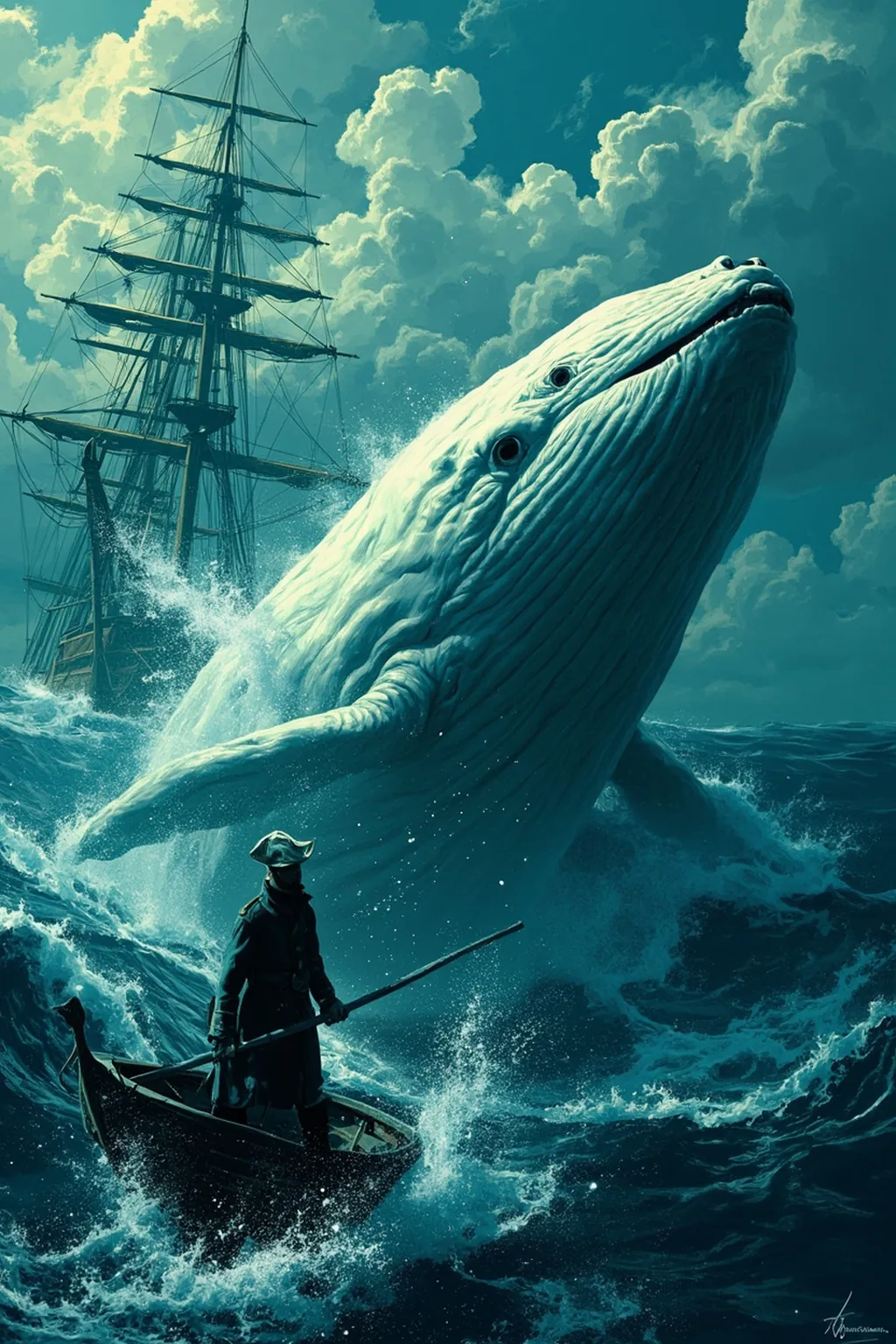
Moby Dick; Or, The Whale cover
Narrative Pressure Wichtige Zitate

Moby Dick; Or, The Whale

Passagen aus der klassischen Literatur, zu denen man gerne zurückkehrt.

Melville, Herman 2001 204 min

Kapitel 5: KAPITEL 1. Loomings.

Zitate

Call me Ishmael. Some years ago—never mind how long precisely—having little or no money in my purse, and nothing particular to interest me on shore, I thought I would sail about a little and see the watery part of the world.

Interpretation lesen

Diese ikonische Eröffnungszeile etabliert die Persona des Erzählers und setzt den existenziellen Ton für den gesamten Roman. Sie signalisiert sofort einen Rückzug aus der Gesellschaft und eine Umarmung des Unbekannten.

Zitate

Whenever I find myself growing grim about the mouth; whenever it is a damp, drizzly November in my soul; whenever I find myself involuntarily pausing before coffin warehouses, and bringing up the rear of every funeral I meet; and especially whenever my hypos get such an upper hand of me, that it requires a strong moral principle to prevent me from deliberately stepping into the street, and methodically knocking people’s hats off—then, I account it high time to get to sea as soon as I can.

Interpretation lesen

Ishmael schildert lebhaft die Symptome seiner tiefen Depression und Ruhelosigkeit. Das metaphorische „feuchte, trübselige November in meiner Seele“ erfasst das innere Unwohlsein, das Männer dazu treibt, das Meer als Heilmittel aufzusuchen.

Zitate

With a philosophical flourish Cato throws himself upon his sword; I quietly take to the ship.

Interpretation lesen

In dem Kontrast zwischen dem dramatischen Selbstmord des römischen Staatsmannes Cato und seiner eigenen ruhigen Abreise rahmt Ishmael die Reise als stoische Alternative zur Selbstzerstörung ein. Dies unterstreicht den Überlebensinstinkt, der seinem Entkommen innewohnt.

Zitate

Posted like silent sentinels all around the town, stand thousands upon thousands of mortal men fixed in ocean reveries.

Interpretation lesen

Dieses kraftvolle Bild beschreibt die magnetische Anziehungskraft des Wassers auf die Stadtbewohner. Es deutet auf ein universelles, unterbewusstes Verlangen nach dem Erhabenen hin, das die alltäglichen Routinen des Stadtlebens transzendiert.

Zitate

And still deeper the meaning of that story of Narcissus, who because he could not grasp the tormenting, mild image he saw in the fountain, plunged into it and was drowned. But that same image, we ourselves see in all rivers and oceans. It is the image of the ungraspable phantom of life; and this is the key to it all.

Interpretation lesen

Ishmael reinterpretiert den Mythos des Narziss, um die menschliche Besessenheit vom Wasser zu erklären. Das „unergreifbare Phantom des Lebens“, das in den Wellen gesehen wird, repräsentiert den flüchtigen Sinn der Existenz, den Menschen jagen, aber niemals vollständig erfassen können.

Zitate

What of it, if some old hunks of a sea-captain orders me to get a broom and sweep down the decks? What does that indignity amount to, weighed, I mean, in the scales of the New Testament? Who ain’t a slave?

Interpretation lesen

Hier versöhnt Ishmael seinen Stolz mit der Plackerei der Handarbeit, indem er eine universellen Knechtschaft heraufbeschwört. Er argumentiert, dass da alle Menschen in gewissem metaphysischen Sinne Diener sind, eine Anweisung von einem Kapitän keine Erniedrigung darstellt.

Zitate

Chief among these motives was the overwhelming idea of the great whale himself. Such a portentous and mysterious monster roused all my curiosity.

Interpretation lesen

Die Erzählung verschiebt sich von allgemeiner Philosophie zum spezifischen Anlass für diese Reise. Der Wal wird nicht nur als Beute eingeführt, sondern als kosmische Entität, die die totale Aufmerksamkeit des Erzählers beansprucht.

Zitate

I am tormented with an everlasting itch for things remote. I love to sail forbidden seas, and land on barbarous coasts.

Interpretation lesen

Ishmael gesteht einen psychologischen Drang zum Gefährlichen und Unbekannten. Diese „Kratzerei“ erklärt seine Bereitschaft, die Gefahren des Walfangs gegen die Sicherheit eines konventionellen Lebens einzutauschen.

Zitate

…mid most of them all, one grand hooded phantom, like a snow hill in the air.

Interpretation lesen

Das Kapitel schließt mit einem geisterhaften, majestätischen Bild des weißen Walfisches. Es kündigt den zentralen Konflikt des Romans an und präsentiert Moby Dick als geisterhafte, überwältigende Präsenz in Ishamaels Seele.

Kapitel 6: KAPITEL 2. The Carpet-Bag.

Zitate

For my mind was made up to sail in no other than a Nantucket craft, because there was a fine, boisterous something about everything connected with that famous old island, which amazingly pleased me.

Interpretation lesen

Ishmael enthüllt eine romantische Sturheit bezüglich seines Abfahrtshafens. Er weist die Praktikabilität von New Bedford zugunsten des historischen Prestiges und wilden Charakters von Nantucket zurück und etabliert seine Präferenz für das „Originelle“ gegenüber dem bloß Bequemen.

Zitate

With anxious grapnels I had sounded my pocket, and only brought up a few pieces of silver,—So, wherever you go, Ishmael, said I to myself, as I stood in the middle of a dreary street shouldering my bag… wherever in your wisdom you may conclude to lodge for the night, my dear Ishmael, be sure to inquire the price, and don’t be too particular.

Interpretation lesen

Die nautische Metapher der „ängstlichen Greifhaken“ unterstreicht seine Verzweiflung, als er seine leeren Taschen überprüft. Dieser Moment der Selbstansprache hebt seine Isolation und die unmittelbare, zermürbende Armut hervor, die seine Bewegungen durch die dunkle Stadt diktiert.

Zitate

It seemed the great Black Parliament sitting in Tophet. A hundred black faces turned round in their rows to peer; and beyond, a black Angel of Doom was beating a book in a pulpit.

Interpretation lesen

Als er eine randalierende schwarze Kirche für ein Gasthaus hält, bietet Ishmael eine halluzinatorische Beschreibung der Szene. Das Bild von Tophet – einem biblischen Tal des Höllenfeuers – unterstreicht seine Desorientierung und die schreckliche, unerwartete Natur seines Irrtums.

Zitate

Coffin?—Spouter?—Rather ominous in that particular connexion, thought I.

Interpretation lesen

Ishmaels Reaktion auf das Schild des Gasthauses und den Namen des Gastwirts kündigt das Sterblichkeitsthema des Romans an. Seine Akzeptanz dieser schlechten Vorzeichen aufgrund seiner Armut zeigt, wie die Notwendigkeit den Aberglauben überwiegt.

Zitate

“In judging of that tempestuous wind called Euroclydon,” says an old writer—of whose works I possess the only copy extant—“it maketh a marvellous difference, whether thou lookest out at it from a glass window where the frost is all on the outside, or whether thou observest it from that sashless window, where the frost is on both sides, and of which the wight Death is the only glazier.”

Interpretation lesen

Ishmael zitiert einen metaphysischen Schriftsteller, um zwischen dem Komfort der Reichen und der Schutzlosigkeit der Armen zu unterscheiden. Das Bild des Todes als einzigem Glaser für ein fensterloses Rahmen ist ein düsteres Memento Mori, das die Verwundbarkeit derer ohne Obdach betont.

Zitate

The universe is finished; the copestone is on, and the chips were carted off a million years ago.

Interpretation lesen

Diese fatalistische Aussage spiegelt Ishamaels Gefühl der Hilflosigkeit gegen die Elemente wider. Er akzeptiert, dass die Welt ein abgeschlossenes, gleichgültiges Bauwerk ist, wo keine Verbesserungen oder Reparaturen gemacht werden können, um sein Leiden zu lindern.

Zitate

Now, that Lazarus should lie stranded there on the curbstone before the door of Dives, this is more wonderful than that an iceberg should be moored to one of the Moluccas.

Interpretation lesen

Unter Bezugnahme auf das biblische Gleichnis kontrastiert Ishmael den erfrierenden Bettler an der Tür mit dem reichen Mann drinnen. Er argumentiert, dass die Nähe eines so extremen Leidens und der Gleichgültigkeit eine größere Anomalie ist als jedes Naturwunder.

Kapitel 7: KAPITEL 3. The Spouter-Inn.

Zitate

In fact, the artist’s design seemed this: a final theory of my own, partly based upon the aggregated opinions of many aged persons with whom I conversed upon the subject. The picture represents a Cape-Horner in a great hurricane; the half-foundered ship weltering there with its three dismantled masts alone visible; and an exasperated whale, purposing to spring clean over the craft, is in the enormous act of impaling himself upon the three mast-heads.

Interpretation lesen

Ishmael entschlüsselt das chaotische, rauchige Gemälde im Eingangsbereich und enthüllt eine Szene katastrophaler Gewalt. Das Bild eines Wales, der Selbstmord durch Aufspießen begeht, dient als düsteres Omen der zerstörerischen Kraft und Wut, die in der natürlichen Welt innewohnt, in die er gerade eintritt.

Zitate

Within are shabby shelves, ranged round with old decanters, bottles, flasks; and in those jaws of swift destruction, like another cursed Jonah (by which name indeed they called him), bustles a little withered old man, who, for their money, dearly sells the sailors deliriums and death.

Interpretation lesen

Die Bar, konstruiert aus einem Wal Kiefer, wird zu einem symbolischen Schlund, wo der Gastwirt Gift an Matrosen verkauft. Der Vergleich des Gastwirts mit Jona im Wal fügt eine Schicht biblischer Ironie zum Schauplatz hinzu, wo Männer sich versammeln, bevor sie den Gefahren des Meeres entgegentreten.

Zitate

“Can’t sell his head?—What sort of a bamboozingly story is this you are telling me?” getting into a towering rage. “Do you pretend to say, landlord, that this harpooneer is actually engaged this blessed Saturday night, or rather Sunday morning, in peddling his head around this town?”

Interpretation lesen

Ishmaels steigende Panik und Verwirrung bezüglich des kryptischen Witzes des Gastwirts über den Harpunier, der seinen Kopf verkauft, unterstreicht die lebhafte Vorstellungskraft und Angst des Erzählers. Dieses makabre Missverständnis baut Spannung auf, bevor der Fremde ankommt.

Zitate

There was no hair on his head—none to speak of at least—nothing but a small scalp-knot twisted up on his forehead. His bald purplish head now looked for all the world like a mildewed skull. Had not the stranger stood between me and the door, I would have bolted out of it quicker than ever I bolted a dinner.

Interpretation lesen

Die physische Beschreibung von Queequeg entmenschlicht ihn und vergleicht seinen kahlen, tätowierten Kopf mit einem schimmeligen Schädel. Ishamaels Instinkt zu fliehen unterstreicht die tiefsitzenden Vorurteile und den Terror, den er gegenüber dem „Wilden“ empfindet, bevor er ihn versteht.

Zitate

First he takes about a double handful of shavings out of his grego pocket, and places them carefully before the idol; then laying a bit of ship biscuit on top and applying the flame from the lamp, he kindled the shavings into a sacrificial blaze.

Interpretation lesen

Queequegs heidnisches Ritual, das einen verbrannten Keks seinem schwarzen Götzen opfert, fasziniert und entsetzt Ishmael. Dieser Moment etabliert die Andersartigkeit des Harpuniers und markiert ihn als Heiden in Ishamaels christlichen Augen.

Zitate

Taking up his tomahawk from the table, he examined the head of it for an instant, and then holding it to the light, with his mouth at the handle, he puffed out great clouds of tobacco smoke. The next moment the light was extinguished, and this wild cannibal, tomahawk between his teeth, sprang into bed with me.

Interpretation lesen

Die Spannung erreicht ihren Höhepunkt, als das Licht erlischt und der bewaffnete Fremde ins Bett springt. Das Bild der TOMAHAWK zwischen seinen Zähnen verwandelt das Bett in einen Ort primitiver Gefahr und provoziert Ishamaels Hilferuf.

Zitate

“Don’t be afraid now,” said he, grinning again, “Queequeg here wouldn’t harm a hair of your head.”

Interpretation lesen

Die beiläufige Beruhigung des Gastwirts entschärft die lebensbedrohliche Situation sofort. Sie markiert den Wendepunkt, wo das schreckliche „Monster“ als harmloser Mann entlarvt wird und verlagert das Kapitel von Horror zur Komödie.

Zitate

Better sleep with a sober cannibal than a drunken Christian.

Interpretation lesen

In einem Moment tiefer Erkenntnis verwirft Ishmael seine Vorurteile und nimmt Queequeg als Bettgenossen an. Diese berühmte Zeile verkörpert das Thema des Romans, über oberflächliche Unterschiede hinauszublicken, um gemeinsame Menschlichkeit zu finden.

Kapitel 8: KAPITEL 4. The Counterpane.

Zitate

Upon waking next morning about daylight, I found Queequeg’s arm thrown over me in the most loving and affectionate manner. You had almost thought I had been his wife. The counterpane was of patchwork, full of odd little parti-coloured squares and triangles; and this arm of his tattooed all over with an interminable Cretan labyrinth of a figure, no two parts of which were of one precise shade—owing I suppose to his keeping his arm at sea unmethodically in sun and shade, his shirt sleeves irregularly rolled up at various times—this same arm of his, I say, looked for all the world like a strip of that same patchwork quilt.

Interpretation lesen

Dieses Eröffnungsbild etabliert das zentrale Motiv des Kapitels der verwechselnden Intimität und visuellen Verschmelzung. Der Vergleich von Queequegs tätowiertem Arm mit der Patchworkdecke löst die Grenze zwischen dem „Wilden“ und dem Häuslichen auf und bereitet die Bühne für Ishamaels Desorientierung beim Aufwachen.

Zitate

Instantly I felt a shock running through all my frame; nothing was to be seen, and nothing was to be heard; but a supernatural hand seemed placed in mine. My arm hung over the counterpane, and the nameless, unimaginable, silent form or phantom, to which the hand belonged, seemed closely seated by my bed-side. For what seemed ages piled on ages, I lay there, frozen with the most awful fears, not daring to drag away my hand; yet ever thinking that if I could but stir it one single inch, the horrid spell would be broken.

Interpretation lesen

Ishmaels Erinnerung an den Kinderschreck dient als psychologischer Spiegel zu seiner aktuellen Situation. Dieser Passus hebt die primitive Angst vor dem Unbekannten und die Lähmung der Einbildungskraft hervor, die er überwinden muss, um die Realität des „Kannibalen“ in seinem Bett zu akzeptieren.

Zitate

Throwing aside the counterpane, there lay the tomahawk sleeping by the savage’s side, as if it were a hatchet-faced baby. A pretty pickle, truly, thought I; abed here in a strange house in the broad day, with a cannibal and a tomahawk!

Interpretation lesen

Die Entdeckung der Waffe verlagert den Ton von übernatürlichem Schrecken zu körperlicher Gefahr und schwarzer Komödie. Die Beschreibung der tödlichen TOMAHAWK als „beilgesichtiges Baby“ juxtapositioniert das Lethale mit dem Infantilen und unterstreicht die Absurdität von Ishamaels Lage.

Zitate

But Queequeg, do you see, was a creature in the transition stage—neither caterpillar nor butterfly. He was just enough civilized to show off his outlandishness in the strangest possible manners. His education was not yet completed. He was an undergraduate.

Interpretation lesen

Diese Beobachtung erfasst das komplexe Thema des Kulturrelativismus und des „Wilden-Zivilisierten“-Kontinuums. Ishmael rahmt Queequegs bizzarres Verhalten – unter das Bett kriechen, um seine Stiefel anzuziehen – nicht als bloße Wildheit, sondern als einzigartigen, hybriden Zustand des Werdens.

Zitate

I was watching to see where he kept his razor, when lo and behold, he takes the harpoon from the bed corner, slips out the long wooden stock, unsheathes the head, whets it a little on his boot, and striding up to the bit of mirror against the wall, begins a vigorous scraping, or rather harpooning of his cheeks.

Interpretation lesen

Das Bild von Queequeg, der sich mit der geschärften Spitze seiner Harpune rasiert, ist eine der ikonischsten Illustrationen seines Charakters im Buch. Es verschmilzt die Gewalt der Jagd mit den Ritualen der Körperpflege und symbolisiert die nahtlose Integration seines Berufs und seines täglichen Lebens.

Kapitel 9: KAPITEL 5. Breakfast.

Zitate

However, a good laugh is a mighty good thing, and rather too scarce a good thing; the more’s the pity. So, if any one man, in his own proper person, afford stuff for a good joke to anybody, let him not be backward, but let him