Chapter 55. Major Cavalcanti
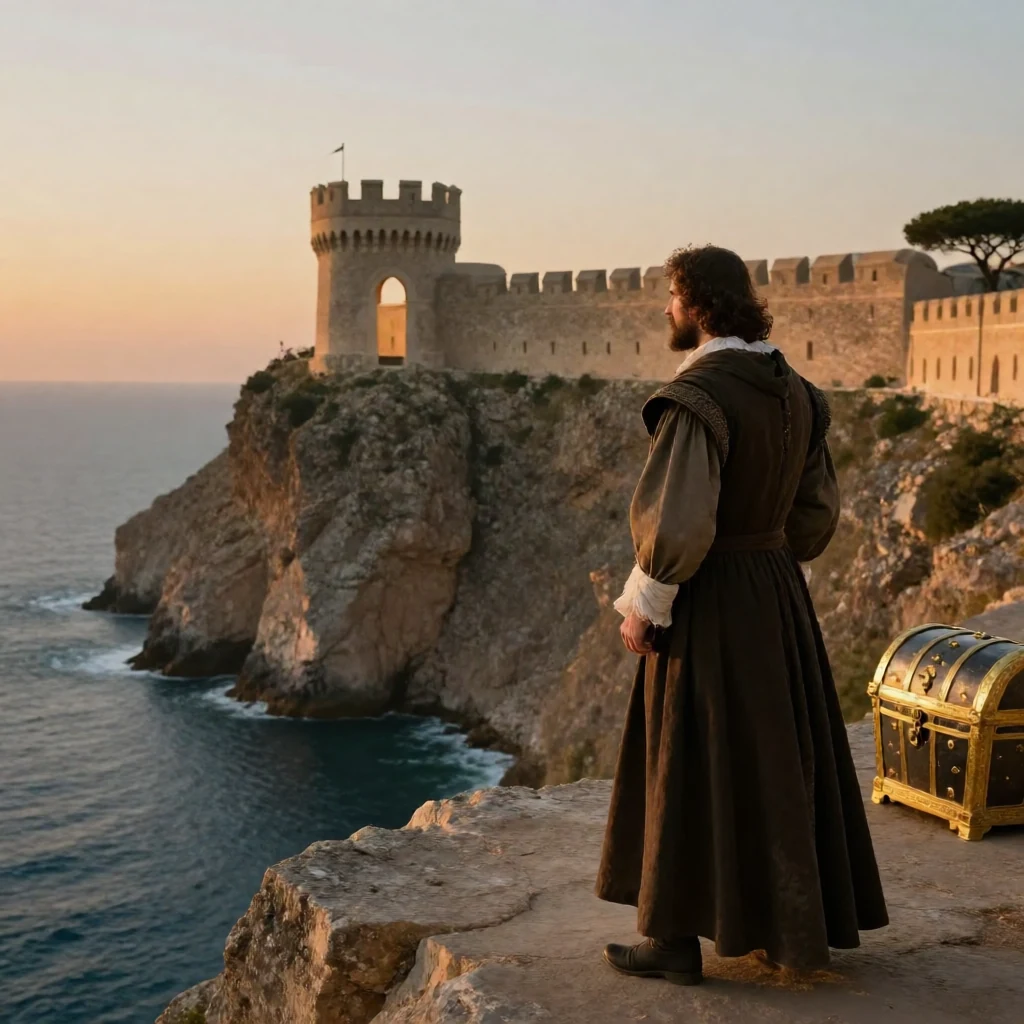
At seven o’clock a cab deposited a man of fifty-two at the count’s gate, dressed in an obsolete green surtout with black frogs still favored in parts of Europe. Ushered into an elegant drawing-room, he was greeted as an old acquaintance: the Marquis Bartolomeo Cavalcanti, bearing a letter of introduction from the Abbé Busoni.
The count read the letter aloud: a worthy Luccan patrician with a half-million income, separated from his only son stolen in infancy. The abbé had forwarded 2,000 francs for travel and credited Monte Cristo with 48,000 more for the major’s use—arrangements the count had clearly orchestrated. He assured the major funds would be forwarded on demand, then handed him a glass of Alicante. The major recited his marriage to the Marchesa Corsinari, her death ten years earlier, and his long search for his lost child.
Monte Cristo produced documents he happened to have: the certificate of the major’s marriage at San Paolo del Monte-Cattini and Andrea Cavalcanti’s baptismal register from Saravezza. He slipped the major an additional 8,000 francs, advised him his costume was out of fashion in Paris, informed him his luggage was at the Hôtel des Princes, and prepared him for the imminent reunion with his son.
Chapter 56. Andrea Cavalcanti
In the adjoining room the count found a tall young man lounging on a sofa—fair, light-haired, red-bearded, and graceful. He was Count Andrea Cavalcanti, bearer of a letter signed “Sinbad the Sailor,” identified by the count as his eccentric English friend Lord Wilmore.
Andrea recited his rehearsed history: stolen at five, raised by kidnappers who educated him to enhance his value, directed to Paris by Wilmore’s letter to claim his father’s identity. The count drew out the confident performance and warned him never to tell the story lest society dismiss him as an upstart.
Touching a hidden spring behind a picture panel, the count watched unseen as Andrea entered to embrace his supposed father. The impostors exchanged theatrical greetings, then, certain they were alone and speaking Italian, dropped their masks. Andrea read aloud the major’s letter from Abbé Busoni; the major then read Andrea’s from Lord Wilmore. Both letters specified the same date, hour, address, and an offer of 50,000 francs a year. Each had been paid; neither knew who was behind it. They agreed a dupe existed, but not themselves, and resolved to play their parts.
The count entered on cue, embraced them warmly, slipped Andrea a packet of bank-notes under the pretense that the major provided for him, and invited them to Saturday’s dinner at Auteuil with precise instructions about attire, horses, and phaeton. Watching them depart arm in arm from his window, the count observed: “There go two miscreants; it is a pity they are not really related!” He turned his thoughts toward visiting the Morrels—finding disgust more sickening than hatred.
Chapter 57. In the Lucern Patch
Behind the chestnut-trees of the Villefort garden, Maximilian Morrel waited in the gathering dusk. Valentine at last appeared, accompanied by Eugénie Danglars, whose visit had delayed her. Watching the two walk arm in arm—one fair and graceful as a weeping willow, the other dark and haughty as a poplar—Maximilian waited until Eugénie departed.
Valentine hurried to the gate and explained: Eugénie had confided her repugnance to the Morcerf marriage, while Valentine had confessed her misery at marrying Franz d’Épinay. Maximilian urged her to confide in Monte Cristo, whose influence over the Villefort household struck him as almost supernatural. Valentine hesitated: the count had never honored her with even one sweet smile; she suspected he might be a paid ally of Madame de Villefort. Maximilian felt a strange kinship with the count and cited the horse Médéah—one evening he had yearned for it; Monte Cristo arrived at a card party and lost just enough to let him buy it; he had even seen a light in the count’s window as he rode past. Yielding her whole hand through the gate, Valentine withdrew in terror at her own sensations; Maximilian kissed it in a transport.
The original text of this work is in the public domain. This page focuses on a guided summary article, reading notes, selected quotes, and visual learning materials for educational purposes.